The most expensive Green Lantern comic on record is All-American Comics #16 (July 1940, first appearance of Alan Scott), a CGC 6.5 copy of which sold for $215,100 in 2018. Next is Showcase #22 (1959, first appearance of Hal Jordan), whose CGC 9.2 realised $149,375 at Heritage Auctions in November 2017. These grail-tier books have nothing to do with the 8-9 EUR blended medians our eBay tool shows for the vol. 2 series: a gap largely explained by the confusion between originals, facsimiles, and reprints.
Green Lantern spans eighty-five years of publishing history and two entirely different characters sharing the same name: Alan Scott (Golden Age, created by Martin Nodell and Bill Finger in 1940) and Hal Jordan (Silver Age, created by John Broome and Gil Kane in 1959). That editorial richness has produced a steady stream of reissues, facsimile editions, and low-cost reprints that routinely generate confusion on eBay and at conventions.
This guide maps the main edition types, lists the physical markers that distinguish each format, and documents the verified values for the major keys. All eBay figures come from our estimator (eBay.fr + eBay.com, June 2026); auction records are drawn from Heritage Auctions and ComicLink.
Alan Scott vs Hal Jordan: two Green Lanterns, two separate grails
The first layer of confusion is the characters themselves. All-American Comics #16 (July 1940) introduces Alan Scott, an engineer who forges a ring from a green magic lantern: a Golden Age character with no connection to the Guardians of the Universe. Showcase #22 (October 1959) completely reinvents the concept: test pilot Hal Jordan is chosen by the ring of dying alien Abin Sur to join the Green Lantern Corps. These two keys belong to separate series (All-American Comics and Showcase respectively): our eBay tool does not cover them, and the medians displayed for Green Lantern vol. 2 bear no relation to either issue.
Major keys: documented values (web records, thin eBay volume)
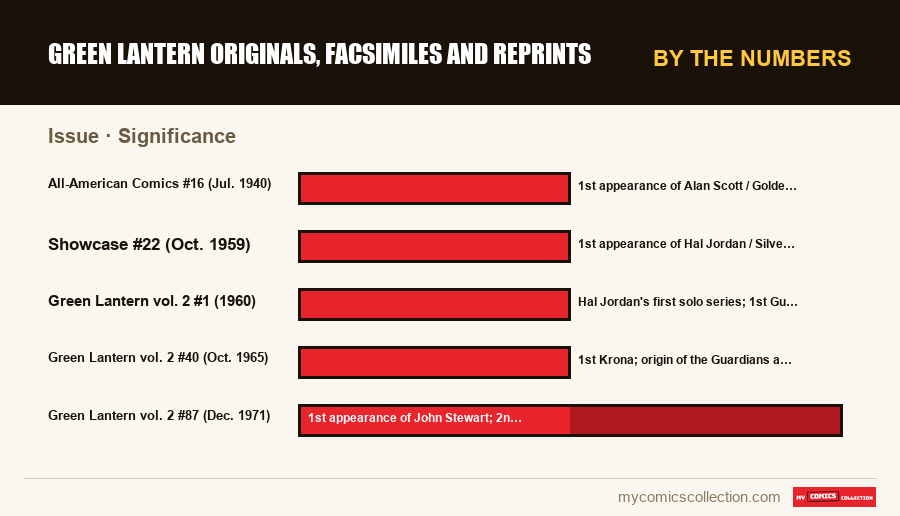
| Issue | Significance | eBay data (vol. 2) | Documented record |
|---|---|---|---|
| All-American Comics #16 (Jul. 1940) | 1st appearance of Alan Scott / Golden Age Green Lantern | Different series: not available | $215,100 (CGC 6.5, Heritage 2018) |
| Showcase #22 (Oct. 1959) | 1st appearance of Hal Jordan / Silver Age Green Lantern | Different series: not available | $149,375 (CGC 9.2, Heritage Nov. 2017) |
| Green Lantern vol. 2 #1 (1960) | Hal Jordan's first solo series; 1st Guardians of the Universe | Median 8 EUR: 40 listings (all printings/grades blended) | ~$6,050 (CGC 9.0, Heritage 2007) |
| Green Lantern vol. 2 #40 (Oct. 1965) | 1st Krona; origin of the Guardians and the DC multiverse | Median 9 EUR: 98 listings (all printings/grades blended) | ~$1,000-$2,000 (CGC 9.2, Hake's) |
| Green Lantern vol. 2 #76 (Apr. 1970) | Start of O'Neil/Adams run; first GL/Green Arrow team-up | Median 9 EUR: 69 listings (all printings/grades blended) | ~$6,100-$7,000 (CGC 9.6, ComicLink) |
| Green Lantern vol. 2 #87 (Dec. 1971) | 1st appearance of John Stewart; 2nd appearance of Guy Gardner | Median 9 EUR: 66 listings (all printings/grades blended) | ~$20,000 (CGC 9.8, Heritage Nov. 2022) |
Record sources: Heritage Auctions, ComicLink, Hake's Auctions.
Why are eBay medians so low?
Our estimator returns medians of 8 to 9 EUR for GL #1, #40, #76, and #87: figures that look absurd next to the auction records above. The explanation is straightforward: eBay groups all printings and all grades into the same search results. For Green Lantern #76 (69 listings), the results blend the 1970 original, the 1992 DC Silver Age Classics reprint, and the 2020/2024 facsimile edition, alongside raw copies in poor condition. The median therefore reflects a heterogeneous pool dominated by the cheapest copies. A clean original or a CGC-graded copy sits far above: a CGC 9.6 of GL #76 exceeds $6,000. The eBay median is only meaningful for unidentified low-grade raw copies. It cannot serve as a valuation benchmark for a certified key.
Showcase #22: telling the original apart from the 2024 facsimile
Showcase #22 (October 1959) is one of the most coveted Silver Age DC books: the issue that gave Hal Jordan his debut, written by John Broome and drawn by Gil Kane and Joe Giella. In April 2024 DC published an official facsimile edition at $3.99-$5.99. The differences from the original are clear-cut.
The 1959 original shows a 10-cent cover price in the price box at lower-left, carries yellowed newsprint paper, a 1959 publication date in the indicia, and no UPC barcode anywhere on the cover. The 2024 facsimile shows a $3.99 or $5.99 price, a 2024 date in the indicia, the modern DC logo on the back cover, and often a "Facsimile Edition" designation on the cover or indicia. The facsimile's paper mimics newsprint but is visibly more uniform and whiter than a sixty-five-year-old original. On eBay, facsimiles sell for a few euros; an unrestored original in low grade (G/VG) trades around $1,000-$2,000.
DC Silver Age Classics (1992): the forgotten reprint
In 1992, DC issued a series of affordable reprints under the DC Silver Age Classics banner, covering among others Showcase #22 and Green Lantern #76. These booklets reprint the full original content but are easy to identify: they carry a UPC barcode (originals from the 1950s-1960s have none), a 1992 date in the indicia, and the words "DC Silver Age Classics" on the cover. They typically sell for under $5 and carry no key-issue premium. They are, however, the main source of buyer confusion on eBay, because cover photographs at low resolution can resemble an original: particularly for GL #76 whose cover composition is reproduced faithfully.
Newsstand vs direct edition: Bronze Age keys (1980-1995)
For issues published from 1980 onward: which includes later printings of the O'Neil/Adams run and the ongoing Green Lantern series: the newsstand versus direct edition distinction applies. DC launched its direct distribution channel around 1980. Both versions carry identical content; only the lower-left cover box differs. Newsstand copies display a standard UPC barcode (two groups of numbers below the bars). Direct editions show the DC bullet logo, a blank rectangle, or a small artwork vignette in place of the barcode. For 1980-1985 issues, direct editions were printed in smaller quantities and can carry a modest premium. From 1986 onward, and especially through the 1990s, newsstand copies in very high grade (9.4+) became far scarcer than their direct counterparts, making the premium for a newsstand of a modern GL key (such as Green Lantern: Rebirth #1 from 2004) potentially significant.
GL #76 and #87: two Bronze Age keys with their own facsimiles
Green Lantern #76 (April 1970, written by Denny O'Neil, drawn by Neal Adams) opens the socially engaged run that defined Bronze Age mainstream comics and is ranked among Overstreet's Top 25 Bronze Age issues. Green Lantern #87 (December 1971, O'Neil and Adams) introduces John Stewart, one of DC's first prominent African-American superheroes, and includes a cameo by Guy Gardner (his second ever appearance). DC has published official facsimiles of both: GL #76 in 2020 and GL #87 in 2024. To identify an original: look for a 15-cent cover price (GL #76) or a 25-cent price (GL #87), the matching year in the indicia, and the absence of any UPC barcode. A facsimile will always show a modern price ($3.99) and a recent indicia date.
The Lanterns HBO series (2026) and its impact on the market
The series Lanterns, premiering on HBO on August 16, 2026, stars Kyle Chandler as Hal Jordan and Aaron Pierre as John Stewart in a crime thriller, with Nathan Fillion appearing as Guy Gardner. The adaptation has reinforced collector interest in Bronze Age keys: copies of GL #87 (first appearance of John Stewart) and its 2024 facsimile now circulate simultaneously on eBay: making indicia verification before any purchase more important than ever.
Not sure whether your copy of Showcase #22 or Green Lantern #76 is an original or a reprint? Get a free valuation with our tool based on real eBay sales to find its low, median, and high value.
Frequently Asked Questions
Alan Scott, introduced in All-American Comics #16 (July 1940), is a Golden Age engineer who forges his ring from a green magic lantern, with no cosmic link to the Guardians. Hal Jordan, reinvented in Showcase #22 (October 1959) by John Broome and Gil Kane, is the Silver Age Green Lantern.
The 1959 original shows a 10-cent cover price, yellowed paper, a 1959 print date in the indicia and no UPC barcode. The 2024 facsimile carries a modern price on the cover, a 2024 date and a barcode.
A series of plain reprints covering Showcase #22 and Green Lantern #76, among others. They reproduce the original's content, but can be recognized by their UPC barcode, which originals from the 1950s and 1960s do not have.
For issues published after 1980, yes. DC launched its direct distribution around 1980 and both versions contain the same stories: only the box at the bottom left of the cover tells them apart, which should be checked before buying.
Green Lantern #76 (April 1970, Denny O'Neil and Neal Adams) starts the socio-political run that redefined the Bronze Age. Green Lantern #87 (December 1971) introduces John Stewart, DC's first African-American superhero to receive a featured series, and shows Guy Gardner.