In short
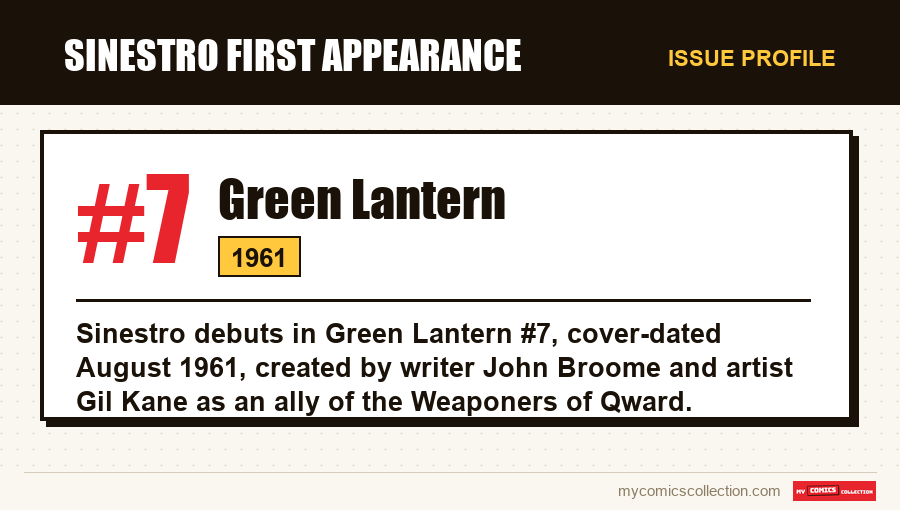
Sinestro debuts in Green Lantern #7, from the 1960 series that reference works also list as volume 2, with an August 1961 cover date. Writer John Broome and artist Gil Kane created him, and Julius Schwartz edited the book. The issue ties him to the Weaponers of Qward, the antimatter rulers who hate the Guardians, and later stories frame him as a Green Lantern from Korugar who was thrown out of the Corps.
When collectors talk about the great Silver Age villain debuts at DC, this issue belongs near the top of the conversation. It is a modest ten-cent comic from the seventh issue of a young series, yet it gives Hal Jordan the antagonist who would define his mythology for decades.
Before writing a word about Korugar or Qward, we confirmed the issue number, the August 1961 cover date, the Broome and Kane credit and the dates of issues #9 and #11 in the published record on Sinestro, on the 1960 title and on Murphy Anderson's bibliography. The notes on buying and on how to read a listing are analysis, with no prices quoted.
The issue at a glance
Green Lantern #7 belongs to the second series, the 1960 revival that followed Hal Jordan's debut in Showcase #22. That series began with a July-August 1960 first issue, and issue #7 carries an August 1961 cover date, listed in the series record as July-August 1961. A seller who quotes either form is describing the same book. By then the series had already built its supporting cast, with Hal Jordan's friend Tom Kalmaku arriving in issue #2 (October 1960), so issue #7 is the moment the young title adds a villain with a past of his own.
The price on the cover is ten cents, the standard for DC's superhero line in 1961. When you identify a copy, rely on the issue number, the title logo of the 1960 series and the cover date together rather than on any single element, because the title has been relaunched many times and several later books also carry the number 7.
The creative team behind the debut
The issue is often summarized with a single name, so it is worth separating the roles that the record supports.
- Writer: John Broome.
- Artist: Gil Kane.
- Editor: Julius Schwartz.
Broome and Kane are the credited creators of Sinestro. Inking credits on the early Green Lantern issues varied from one issue to the next, with several inkers working over Kane in the 1960 series, so read the inker named on a slab label or in a listing with care and confirm it against the book before treating it as a selling point.
Schwartz was the editor guiding DC's Silver Age revivals, and the Green Lantern relaunch was one of his signature projects. If you want to follow the editor across the era, the Julius Schwartz author page collects the titles he shepherded.
How Sinestro is introduced
The story pits Hal Jordan against Sinestro in alliance with the Weaponers of Qward. Qward is the antimatter world whose rulers, warriors and scientists alike, hate the Guardians of the Universe and every Green Lantern, which makes them natural partners for a renegade from the Corps.
Two features define the character from this point on. First, Sinestro is someone who has worn the ring himself: his homeworld is Korugar, in space sector 1417, and the Guardians stripped him of his membership and exiled him to Qward for abusing the ring's power. That past is the root of his threat, because he understands the methods of the man he is fighting. Second, his alliance with Qward gives him resources beyond his own will, which sets up the antagonism that later issues deepen.
This guide does not retell the plot beat by beat, and it does not quote any dialogue. The point for a collector is the structural one: issue #7 creates a mirror for Hal Jordan, a rival who knows the same power source and has a very different idea of how to use it.
Who created him, and why in 1961
Broome and Kane are credited as the creators. Kane has said that he based Sinestro's look on the British actor David Niven, which explains the thin mustache and the refined, urbane bearing of the Korugarian.
The context is the Silver Age relaunch. Under Julius Schwartz, DC had restarted Green Lantern with a new test-pilot hero in Showcase #22, then given him his own series. By issue #7 the book had to move beyond one-off threats and offer a figure who could return. Sinestro is the answer: a recurring opponent with a personal history, rather than another menace of the month. The character's first return is in issue #9 (December 1961), inked by Murphy Anderson over Kane, and he appears again in issue #11 (March 1962), where his conflict with Jordan continues.
That early rhythm tells you something about the market too. A villain who reappears within the first year of the series becomes a real character, not a one-shot, and that is part of why the debut is collected the way it is.
One structural detail is worth keeping in mind when you handle a copy. A ten-cent comic of 1961 was printed on cheap paper and sold from newsstand racks, and nobody expected it to survive. The issue's interest to a collector therefore rests on three things at once: the debut of the villain, the Broome and Kane credit, and the physical survival of an inexpensive book that was read, folded and often thrown away.
Do you collect this series?
Track what you own, what you are missing and what your collection is worth. 7-day trial.
Start my trial →
Why this is a key issue
There are three reasons the issue carries weight.
It is the debut of the villain most associated with Green Lantern. The later Sinestro Corps story, which turned the character into the head of an army fueled by fear and ran from Green Lantern (vol. 4) #23 (September 2007) into Green Lantern Corps (vol. 2) #14 (July 2008), is a major crossover covered in our Sinestro Corps War guide, and every reader who arrives through that event eventually asks where he started.
It also introduces the Korugarian whose home sector, 1417, and whose exile to Qward later writers kept returning to. A debut that plants that much of the later mythology gives the issue a story to tell when you describe a copy, and it helps you spot listings that confuse it with later Sinestro books.
Finally, the book sits close to another collector target. The hero's own debut came earlier, in Showcase #22, which is why this issue sits naturally beside it in a Silver Age Green Lantern set. The history of Green Lantern shows how those pieces fit together.
Reprints and look-alike numbers
The story has been collected, which is useful if you want to read it without handling a fragile original. Green Lantern Chronicles volume 2 gathers issues #4 to #9 of the 1960 series, so it holds both the debut and the first return, and Showcase Presents: Green Lantern volume 1 reprints Showcase #22 to #24 with Green Lantern #1 to #17 in black and white, the cheapest way to read the debut in its run.
A few confusions come up again and again:
- Showcase #22. The debut of Hal Jordan, not of Sinestro. The two are often sold as a pair, but they are separate keys.
- Green Lantern #9 and #11. The next appearances, not the debut.
- The modern series. Later volumes of Green Lantern restart their numbering. A listing that says only "Green Lantern #7" must also give the year, and for this issue it should read 1961.
- Reprints. Collected editions reproduce the story but are not the original comic. Check the format and the indicia before buying anything described as issue #7.
If you are unsure whether a book is a legitimate original, the Green Lantern grading guide walks through the identifying features of a graded copy and what the label should tell you.
What to check before you buy
For a book from 1961, the quality issues are the classic ones of the Silver Age, and they can be assessed with patience and good light.
Begin with color and the cover. Silver Age covers show wear as color-breaking creases and white edge chipping, and a book with strong, glossy color can be a better find than a higher nominal grade with a dull cover. Look for stress lines around the staples and a spine that lies flat. A spine roll or a split along the staple is a major downgrade, and it is easy to hide in a photo taken at a flattering angle, so ask for an image of the spine and of the open centerfold.
Check for restoration. Color touch, piece replacement, tear seals and cleaning are all common on books of this age and value, and they are only a problem when undisclosed. A restored copy with an honest label has its own market and should only be weighed against other restored examples. If a seller is silent on the point, ask directly.
Read the label with the book. On a slabbed copy, match the 1961 date, issue 7 and the page-quality line to the book itself, and see whether the notes box mentions Sinestro's debut. Labels and cases can be swapped, and a mismatch is a reason to step back.
Judge price by method, never by headline. Line up completed sales of this issue in one grade band, set the extremes aside and note each sale date, so that a burst tied to a screen announcement does not skew your reading. A copy with disclosed restoration, a copy in lower grade with strong color and a copy in higher grade with a faint spine issue are three different purchases, and your budget and goals decide which one fits.
The appearances after the debut that count
A short Sinestro set should include the debut and a handful of issues that show how the character grew.
- Green Lantern #9 (December 1961). His next appearance, with Murphy Anderson inking Kane, in the sequence that develops his conflict with Hal Jordan.
- Green Lantern #11 (March 1962). A further clash in the early run that establishes him as a recurring figure.
- The Sinestro Corps War. The 2007 and 2008 crossover that made him the leader of a Corps of his own, detailed in the key issues guide.
- The solo series. His own Sinestro title, running in 2014, is a modern complement to the Silver Age debut.
If you want the overall arc rather than single keys, the character's story and the best Green Lantern runs place those issues in order.
Frequently asked questions
Green Lantern #7 from the 1960 series, cover-dated August 1961 and listed in the series record as July-August 1961. John Broome wrote it, Gil Kane drew it and Julius Schwartz edited it. The issue ties Sinestro to the Weaponers of Qward, his allies in his first clash with Hal Jordan.
His homeworld is Korugar, in space sector 1417. He served as a Green Lantern until the Guardians removed him for abusing the ring and exiled him to Qward, whose Weaponers hate the Corps. Green Lantern #7 shows him as their ally, which is why the debut already reads as a clash between former colleagues.
Writer John Broome and artist Gil Kane are credited as creators. Julius Schwartz edited the issue. Kane has said he modeled Sinestro's appearance on the British actor David Niven, which accounts for the character's refined look next to the usual Silver Age villains.
Green Lantern Chronicles volume 2 collects issues #4 to #9 of the 1960 series, so it covers the debut and his first return. Showcase Presents: Green Lantern volume 1 reprints Showcase #22 to #24 and Green Lantern #1 to #17 in black and white, a thick and affordable reading copy.
Green Lantern #9 (December 1961) is his next appearance, followed by issue #11 (March 1962). Many collectors then jump to the Sinestro Corps War crossover of 2007 and 2008, which turned him into the head of a Corps, before looking at his later solo series.
Holding a Silver Age Green Lantern with a 1961 cover date? Get a quick read on its likely grade band before you decide how to protect or sell it.
Estimate my comic