Green Lantern is one of the most vast and complex properties in the DC Comics universe. With over 65 years of history, multiple bearers of the power ring, dozens of parallel series, monumental cosmic crossovers, and a mythology that spans the entire universe, collecting Green Lantern represents one of the most ambitious challenges a DC collector can take on.
Green Lantern is one of the most vast and complex properties in the DC Comics universe. With over 65 years of history, multiple bearers of the power ring, dozens of parallel series, monumental cosmic crossovers, and a mythology that spans the entire universe, collecting Green Lantern represents one of the most ambitious challenges a DC collector can take on. From Showcase #22 (1959, first appearance of Hal Jordan) to the Blackest Night saga by Geoff Johns, through the Denny O'Neil/Neal Adams run that revolutionized American comics, Green Lantern offers decades of exceptional content to explore and collect.
This guide gives you the complete map of Green Lantern territory: the character's history since the Golden Age, analysis of each major editorial era, identification of essential key issues, and an organizational method for your collection. Whether you're a fan of Hal Jordan, Kyle Rayner, or John Stewart, you'll find everything you need here to build a coherent and well-valued Green Lantern collection.
Green Lantern: from the Golden Age to the Silver Age
Alan Scott, The original Green Lantern (1940)
The very first Green Lantern is not Hal Jordan but Alan Scott , who appeared in All-American Comics #16 in July 1940. Created by Martin Nodell and Bill Finger, Alan Scott is a railroad engineer who finds a magical lantern made of green metal of mystical origin, unrelated to the Green Lantern Corps that would be introduced later. His power ring, forged from this magical metal, grants him near-unlimited powers with a unique weakness against wood.
Alan Scott is a Golden Age character, a distinct editorial era that precedes the Silver Age. His appearances in All-American Comics, and then in Green Lantern Comics (a solo series that ran until 1949) are extremely rare and valuable collector's pieces, accessible only to the most affluent collectors. All-American Comics #16 is one of the most important, and most expensive, DC key issues on the market.
Showcase #22 (1959), The Silver Age revolution
Showcase #22 (October 1959) marks one of the most important revolutions in the history of American comics. In the pages of this DC Comics tryout title, writer John Broome and artist Gil Kane completely reinvented the Green Lantern concept. Gone are the magic and fantasy of the Golden Age: the new Green Lantern is Hal Jordan, an American Air Force test pilot. His power ring is not magical but technological, created by the Green Lantern Corps, an intergalactic police organization governed by the Guardians of the Universe on the planet Oa.
This radical shift in concept, from fantasy superhero to space science-fiction hero, is characteristic of the Silver Age approach at DC Comics. Showcase #22 is a key issue of capital importance, not only for the Green Lantern collection but for the history of American comics as a whole. A copy in CGC 9.0 can be worth tens of thousands of dollars today.
The Denny O'Neil & Neal Adams run, A social revolution
The run by Denny O'Neil and Neal Adams on Green Lantern (issues #76 to #89, 1970-1972) is one of the most important runs in the history of American comics, not just for the Green Lantern collection. By sending Hal Jordan and Green Arrow (Oliver Queen) on a road trip across America to confront real social problems (racism, poverty, drugs, corruption), O'Neil and Adams broke the conventions of the superhero genre and paved the way for the "adult comics" that would develop in the following decades.
The iconic cover of Green Lantern #76 : where a Black man addresses Green Lantern: "I know you mean well, Lantern, but as far as our block is concerned, you never thought about us!", is one of the most striking images in the history of American comics. This run introduced John Stewart in Green Lantern #87 (1971), the first major Black superhero at DC Comics, and addressed drug addiction as early as 1971, well before the Comics Code Authority permitted its treatment in the following years.
The issues from this run (GL #76-89) are highly sought-after Bronze Age key issues. GL #76 in particular is the most sought-after issue of the period. GL #87 (first appearance of John Stewart) is a major key issue whose value has significantly increased since John Stewart became the Green Lantern of the Justice League animated series.
The major Green Lantern editorial eras
The Vol. 2 series (1960-1986), The classic Hal Jordan era
After the tryout issues in Showcase, Green Lantern got his own series in 1960. Green Lantern Vol. 2 ran from July 1960 to September 1986, spanning 224 issues. It's the benchmark series of the Silver and Bronze Age era. Beyond the O'Neil/Adams run, it features important storylines: the introduction of Sinestro as the major antagonist (GL #7, 1962, first appearance), the creation of the concept of space sectors divided among Lanterns, and the introduction of Guy Gardner as a potential successor to Hal Jordan (GL #59, 1968).
Green Lantern Vol. 3, Hal Jordan, Guy Gardner, and Kyle Rayner (1990-2004)
The 1990 relaunch ushered in a chaotic but exciting transitional era. Ron Marz's run in the 90s is marked by the most controversial event in GL history: "Emerald Twilight" (Green Lantern #48-50, 1993-1994). Devastated by the destruction of his hometown Coast City, Hal Jordan descends into madness, kills the majority of the Green Lanterns, and destroys the Corps to absorb all the energy from the Central Battery on Oa. He becomes Parallax, one of DC's great cosmic antagonists.
To replace Hal Jordan, Ron Marz created Kyle Rayner, a young graphic artist to whom the last ring is entrusted by a dying Guardian. This decision divided the fandom, Hal Jordan fans created a "Hal's Emerald Alliance" movement to demand his return, but Kyle Rayner became a beloved and credible character with his own collector base. Green Lantern #48 (Emerald Twilight, part one) and #50 (end of Emerald Twilight, start of the Kyle Rayner era) are important key issues from the 90s.
Green Lantern: Rebirth (2004-2005), Geoff Johns revolutionizes GL
The Green Lantern: Rebirth mini-series (6 issues, 2004-2005) by Geoff Johns and Ethan Van Sciver is one of the most important DC editorial events of the 2000s. Johns rehabilitates Hal Jordan: he reveals that his descent into Parallax was the result of possession by a cosmic fear entity (Parallax, now a separate being) and not an inherent corruption of the character. Hal Jordan is resurrected and reclaims the title of Earth's Green Lantern in a relaunch of the solo series.
Green Lantern: Rebirth #1 is a highly sought-after modern key issue, with cover variants selling well above cover price. The relaunch kicked off what is considered the golden age of modern Green Lantern collecting: the Geoff Johns run (2005-2013).
Catalog your Green Lantern collection
Import your Green Lantern series into My Comics Collection and manage Hal Jordan, Kyle Rayner, John Stewart, and Guy Gardner simultaneously without confusion.
Free 7-day trial, No commitmentThe Geoff Johns run, The Blackest Night era
The run by Geoff Johns on Green Lantern (2005-2013, issues #1 to #67 of Vol. 4, plus the Rebirth mini-series) is by far the most ambitious and important run in the character's modern history. Johns develops the mythology of Oa encyclopedically, introduces the concept of colored Lantern Corps (each color of the light spectrum corresponds to an emotion and a Lantern Corps), and builds toward the great cosmic event that is Blackest Night (2009-2010).
The major arcs of the Johns run include: Sinestro Corps War (GL #21-25, 2007-2008, introduction of the Sinestro Corps and yellow rings), Secret Origin (GL #29-35, 2008, retelling of Hal Jordan's origins), and of course Blackest Night (crossover in 8 issues + tie-ins, 2009-2010). Green Lantern Vol. 4 #25 (end of Sinestro Corps War) and the Blackest Night-related issues are particularly sought-after modern key issues.
Essential Green Lantern key issues
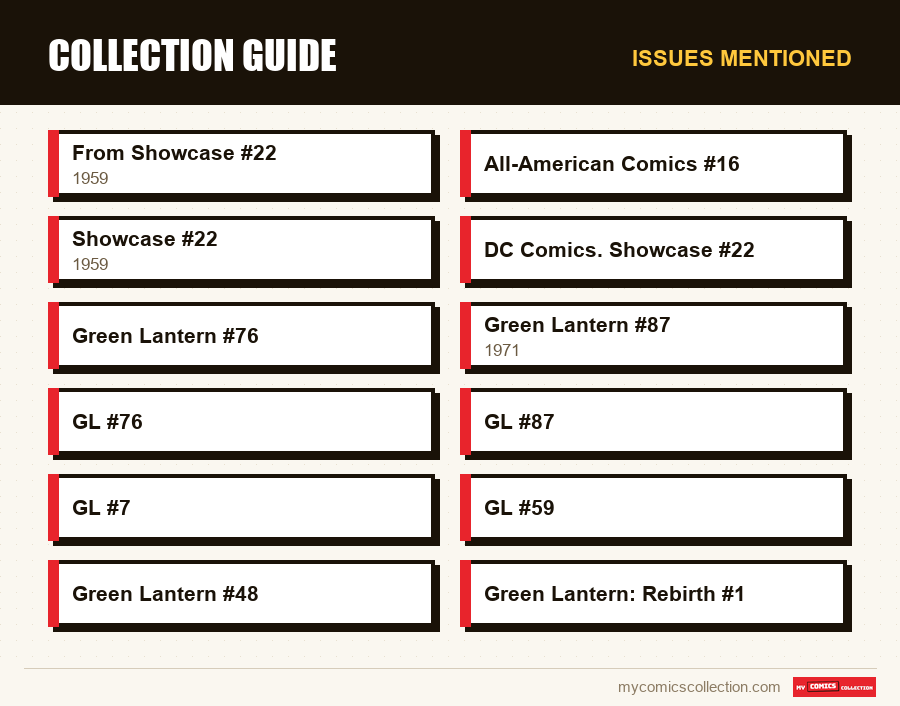
- All-American Comics #16 (1940) : First appearance of Alan Scott (Golden Age Green Lantern). A museum piece for affluent collectors.
- Showcase #22 (1959) : First appearance of Hal Jordan and the Silver Age GL concept. Major DC key issue.
- Green Lantern Vol. 2 #7 (1962) : First appearance of Sinestro, the franchise's main antagonist.
- Green Lantern Vol. 2 #59 (1968) : First appearance of Guy Gardner (2nd human Green Lantern).
- Green Lantern Vol. 2 #76 (1970) : First issue of the O'Neil/Adams run, iconic cover on racism.
- Green Lantern Vol. 2 #87 (1971) : First appearance of John Stewart, future GL of the animated Justice League.
- Green Lantern Vol. 2 #172 (1984) : First appearance of John Stewart as Earth's primary GL.
- Green Lantern Vol. 3 #48-50 (1993-1994) : "Emerald Twilight": Hal Jordan's fall into Parallax, transition to Kyle Rayner.
- Green Lantern Vol. 3 #51 (1994) : First full appearance of Kyle Rayner as Green Lantern.
- Green Lantern: Rebirth #1 (2004) : Start of the Johns saga, return of Hal Jordan. Highly sought-after modern key issue.
- Green Lantern Vol. 4 #25 (2008) : Conclusion of Sinestro Corps War. Key issue from the Johns run.
- Blackest Night #0 (2009) : Distributed free on Free Comic Book Day. Paradoxically difficult to find in good condition.
Top priority for GL collectors: If you must choose just one arc to collect in Green Lantern, choose the Sinestro Corps War crossover (Green Lantern #21-25 + Green Lantern Corps #14-19, 2007-2008). It's the ideal starting point for understanding the Johns era, it's complete in just 11 issues, and the #1s of each companion series remain very accessible. Also see our guide on Crisis on Infinite Earths key issues, the other great DC crossovers to collect.
Collecting this series?
Track what you own, what you are missing and what your collection is worth. 7 day trial.
Start my trial →Parallel series: Green Lantern Corps and beyond
One of the distinctive features of Green Lantern collecting is the permanent existence of parallel series alongside the main series. Since the 80s, DC regularly publishes titles like Green Lantern Corps , Tales of the Green Lantern Corps , Green Lantern Corps Quarterly , Guy Gardner: Warrior , Kyle Rayner: Green Lantern, and other spin-offs. Managing a complete GL collection means navigating this ecosystem of parallel series with method.
The complexity increases further during the "Brightest Day" era post-Blackest Night and during the New 52 (2011), which relaunches multiple GL series simultaneously: Green Lantern, Green Lantern Corps, Green Lantern: New Guardians, Red Lanterns. Collectors who want the complete set of GL series during this period have considerable work ahead of them, but also a very comprehensive view of the Corps mythology.
How to organize a Green Lantern collection
Choose a reference Green Lantern
Start by deciding which ring bearer you're collecting as a priority: Hal Jordan (the most classic), Kyle Rayner (the 90s), John Stewart (the animated GL), or Guy Gardner. Each character has their own series and their own key issues, this decision structures your entire collecting approach.
Catalog by volume and by character
In My Comics Collection, create distinct entries for each GL series (Vol. 2, Vol. 3, Vol. 4, Green Lantern Corps, Rebirth...). This gives you a clear view of each run's progress and allows you to precisely identify missing issues.
Prioritize accessible Silver Age key issues
Showcase #22 is out of reach for most budgets, but Green Lantern Vol. 2 #7 (Sinestro), #76 (O'Neil/Adams), and #87 (John Stewart) are attainable Bronze Age key issues for determined collectors. Target these issues in acceptable condition (Good to Fine).
Build the Johns run first
Green Lantern Vol. 4 (2005-2013, 67 issues) is the benchmark modern run and the ideal entry point for GL collecting on a reasonable budget. These issues are accessible, coherent, and tell a complete and monumental story.
Manage the tie-ins of major crossovers
Blackest Night, Brightest Day, and War of Light generate dozens of tie-ins across different series. Precisely list the tie-ins for each event in your app so you don't get lost during purchases at conventions or online.
Green Lantern market status in 2026
The Green Lantern comics market in 2026 is in an interesting position. DC hasn't produced a major GL event in several years, and the absence of a Green Lantern film since the 2011 critical disaster has kept prices at relatively stable levels, even accessible for series from the 90s and 2000s. The Johns run (2005-2013) remains the most in-demand, with #1s holding their value well. Silver and Bronze Age key issues have seen a slight correction since the 2021-2022 peaks.
The potential catalyst for the GL market will be James Gunn's DC Universe project, which includes Green Lantern among the confirmed characters for the new DC phase. Any concrete announcement of a GL film or HBO series could trigger a significant increase in key issues, particularly Showcase #22, GL #76, and GL #87. Collectors building their GL run now are in a privileged position. For a broader DC perspective, check out our DC Comics collection guide.
FAQ, Managing your Green Lantern collection
Manage your GL run issue by issue
My Comics Collection lets you manage all your Green Lantern series in parallel, from Showcase #22 to the Geoff Johns run, without ever losing track.
Free 7-day trial, No commitment