On August 30, 2026, on a general American auction site, the best ad found for a booklet from the 2020s demanded $210.00: a Ghost Rider #7 in signed blank cover, graded 9.8 by a verification agency, presented as the first appearance of Exhaust. On the same day, the sixties high approached $33,000. This is not a drop in value: it is a ranking built on a single sampled year, 2022, which only brought back 48 announcements, including several outside the decade. After cleaning, only four usable lines remained. All amounts quoted here are requested by sellers, not cashed during a sale.
This article closes a series of eight rankings by decade, all established on the same day, with the same query and the same method. The previous seven related to ancient periods, where time has done its work of sorting: scattered prints, damaged copies, a few survivors in perfect condition. This concerns issues that are four years old. The result is so low, compared to the rest of the series, that the subject of the article is no longer the ranking itself but what its collapse reveals about the way in which these lists are made.
A clarification must be made before everything else, and it applies to each figure that follows. This is a classification by amount claimed, recorded on a single date. No one paid these sums before my eyes; these are prices posted by sellers who hope to obtain them. A measurement taken on August 30 shows no movement, no trend, no direction: it photographs requests, nothing more. I am not judging any story here, I am not recommending any purchase as an investment, and I am not predicting anything about what these booklets will be worth in a year. If you're looking for a reading review or investment advice, you've come to the wrong article.
What the survey measures, and especially what it does not measure
The collection took place on August 30, 2026 on a general auction site, American market, amounts expressed in dollars, retaining only copies passed by an independent verification body and therefore carrying a grade. This filter is voluntary: without it, we compare states declared by the sellers themselves, which has no comparative value. It comes at a cost, however, and it must be borne. A recent, abundant booklet, purchased on newsstands four years ago, has no particular reason to be sent for certification: the process is expensive and takes time. By keeping only the verified copies, I have therefore discarded the vast majority of the fascicles of the decade, which circulate without note and often for a few dollars. The ranking does not describe the decade: it describes the small subset of recent fascicles that someone has found profitable to have graded.
Second limit, even heavier: the statement concerns a single year sampled, 2022, and this year brought back 48 announcements in total. Forty-eight is not enough. After removing the lines that did not relate to the decade and those that did not show any usable amount, only a handful of truly classifiable objects remained. I refuse to draw a conclusion about "the price level of 2020s comics": with such a thin field, a single optimistic seller moves the top, and a single seller who withdraws his listing wipes out the top spot. A top built on this doesn't describe a market, it describes a few online ads on a given Sunday. It is written in black and white because most of the rankings that you will come across elsewhere are based on samples of the same order without ever saying it.
Third limit, that of the single date. An asking price on August 30 compares to nothing but itself. To observe a movement, two spaced readings would be required, made with the same query and the same filters, and the difference between the two would still only say what two different populations of sellers requested. Nothing in what I have in front of me authorizes a sentence like “it’s going up” or “it’s going down”. The only thing that a single photograph allows is a lateral comparison: since the eight decades were recorded on the same day with the same method, their peaks are comparable to each other. That's the whole point of the series, and it's also its only honest outing.
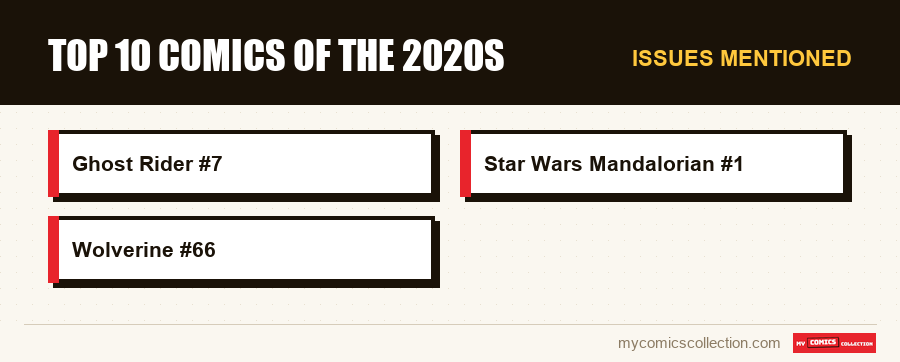
The top of the rankings for August 30, 2026, line by line
Ghost Rider #7-210,00 $
Advertisement labeled "Ghost Rider #7 Virgin Signed [...] CGC SS 9.8 KEY 1st appearance of Exhaust". A blank cover, that is to say printed without logo, without title and without cover text, resold signed and verified in 9.8. It's the peak of the decade that day. The booklet is presented as the first appearance of Exhaust; the sales argument combines three things that have nothing to do with the story: a manufacturing variant, a signature, a maximum score. You can locate the character and his series from the hub Ghost Rider.
Star Wars Mandalorian #1-$165.00
Advertisement labeled « Star Wars Mandalorian #1 CGC 9.8 1:50 [...] 1st Appearance [...] 2022 ». The acronym 1:50 designates an alternative cover distributed at the rate of one copy for every fifty ordered: the rarity is not the result of time, it was decided at printing. The seller adds a mention of first appearance and a rating of 9.8. Second position in the ranking, $45 from the top.
Star Wars Mandalorian #1-135,00 $
Advertisement labeled “Star Wars Mandalorian #1 CGC 9.8 1:50 [...] 2022”. Same title, same number, same circulation ratio, same rating. Third in the ranking is même objet than the second, at thirty dollars less, put on sale the same day on the same platform. Two sellers, two estimates, no arbitrator in between.
Moon Girl and Devil Dinosaur 1-135,00 $
Advertisement labeled “Moon Girl and Devil Dinosaur 1 CGC 9.8 1st Appearance 1:25 [...] Variant 2023”. Another alternative cover, this time with one copy for twenty-five, another 9.8 rating, another first appearance mention. The wording bears the year 2023 while the advert is sent back in a query relating to 2022: the vintage displayed by the seller and that used by the classification do not necessarily coincide.
Four lines. This is the totality of what the request left standing once the intruders were removed. We immediately notice what these four ads have in common: none sells on its story. All are sold on a material characteristic (a cover without text, a limited edition ratio, a signature) coupled with a maximum rating and a mention of first appearance. In earlier decades, the top of the ranking was occupied by booklets whose contents everyone knows. Here, the object has taken up all the space, and the story appears nowhere in the sales arguments.
None of these four amounts are sales prices. These are sums displayed by sellers on August 30, 2026 and which, on that day, had not been validated by any buyer. An isolated maximum reflects the hope of the seller, not a level observed on the market.
With four collectable items, I also can't say that "2020s comics are worth around $200 at best." The correct formulation is more modest and truer: that day, in that sample, no one asked for more.
Two announcements that had no place in a decade
The two highest amounts reported by the request were excluded, and this exclusion deserves further development, because it explains why so many rankings circulating online are false without their authors lying. The first ad demanded $1,186.62 for a lot bringing together two 1992 booklets, labeled “Amazing Spider-Man 361 362 CGC 9.8 1st Carnage appearances”. The second asked for $252.43 for a 2008 booklet, “Wolverine #66 CGC 9.6 1st Appearance Old Man Logan.” Neither is from the 2020s. If I had left them in, the decade high would have increased more than five times, and the article would have told an entirely false story.
What made these two announcements stand out was their wording. Both begin with the same commercial formula evoking cinema adaptations. The same seller, or the same seller's practice, places under a single banner issues separated by thirty years, because this banner captures the searches of those who are looking for a film rather than an issue. This is not a deception: the wording honestly indicates the real title, number and year of each issue, and the attentive buyer sees exactly what he is buying. It's a perfectly banal SEO technique, and perfectly devastating for anyone who builds an automatic ranking from titles.
The practical consequence is simple: any sorting by year based on ad labels is unusable without manual inspection. I had to read each line to verify that it actually belonged to the decade announced. Out of 48 ads, it's doable. Out of several thousand, no one does it, and this is how the top picks of the decade find themselves crowning a booklet published twenty years earlier. The hubs Carnage et Old Man Logan allow us to put each of these two intruders back in their real chronological place.
Six pitfalls that make this ranking fragile
A sample of four objects
After cleaning, the ranking is based on four advertisements. On this scale, the notion of “average” has no meaning and the top depends on a single seller. Refuse any general conclusions drawn from such a small number, including my own if I risked it.
One date, no trajectory
The statement is a photograph of August 30, 2026. It does not contain any information on what was asked yesterday or what will be asked tomorrow. Any sentence in the future tense about these amounts would be invented.
Wordings that mix the eras
A common commercial formula brought up fascicles from 1992 and 2008 in a request for 2022. The vintage written by the seller can also diverge from that of the classification, as on the Moon Girl line.
Lots counted as an object
The most expensive rejected ad brought together two issues under a single amount. A lot says nothing about the unit price of its components and mechanically inflates the top of any classification that accepts it.
The same object at two prices
Two ads for the same issue, rating and coverage ratio, thirty dollars apart. The classification treats them as two separate entries even though they describe the same product.
The certification filter
Retaining only verified copies makes the lines comparable, but eliminates almost all of the recent fascicles, which circulate without notes. The classification describes a narrow showcase, not the entire production.
One hundred and fifty times less than in 1963: read the gap without over-interpreting it
The eight readings having been taken on the same day, their peaks can be compared. About $33,000 for 1963, almost $30,000 for 1974, $899.99 for 1988, $1,195.00 for 1992, $1,299.99 for 2004, $599.99 for 2014, and $210.00 here. The peak in the 2020s is more than a hundred and fifty times lower than in the 1960s. This is by far the most brutal discrepancy in the series, and it is the only truly solid result in this article, precisely because it does not rely on the finesse of the sample but on an overwhelming order of magnitude.
The main factor is time, and it acts in several ways simultaneously. A booklet from 1963 has survived sixty years of moves, attics, resales, children's reading; intact examples have become rare because most have been destroyed or defaced. A 2022 issue is four years old. It is abundant, it sleeps in pockets in thousands of people, it is very often in perfect condition, and nothing has yet had time to reduce its number. Added to this is the fact that old prints were printed without anyone thinking of preserving them, while recent production is purchased partly with a view to conservation from day one.
We must resist the conclusion that everyone expects at this point. I am not saying that these fascicles “will increase in value over time”, and I do not have any data that would allow me to say so. It would be a prediction, therefore an invention. What the survey shows is a state at a date: recent issues are abundant and are inexpensive, old ones are rare and are expensive. The transition from one to the other is not an automatic mechanism, and absolutely nothing in a single photograph indicates what will happen to the 2022 production. The link between grade, rarity and amount requested is detailed in the guide on rating and grades.
A second point of attention concerns reading the series itself. The highs do not decrease regularly from 1963 to 2022: 1988 is lower than 1992, and 2004 exceeds both. The decade is therefore not the sole explanatory factor, and I will be careful not to build a law on seven points noted only once. What emerges is a massive contrast between the very old and the very recent, with an irregular middle of the series whose variations this survey does not explain.
Collecting this series?
Track what you own, what you are missing and what your collection is worth. 7 day trial.
Start my trial →When manufacturing replaces storytelling
The most interesting observation of the ranking is not its level, it is its composition. The four lines selected are, without exception, alternative limited edition covers or blank covers. A blank cover is a printed version without a logo or text, often intended to receive a drawing or signature. A ratio cover, like the 1:50 or 1:25 of the noted advertisements, is only distributed at the rate of one copy for every fifty or for twenty-five ordered: its rarity is an industrial decision, taken before printing, not an accident occurring over the decades.
Over this decade, it is no longer the content that distinguishes a copy from its neighbor, it is its manufacturing. Two buyers can own the same issue, with the same story inside, and end up with items classified very differently depending on the cover that wraps them. The signature adds an additional layer to the same mechanism: it does not modify a line of the text, it modifies the copy. This move completely changes the way we keep an inventory, since a simple serial number is no longer enough to identify what we own.
This observation has a direct and very concrete consequence for anyone storing their collection. Noting “Ghost Rider #7” says nothing: it must be specified whether it is the current edition, an alternative cover, which alternative cover, whether the copy is signed, and whether it has been verified. Without these details, two copies that are completely separate end up on the same line. I devoted an entire article to how an ad like this sells an expectation rather than an object, read here: when an ad sells an expectation.
A final note on the mentions of first appearance, present on three of the four lines. They are a standard sales argument, and they are not verified from the wording itself: the seller affirms, he does not prove. The verification goes through the catalog and the serial sheets. Character pages like that of Ghost Rider, and creator pages like that of Donny Cates, are used for exactly that: to cross-check an ad statement with a source who is not trying to sell you the item.
Thirty dollars difference on two identical copies
Two ads in the ranking describe the same issue, with the same coverage ratio and the same rating of 9.8, thirty dollars apart. This is probably the most instructive detail of the survey, and it deserves more attention than the summit itself. One might believe that a price difference is always explained by a difference in the condition, edition or history of the copy. Here, these three variables are neutralized: the note is identical, the cover is the same, and these are new objects on the scale of the history of the medium.
What remains, once all objective differences are removed, is the seller's assessment. One asks $165, the other $135, and nothing in the product features separates the two. This is not an anomaly, it is the normal functioning of a market where each seller freely sets their display price. But this ruins the idea that a requested amount can serve as a reference value, even in the most favorable conditions: recent, abundant, identified object, noted by an independent organization. If the gap exists there, it exists everywhere.
For a collector, the practical translation is clear. An amount seen in an ad doesn't tell you what your copy is worth, it tells you what a particular seller hopes to make from it. Two ads are enough here to show a range of more than twenty percent on a strictly identical item. Encrypting a real copy requires a different approach, described in the guide on the estimation of a precise fascicle: look at several advertisements, distinguish what is requested from what is concluded, and accept that a wide range is a more honest answer than a single number.
What to note in your inventory after this reading
Save the cover, not just the issue. The four lines in the ranking are alternate or blank covers. In the 2020s, the “series + number” line is no longer enough to identify what you own: systematically add the type of cover and, when it exists, the announced print run ratio, otherwise your file will describe an object different from the one in your box.
Note whether the copy is signed, and keep track of the certificate. The top of the statement is a signed copy, and the signature is part of what the seller puts forward. A signature is not a characteristic of the series, it is a characteristic of your copy: it must live in your file, with the reference of the document which accompanies it, not in your memory.
Record the date of each amount you record. Everything written here is dated August 30, 2026 and only makes sense when accompanied by this date. When you note a price seen somewhere, write the day you saw it; without a date, a figure kept in an inventory becomes a timeless statement that no observation any longer supports.
Always distinguish between requested and concluded in your notes. None of the amounts in this article have been paid. If your inventory mixes displayed prices and prices actually collected in the same column, it will produce unusable totals. Two separate fields cost thirty seconds to create and avoid years of confusion over what the whole thing is actually worth.
Check the actual year before filing, never the wording. Two advertisements in this survey carried a commercial formula which made them appear in a decade which was not theirs. When you organize a booklet by period, take the year of publication in the catalog and not that suggested by the title of an advertisement or a lot, otherwise you will create classifications that do not hold up.
The survey does not allow this to be confirmed. It shows that, on August 30, 2026, in a sample of four usable ads for the year 2022, no one asked for more than $210. Four items don't describe an entire decade, and an amount asked for is not an amount gotten. The exact wording is: on that day, in that sample, no demand exceeded this level.
Because a condition declared by the seller himself is not comparable from one ad to another. A rating assigned by an independent organization provides a common basis. The price of this choice is important and I accept it: most recent issues are never sent for certification, so this classification describes a narrow showcase and not the entire production of the decade.
It is an alternative cover distributed at the rate of one copy for every fifty, or for every twenty-five, ordered by a reseller. Its rarity is decided before printing, unlike that of an old booklet which results from wear and accumulated losses. Three of the four lines of the ranking are based on this type of rarity organized in advance.
By its wording. Two rejected advertisements began with the same commercial formula evoking film adaptations, a formula which brought them up in very broad searches. However, the title correctly indicated the number and year. This is not a deception but a referencing practice, and it requires checking each line by hand before any chronological classification.
No, and that is not its purpose. It orders the amounts claimed on a given day; it makes no judgment on the stories, does not compare any reading quality and does not constitute purchasing or investment advice. A price displayed by a seller remains an opinion, and this article is limited to describing what was displayed, with its sample limitations.
Keep one card per copy, not one line per number
This statement shows that the same number can cover several very different objects: current cover, alternative ratio cover, blank cover, signed copy, verified copy. A collection noted by number alone becomes illegible as soon as these variants slip into it. My Comics Collection lets you register each copy with its cover type, condition, provenance and your own dated statements, so that your inventory describes your real objects and not an abstract series.