On August 30, 2026, on a general auction site oriented to the American market, the highest amounts claimed for booklets from the 1980s verified by an independent organization peaked below the thousand dollar mark. At the head, a copy of Amazing Spider-Man No. 300 from 1988 listed at $899.99, in front Miracleman No. 15 at $525.00 and Wolverine #1 at $250.00. For 1984, the high falls to $399.63 with a Star Wars No. 81. These figures are amounts requested by sellers that day, not completed transactions, and they are based on two sampled years totaling only fourteen listings.
This article does one thing and one thing only: it arranges by amount claimed the advertisements noted on August 30, 2026 for American issues published in 1984 and 1988. It is neither a collection guide, nor a review of the titles that the decade has made desirable, nor an estimation method. You will find no investment advice, no judgment on the quality of the stories, no guidance on how to price a copy yourself. The site already offers pages for each of these three needs, and they are noted below. Here, we look at price tags, put them in order, and stop where the data stops.
This limit deserves to be raised from the outset because a price ranking always tends to be read as a list of values. He is not one. An asking amount measures what a seller hopes to obtain on a given morning, on a given platform, for a given item. It measures neither what someone has paid nor what someone will pay. The only solid fact that a survey of this type produces is a photograph: on this date, here are the levels displayed. The rest consists of describing this photograph honestly, also saying what it does not show.
How this statement was compiled
The collection took place on August 30, 2026 on a general auction site, that is to say a platform where anyone puts anything up for sale, without editorial selection or prior validation of descriptions. The market observed is the American market and all amounts are expressed in dollars; no conversions have been applied, and no shipping or import fees are included. The selected advertisements concern copies submitted to an independent verification body, which gives them a numerical condition score and seals them in a box. This note is reproduced as it appears in the title of the announcement, without checking on my part on its accuracy.
The most important point can be summed up in one sentence: the amounts listed here are claimed, not collected. An ad posted for $899.99 proves that a seller entered that number into a form. It doesn't prove anything else. The copy may remain online for months, be withdrawn, be sold much lower after negotiation, or never find a buyer. A ranking of amounts requested is a ranking of sales intentions. This is real information, because it says at what level the holders are positioned, but it does not replace a transaction history.
Second restriction, just as clear: the statement does not cover the decade. It covers two sampled years, 1984 and 1988, chosen to frame the middle and end of the period. This is not a census. Major titles published in 1980, 1982, 1985, 1986 or 1989 are out of the field by construction, and their absence from this ranking means absolutely nothing about their price level. Finally, the two queries brought back very few announcements: eight for 1988, six for 1984. Fourteen lines in total. This figure must be kept in mind in each paragraph that follows.
Last method clarification: a measurement taken on a single date does not describe any movement. There is no comparison to the previous week or to last year, so no sentence in this article can state that an amount is going up, down or stabilizing. This vocabulary is deliberately absent. What is described here are relative positions observed simultaneously, and nothing more.
Top of the ranking: 1988
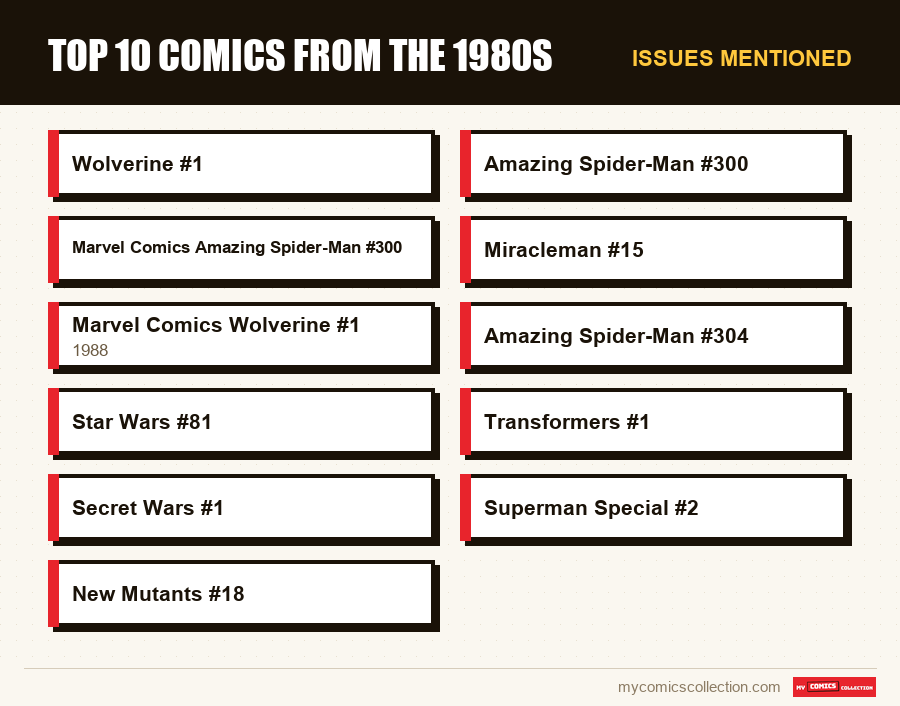
Of the eight advertisements brought back for 1988, six carry amounts sufficiently separated to form a legible order. The first four places are detailed below, with the wording as it appeared in the announcement and the amount requested on August 30, 2026.
Amazing Spider-Man #300-$899.99
Ad labeled “Marvel Comics Amazing Spider-Man #300 CGC 9.4 Copper Age 1988”. This is the highest amount in the entire survey, all years combined, and therefore constitutes the ceiling observed for this decade on that day. The copy is presented as verified by an independent organization, with a condition rating located at the top of the scale without occupying the top.
Miracleman #15-$525.00
Advertisement labeled “Miracleman #15 (1988) CGC 9.8 [...] COPPER AGE KEY”. Second position, a little less than six tenths from the leading post. The copy bears a condition grade higher than that of the first in the classification, which is enough to remind you that the grade does not determine the rank: it is the issue concerned which first sets the level, the condition then intervening.
Wolverine #1-$250.00
Ad labeled “Wolverine #1 (1988) CGC 9.6 Marvel Copper Age First Appearance”. Third position. The same number appears twice in the statement, at two different state levels, providing the only usable direct comparison of the entire sample. It is detailed further below.
Wolverine #1, second copy: $120.00
Ad labeled "Marvel Comics Wolverine #1 (1988) CGC 9.2 [...] 1st Wolverine as Patch". Same issue as the previous line, four status points lower on the verification scale, and an amount requested less than half. Two sellers, two positions, one and the same number.
The last two lines from 1988 complete the picture without upsetting it: a Amazing Spider-Man No. 306 displayed at $109.99 and a Amazing Spider-Man #304 listed at $99.99, both shown as verified. We therefore see, over a single year and a single series, a gap of a factor of nine between number 300 and its immediate neighbors numbered four and six notches further. This internal gap within the same series is a robust observation in the sense that it is based on simultaneous and comparable announcements; On the other hand, it does not authorize any numerical conclusion on what these three numbers are really worth.
The leading issue in this ranking belongs to a series that the site also covers: the hub Spider-Man brings together articles dedicated to the character, and the hub Wolverine does the same for the second highest placed title of 1988.
Readers who wish to place the Spider-Man issues from this end of the decade in the path of the authors of the time will find an entry point on the page devoted to Todd McFarlane. This classification does not deal with the authors or the content of the stories: it only looks at price tags.
The year 1984: six announcements, one lower peak
The query for 1984 brought back six advertisements. This is very little, and it must be said before presenting the content: on such a number, the ranking obtained describes what was online that morning, not a price level characteristic of the year. A single ad removed or added would have changed the summit.
In the lead, a Star Wars #81 verified, labeled “STAR WARS #81 CGC 9.2 Return Of Boba Fett Marvel Comics Key 1984,” listed at $399.63. Next comes a Transformers #1 verified at $300.00, then a Secret Wars #1 verified at $199.99. Fourth place goes to a Superman Special #2 verified at $129.95, whose ad mentions blank pages. The character concerned also has a dedicated entry point on the site: the hub Superman.
The last two lines of 1984 are a Detective Comics No. 524 at $64.99 and a New Mutants #18 verified at $55.00. The first deserves attention: its wording explicitly indicates “Not CGC”, that is to say that the seller himself indicates that the copy has not been submitted to a verification body. This mention was not obligatory. Seeing it in a listing title is uncommon, and is useful information for the buyer, who immediately knows they are comparing an unverified item to verified items.
A structural point emerges from these six lines: the classification mixes superhero series and adaptations of licenses from cinema or toys. Two of the top three spots in 1984 are occupied by titles that exploit property outside the publisher. The decade has clearly broadened what is collectable beyond the scope of in-house characters, and the sample, however small, shows this directly.
A very low ceiling compared to neighboring decades
The central fact of this article is not the order of the lines, it is the level at which they stop. The highest amount in the entire statement is $899.99. On the same day, on the same platform and using the same method, the peaks recorded for previous decades were around thirty-three thousand dollars for the year 1963 and almost thirty thousand dollars for 1974. The difference is approximately a factor of thirty between the ceiling of the 1980s and that of the preceding decades.
This gap is too wide to reflect the composition of the sample. Fourteen announcements do not make it possible to say at what precise level the real ceiling of the decade is located, but they are more than enough to establish that it is not of the same order of magnitude as that of the 1960s and 1970s. A ratio of one to thirty is not obtained by chance on a print of a few lines.
The explanation lies in abundance. The fascicles from the 1980s were printed in large numbers and, above all, they were preserved in large numbers. The transition from newsstand distribution to specialized circuits, the generalization of protective sleeves and the appearance of a practice of duplicate purchasing intended for conservation have produced a lasting stock of copies in good condition. I'm not putting forward any circulation figures here, because I don't have any: it's a general mechanism, not measured data. But it accounts for what the survey shows, namely a low ceiling where the scarcity of access caused it to rise in previous decades.
The practical consequence is that, over this period, the question asked of a copy changes its nature. For older decades, the difficulty is finding the object; the price pays for access. For the 1980s, the object is found, and what you pay for is its condition. This is exactly what the only internal comparison available to the sample highlights.
Collecting this series?
Track what you own, what you are missing and what your collection is worth. 7 day trial.
Start my trial →Same number, two states, two prices
Two announcements in the survey relate to the same issue: Wolverine No. 1 of 1988, verified in both cases. The first ad states a condition rating of 9.6 and asks $250.00. The second declares a rating of 9.2, four points lower on the scale used by verification organizations, and asks for $120.00. The amount claimed is less than half of the first for an object identical in content, series, number and year.
This is the most instructive comparison in the survey, because it isolates a single variable. Same title, same publication, same verification status: what differs is the rating. In older decades, such a difference in condition obviously shifts the price, but it does not push the object into another category, since even an average example remains difficult to find. Here, with copies available at several state levels simultaneously, the buyer arbitrates, and the price differential reflects this arbitrage.
Two reservations are nevertheless necessary. First, two listings are not a measurement: they show how two sellers are positioned, not what the average price ratio is between these two status levels. Then, the wording of the two advertisements does not put forward the same argument, which can also affect the amount displayed. The mechanism is clear, its quantification is not. To understand how a condition rating relates to a price level in general, the dedicated article Comics rating: understanding the link between grade and price addresses the issue head-on, which this ranking does not do.
What fourteen announcements do not allow us to conclude
No price level for the decade
Eight ads for 1988 and six for 1984 describe what was online at any given time. Refusing to deduce a characteristic price is not rhetorical prudence: on such a number, the withdrawal of a single line moves the displayed peak.
No change over time
The reading has a single date, August 30, 2026. A single measurement cannot by construction show either an increase, a decrease or stability. Any reading of this ranking as a trend would be a false reading.
No sales concluded
Each amount quoted is a seller's request. An isolated maximum reflects a hope, not a transaction. The statement does not include any history of completed sales and therefore cannot say anything about what buyers actually agreed to pay.
Two years out of ten
1984 and 1988 are two samples, not a census. No conclusion can be extended to 1980, 1985 or 1989. The absence of a title in this classification means that it did not appear in these two requests, nothing more.
Declarative status notes
The notes cited are taken from the announcement titles. They come from verification organizations, but their transcription in the advertisement remains the responsibility of the seller, and the statement does not include any independent control of these mentions.
A single sales channel
The announcements come from a general auction platform, on the American market, in dollars. Specialized boutiques, sales between collectors and other geographic markets are absent from the observed field.
What to remember from this ranking
The decade's cap is under a thousand dollars. This is the main lesson, and the only one that resists the smallness of the sample, because the gap with neighboring decades (about thirty-three thousand dollars for 1963, almost thirty thousand for 1974) is an order of magnitude too great to be an artifact of the print run. What this survey establishes is a change in scale, not a precise number.
The state once again becomes the variable that decides. The same Wolverine #1 goes from $250.00 to $120.00 for four state points difference. On booklets available in several copies simultaneously, the price no longer pays for access to the object but for its condition. This is the most concrete reversal produced by the comparison between this decade and previous ones.
An advert that declares its lack of verification is worth reporting. Le Detective Comics No. 524 of 1984 itself indicates, in its title, that the copy was not submitted to an independent body. Nothing required the seller to make this mention. This frankness is rare and it makes the listing immediately comparable to others, which is precisely what a buyer is looking for.
The ranking mixes the universes. Two of the first three places in 1984 went to adaptations of licenses outside the publisher, alongside superhero titles. On such a small sample, it is an indication and not a demonstration, but it goes in the direction of a decade where the field of what is collected has broadened.
The sample size is the honest limit of the exercise. Fourteen announcements spread over two years, a single sales channel, a single date. This classification describes what was happening that day and nothing else. Saying it clearly is better than presenting what is only a snapshot as a list of achievements.
No. Each figure cited is the amount a seller was asking for on August 30, 2026 in their ad. None of these copies are presented here as sold. A claimed amount indicates the level at which a holder is positioned; it says nothing about what a buyer has agreed or will agree to pay, and an isolated high amount primarily reflects a seller's expectation.
Because the survey covers two sampled years and not the entire decade. This is not a census. The booklets published in other years were simply not questioned, and their absence from this table does not provide any information on their price level.
The workforce prohibits setting a precise ceiling for the 1980s, but a ratio of one to thirty cannot be explained by the chance of a small print run. The survey therefore establishes a change of order of magnitude between decades, while remaining unable to quantify this ceiling with accuracy.
She points out that the copy has not been submitted to an independent verification body: it has therefore not received any quantified condition note and is not sealed. The seller chose to specify this in his title even though nothing forced him to do so, which means that this copy will not be mistakenly compared to verified copies.
No, and that is not its purpose. A snapshot of fourteen requested ads on a single channel is not a basis for evaluation. The estimation process, with its sources and precautions, is covered in a separate article to which this page refers.
Track your 1980s copies issue by issue
Noting the declared state, the date of a statement and the amount observed for each issue avoids having to reconstruct this information from memory. My Comics Collection records your issues, their condition and your market observations, and instantly finds the details of a copy in the middle of your entire collection.
The eight decades, recorded on the same day
- Décennie précédente : les années 1970
- Décennie suivante : les années 1990
- Les années 1950
- Les années 1960
- Les années 2000
- Les années 2010