The 1980s marked a radical turning point in the history of American comics. It's the decade that saw the birth of revolutionary works like Watchmen and The Dark Knight Returns , epic crossovers like Secret Wars and Crisis on Infinite Earths, and the emergence of graphic novels as a legitimate format.
The 1980s marked a radical turning point in the history of American comics. It's the decade that saw the birth of revolutionary works like Watchmen and The Dark Knight Returns , epic crossovers like Secret Wars and Crisis on Infinite Earths, and the emergence of graphic novels as a legitimate format. For a collector, 80s comics represent a pivotal era: still affordable for the most part, but with increasing value for key issues.
This guide helps you understand the two major eras that overlap in this decade, identify the issues that deserve your attention, and set up solid management for this part of your collection.
The two eras of 80s comics: Bronze Age and Modern Age
Bronze Age (late 1970, late 1985)
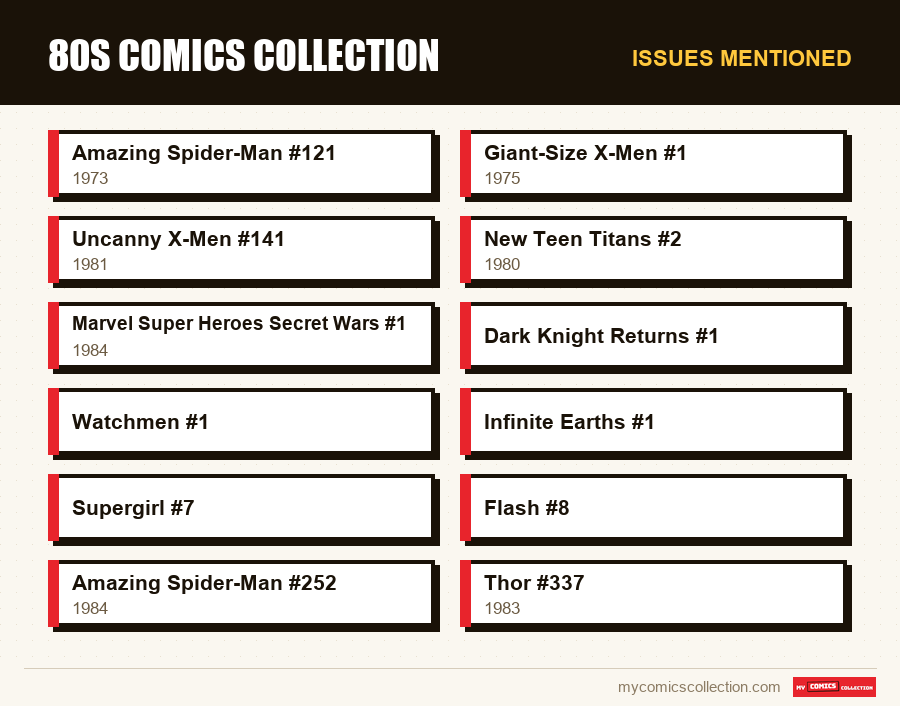
The exact beginning of the Bronze Age is debated, but most experts place it around Amazing Spider-Man #121 (death of Gwen Stacy, 1973) or Giant-Size X-Men #1 (1975), which relaunched the X-Men franchise. The Bronze Age extends into the mid-80s before being displaced by the Modern Age revolution.
The Bronze Age is distinguished by unprecedented narrative complexity: characters are more nuanced, social issues make their entrance (drugs, violence, racism), and the Comics Code Authority begins to loosen. It's a transitional period between the innocence of the Silver Age and the maturity of the Modern Age.
Bronze Age key issues from the 80s:
- Uncanny X-Men #141 (Days of Future Past, 1981), one of the most influential story arcs in X-Men history
- New Teen Titans #2 (1980), first appearance of Deathstroke, one of the most popular DC characters
- Marvel Super Heroes Secret Wars #1 (1984), first major large-scale Marvel crossover
Modern Age (since 1985-1986)
The Modern Age was triggered by two works published in 1986 that forever changed the perception of the medium: Watchmen by Alan Moore & Dave Gibbons and The Dark Knight Returns by Frank Miller. These two series demonstrated that comics could tackle adult themes with unprecedented literary and visual depth.
The Modern Age is characterized by stories aimed at an adult audience, the rise of anti-heroes, the deconstruction of superhero figures, and the explosion of the graphic novel format. It's also the period when comic book speculation emerged, by the late 80s, the idea that comics could be an investment began to spread, foreshadowing the speculative boom of the 90s.
Major works from the 80s to collect
The decade is packed with foundational issues. Here are the ones that generate the strongest demand on the collectors' market today:
- The Dark Knight Returns #1-4 (1986, Frank Miller / DC), revolutionizes Batman and the very concept of the aging superhero
- Watchmen #1-12 (1986-87, Alan Moore & Dave Gibbons / DC), the ultimate genre deconstruction, considered one of the greatest works of graphic literature worldwide
- Batman: The Killing Joke (1988, Alan Moore & Brian Bolland / DC), foundational one-shot on the Batman/Joker relationship
- Crisis on Infinite Earths #1-12 (1985-86, DC), first major reboot of a superhero universe, with major deaths (Supergirl #7, Flash #8)
- Marvel Super Heroes Secret Wars #1-12 (1984-85, Marvel), first large-scale Marvel crossover, introduces Spider-Man's black costume
- Uncanny X-Men #141-142 (Days of Future Past, 1981), story arc that inspired a film and remains a pillar of X-Men culture
- Amazing Spider-Man #252 (1984), first appearance of the black symbiote costume
- Thor #337 (1983), first appearance of Beta Ray Bill
- Alpha Flight #1 (1983), first solo series for the Canadian superhero team
The Dark Knight Returns #1 (1986) sells today for between 50 and 300 euros depending on condition. It's the work that proved comics could be great literature, a cultural revolution whose value continues to appreciate.
The major comic events of the 80s
The 80s saw the birth of the large-scale editorial crossover concept, a format that would become the norm in the following decades. For a collector, knowing how to distinguish main issues from tie-ins is essential to building a relevant collection without spreading too thin.
Crisis on Infinite Earths (DC, 1985-86) is the first major reboot of an editorial universe. Issues #7 (death of Supergirl) and #8 (death of Flash) are absolute key issues, highly sought after in Near Mint condition. The 12-issue series remains accessible, but these two specific issues have significantly higher value.
Marvel Super Heroes Secret Wars (Marvel, 1984-85) is Marvel's first large-scale crossover. Issue #8 is particularly prized: it's where Spider-Man's black costume first appears, directly linked to the origin of Venom. Issue #1 is also a first appearance key issue.
Mutant Massacre (Marvel, 1986) is one of the first major X-Men events involving multiple series (Uncanny X-Men, X-Factor, New Mutants, Thor). It's a secondary event but appreciated by completist X-Men collectors.
The golden rule for events: focus on the main issues from the main series. Tie-ins rarely have significant resale value and weigh down the collection without substantially increasing its overall value.
Collecting this series?
Track what you own, what you are missing and what your collection is worth. 7 day trial.
Start my trial →How to manage an 80s comics collection
80s comics have specific characteristics that make their management different from more recent comics. Here is the recommended method, step by step:
Assess the condition
80s comics have often suffered from time: acidic paper, yellowing pages, spine roll, stains. Condition is the most critical factor for value, a comic in NM (Near Mint) can be worth ten times more than a Good copy of the same issue. Start with a thorough inventory of each copy's condition.
Identify your key issues
Use the key issue lists available on the My Comics Collection blog to find out which of your comics deserve special attention. First appearances, major deaths, first printing of a foundational work: these are the issues that have or will have value.
Import your series into My Comics Collection
Register each series in the app with the precise condition of each copy. This step gives you a daily-updated valuation of your entire 80s collection, based on current eBay listings.
Consider professional pressing and cleaning
For comics of certain value, professional pressing can significantly improve the apparent condition before CGC submission. This treatment, performed by specialized providers, removes creases and improves the visual appearance without altering the comic. It's recommended before any CGC submission for issues worth more than 80-100 euros.
Separate ordinary comics from key issues
Physically store and manage your key issues (optimal preservation, potential grading) separately from your regular run comics. This separation simplifies management, better protects valuable copies, and gives you a clear view of your collection's real value.
Condition of 80s comics: the major challenge
The vast majority of comics published in the 80s used poor-quality wood-based paper rich in acid. This paper yellows and becomes fragile over time in an irreversible way, unlike modern comics published on higher-quality paper. For a collector, this reality demands particularly rigorous storage conditions.
Paper acidification is a natural chemical process that can only be slowed, never stopped. Heat, humidity, and light accelerate this process. An 80s comic stored in poor conditions for 30 years may have lost 50 to 80% of its potential value from paper degradation alone.
The best storage conditions for 80s comics:
- Stable temperature between 18 and 20°C, temperature fluctuations are particularly damaging
- Low humidity (40-50% relative humidity), moisture accelerates acidification and promotes mold
- Storage away from direct light, especially UV
- Acid-free bags and backing boards for each copy
- Vertical storage in quality longboxes
Essential equipment for 80s comics
- For any valuable 80s comic, invest in Mylar bags (far superior to ordinary poly-bags), they are chemically inert and do not transmit acidity
- Pair them with acid-free backing boards to prevent spine roll and warping
- A poorly stored comic can lose 50 to 80% of its value in just a few years, the cost of Mylar bags is negligible compared to this potential loss
- For highly valuable key issues, consider CGC slabs which provide controlled-atmosphere preservation and authentication certification
FAQ, 80s Comics
Unlock the value of your 80s collection
Identify the hidden key issues in your 80s comics collection. My Comics Collection calculates the estimated value of each issue based on current eBay listings.
🚀 Free 7-day trial