The 1990s are one of the most fascinating, and most complex, decades in the history of American comics. On one hand, an unprecedented creative explosion: the birth of Image Comics, Batman and X-Men movie adaptations that popularized superheroes, the death of Superman.
The 1990s are one of the most fascinating, and most complex, decades in the history of American comics. On one hand, an unprecedented creative explosion: the birth of Image Comics, Batman and X-Men movie adaptations that popularized superheroes, the death of Superman. On the other, an unprecedented speculative bubble that led to the market collapse of 1993-96. For today's collector, navigating the 90s requires method: the majority of comics from this era are worth nothing, but a few key issues are worth their weight in gold.
The 90s speculative bubble: what you need to know
Understanding the 90s speculative bubble is essential for any collector who owns comics from this decade. The mechanisms that inflated the market are the same ones that explain why most of these comics are worth almost nothing today.
- Publishers and collectors believed that #1 issues would systematically increase in value, as certain comics from the 60s and 70s had done.
- Proliferation of variant covers (silver foil, holograms, polybagging with cards) explicitly designed to trigger speculative purchases.
- Record print runs: X-Men #1 (Jim Lee, 1991) printed at 8 million copies, an absolute record that mechanically destroyed any collectible value.
- Death of Superman (1992): Superman #75 sold in millions with a black bag and obituary, millions of unopened copies stored in basements.
- Market collapse: 1993-1996, cascading bankruptcies of distributors and publishers, closure of thousands of comic shops across the United States.
The perfect example of destructive speculation: Superman #75 (1992, "The Death of Superman") was sold in a special polybag to millions of copies. Today, a sealed copy is worth 5-20 euros, the perfect example of how speculation can destroy a comic's value. A massive print run organized around the event made the comic as common as a box of cereal.
What's actually worth something from the 90s
The bad news: 95% of the 90s comics you own are worth less than 5 euros. The good news: exceptions exist, and some are spectacular. Here are the real 90s key issues that deserve your attention:
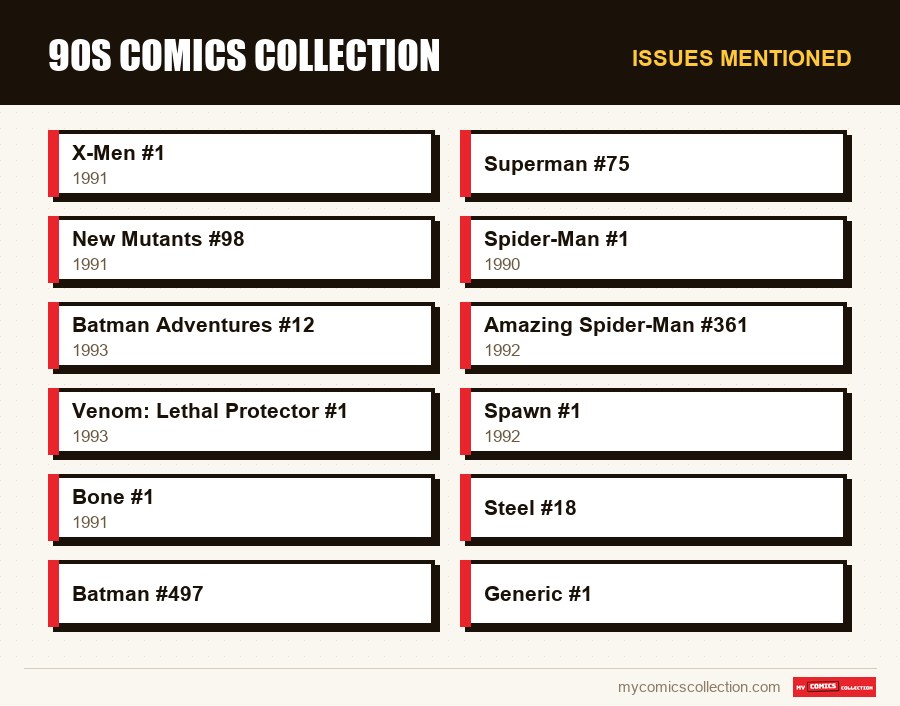
- New Mutants #98 (1991), First appearance of Deadpool: 200-1,500 euros depending on condition. The great exception of the decade.
- X-Men #1 (1991, Jim Lee): Regular editions are worth little, but the "gatefold" A-E variants (foldout cover) trade for 10-50 euros each.
- Spider-Man #1 (1990, McFarlane): Watch out for versions, with polybag is not the same as without, and the gold/platinum/silver editions are significantly rarer.
- Batman Adventures #12 (1993), First appearance of Harley Quinn: 300-800 euros depending on condition. A key issue that became major with the explosion of the character's popularity.
- Amazing Spider-Man #361 (1992), First appearance of Carnage: 50-200 euros.
- Venom: Lethal Protector #1 (1993): 30-100 euros.
- Spawn #1 (1992, Todd McFarlane / Image): 20-100 euros, first Image Comics issue.
- Bone #1 (1991, Jeff Smith): 200-500 euros for true Cartoon Books first editions, watch out for reprints.
New Mutants #98: the great exception of the 90s. With only around 300,000 copies printed (compared to X-Men #1's millions), and a first appearance of Deadpool now bankable at the cinema with Ryan Reynolds, this comic is worth between 200 and 1,500 euros today depending on condition. It was published before the speculative bubble inflated print runs to absurd levels, that's exactly what saved it.
The major 90s events: collecting smartly
The 90s were the era of mega-events. Every publisher released massive crossovers, often with special covers and polybagging. The reality of these events' collectible value is often disappointing.
Death of Superman (1992-93)
Superman #75 and Man of Steel #18, disappointing value despite the historical hype. Print runs too massive for any significant value.
Knightfall (1993-94)
Batman #497 (Bane breaks Batman's back) is the only truly interesting issue: 20-80 euros. The rest of the crossover is affordable and not particularly sought after.
Age of Apocalypse (1995-96)
Complete alternate X-Men series, cult but affordable. Interesting for continuity enthusiasts, without significant resale value.
Onslaught (1996)
A mediocre series with little collectible interest. Marks the beginning of Marvel heroes' departure into an unpopular "Heroes Reborn."
Zero Hour (1994, DC)
An attempt to reboot DC continuity. Little collectible interest today despite some nice "zero" issues.
Maximum Carnage (1993)
An entertaining series but mass-produced, with foil covers. Little resale value despite Carnage's enduring popularity.
The general rule for 90s events: avoid buying these series "for the value". Buy them if you enjoy the stories. For collecting purposes, focus on isolated key issues rather than complete crossovers.
Events with polybags, holograms, or ordinary foil covers
These 90s editorial gimmicks were designed to stimulate speculative purchases. They have zero positive impact on value today, and can even make a comic less attractive to some collectors who prefer standard covers.
Generic #1 issues from the decade
A 90s #1 is not automatically valuable. Check the estimated print run before getting excited. If the series launched during the peak of the bubble (1991-1994), print runs often exceeded one million copies, which makes the value virtually nil.
Verified first appearances and key deaths
Focus your efforts on comics with a documented first appearance of a character who became important (Deadpool, Carnage, Harley Quinn) or a major narrative moment (Knightfall). These are the only 90s issues whose value is real and lasting.
Collecting this series?
Track what you own, what you are missing and what your collection is worth. 7 day trial.
Start my trial →The birth of Image Comics: the founders and their works
In 1992, seven of Marvel's most popular artists left the publisher to found Image Comics : the most disruptive event in the industry in decades. Understanding Image Comics means understanding an essential part of the 90s.
- Todd McFarlane (Spawn), Image's biggest commercial success
- Jim Lee (WildC.A.T.s), left to join DC in 1998, now co-publisher of DC Comics
- Rob Liefeld (Youngblood), the embodiment of the 90s' graphic excesses
- Marc Silvestri (Cyberforce), founder of Top Cow Productions
- Erik Larsen (Savage Dragon), the only original Image series still published by its creator
- Jim Valentino (ShadowHawk)
- Whilce Portacio (Wetworks)
From a collecting standpoint: Spawn #1 is Image era's real success and remains sought after in good condition (20-100 euros). Most other 90s Image series benefited from enormous print runs driven by the hype of Image's creation, which severely limits their resale value today.
90s Image series to know
- Spawn #1 (1992) : the most sought after, 20-100 euros
- Savage Dragon #1 (1992) : interesting for Image collectors
- WildC.A.T.s #1 (1992) : massive print run, limited value
- Youngblood #1 (1992) : first published Image comic, negligible in value
- Bone #1 (1991, Jeff Smith) : independent from the Image era, much rarer and more valuable
How to manage a 90s comics collection
Faced with longboxes full of 90s comics, the temptation is to keep everything "just in case." That's a mistake. Here's a five-step method to intelligently manage this part of your collection:
Sort it out: separate the real collectibles from the fakes
Start by identifying your documented first appearances and key deaths. Everything else, foil comics, ordinary polybags, complete events, should be filed under "sentimental value only" unless proven otherwise.
Check the print runs
A comic printed at 8 million copies will struggle to gain value. Consult databases like Comichron to estimate your comics' print runs. A print run below 500,000 in 1990-1995 is already relatively rare for that era.
Import into My Comics Collection to identify key issues
Use My Comics Collection to catalog your 90s collection and automatically identify which issues are listed as key issues. The app lets you cross-reference your inventory with current market value data.
Don't open polybagged comics in good condition
If you own comics still sealed in their original polybag (Spider-Man #1 gold/platinum, numbered special editions), don't open them. For these specific editions, an intact polybag can make a significant difference in value.
Get your potential key issues professionally evaluated
For your New Mutants #98, Batman Adventures #12, or Amazing Spider-Man #361 in good condition, consider CGC grading. Professional certification can multiply resale value and guarantees authenticity for buyers.
FAQ, 90s Comics
Sort through your 90s collection
Use My Comics Collection to identify the real key issues in your 90s collection and calculate their actual value based on current eBay listings.
🚀 Free 7-day trial, No commitment