In the American comic collecting world, few concepts carry as much weight, and spark as much debate, as the key issue. An ordinary issue can sit in a 50-cent longbox for decades, then rocket to hundreds or thousands of euros in a matter of weeks, propelled by a casting announcement or a production rumor.
In the American comic collecting world, few concepts carry as much weight, and spark as much debate, as the key issue. An ordinary issue can sit in a 50-cent longbox for decades, then rocket to hundreds or thousands of euros in a matter of weeks, propelled by a casting announcement or a production rumor. Understanding what a key issue is, how to identify one, and why certain issues are worth what they are has become essential for any serious collector.
In simple terms, a key issue is a comic that contains a significant event (a first appearance, a death, an origin story, a wedding) that lastingly increases demand for that issue on the secondary market. The concept is both simple in principle and complex in application: not every "important" issue is a key issue in the strict sense, and some key issues are only recognized as such years after publication.
The 6 types of key issues
The key-issue market has structured itself around several well-defined categories. Here are the six types every collector should know:
First Appearance
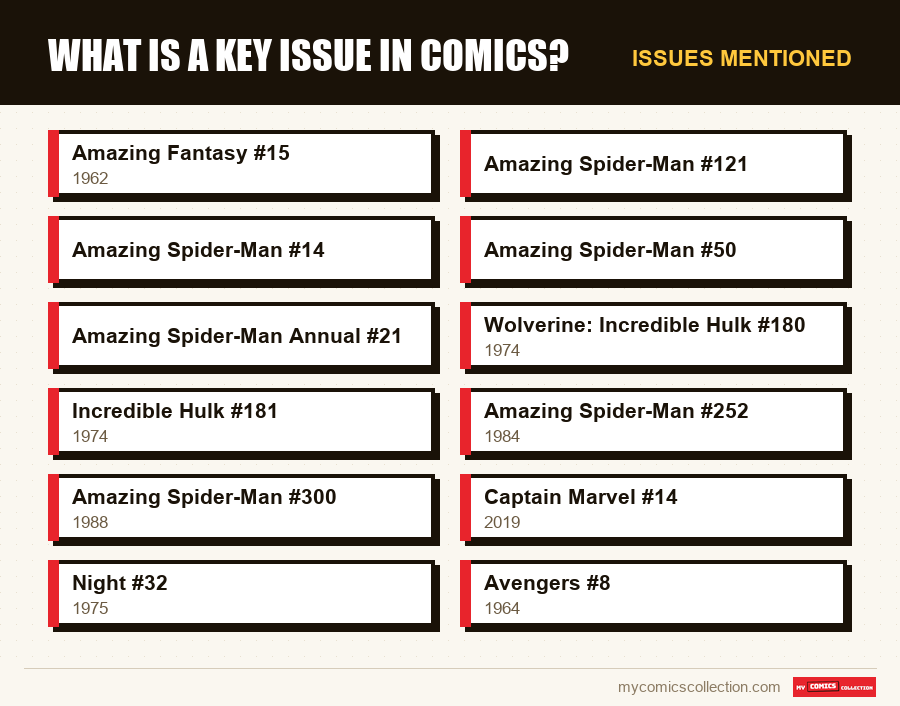
The first appearance of a character: hero, villain or supporting cast. This is the most sought-after type of key issue. Amazing Fantasy #15 (Spider-Man, 1962) is the absolute example.
Origin Story
The issue where a character's origin story is told for the first time. Sometimes different from the first appearance, the origin can come several issues later.
Death / Return
The death of a major character (Amazing Spider-Man #121, death of Gwen Stacy) or their spectacular return. These issues capture pivotal moments in continuity.
First Villain
The first appearance of a major antagonist. Amazing Spider-Man #14 (Green Goblin), Amazing Spider-Man #50 (Kingpin): cult villains have their own highly sought-after key issues.
Marriage / Major Event
Weddings (Amazing Spider-Man Annual #21, Peter Parker and Mary Jane), major alliances, or secret-identity reveals fall into this category.
Iconic Cover / Milestone
Some issues are key not for their content but for their iconic cover or anniversary number (#100, #200, #500). These milestones carry strong symbolic value.
First appearance vs cameo appearance: a crucial distinction
One of the most frequent debates in the collector community concerns the distinction between first appearance and cameo appearance. This nuance has direct consequences on an issue's value: sometimes hundreds of euros of difference.
A cameo is a brief appearance: often in the background, in silhouette, or limited to a few panels without character development. A first full appearance refers to the first issue in which the character plays a real narrative role, with dialogue and significant presence in the story.
The most cited example is Wolverine: Incredible Hulk #180 (1974) contains his cameo: an appearance in the last panel. Incredible Hulk #181 (1974) is his first full appearance, with a central role. Both issues are key issues, but #181 consistently sells higher. In Very Good condition, Incredible Hulk #181 regularly exceeds €2,000 on eBay.
Venom case: Amazing Spider-Man #252 (1984) is often cited as the first appearance of the black costume, but that's the alien costume: not yet Venom as a villain. Amazing Spider-Man #300 (1988) is the true first full appearance of Venom. Both issues are highly valued key issues, for different reasons.
This cameo/full appearance distinction is sometimes subject to interpretation, creating heated debates in the community. Resources like the CBCS Key Comics list or the Marvel Comics Database are authoritative for settling these questions and establishing which issues are "officially" recognized by the market.
How film and TV blow up key-issue values
The MCU phenomenon has deeply transformed the key-issue market. Since Iron Man in 2008, every movie or TV series announcement triggers demand spikes, and thus value spikes, on issues containing first appearances of the relevant characters.
Recent examples are numerous. When the Ms. Marvel Disney+ series was announced, the value of Captain Marvel #14 (2019), first appearance of Kamala Khan in this universe, multiplied by 5 within days. The Moon Knight series propelled Werewolf by Night #32 (1975, first appearance of Moon Knight) to new highs: a CGC 9.4 copy sold for more than €10,000 in 2022. The Loki series revived interest in issues tied to variants and Kang, including Avengers #8 (1964, first appearance of Kang).
This mechanism creates a form of speculation: collectors buy key issues before official announcements, based on casting rumors or script leaks. Issues whose value has spiked often sell at their peak, then settle at a level higher than their pre-announcement price but lower than their speculative peak.
Modern key issues: speculative mirror or real value?
The question of real value for modern key issues is legitimate. Comics published since the 1990s have been printed in millions of copies, and many have been preserved in excellent condition by savvy collectors from release. Supply is therefore abundant, which mechanically limits long-term value.
A "modern" key issue like New Mutants #98 (1991, first appearance of Deadpool) has nevertheless established itself as a classic: printed in several hundred thousand copies, it now sells between €100 and over €1,000 depending on condition, with peaks during movie releases. Its value is real because demand exceeds available supply in top condition.
On the other hand, some 1990s-2000s key issues never found their audience and remain at prices close to their original cover price. Short-term speculation is risky: a "hot" issue today can cool quickly if the associated movie project is cancelled or disappoints.
Modern key issues that have proven their value
- New Mutants #98 (1991): First appearance Deadpool
- Amazing Spider-Man #300 (1988): First full appearance Venom
- Batman Adventures #12 (1993): First comic appearance Harley Quinn
- Wolverine #1 (1982): First solo series Wolverine
- Saga #1 (2012, Image): Modern Image Comics key issue
Collecting this series?
Track what you own, what you are missing and what your collection is worth. 7 day trial.
Start my trial →How to evaluate a key issue's potential before buying
Identifying a key issue before its value explodes requires a combination of editorial knowledge, news monitoring and market analysis. Here are the steps to follow:
Verify the issue's narrative importance
Does the issue contain a real first appearance, an origin story, or a significant death? Use the Marvel Comics Database, DC Wiki or the CBCS Key Comics list to confirm the issue's official status.
Analyze the eBay sales history
Consult completed sales (not asking prices) on eBay for this issue across various grades. This real data tells you the current market price and its recent trend.
Monitor film and TV news
Follow casting and production announcements from Marvel, DC and Image Comics adaptations. A character announced for a major production often sees their first appearance gain value well before release.
Evaluate print run and real rarity
A Silver Age key issue printed in 200,000 copies, 90% of which were destroyed, is rarer than a modern key issue printed in 500,000 copies kept in NM. Real market scarcity matters more than gross print run.
Factor in condition
A key issue's condition is decisive. A Near Mint copy can be worth 10 to 50 times more than a Good copy of the same issue. Buy the best condition your budget allows.
Resources to identify key issues
Several resources are authoritative in the community for identifying and validating a key issue's status:
CBCS Key Comics (cbcscomics.com) publishes an official list of key issues by character and by publisher, with precise criteria justifying each designation. It's the most neutral and complete reference available free online.
The Marvel Comics Database (marvel.fandom.com) and the DC Database (dc.fandom.com) let you verify each character's official first appearances, arc by arc. Essential for confirming whether an issue is truly a first appearance or only a cameo.
Key Collector Comics (mobile app) sends real-time alerts on key issues gaining popularity, with built-in eBay sales data. A practical tool for active monitoring.
Finally, My Comics Collection lets you automatically identify key issues in your own collection, with estimated values based on current eBay listings. Knowing which issues you already own are key issues is the first step to intelligently valuing your collection.
FAQ: Key issues in comics
Identify your key issues with My Comics Collection
Know exactly which issues in your collection are key issues and consult their estimated value based on current eBay listings.
🚀 Free 7-day trial: No commitment