On August 30, 2026, on a general auction site in the American market, the highest amounts claimed for booklets from the 1960s focused on two titles: a copy of Amazing Spider-Man #1 rated 6.5 is listed at $33,000.00 and a Uncanny X-Men #1 rated 6.0 at $22,500.00. The most useful fact in the statement is not the top, it's an inversion: a restored example rated 8.0 commands $20,000.00, significantly less than an intact example rated two notches lower. This ranking orders prices asked, not transactions concluded, and it says nothing about the quality of the stories.
A ranking by amount is not a list of achievements. There is already, on this site, a qualitative arrangement of the 1960s in stages, which answers a different question: what can still be read today, what has aged, what has mattered. The page you are reading does not judge any story, award any rank of merit, or recommend any purchase as an investment. It does something else, much narrower: it notes what sellers were asking for on a given day, it arranges these requests by decreasing amount, and it tries to understand why they are arranged in this way.
This limit must be placed before the numbers, because it changes the way of reading them. A posted price is a one-sided proposition: it expresses a seller's hope and nothing else until someone pays. A list of displayed prices, even sorted neatly, therefore remains a snapshot of intentions. It becomes interesting when we give up asking her what she doesn't know (the state of the market, its direction, the "real" value of a booklet) and ask her what she knows: how the characteristics of a copy translate into differences in amounts, at a precise moment, on a precise sample.
The survey method, stated without rounding
The amounts cited here come from a consultation made on August 30, 2026 on a general auction site, on the American market side, with amounts expressed in dollars. The copies selected are those whose advertisement indicates having passed through an independent verification body, that is to say whose condition has been assessed by a third party and not by the seller himself. Each amount is therefore an amount claimed at the time of the consultation, never an amount collected.
The survey does not cover the decade. It covers two sampled years, 1963 and 1969, chosen to frame the period. For 1963, the request lists forty-six advertisements in total; for 1969, twenty-seven. These are low numbers. From a few dozen ads, a classification describes what was on sale that day, with the specific copies that a few dozen sellers had decided to offer at that time. It does not describe a stable state, much less a reference price level for the 1960s.
Finally, a single date shows no movement. It would take at least two surveys separated in time, constructed in the same way, to start talking about evolution. No sentence in this article will therefore say that an amount rises, falls or remains stable: the measurement does not allow this, and to claim the opposite would be to fabricate information.
1963: the top of the ranking is contained in two booklets
Amazing Spider-Man #1, noté 6,5-33 000,00 $
The highest amount on the statement, all years combined. The ad places it in the Silver Age, March 1963, and notes a verified, unrestored example. This is the only amount on the statement to exceed thirty thousand dollars.
Uncanny X-Men #1, noté 6,0-22 500,00 $
Second position, with a rating half a point lower than the previous one and an amount claimed about a third lower. The announcement highlights a first appearance.
Amazing Spider-Man #1, noté 8,0 mais restauré: 20 000,00 $
The highest score in the 1963 survey, and yet third place. The advert bears the mention of restoration. It is the apparent anomaly which gives the key to reading the whole picture.
Bottom of the pack: $16,700.00, $16,000.00, $15,500.00
Un Amazing Spider-Man #1 noté 4,5, un Uncanny X-Men #1 rated 4.0, then a second Amazing Spider-Man #1 noté 6,0 mais restauré. Six annonces, deux titres seulement.
The first thing this ranking shows is not a number, it is a concentration. Six of the first seven places in 1963 are occupied by two issues, available in several copies with different notes. In other words, the top of the range of that year is not a set of varied objects: it is a very small group of objects, presented several times. For a collector, the practical consequence is simple: almost all of the sums at stake are based on a handful of references, and the rest of the year produces amounts of another order of magnitude.
This concentration also explains why we should be wary of the expression “comics of the 1960s” used as a price category. There is no level for the 1960s. There are some very sought-after issues, and a mass of issues for which the same decade has no mechanical effect on the amount requested. If you want to quantify a copy, it is from this copy that you must start, never from its decade of publication.
The central observation of the survey is a comparison. A copy of Amazing Spider-Man #1 rated 6.5, unrestored, is asking $33,000.00. A copy of the same issue rated 8.0, therefore two notches above, but restored, is asking $20,000.00. The best rated is much cheaper.
There is no inconsistency: the restoration changes the nature of the object. A material intervention on the paper, color or assembly produces a copy whose appearance has been restored, and the condition assessment then relates to the result of this intervention. Two copies can therefore display close notes while not being comparable. The note is never read alone; it is read with the mention of restoration, and this mention carries more weight here than two rating points.
1969: the same exercise, an order of magnitude lower
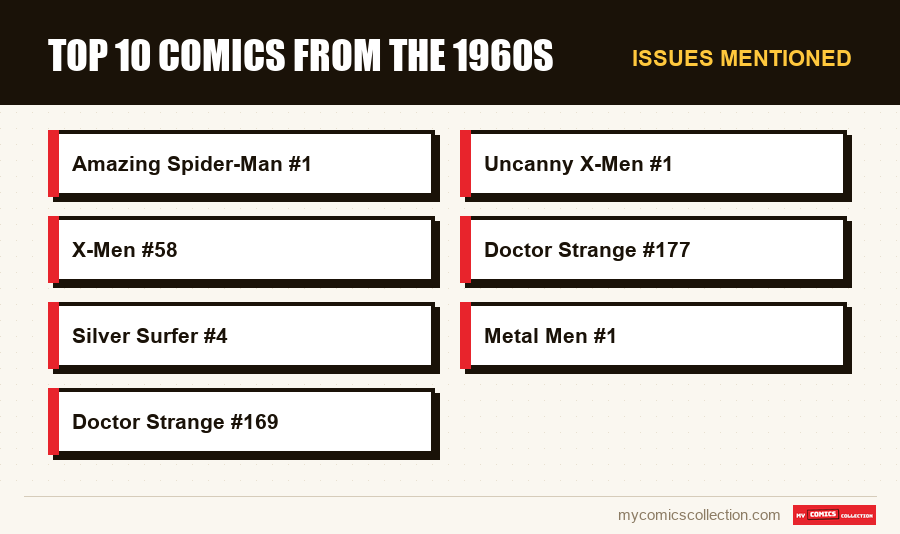
The second year sampled gives a very different picture. In the lead, a X-Men #58 rated 9.4 with blank pages, whose ad indicates a first appearance in Havok costume, is asking $2,995.00. Follows a Doctor Strange #177 checked and signed for $2,050.00, then a Silver Surfer #4 rated 6.5, whose wording emphasizes a confrontation with Thor and the iconic nature of the cover, at $1,599.99.
The rest goes down quickly. A Metal Men #1 rated 9.4 is listed at $695.00, a Superman 123 rated 3.0 presented as a key issue of the Silver Age, with a trial mention around Supergirl, at $595.00, and a Doctor Strange #169 rated 4.0, featured as the character's first issue in his own title, at $499.95. Twenty-seven announcements in total for this year: again, too small a number to draw a level from.
The gap between the two years is the second lesson of the survey. The 1963 peak exceeded thirty thousand dollars; that of 1969 does not reach three thousand. Over the same decade, the position in time therefore weighs more than the decade itself. Six years separate the two samples, and this distance is enough to produce a ratio of approximately one to ten between the head amounts. Speaking of “the sixties” as a homogeneous block has, when reading this table, no operational meaning.
One detail deserves to be pointed out rather than erased: the announcement of Metal Men #1 bears the mention 1963 in its wording although it appears in the 1969 statement. This kind of discrepancy reminds us that a classification constructed from advertisements first classifies descriptions written by sellers, with their approximations, their shortcuts and their errors. This is an additional reason to treat these lists as context clues and not as sources of civil status for a booklet.
What technical mentions add to the rating
The same Metal Men #1 carries a second indication, “Slight (A)”, which indicates a slight alteration. These technical annotations do not replace the note: they accompany it and qualify it. A copy can thus display a flattering figure while carrying a reservation which explains, in itself, a lower amount requested than what the figure would suggest.
For a buyer, the consequence is direct: you must know that these notices exist before purchasing, and get into the habit of reading the entire line rather than the isolated number. A verified copy is described by at least three elements (the note, the presence or absence of restoration, and any technical annotations) to which are added announcement details such as the color of the pages. A comparison between two examples that ignores one of these elements compares different objects while believing it is comparing the same one.
This is exactly what the 1963 reversal shows, and this is why it is the most informative fact in the survey, well before the record amount. A classification by amount highlights the prices; in reality, it mainly teaches how to read state cards.
Six reading errors that classification by amount causes
Take an asking price for a price paid
All amounts quoted are claimed, not cashed. There is no indication that a buyer accepted any of them. An isolated maximum reflects the hope of a seller, and this hope only becomes information the day someone validates it.
Deduce a trend from a single date
The reading was taken on one day, August 30, 2026. A single measurement contains no direction. Any sentence like "it's going up" or "it's stabilizing" would here be a pure invention, for lack of a second, identically constructed point of comparison.
Read the note without reading the restoration
This is the error that the statement makes visible: 8.0 restored at $20,000.00 versus 6.5 intact at $33,000.00. Sorting by note alone would have reversed the two lines and produced a false conclusion on both copies.
Generalize from a few dozen ads
Forty-six advertisements for 1963, twenty-seven for 1969. Of such numbers, the arrival or withdrawal of a single advertisement moves the ranking. What is described is a stall at a given time, not a market.
Confusing title and number
Head amounts do not relate to series, they relate to specific numbers. Two issues from the same series published a few months apart have no reason to behave the same in such a classification.
Confusing amount and quality
Nothing in this statement says that a story is good. The amounts claimed are based on the supposed rarity, condition and advertisement notices. The reading judgment is another exercise, and is carried out using other criteria.
Collecting this series?
Track what you own, what you are missing and what your collection is worth. 7 day trial.
Start my trial →Where to find these titles in the rest of the site
Three families appear in the survey, and each has a dedicated page here which brings together the corresponding articles. For the first title in the ranking, the page dedicated to Spider-Man brings together what has been written about the character and his numbers; if you are specifically looking for the reference numbers of the series, the article dedicated to key issues of Amazing Spider-Man addresses the issue head on. For the second, the page dedicated to the X-Men covers both the first issue from 1963 and later episodes of the series. For the third name cited in 1969, the page dedicated to Silver Surfer does the same job.
The statement says nothing about the creators: the ads classify objects, not signatures. If, on the contrary, you want to follow a career rather than a title, the author files are used for that, like the one devoted to Steve Ditko. This is another entry in the same catalog, and often the most convenient when building a coherent collection rather than a list of isolated issues.
What this statement changes to the appearance of your collection
Save the restoration mention as a field in its own right. This statement shows that it weighs more than two rating points on the amount requested. If your copy sheet only has one note, it is incomplete: two copies rated the same, one intact and the other restored, will never occupy the same line in a classification by amount. Write down the information when you acquire the booklet, while the original sheet is still in front of you.
Maintain the exact wording of technical annotations. A mention of slight alteration like that noted on the Metal Men #1 cannot be summarized, it is copied. Reformulated from memory a few years later, it loses the precision which made it possible to understand why this copy was located at this level and not at another. Good practice is to store the wording as it appeared, without translation or in-house abbreviation.
Date each amount you note. A figure without a date is worthless, because it becomes impossible to know whether it describes an old or recent observation. The amounts in this article are valid for August 30, 2026 and nothing else. Apply the same discipline to your own statements: amount, date, source, and clarification that it was an asking price.
Write down the number, not just the series. The 1969 statement brings together two numbers of the same title at very different levels, and the 1963 statement concentrates most of its amounts on the first two numbers. A collection held at the level of the series does not allow any useful comparison; you have to go down to the number for your data to be useful.
Distinguish your two classifications. You probably have an order of reading preference, and you will have, if you record amounts, an order of requested values. The two do not coincide and have no reason to coincide. Keeping them separate avoids the most costly confusion in collecting: believing that you bought a good story because you paid a lot, or the opposite.
How to redo this statement yourself
The procedure is reproducible, and this is its only truly lasting quality. First set the scope: a year of publication, a market, a currency, and the restriction to copies verified by an independent organization. Note the total number of ads shown, because it is this number that decides what you will be able to conclude. Below ten, do not conclude anything on a price level; just describe the ads one by one.
Then copy the full wordings rather than summaries. It is in the wording that we find the mention of restoration, the technical annotations, the color of the pages and the seller's arguments. A table that only keeps the title, the note and the amount loses precisely the information which explains the order obtained, and will leave you with incomprehensible inversions.
Finally, repeat the exercise at regular intervals, with exactly the same perimeter. It is repetition that transforms a photograph into a series, and a series is the only thing that ever allows us to speak of movement. As long as you only have a statement, you have a description; it's already useful, provided you don't present it as something else.
Frequently asked questions
No, and it's not built for that. It orders amounts claimed on August 30, 2026, which is a measure of what sellers were asking for, not an assessment of stories. Arrangement by quality exists separately on this site, in the form of levels, and it answers a completely different question. The two exercises can produce very different orders without either being at fault.
Because the 8.0 in the reading is restored and the 6.5 is not. A restoration is a material intervention on the object: the appearance is restored, but the example is no longer in its original state. The numerical assessment relates to the result obtained, and the mention of restoration accompanies it as an inseparable qualifier. Comparing the two notes without reading this notice amounts to comparing two objects of a different nature.
Not directly. These amounts concern specific copies, with a note, possible restoration and annotations specific to them, on a given market and in a given currency. To quantify a copy that you own, you must start from its characteristics and cross-reference several observations; the approach is described in the estimation guide for a specific booklet linked earlier in this article.
Because the survey is an assumed sample, not a census. Two years covering the period are enough to reveal two things: the concentration of high amounts on very few issues, and the considerable gap between the beginning and the end of the decade. An exhaustive census would be another job, with other means; it has not been done here and the article does not claim otherwise.
It is a technical annotation which accompanies the note attributed to the specimen and qualifies its scope. She indicates that an element was noted during the exam, but this was not enough to lower the grade. Its practical interest is to exist before the purchase: it informs you that a well-rated copy may carry a reserve, which sometimes explains why it is asked for less than another with a similar value.
Keep track of what you own, number by number
Note, mention of restoration, technical annotations, amount recorded and date of statement: these are five fields, and they do not fit in a list of titles. My Comics Collection allows you to save each copy at issue level, with its own characteristics, so that your comparisons finally relate to truly comparable objects.