Top 10 comics from the 1970s: the highest amounts actually requested
This classification does not evaluate the quality of the stories: it orders booklets from the 1970s by the amount that their seller displayed on August 30, 2026 on a general auction place, American market, in dollars, on copies passed by an independent verification organization. The top of the survey is a Amazing Spider-Man #129 rated 9.6 and signed, posted for $29,995.00, but a second ad with strictly identical wording demanded $19,999.99. These figures are requests from sellers, never completed transactions, and the statement only covers three sampled years: 1971, 1974 and 1978.
The site already offers a ranking from the 1970s based on reading judgment, with its levels S, A, B and C. This article does not pursue the same goal and does not compete with it. We will find no appreciation of a scenario, no hierarchy between designers, no purchase recommendation presented as an investment. A single criterion organizes the list: the number entered in the “price” field of an announcement, on a given day, for a copy whose condition has been checked by a third party. This criterion is narrow, it is easy to verify, and it says nothing about the value of a story.
We must set the limit straight away, because it conditions the reading of each line that follows. An asking amount reflects what a seller hopes to get. There is no guarantee that a buyer has accepted it, or that they will ever accept it. The reading was taken on a single date: it cannot therefore show any movement, neither rise nor fall, since there is no second measurement to compare it to. Any phrase like “this number is going up” would be a pure invention here. We describe a snapshot, and a snapshot doesn't tell a story.
How this statement was constructed, and what it cannot prove
The process is deliberately simple, to remain reproducible. A general auction site was surveyed on August 30, 2026 on three separate vintages (1971, 1974 and 1978) retaining only the examples accompanied by a condition inspection by an independent organization. The amounts are those displayed by sellers, in dollars, on the American market. Three years do not make a decade: it is not a census, it is a sample, and it must be treated as such. The volumes themselves are modest - 27 advertisements for 1974, 21 for 1978, only 5 for 1971 - which prohibits speaking of "market prices" and only allows us to describe the objects actually seen that day.
A word on the choice to only count verified copies. A booklet whose condition has been assessed by a third party and sealed carries stable information, comparable from one advertisement to another. A copy freely described by its seller does not offer this comparability: “very good condition” does not mean the same thing depending on the hand that writes it. By restricting the survey to controlled copies, we gain in homogeneity what we lose in representativeness, since we exclude by construction the entire lower part of the market, that of reading copies sold without certification. The following classification therefore describes a particular segment, not the entire 1970s.
The four highest amounts on the statement
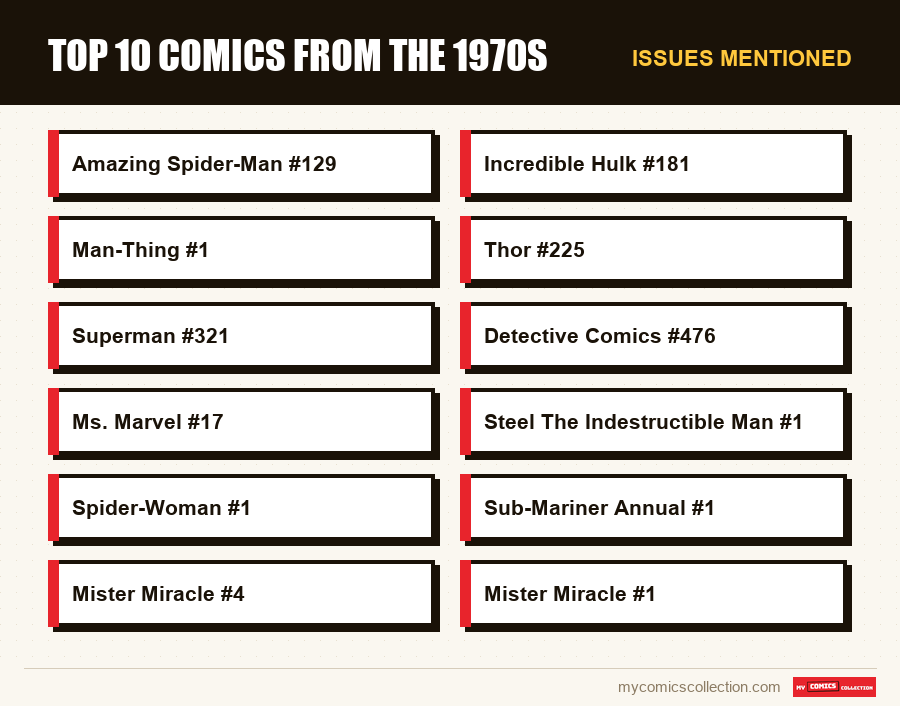
Amazing Spider-Man #129-$29,995.00
Copy rated 9.6, accompanied by a signature affixed under control. The announcement highlights the first appearance of Punisher. This is the absolute ceiling of the statement, all years combined, and it comes from a single seller.
Amazing Spider-Man #129-$19,999.99
Same number, same note 9.6, same signature, announcement wording identical to the character. Ten thousand dollars separate the two requests, however. No information visible in the advertisements explains this discrepancy.
Incredible Hulk #181-$4,395.00
Rated 7.5, featured for the first appearance of Wolverine. A second copy of the same issue, down to 4.5 with off-white pages, was listed for $2,699.99: two grades, two levels of demand.
Man-Thing #1-$1,375.00
Rated 9.8 with blank pages, the top of the condition scale. This amount closes the four-digit group for 1974; below that, we immediately fall below the thousand dollar mark.
The 1974 sequel establishes itself at levels beyond measure. A complete series of OMAC, eight numbers from #1 to #8, all checked in a range of 7.0 to 9.0, was listed at $560.00 for the set. A Thor #225 rated 9.0, flagged for Firelord's first appearance, was asking $489.95. Between the year's ceiling and these two lines, the ratio exceeds fifty to one: within the same vintage, on the same place of sale, on the same day.
The duplicate of Amazing Spider-Man #129 is the strongest lesson from this survey, and it is disappointing for anyone looking for a reference number. Two advertisements describe the same item in the same terms, with the same note and signature, and claim separate amounts of ten thousand dollars.
No available data allows us to decide which of the two is “the good one”. The conclusion to be drawn from this is not that a seller is wrong, but that an amount displayed in isolation is worthless until it is compared to other advertisements of the same item. A single number, no matter how precise it is down to the penny, is not an estimate.
Six observations that the survey allows
Two twin ads, ten thousand dollars apart
Identical wording, identical note, identical signature. The discrepancy is not justified by anything visible. This is the clearest demonstration that this statement has of what an isolated amount claimed is worth: nothing, as long as it is not compared.
Three years, not a decade
1971, 1974 and 1978 were sampled. The other seven vintages were not surveyed. Nothing written here can be extended to the entire 1970s without lying about the method.
The documented provenance
Un exemplaire de Superman #321 bears the indication of an identified collection, with a grade of 9.0. Another copy of the same issue, rated 9.4 without this mention, fetched $139.95 compared to $129.95. The two amounts are close.
Eight numbers for less than one
La série complète d'OMAC, eight issues all checked, was posted at $560.00. A unique Man-Thing #1 claimed $1,375.00 the same year. Completeness is not monetized like the rarity of an isolated number.
Five announcements for 1971
Such a thin workforce does not support any classification. The amounts recorded for this vintage describe five specific objects put up for sale that day, and absolutely nothing else. To draw a price level from it would be a misreading.
A variant born from a readership survey
Un Detective Comics #476 rated 8.5 is flagged as a reader survey variant, at $295.00. The particularity of printing is here the main argument of the ad, before the condition note.
1978: a ceiling thirty times lower than that of 1974
The year 1978 brought back 21 announcements, a number comparable to that of 1974, but an unrelated scale of amounts. The highest demand of the vintage is a Ms. Marvel #17 rated 9.8, featured for the first appearance of Mystique, at $349.22. The 1974 cap was $29,995.00. The ratio between the two exceeds eighty to one if we retain the top, and remains above thirty if we dismiss the highest ad as atypical and retain its twin at $19,999.99. In both cases, the order of magnitude changes in nature.
The rest of 1978 is held in a narrow band. A Steel The Indestructible Man #1 rated 9.8 was listed for $295.00, exactly at the same level as the Detective Comics #476 variant rated 8.5. Two copies of Superman #321 follow, at $139.95 for the 9.4 with white pages and $129.95 for the 9.0 from a documented collection. A Spider-Woman #1 rated 9.0 closes the list at $119.99. Between the first and last lines of the vintage, the ratio is less than three: where 1974 had a ratio of more than fifty within the same year.
This difference in dispersion deserves to be noted for its own sake, without being transformed into an explanation. In the advertisements seen that day, 1974 appears to be a year with a very strong internal hierarchy, drawn by two or three lines, while 1978 forms a compact group. We can describe this shape; we cannot deduce a rule on the decade, nor assert that it would recur on another statement date or another place of sale. To speak of the 1970s as a homogeneous block would, in the light of this single sample, make no sense.
A detail from 1978 deserves the attention of those who keep an inventory: two copies of the same number coexist there with crossed characteristics. One displays the best grade, the other the documented provenance, and their claimed amounts are only ten dollars apart. The two sellers therefore, each in their own way, valued a different attribute to achieve an almost equivalent result. This is a useful reminder: the status note is not the only field that weighs in the construction of an application.
Collecting this series?
Track what you own, what you are missing and what your collection is worth. 7 day trial.
Start my trial →1971: five announcements, and therefore no ranking
The 1971 vintage brought back only five ads meeting the criteria. It must be said frankly rather than covering up this void: such a number does not allow any conclusion on a price level. Five objects do not draw a market, they draw five offers, of which we do not know whether they have found a buyer. The following figures are given for the transparency of the statement, not to be classified.
On y trouve un Sub-Mariner Annual #1 rated 9.2 at $179.99, one Mister Miracle #4 rated 5.0 reported for a first appearance, that of Big Barda, at $125.00, a Mister Miracle #1 rated 7.5 with off-white pages at $120.00, and a New Gods #1 rated 4.0, also featured for a first appearance, at $82.99. The top and bottom of this handful of listings are separated by a ratio of just over two.
Three of these titles:OMAC côté 1974, Mister Miracle et New Gods side 1971: are associated with the same author, Jack Kirby. This is the only editorial commonality discernible in the sample, and it is not accompanied by any regularity in amount: these lines range from $82.99 for a low-rated copy to $560.00 for the complete eight-issue series. The signature of an author, in this statement, does not order anything.
The low numbers in 1971 may have several origins: a choice of keywords, the way sellers provide the year, the composition of the offering that day. None of these hypotheses is verifiable with the data in hand, and it would be dishonest to favor one. What we can say is limited to this: on this request, on this date, five advertisements were returned, and five advertisements did not rank.
Why the state note does not order the amounts on its own
A quick reading would suggest that a higher note corresponds to a higher amount. The statement contradicts it as soon as we cross-reference the vintages. A Man-Thing #1 rated 9.8, almost a maximum score, demanded $1,375.00; A Incredible Hulk #181 rated 4.5, a significantly more marked copy, fetched $2,699.99, almost double. The note therefore only prioritizes copies of the same number among themselves, never numbers that are different from each other.
Within the same issue, on the other hand, the relationship can be clearly read. The two copies of Incredible Hulk #181 offers the cleanest illustration of the statement: $4,395.00 for the 7.5, $2,699.99 for the 4.5. Three points difference on the status scale here corresponds to a third less demand. This report applies to these two specific announcements and does not constitute a scale; it simply shows which way the note is working. The mechanism is detailed in the guide dedicated to the relationship between rating and price.
A third factor further confuses the reading: the mention of a signature affixed under control, present on the two most expensive advertisements in the statement. It transforms a copy into a doubly attested object: the condition on one side, the authenticity of the signature on the other. But since the two advertisements carrying it display amounts separated by ten thousand dollars, this characteristic does not explain, on its own, the level requested. No single attribute is enough to predict a number.
Finally, two announcements in the survey do not relate to a single copy. The complete series of OMAC brings together eight fascicles in a single set, with a range of notes rather than a single note. Its $560.00 asking comes to $70.00 per controlled issue if divided mechanically, which places it below almost all individual lines from 1974. A lot sells by the lot, and direct comparison with an isolated copy is only meaningful if you say so.
What to note in your own inventory after this reading
Record the date of each amount you record. All of the above only applies to August 30, 2026. A number written down without its date becomes a timeless statement that no reading supports. In a collection sheet, the date of observation is as important as the number itself, because it alone will later allow two measurements to be compared and to note, or not, a movement.
Systematically distinguish between an amount requested and an amount obtained. The twenty lines of this statement are requests from sellers. None proves that a transaction took place at this level. If your inventory mixes displayed prices and concluded prices in the same field, it will automatically produce an inflated estimate, and you will no longer know, six months later, which line is based on which.
Note the number of announcements that were used to form your idea of a level. Twenty-seven announcements for 1974 and five for 1971 do not read the same way. A sheet that says “around $120, seen in 5 ads” can be read without error; a form that simply says “$120” will be taken as a certainty after a few months. The workforce is part of the information.
Record the attributes that accompany the grade, not just the grade. Controlled signature, documented provenance, variant linked to a readership survey, color of the pages: each of these elements appears in the announcements of the statement and each changes the comparability of two copies of the same issue. An inventory that only records the number of the note loses exactly what explains the differences between neighboring lines.
Treat batches and complete series as separate entries. The line OMAC #1-8 is not comparable to any individual line in the statement. If you have a complete set, note it as a set and note the condition of each issue separately: the day you want to compare your lot to an ad, you will need both levels of information, and piecing together the detail after the fact is much more time-consuming than entering it once.
No, and that is not its purpose. The only sorting criterion is the amount displayed by a seller on August 30, 2026. The site also publishes a qualitative ranking of the decade, organized in levels, which answers a completely different question. A booklet can occupy the top of this list and a modest place in the other, without there being the slightest contradiction: the two do not measure the same thing.
The information available does not allow us to know this. The two labels describe the same number, the same note and the same controlled signature, and nothing in the advertisements distinguishes the two copies. We can only learn the lesson of method: an amount displayed in isolation is not an estimate, and two sellers can aim for very different levels for an object described in the same terms.
It indicates that the issue is linked to an identified and traced collection, which adds original information to the status information. In this statement, a copy of Superman #321 bearing this designation with a rating of 9.0 was displayed at an amount very close to another copy rated 9.4 without it. On these two advertisements, the provenance attribute therefore seems to compensate for the difference in rating, but two lines are not enough to make it a rule.
No. Only five announcements were made for this vintage. Such a low number describes the five items put up for sale that day and nothing more. No price level, no average, no ranking can be honestly drawn from this. The figures are published to keep the method verifiable, not to serve as a reference.
Within the same number, the relationship is verified on this statement: a Incredible Hulk #181 rated 7.5 demanded more than the same number rated 4.5. From one issue to another, on the other hand, it disappears completely: a copy rated 9.8 of a title required less than half of a copy rated 4.5 of another title from the same year. The note prioritizes comparable examples, never different references.
Keep track of your own statements, complete with date
An amount without date or actual amount turns into a belief after a few months. My Comics Collection allows you to record each issue, its condition, its particularities and the observations you make yourself, to later find out what your idea of a level was based on.