This ranking does not evaluate any story: it orders booklets from the 2010s by the amount that sellers displayed for them, on August 30, 2026, on a general auction site in the American market, in dollars and on copies accompanied by independent verification. The highest price reached $599.99, for an alternative cover printed in one copy for twenty-five. These amounts are claimed by sellers, not collected at the end of a sale. And the survey only covers one sampled year, 2014, which only brought back twenty-five announcements: that's too few to talk about the decade.
There already exists, on this site, a ranking of comics from the 2010s which judges the series and ranks them by quality levels. The one you are reading does no such thing. It does not say what is worth reading, it does not designate any artistic peak, it does not recommend any purchase as an investment. He is content with a much more modest and much more verifiable operation: looking at what sellers were asking, on a specific day, for booklets published during that decade, then ordering these requests from highest to lowest. A displayed amount is neither an estimate, nor a rating, nor a judgment. This is a sales intention.
This distinction changes everything that follows. When a seller lists $599.99 on an ad, they are expressing what they hope to get; there is no evidence that a buyer followed him. An isolated amount, at the top of a short list, first describes the optimism of the person who entered it. This is why this text systematically speaks of amounts claimed, never of prices recorded, and why it refuses to announce the slightest development: a statement taken on a single date does not show any movement, it shows a state. Comparing today to yesterday would require two measurements, and we only have one.
How this statement was constructed, and what it does not allow us to say
The statement dates from August 30, 2026. It relates to a general auction site, on the American market side, and all amounts are expressed in dollars. The advertisements selected concern copies accompanied by verification by an independent organization, that is to say, fascicles sealed and noted by a third party rather than described by the seller himself. This restriction is voluntary: it makes the announcements comparable to each other, since the same state vocabulary applies to all.
The biggest limitation is the sample size. Only one year of the decade was queried, 2014, and the query returned twenty-five ads in total. Twenty-five, for an entire year of worldwide publication, is nothing statistically solid. Six of them stand out by their amount and form the classification below; the others remain below and do not provide additional information at the top of the list. In other words, this text describes what was happening on that day in that marketplace, for that year. It doesn't describe the 2010s.
This caution is not a rhetorical ornament. Such a low headcount means that a single ad removed or added would move the top of the rankings. If a particularly ambitious seller had posted their ad on August 31st rather than the 30th, the first amount on this list would be different. A classification built on six lines is a photograph taken with a very narrow lens: sharp in the center, silent throughout the rest of the frame.
Finally, none of these amounts say what a copy is worth. He says what we ask. The difference between the two is exactly the space in which a negotiation plays out, and that space appears nowhere in the public data of a current announcement.
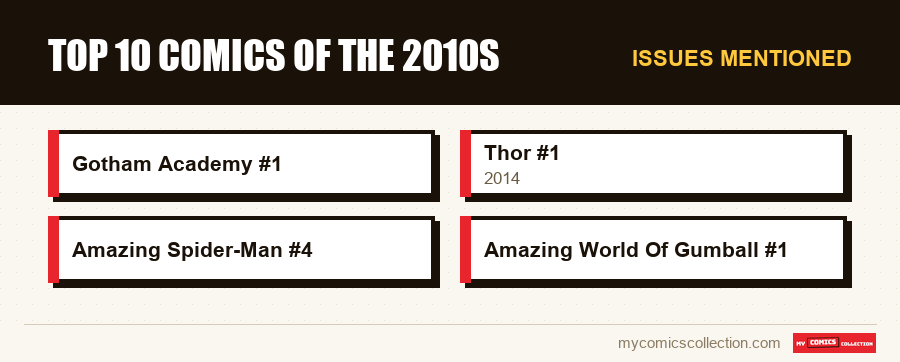
The ranking of August 30, 2026: the six highest amounts
$599.99: Gotham Academy #1, alternate cover
At the top of the list, a first issue from 2014 published by DC Comics, presented as a first appearance and especially as an alternative cover printed at the rate of one copy for twenty-five. Verified copy, rated 9.8. The amount requested clearly distinguishes it from the following, but it is based on a single announcement.
$499.00: Thor #1 (2014)
A first issue from 2014 whose announcement highlights a first appearance linked to the character of Jane Foster. Verified copy, rated 9.8. One hundred dollars separate this request from the previous one, on a list where only six lines range between 250 and 600 dollars.
$449.99: Amazing Spider-Man #4, third series
A number 4 announced as the first appearance of Silk, with a decisive mention: “3rd series”. The seller thus indicates that this is a third volume bearing the same title. Verified copy, rated 9.8. Without this precision, the number would be impossible to locate.
$299.99: Amazing World Of Gumball #1
A first issue of 2014 published by kaboom!, presented with a notice of limited edition of one copy for ten. Verified copy, rated 9.8. Its presence at the top of the list shows that the list is not limited to the two major superhero publishers.
Two announcements complete the list. At $253.90, a first issue of Iron Fist: The Living Weapon dated 2014, announced as the first appearance of the character of Pei, with the particularity of having been verified by an organization different from that which appears on the other announcements, and also rated 9.8. At $250.00, a first issue of All New Ghost Rider from 2014, billed as the first appearance of Robbie Reyes, in an alternate cover version: it's the only one of the six ads not rated 9.8.
Six ads don't make a deal. They are neither sufficient to establish a price level for the year 2014, nor to situate the 2010s in relation to other decades. Everything that follows is a reading of structure: what these six lines have in common, and what this regularity suggests about how an example from this period is described and researched.
None of the comments below should be read as purchasing advice. A booklet displayed at a certain amount is not necessarily a good that can be resold, and this site does not tell anyone what to buy.
When the score stops deciding
Five out of six ads carry the same rating: 9.8. This is the most striking fact of the survey, and it is not anecdotal. On recent fascicles, printed in large numbers, preserved from the outset by readers who already knew what they were doing, the exceptional condition is not rare. It is even expected. A very high-grade 2014 copy is not an improbable survival; it involves the careful storage of a twelve-year-old object.
The consequence is mechanical. When almost the entire top of a market shares a single state, the grade no longer sorts anything. It becomes an entry ticket: without it we do not appear in this part of the list, but with it we are not distinguished from anyone. The classification must then be played out elsewhere, and the survey shows precisely where: on the version of the cover, on the announced print run, on the appearance highlighted in the title of the ad.
This operation is very different from that of ancient periods, where a high note is in itself a rare event and is enough to create the gap between two copies of the same number. In the 2010s, rarity no longer comes from conservation. It comes from manufacturing: from what the publisher has decided to print in limited quantities.
For a collector, this shifts the work. Checking the condition remains necessary, but is no longer enough to understand why two apparently identical copies are displayed at distant amounts. The explanatory detail is almost always found in the cover note. The relationship between note and amount is developed in the rating and grade guide.
Alternative coverage becomes the main feature
Three out of six ads explicitly mention an alternative limited edition cover. Two of them specify a ratio: one copy for twenty-five in one case, one copy for ten in the other. These ratios describe a conditionally printed quantity, proportional to the orders placed on the current version. They create an internal hierarchy within the same number.
This is the point that most clearly distinguishes this decade from previous ones. Historically, the identity of a booklet lay in its title and its number: these two elements were enough to designate the object without ambiguity. In the 2010s, this is no longer enough. The same title, the same number, the same date can cover several distinct objects, the only difference of which is the image printed on the first page and the number of copies produced with it.
In the report, first place does not go to the most commented number nor to the best known character: it goes to the one whose ad displays the most restrictive ratio. The version of the cover therefore became, for this period, the primary characteristic of a copy, more than its number. A collector who notes his acquisitions without recording this information loses the element that truly identifies what he owns.
This requirement comes at a practical cost. It is necessary to record, for each copy, the cover version and the ratio announced, in the same way as we record the title and number. Without it, a 2010s collection quickly becomes impossible to describe to a third party, and impossible to compare to an online ad. There method of estimating a precise specimen begins with this identification step.
The trap of series that start again at number 1
One of the six advertisements is marked “3rd series”. The seller did not add it out of overzealousness: without it, a buyer would not know which number 4 they were talking about. A third volume bearing the same title starts its numbering again at 1, so that its number 4 has nothing to do with number 4 of the volumes which preceded it: neither by its date, nor by its content, nor by what occurs there.
This is the difficulty of identification specific to this period. Numbering updates are frequent, and a popular title can have several successive volumes in a few years. The consequence is immediate for those who keep an inventory: a “title + number” pair no longer constitutes a reliable key. The year of publication and the volume must be added, otherwise two different objects end up recorded in the same place.
The problem spreads to search. Querying a marketplace for a title and a number brings up copies belonging to different volumes, the amounts of which have no reason to be comparable. An amount claimed on the number of one volume says nothing about the homonymous number of another volume, and believing otherwise leads to false estimates in both directions.
The markers of a long series remain useful for navigating between these volumes: the selection of numéros marquants d'Amazing Spider-Man helps to situate the eras in relation to each other, just like the character sheets of Spider-Man, de Thor ou de Ghost Rider, which collect appearances without relying on unique numbering. Following a creator rather than a title is another way to get around the obstacle: a page like that of Jason Aaron brings together publications that numbering alone would disperse.
Collecting this series?
Track what you own, what you are missing and what your collection is worth. 7 day trial.
Start my trial →Six concrete difficulties in cataloging a booklet from this decade
The grade is no longer enough
Five out of six ads show 9.8. Searching for “the best available condition” hardly narrows the field over this period: a second criterion is needed to distinguish two examples.
L'année devient obligatoire
Without the year of publication, an issue is not linked to any volume. The six announcements in the survey all mention it explicitly, and this is no accident of wording.
The cover version must be recorded
Three out of six ads are based on it. An inventory sheet that does not provide this field loses the information that explains the difference between two copies of the same number.
The draft ratio is a data in itself
One copy for twenty-five and one copy for ten do not describe the same thing. The announced ratio is noted as is, without interpreting or rounding it.
Les numérotations recommencent
An announcement of the statement specifies “3rd series”. The same title can have several volumes, and their numbers overlap without having the slightest connection between them.
Verification scales differ
One copy of the statement was verified by a different organization than the others. Several organisms coexist and their scales do not mechanically overlap.
What $599.99 Means Next to Old Decades
On the same day, on the same market place and according to the same protocol, the peak recorded for the year 1963 approached thirty-three thousand dollars, and that of the year 1974 almost thirty thousand. The high of our 2014 sample is $599.99. The difference is not in degree, it is in nature: approximately fifty times between the high of 2014 and the high of 1963, always in amounts claimed and not in sales concluded.
This contrast is explained without mystery by the above. In ancient periods, rarity comes from destruction: very few examples have survived, even fewer in good condition, and this shortage is directly reflected in the amounts displayed. In the 2010s, very high grade copies are abundant, and the rarity must be organized in printing to exist. A scarcity decided by a circulation ratio does not produce the same orders of magnitude as a scarcity produced by sixty years of losses.
We must resist the temptation to draw a prediction from this. Nothing in these three figures says that a 2014 issue will one day reach the level of a 1963 issue, nor that it will remain far from it. These are three measurements taken on the same day, in three places in a catalog; they describe a present gap, not a trajectory. Asserting a direction would require repeated measurements over time, which we do not have.
What the comparison provides, on the other hand, is an order of magnitude useful for getting your bearings. She indicates that a copy from the 2010s priced at several hundred dollars occupies, in its own segment, a position comparable to that of an old copy priced at several tens of thousands. The top of a list is always read in relation to the other lines of this list, never in absolute terms.
What to Note in a 2010s Collection
Record the cover version before anything else. Over this decade, it is she who identifies the object. Three of the six announcements in the survey explicitly mention it, and first place in the ranking goes to the one with the most restrictive ratio. A file which only retains the title and number describes an object which does not really exist, since several distinct examples are hidden behind the same designation.
Record the draw ratio as advertised. One copy for twenty-five and one copy for ten are two different pieces of information that should neither be converted nor summarized in a single word. These ratios appear in ads because they are the seller's main argument; copying them without interpreting them allows you to later find the exact object in a search engine.
Always add the year and volume to the number. The mention “3rd series” noted on a classification announcement is enough to remind us that number 4 of one volume has nothing in common with number 4 of another. Without a year or volume, an inventory from the 2010s mixes unrelated objects and makes any comparison of amounts misleading.
Note the verifying body, not just the rating. One of the six announcements comes from a different organization than the others. As the scales do not mechanically overlap from one organism to another, a note deprived of its source loses part of its meaning. Recording the two together avoids later comparing two figures that were not produced in the same way.
Date each amount you note. The six amounts in this article are valid for August 30, 2026 and nothing else. An amount without a date becomes unusable after a few months, because no one knows whether it described a state of the market or an isolated announcement. Writing the date next to the number is the gesture that distinguishes an observation from a rumor.
No, and he doesn't try to say it. It arranges six issues according to the amount that a seller displayed for them on August 30, 2026. No story is evaluated, no series is recommended. A qualitative ranking of the 2010s also exists on this site, in the form of levels; it answers another question and does not use the same criteria.
Because only one year was questioned during the survey, and it only brought back twenty-five advertisements. Extending these six lines to ten years of publication would be an unfounded extrapolation. The title announces the decade, but the measurement concerns a narrow sample, and this limit is written rather than hidden.
Nothing guarantees it. A current listing indicates what a seller hopes to get, not what a buyer has agreed to pay. Until the deal closes, the figure remains a ask. This is especially true of the highest amount on a shortlist, which often reflects the ambition of a single seller.
Because the fascicles from this period are recent and have been preserved since their publication by readers attentive to their condition. The very top of the scale is common there, while it remains exceptional in older decades. The rating therefore becomes a condition for entry into the top of the market rather than an element of distinction.
The information cannot be deduced from the number: it appears in the description of the edition, in the form of a cover note and, where applicable, a print run ratio. Compare the image of your copy to the different versions listed for this issue and this year, then record the exact mention in your file rather than an approximate description.
Keep track of exactly what you own
Cover version, circulation ratio, year, volume, verification body: in the 2010s, these are the five fields that identify a copy, and a handwritten list loses them very quickly. My Comics Collection saves them for each issue and allows you to find the exact item when comparing it to an ad.