On August 30, 2026, on a general auction site in the American market, the issues from the 1950s displayed at the highest rose to $30,000.00 for a copy announced as the only known verified one, then $24,995.00 for Detective Comics #225 and $16,400.00 for Batman #92. These figures are amounts claimed by sellers that day, in dollars, not completed transactions. The survey only covers two sampled years, 1955 and 1957: it describes a display state, not a decade's worth.
This ranking does not evaluate anything. He does not say which issues from the 1950s are worth reading, nor which ones have marked the history of the medium, nor which ones would be wise to acquire. It measures only one thing, and this limit must be set before the first line of the table: the amount a seller lists on their ad on a given day. Nothing more. An asking price is a unilateral proposal, formulated without contradiction, that no one has yet accepted at the time the statement is taken. It reflects an expectation, sometimes a hope, sometimes a display strategy intended to serve as an anchor point for a negotiation. It never translates, on its own, what the market is really willing to pay.
This precaution is not rhetorical. It completely changes the way of reading the fourteen lines that follow. When two advertisements relating to the same issue, in the same certified condition, one asks for more than twice as much as the other, it is not the market which hesitates: it is two sellers who do not have the same idea of what their copy is worth. A statement of asking prices captures this dispersion. It is even its only real wealth, and this is what no qualitative classification or investment article shows. Finally, a measurement taken on a single date shows no evolution: there is no increase, no decrease, no trend here, since there is only one point in time.
How this statement was compiled, and what it does not cover
The survey was carried out on August 30, 2026 on a general auction site, that is to say a platform open to all sellers and not a specialized house catalog. The scope is the American market and all amounts are expressed in dollars; no conversion has been applied, and no additional fees are included. Unless otherwise stated in the wording of the advertisement, the copies listed have been submitted to an independent verification organization and carry a rating assigned by this third party. This precision matters: a verified copy and a copy described by its sole seller do not compare, and mixing them would produce a meaningless classification.
Only two years were retained: 1955, which reported 973 advertisements for the query used, and 1957, which reported 660. This is not a census of the decade. Eight out of ten vintages are absent. A 1953 or 1959 issue priced higher than anything listed below may exist, and this survey would be unable to see it. We must therefore read this classification for what it is: two cross-sections, taken on the same day, in a stock of online advertisements. They faithfully describe what was on offer at that moment in these two vintages, and nothing beyond.
The numbers, on the other hand, are sufficient for the reading to make sense. Nearly a thousand announcements in 1955, six hundred and sixty in 1957: we are not in the case of a handful of isolated proposals where the top of the ranking would only reflect an individual eccentricity. The highest amounts sit alongside dozens of much more modest announcements, and it is precisely because the base is large that the differences observed at the top become instructive.
The top of the rankings, year by year
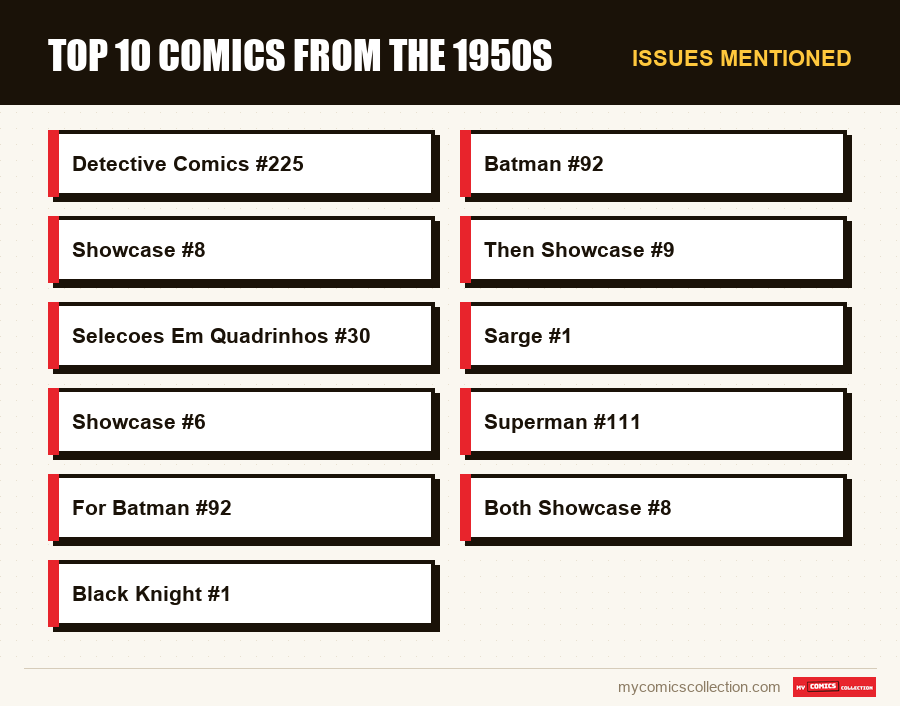
In 1955, the lead is occupied by an advertisement for $30,000.00: a booklet entitled Monster Picture Story Godzilla, without printed number, rated 3.5 by a verification body, whose wording explicitly claims the status of the only known verified copy. Next comes Detective Comics #225 at $24,995.00, rated 6.5, touted as containing the origin and first appearance of J'onn J'onzz, the Martian Hound. Third position for Batman #92 at $16,400.00, rated 8.5, advertised for the first appearance of Bat-Hound. Fourth position, and this is where the reading becomes really interesting: again Detective Comics #225, again rated 6.5, but from another seller, at $10,975.00. There follow three lines devoted to Black Knight: a five-issue set from 1955 shown as first appearance, published in the United Kingdom by L. Miller, at $9,900.00; #1 rated 6.5 at $6,849.99, described as rare in high condition; and the same #1 rated 3.5, in the British edition, at $6,767.65.
In 1957, the peak returned to Showcase #8 rated 8.0, advertised as the second appearance of the Silver Age Flash, at $10,800.00. Then Showcase #9 rated 7.5 at $7,650.00, presented as an essay issue dedicated to Lois Lane. Third, a surprise: Selecoes Em Quadrinhos #30, Brazilian edition featuring a Ghost Rider character, rated 6.0, at $7,500.00. Fourth, Showcase #8 again, same rating of 8.0, but with “restored” in the wording, at $6,000.00. Next Sad Sack and the Sarge #1 rated 9.4 at $4,850.00, Showcase #6 rated 6.5 announced for the first appearance and origin of Challengers of the Unknown at $4,650.00, and Superman #111 rated 9.2 at $4,500.00, shown as second highest condition.
Four observations that this survey allows us to make
The same number, the same note, from single to double
Two copies of Detective Comics #225, both rated 6.5 by a verification agency, are claimed $24,995.00 and $10,975.00. The gap is more than double. No information visible in the advertisements allows us to decide: neither the note, nor the year, nor the number differ. This is the most useful observation in the survey, because it demonstrates that an asking price is not a property of the object.
The restoration can be read in the wording, and not elsewhere
Showcase #8 rated 8.0 is claimed $10,800.00 in one case and $6,000.00 in the other. The second label says “restored”. This is the only variable that changes between the two lines. The figure in the note, taken in isolation, is therefore never enough to compare two copies: you must read the entire certified statement.
A foreign edition in seventh place
A Brazilian fascicle appears prominently in the 1957 statement, at $7,500.00. Editions published outside the United States do not remain confined to a local market: they reach the high end of the American market. The 1955 statement confirms this with three lines relating to British editions.
First appearances, not followed series
Origin of the Martian Hound, first appearance of Bat-Hound, first appearance of Challengers of the Unknown, trial numbers, second appearance of a character: the ranking is almost entirely made up of one-off events. No issue appears there for its belonging to a regular long-term series.
To these four observations is added a reservation, and it deserves to be formulated bluntly. The announcement which dominates the 1955 survey claims the status of the only known verified copy. This statement cannot be checked from an advertisement page: it concerns what exists elsewhere, with other holders, in registers that the buyer does not consult at the time he reads the wording. This is not to question the good faith of the seller, who may have solid elements. It is a matter of noting that an assertion of absolute rarity is, by construction, unverifiable at this level, and that it nevertheless constitutes the main argument justifying the difference of $5,000.00 with the second line of the classification.
A third year had been questioned and had to be excluded. The request for 1952 brought up 16,773 advertisements, a number out of proportion to the other two. Upon examination, the most expensive proposals had nothing to do with the decade: a 1940 issue bearing the number 52, a 1966 issue also bearing the number 52. The search engine had simply confused the year requested with the issue number, and repatriated everything that contained the string "52" somewhere.
This failure is reported here because it is what guarantees the cleanliness of the other two vintages. The 1955 and 1957 requests did not present this confusion: their numbers, 973 and 660, remain in a consistent order of magnitude, and the wordings retained all mention the year in the body of the announcement. A statement that no one has tried to break is worthless; this one was broken once, over a year, and this year was removed.
Six reading pitfalls specific to this type of reading
Get the most for the price
The highest line in a ranking is, by definition, the one that no other validates. The $30,000.00 lead is not confirmed by any second comparable announcement in the statement. An isolated top documents a seller's expectation, not a market level.
Read an evolution in a photograph
All these amounts were recorded on the same day. It is physically impossible to see a progression or a regression, since there is no previous point of comparison. Any phrase like “it’s going up” would be made up out of nothing.
Compare two notes without reading the full notice
Two examples rated 8.0 may fall into two different categories if one is marked as restored. The number alone is ambiguous; the entire label is valid, as shown by the difference of $4,800.00 between the two Showcase #8.
Align a batch to a single copy
One of the 1955 lines is for five issues sold together, at $9,900.00. This amount cannot be compared to neighboring lines, which concern a single issue. A set and an isolated part relate to two distinct display logics.
Confusing year and number
This is exactly what disqualified the 1952 request. A general search engine does not always know how to distinguish a vintage from an issue number. Always check that the year is in the body of the ad and not just in your query.
Assume only one edition per title
Several lines relate to British editions, another to a Brazilian edition. The same title can exist in several forms depending on the territory, with very different asking prices. The country of publication is part of the identity of the object.
Why the gap on Detective Comics #225 is the focal point
We must focus on this pair, because it contradicts a very widespread intuition. Many collectors reason as if the grade awarded by an independent organization settled the question of price: equal grade, equal price, or at least similar prices. The statement from August 30, 2026 shows the opposite in the clearest possible manner. Two copies of the same number, in the same certified condition, are claimed for $24,995.00 and $10,975.00. The first requires more than double the second. The note here did not bring the two announcements together: it left them more than fourteen thousand dollars apart.
What this discrepancy means cannot be deduced from the reading, and the temptation to explain it must be resisted. Real differences perhaps exist between the two objects: centering, gloss of the cover, history of the copy, sub-statements on the label. They can also be non-existent, and the difference can only be down to two sellers who have neither the same urgency, nor the same knowledge of the market, nor the same negotiation strategy. Neither hypothesis is verified from a list of announcements. The only defensible conclusion is negative: for the same score, the asking price is not determined.
This conclusion has an immediate practical consequence. If you look at just one ad to get an idea of what a 1950s booklet you own is worth, you have a 50/50 chance of coming across one asking twice as much as the other. The procedure to follow therefore consists of identifying several proposals relating to the same number and the same note before forming an opinion, exactly as described in the method of estimating a precise fascicle. A single line never constitutes a reference.
The reasoning extends to all other lines of the ranking. For Batman #92 as for Superman #111, the statement contains only one ad. So we don't know if these amounts are high, low or median compared to what other sellers were asking for on the same day. Where the statement contains two comparable lines, it reveals a considerable discrepancy; where it contains only one, prudence requires us to consider that the same gap could exist without us seeing it.
Collecting this series?
Track what you own, what you are missing and what your collection is worth. 7 day trial.
Start my trial →What the restoration changes in a wording
The second pair of the statement is more readable than the first, and that is precisely what makes it useful. Both Showcase #8 share the title, number, year, and rating of 8.0. Only one thing separates them in the wording: one is announced as restored, the other not. The amounts claimed are $6,000.00 and $10,800.00 respectively. Unlike the previous case, the variable is identified and appears in black and white in the text of the ad.
However, this difference should not be transformed into a numerical rule. Two advertisements do not establish a ratio, and there is nothing to confirm that a restored copy systematically claims a given level compared to an intact copy of the same grade. What the survey establishes is that an informed seller positions a restored example clearly below, and advertises it openly. The mention was not hidden: it appeared in the very title of the ad.
For a collector, the lesson is method. The numerical note circulates easily: it fits in three characters, it can be copied into a spreadsheet, it can be read at a glance. The qualitative statement that accompanies it circulates much less well, and it is this which carries the decisive information. Recording “8.0” without recording “restored” means keeping half the information, and the more expensive half. The relationship between the certified state and the displayed amount is developed in the guide dedicated to rating and price.
Characters that have become references, and little-expected supports
The composition of the ranking deserves a word. Of the fourteen lines retained, the majority is based on an event of the first appearance or presentation of a character. Detective Comics #225 is announced for the origin of the Martian Hound, Batman #92 for Bat-Hound's inaugural appearance, Showcase #6 for Challengers of the Unknown, Black Knight #1 for that of the title character. Two issues of the series Showcase are listed for trial or repeat roles. It is not the regularity of a publication that carries these amounts, it is the punctual nature of what it contains.
Two emblematic titles also structure this statement on both sides. Papers related to Batman occupy two of the first four places in 1955, between Detective Comics and the homonymous series; those related to Superman appeared in 1957 with #111 and, indirectly, with the essay issue dedicated to Lois Lane. The third pillar of the 1957 survey is Flash, whose second appearance in Showcase #8 dominates the vintage. To situate the editorial trajectory of the first of these titles on the scale of decades, our look back at the history of Batman comics places these fascicles in their chronological sequence, and the sheet devoted to Bob Kane brings together the publications linked to this author in the catalog.
Alongside these expected names, the survey reveals objects of a completely different nature. A booklet devoted to Godzilla, without a printed number, took first place in 1955. A Brazilian edition rose to third place in 1957. Sad Sack and the Sarge #1, rated 9.4, appears in fifth position of the same vintage, on a humorous register very far from the costume series. A classification by amount claimed does not sort by notoriety: it brings up everything that sellers position high, including titles that an overview of the decade would not mention.
This heterogeneity is one more argument against qualitative reading. The statement does not say that these issues are the most important of the 1950s. It says that they were, on August 30, 2026, those for which sellers asked the most. These are two completely different claims, and only the second is documented here.
What to note and record after this reading
Note the full certified statement, not just the numerical score. The $4,800.00 gap between the two Showcase #8 is entirely due to a word present in one wording and absent from the other. In your file, the “condition” line must contain the note and all the qualifications that accompany it, restoration included. A copy registered under the single number “8.0” will become incomparable as soon as you want to compare your copy to an ad.
Record the country of edition for each issue from the 1950s. Three lines from 1955 relate to British editions and one line from 1957 to a Brazilian edition. Over this decade, the same title can correspond to several distinct objects depending on the territory of publication. A form which only records the title and number will lose this distinction, although it weighs on the amount claimed.
Record the date on which you recorded an amount, systematically. All the numbers in this article have a single date, August 30, 2026, and that date is what makes them interpretable. An amount noted without a date loses all usefulness in six months: you will no longer know if it describes the state of the market at the time you saw it or an approximate memory. The date is part of the data.
Find several advertisements for the same number before retaining an amount. La paire Detective Comics #225 demonstrates that an isolated ad can charge more than twice as much as another with the same rating. If your form only contains one reference amount, there is a significant chance of having chosen the extreme rather than the center. Two or three readings are infinitely better than one, and it is useful to note the range between them.
Mark rarity claims as assertions, not facts. The lead announcement claims the status of the only known verified copy. This notice is a seller's declaration, and your listing must retain it as such, with its source, rather than recording it at the same rank as a number or note. Unverifiable data placed among the verified data contaminates the entire rest of the form.
No, and he doesn't claim it. It lists the amounts claimed by sellers on August 30, 2026 on a general auction site on the American market. An amount requested is not an amount received: none of the lines cited correspond to a concluded transaction. To approximate a value, these requests would have to be compared to what buyers actually agree to pay, which this statement does not measure.
Because the survey proceeds through annual queries and only two of them produced usable results: 1955, with 973 advertisements, and 1957, with 660. A third query for 1952 was rejected, its engine confusing the year with the issue number. Eight vintages from the decade are therefore not covered, and a more expensive booklet could very well be there without appearing here.
The announcements do not allow you to know this. The two copies bear the same number, the same year and the same grade of 6.5, and are asked for $24,995.00 and $10,975.00. Material differences may exist without being visible in the wording, but the difference may just as well be due to the respective strategies of the two sellers. In the absence of any element allowing a decision to be made, the only honest reading is to note the dispersion without explaining it.
The reading shows that yes, at least in display. A Brazilian edition featuring a Ghost Rider character, rated 6.0, ranks third for 1957 at $7,500.00, ahead of several American titles of the same vintage. In 1955, three lines concern British editions of Black Knight. The publication territory therefore does not confine a booklet to a local market.
It must be treated as an assertion to be confirmed, without making it a trial of intention. A seller can have serious elements to write it. But a declaration relating to what does not exist elsewhere cannot be checked from the announcement page itself: it requires consulting external registers. As long as this verification is not made, the mention remains a commercial argument and not an established characteristic of the object.
Keep track of your statements, not just your fascicles
Complete note, country of edition, amount recorded and date of statement: these four pieces of information transform a collection into a comparable basis. My Comics Collection records them for each copy and allows you to find, six months later, what you noticed and when.