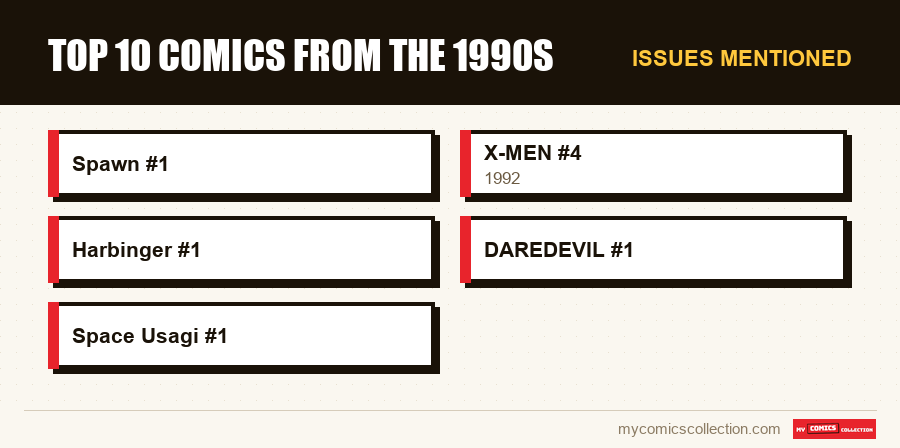
The highest amount claimed for a 1990s comic, as of August 30, 2026, is $1,195.00 for a copy of "Spawn #1 CGC 9.8 Image 1992 1st Appearance!" Newsstand! ". Followed by $1,083.03 for “X-MEN #4 (1992) ** 1ST APPEARANCE OMEGA RED ** CGC 9.8 WHITE PAGES ** NEWSSTAND”, then $945.00 for “Harbinger #1 CGC 9.8 Valiant 1992 RARE 1st Appearance! ". These are prices displayed by sellers on a general auction site for the American market, not completed transactions. Two other listings for the same Spawn #1, at the same rating and with the same channel mention, are asking $895.00 and $835.00: thirty percent difference between the top and bottom of an identical trio.
This article is a ranking, and nothing else. He lines up the amounts claimed on a given day, for specific copies, and he stops there. You will find no purchase or resale recommendations, no answer to the question of whether comics from the 1990s are "still worth anything", and no method for valuing an issue you might have at home. These three subjects exist elsewhere on this site and they call for reasoning different from mine. Here, we look at price tags, put them in order, and describe what their alignment shows. The limit is voluntary: a table of requested amounts is already difficult information to obtain properly, and mixing it with advice would make it less readable, not more useful.
The second thing to ask right away is that this survey does not cover the entire decade. I sampled two vintages, 1992 and 1996, chosen to frame the period without claiming to represent it. A complete census from the 1990s would require ten queries, deduplication work ad by ad and constant attention to incorrectly entered titles. This is not what was done. The following describes two showcase days over two vintages, with the exact figures I read, and the precautions that go with them.
How these amounts were raised
The reading was carried out on August 30, 2026 on a general auction site, on the American market side, in dollars. Two queries were launched, one for 1992, the other for 1996, and the results were sorted by decreasing amount. All selected copies are accompanied by a rating given by an independent verification body: the booklet is encapsulated, its condition is determined by a third party, and the seller cannot therefore describe the object as he wishes. This constraint is the only reason why these amounts are comparable to each other. A raw copy, described by its owner, would not have its place in the same painting.
The next point is the most important in the entire article, and I'd rather write it twice than once. These figures are claimed amounts. These are requests from sellers, displayed at a specific time, for items still available. None are the result of a completed transaction. A seller can ask for whatever he wants; no one is forcing him to find a buyer. A high amount therefore tells what an individual hopes to get, and not what a buyer has agreed to pay. To confuse the two is to mistake a person's ambition for market data.
Second precaution: a reading taken on a single date does not describe any evolution. I don't have any measurements from the day before, nor from the previous month, nor from last year. I can therefore neither say that these amounts are rising, nor that they are falling, nor that they are stagnating: these three statements would require at least two photographs taken at different times. All I have is a single photograph. If you read elsewhere that an isolated figure “proves” a trend, the demonstration is missing half of its elements.
Third precaution, specific to the way the queries work: the year typed in the search is searched in the text of the advertisements, not in a bibliographic database. A seller who writes “1992” in his title for some reason moves up in the results, even if his booklet is dated elsewhere. This is exactly what happened, and the next paragraph is devoted to it.
1992: five ads at the top, and the same issue three times
$1,195.00: Spawn #1, rating 9.8
Advertisement titled « Spawn #1 CGC 9.8 Image 1992 1st Appearance! Newsstand! ». This is the highest amount requested for an issue actually belonging to the decade, in this statement. The title claims both current maximum rating, first appearance and distribution channel.
1 083,03 $: X-Men #4, note 9.8
Advertisement titled "X-MEN #4 (1992) ** 1ST APPEARANCE OMEGA RED ** CGC 9.8 WHITE PAGES ** NEWSSTAND". The amount is fixed to the nearest cent, which distinguishes this ad from the others, all rounded. It combines the same arguments: high note, first appearance, channel, plus a mention on the color of the pages.
$945.00: Harbinger #1, rating 9.8
Listing titled "Harbinger #1 CGC 9.8 Valiant 1992 RARE 1st Appearance!" ". Third position in the survey, and the only publisher in the top trio not to be among the two houses best known to the general public. The word “rare” is used there by the seller, not by a counting source.
$895.00 and $835.00: again Spawn #1
Two other announcements repeat word for word the wording of the first: same number, same note, same mention of channel. They are asking $300 and $360 less. Between them, they occupy three of the five top places in the 1992 ranking.
The query for 1992 returned 117 ads in total. This is a comfortable number: out of a hundred proposals, the top of the table is not the result of a coincidence of display, and the repetition of the same booklet in three separate copies is not an artifact of failed duplication: these are indeed three different sellers each offering their object. This abundance is precisely what makes the gap interesting. On a rare booklet, three different prices could be explained by the absence of a common reference. Here, the object is everywhere, its grade is standardized, and the three sellers should converge. They do not converge.
Three ads, one and the same number, one and the same note, the same mention of distribution channel in the title: $1,195.00, $895.00, $835.00. Thirty percent separate the most greedy from the most modest, for an object that nothing distinguishes in the description.
This is the central observation of this survey. On an abundant booklet, perfectly identified and whose condition has been determined by a third party, the amount requested remains a personal opinion. The displayed price is not a property of the item; it's a seller's decision, and three sellers make three different decisions on the same day.
The 1964 booklet which had nothing to do there
Topping the results for 1992 was a $9,500.00 ad, titled "DAREDEVIL #1 CGC 8.0 (1st APPEARANCE/ORIGIN) MAJOR KEY SILVER AGE." It dwarfed everything else by a factor of eight. It does not belong to the decade: the booklet dates from 1964. I left it out of the classification.
This kind of intruder happens because the search scans the text of the ads. The number 1992 appeared somewhere in this listing (in a reference, a history note, a seller ID, whatever) and that was enough to bring it up. Nothing malicious about it; This is the normal operation of an engine that searches for characters and not publication dates.
I tell about this gap rather than passing it over in silence, because it is the only guarantee you have on the cleanliness of the rest. If I hadn't checked, the 1990s rankings would have opened with a nine thousand five hundred dollar Silver Age booklet, and the conclusion of the article would have been exactly the opposite of the one it defends. A table with figures is only as good as the lines that have been removed from it, and the fact that we say which ones.
The lesson goes beyond this specific case: whenever a number exceeds its neighbors by an order of magnitude, the first hypothesis to test is not “here is an exceptional piece”, it is “does this line really belong to what I am counting”. In a classification, the anomaly is more often a perimeter error than a discovery.
1996: five announcements, and no ranking possible
The query for 1996 returned five advertisements. Five. I give them because they are part of the statement, but I refuse to derive a price level for the vintage from them, and you should do the same. Such a small number says nothing: all it takes is for one seller to have entered their title incorrectly, for another to have withdrawn their advert the day before, and the whole picture changes. Out of five lines, each line weighs twenty percent of the result.
In descending order, we find "STAR WARS HEIR TO THE EMPIRE 1 CGC 9.0 WP 1st APPEARANCE" at $200.00, "Space Usagi #1 CGC 9.0 [...] Dark Horse Comic 1996" at $89.99, "Iron Man 1 (V2): CGC 9.4 - Key 1st Appearance of Heroes Reborn" at $74.63, “X-Men 53 CGC 8.5 White Pages 1996 1st Full Appearance of Onslaught” for $69.99, and “Star Wars SHADOWS OF THE EMPIRE 2 Newstand 1st DASH RENDAR” for $32.00. The highest amount in the group, two hundred dollars, is six times below the peak recorded for 1992.
Should we conclude that 1996 weighs less than 1992? No, and that's important. With one hundred and seventeen ads on one side and five on the other, it's not two vintages that I'm comparing, it's a sample against a handful. The difference in numbers is so great that it alone can produce the observed difference: where one hundred and seventeen advertisements leave a chance for a high-end copy to appear, five advertisements leave almost none. The small number is not information about 1996 prices; This is information about my query.
What these five lines show, however, without risk, is the diversity of what is collected. There is a historical publisher, an independent publisher, and two booklets taken from a cinema license. The first issue of a new series of Iron Man neighbor with a bachelor's degree and a samurai rabbit. The decade clearly broadened the scope of what a collector can look for, and this broadening can still be seen in today's display cases.
Collecting this series?
Track what you own, what you are missing and what your collection is worth. 7 day trial.
Start my trial →One thousand two hundred dollars versus thirty thousand
The same day, on the same site, with the same method, two other vintages were recorded. For 1963, the peak approached thirty-three thousand dollars. For 1974, it was around thirty thousand. The 1990s high, in my reading, is under $1200. The difference is a factor of twenty-five to thirty.
This gap deserves to be described soberly, because it is easy to make it mean anything. He does not mean that the decade would be “worthless”: one thousand one hundred and ninety-five dollars is still a considerable amount for a booklet. Nor does it mean that a booklet from the 1960s would be “better”. He says something simpler: in the windows that day, objects from the 1990s are an order of magnitude lower than objects from older decades.
The general mechanism behind this type of discrepancy is known, and I formulate it without figures because I have none to support it: a decade which produced a lot and whose copies were well preserved leaves more survivors in good condition than an older decade, where the issues were circulated, read, thrown away, damaged. I have no circulation data, no verified copy count, no population census. I therefore cannot quantify this effect, and I am careful not to present it as demonstrated by my figures. What my numbers show is the result, not the cause.
There is also an indication of this abundance in the survey itself: the same issue occupies three places out of five at the top of the 1992 classification. On a truly rare object, this configuration would be impossible. The first issue of Spawn is available, in high condition, in several simultaneous copies, from several sellers, on the same day. It is the portrait of a sought-after but abundant object, and it is also what explains why three sellers can display three different prices without anyone being wrong.
Six reading points for this table
Requested, never concluded
Each amount cited here is a request posted by a seller on August 30, 2026. None has been validated by a buyer. A classification of amounts claimed classifies expectations, with all the subjectivity that this supposes.
One date, no trajectory
The reading was only done once. It therefore does not allow us to say either an increase, a decrease or stability. Any reading in terms of movement would require at least a second measurement taken on another day.
The same object, three prices
$1,195.00, $895.00, $835.00 for an identical booklet, at the same note, with the same channel mention. The thirty percent difference does not come from the object; it comes from the three people who put it up for sale.
The mention of channel comes to mind
The three highest advertisements in the 1992 survey all carry the word “newsstand”, which designates a separate distribution circuit for the same issue. I do not have a separate measurement for the other circuit, so I note the presence of the mention without quantifying its effect.
Five ads don't make a ranking
The 1996 vintage only brought in five lines, the highest at $200.00. This is too little to establish anything about the price level of that year, and it should be said rather than filling out a table at all costs.
Three families of publishers mixed together
The survey brings together historic houses, independent structures and license adaptations. None of these families dominates the top of the table alone: the decade has expanded what is collected, and the classification keeps track of this.
What to note in your collection tracking
Record the distribution channel mention as a separate attribute. The three most expensive ads in the 1992 survey have it in their title. It does not change the issue number, it does not change its content, but it systematically appears where the amounts are the highest. If your tracking does not have a field to record it, two copies of the same number become indistinguishable in your files while the sellers distinguish them.
Note the date on which you recorded an amount, as well as the amount. A figure without a date is unusable: it cannot be compared to anything, neither to an older statement nor to a future statement. This is exactly the limit that this article suffers, which only has August 30, 2026 and therefore cannot describe any movement. Your tracking can accumulate dates and escape this limit over time.
Explicitly distinguish the amounts requested from the amounts obtained. These are two types of data, and mixing them in the same column makes the whole thing unusable. A booklet priced at $1,195.00 and a booklet sold at $1,195.00 have nothing to do with each other: the first describes an intention, the second an agreement. Two separate fields, or a nature field next to the amount, are enough to preserve the difference.
Record the rating and the organization that assigned it. This entire classification only holds because the compared copies carry a rating set by an independent third party. Without this information, a line in your inventory cannot be compared to any advertisement: you would compare a condition that you have judged yourself to a condition judged by someone else according to an explicit scale.
Keep track of the number of ads viewed, not just the price viewed. One hundred and seventeen results and five results don't read the same, and it's the number of ads that warns you. An amount raised in the middle of a hundred proposals is supervised by its neighbors; an amount recorded alone, or almost, is not recorded by anything. Writing down the headcount next to the number is the most economical way to remember what the number is worth.
A copy of the first issue of Spawn, rated 9.8, offered for $1,195.00 on August 30, 2026 on a general auction site in the American market. This is an amount requested by a seller, on a copy still available: no buyer has validated it. Two other copies of the same number, at the same grade, were posted the same day at $895.00 and $835.00.
Because the search looks at the text of the ads and not a basis of publication dates. The number 1992 appeared somewhere in this form, which was enough to bring it back to the top with an amount of $9,500.00. I removed it from the ranking: it does not belong to the decade studied, and leaving it would have distorted all the conclusions.
No. The reading was taken only once, on August 30, 2026. A single measurement has nothing to compare to: it can show neither increase, nor decline, nor stability. It would take at least a second reading, carried out on another day with the same method, to speak of any development.
This statement does not allow us to confirm this. The query for 1996 brought back only five announcements, compared to one hundred and seventeen for 1992. Such a massive difference in numbers can alone produce the difference in amounts observed, independently of any real interest from collectors. Five lines are not enough to establish a year's price level.
By the sellers, not by the items. The three advertisements describe the same number, the same rating assigned by an independent organization and the same distribution channel mention. Nothing in the descriptions separates them. What separates them is what each seller decided to ask for: which reminds us that a displayed price remains an opinion, even on a perfectly identified item.
Track your copies, notes and transcripts in one place
A ranking like this is only valid for a given day. Your collection deserves monitoring which accumulates notes, channel mentions, statement dates and amounts observed, copy by copy. The site's character hubs, such as that of X-Men, and creator files such as that of Todd McFarlane, allow you to quickly find the catalog issues to attach to your own lines.