This classification does not evaluate anything: it copies the amounts that sellers displayed on August 30, 2026 on a general auction site in the American market, for issues from the 2000s verified by an independent organization. Leading the way were two copies that fetched over a thousand dollars-a 2004 issue carrying Laura Kinney's first appearance at $1,299.99, and a 2008 issue carrying Ahsoka Tano's first appearance at $1,235.00. These are sums requested, not sales concluded, and the statement only covers two years sampled out of the decade. You will not find any investment advice, estimation method or opinion on the quality of the stories.
Three other pages on this site already talk about the 2000s: one explains how to build a collection on this decade, another deals with the subject from an investment angle, a third details how to value an issue from this period. This article does none of those three things. It is simply a mechanical operation: opening an auction site on a given day, filtering on verified examples bearing a vintage from the 2000s, and transcribing the amounts displayed from highest to lowest. Nothing more. None of the numbers below say what an issue is worth, what it will be worth, or what anyone actually paid for it.
This limit deserves to be posed from the outset, because a ranking spontaneously reads like a list of values, and it is not one. A claimed amount reflects what a seller wants to get. It can remain posted for months without finding a buyer, be halved the following week, or correspond to an object that no one is looking for. The only thing he documents with certainty is the supply visible that day. Everything else (demand, transactions, trend) completely escapes this type of statement, and I won't try to say so. A photograph taken on a single date shows no movement: it simply has no before or after.
How this survey was done, and what it leaves out
The protocol is in a few lines. On August 30, 2026, on a general auction site oriented towards the American market, I launched two separate requests: one on the 2004 vintage issues, the other on those 2008 vintages, restricting to copies accompanied by a condition certificate issued by a verification body. The first query returned sixteen advertisements, the second twenty-two. All amounts are in US dollars and are the displayed price, not a negotiated price or auction price. Two years out of ten is obviously not the decade: it is a sample, and a deliberately narrow sample. A statement for 2001, 2006 or 2009 would show other titles, other amounts, and could very well contradict what we read here. I am therefore not presenting a “top 10 of the 2000s” in the sense of an established list, but the ten highest positions of two occasional cuts, which is a much more modest and much more honest thing.
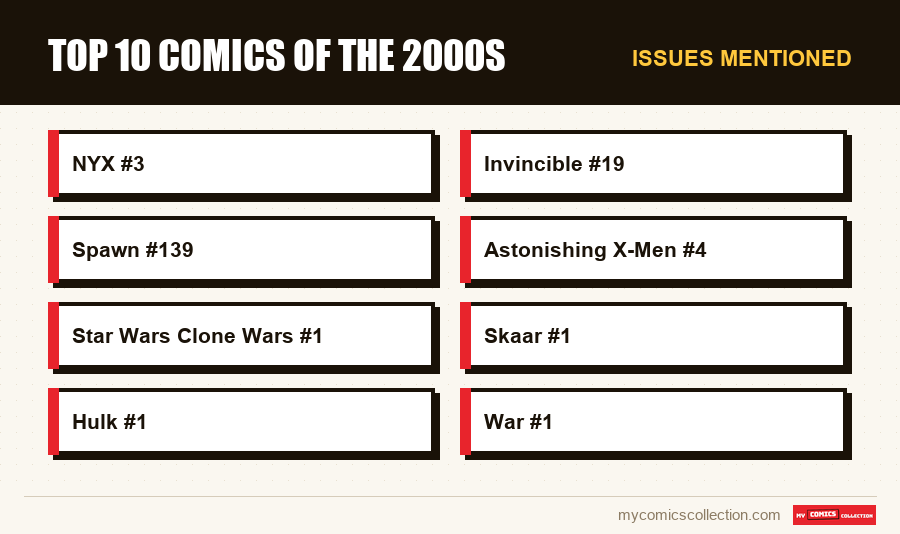
The highest amounts recorded for the 2004 vintage
$1,299.99: NYX #3, rating 9.6
The most expensive ad in the 2004 sample. It highlights the first appearance of X-23, Laura Kinney, and it is this argument that structures the seller's description. Three of the six leading announcements relate to this same number with different notes, which gives the 2004 statement a very concentrated appearance on a single issue.
$949.00: Invincible #19, rating 9.6
Second amount of the vintage, fifty dollars from the symbolic threshold of one thousand. The announcement builds on the first appearance of Battle Beast. It is the only major independent series not part of a historical superhero universe, and its author has a dedicated file: Robert Kirkman.
$716.40 and $625.00: the same number, two notches lower
Two other copies of NYX #3, rated 9.4 and 9.0. Going down from 9.6 to 9.4, the amount claimed loses around 45%. Going down further to 9.0, it loses ground again. On the number alone that the survey documents at four state levels, the staircase is perfectly legible.
$299.99 and $179.10: the back of the pack
Spawn #139 rated 9.8, featured for She-Spawn's first appearance, then Astonishing X-Men #4 rated 9.8, featured for Armor's first appearance. Two copies at the very top of the scale, very far behind the head amounts: the maximum condition alone is not enough to raise an advert.
This first table calls for a methodological remark. Out of sixteen announcements, four relate to the same issue. The 2004 ranking is therefore not an overview of the year, it is largely the breakdown by state of a single object, plus two isolated announcements. If the seller of these four copies withdraws his advertisements tomorrow, the entire appearance of the statement changes. This is exactly the kind of fragility that a squad of sixteen makes it impossible to ignore.
A point that comes up in both samples: the state note does not read like a regular graduation. Between two notches close to the top of the scale, the amount claimed does not fall by a few percent, it changes in order of magnitude. On booklets printed in large numbers and kept in boxes as soon as they were released, the beautiful copy is not rare; it’s the almost perfect one that is.
This mechanism is the exact opposite of that of the old decades, where a very damaged copy retains a high amount because the object itself has become rare in any condition. In the 2000s, an average copy stands out from nothing. There are too many.
The highest amounts recorded in the 2008 vintage
$1,235.00: Star Wars Clone Wars #1, rating 9.6
The peak of the 2008 sample. The ad is built around the first appearance of Ahsoka Tano. It comes under a license from outside the superhero catalog, which clearly distinguishes it from the top rankings of the 2004 vintage.
$749.99: Skaar #1, alternate cover, rating 9.8
Second amount of the vintage. The announcement combines two arguments: a first appearance and an alternative cover, on a copy rated at the top of the scale. Nothing in the statement makes it possible to say which of the two arguments carries more weight.
$699.99: Hulk #1, alternate cover 1:50, rating 9.8
An alternative cover with a limited edition: one copy distributed for fifty. The announcement highlights the first appearance of Red Hulk. See also the character page dedicated to Hulk.
$599.99: Gears of War #1, rating 9.9
A score of 9.9, that is to say a notch above what we usually encounter at the top of the scale. This rating is exceptionally high and is enough, in itself, to put the ad in the top quartet. The reading says nothing about its actual frequency.
$299.99: Hulk #1, alternate cover 1:50, rating 9.6
Strictly the same object as the third line: same number, same alternative cover, same limited edition. Two tenths of a state point less, and the amount claimed falls to less than half. This is the clearest observation of the entire survey.
$299.99: Gears of War #1, alternate cover, rating 9.6
Another alternate cover of the same first issue, at a lower rating than the 9.9 copy. Of the two pairs that the 2008 sample allows us to compare, the state difference each time produces a division of the amount claimed, not a simple adjustment.
Two tenths of a point, less than half the amount
The comparison between the two Hulk #1 ads is the only place in the report where all variables are neutralized. Same title, same number, same vintage, same alternative cover, same print run ratio, same type of certificate. Only one thing differs: the condition score, 9.8 in one case, 9.6 in the other. The amount claimed drops from $699.99 to $299.99. The difference is not marginal, it is structural: the second seller asks less than 43% of what the first asks for an object that nothing else distinguishes.
This observation does not generalize mechanically to the entire market, but it is consistent with the second pair of the sample, Gears of War #1 in 9.9 then in 9.6, where we find a relationship of the same order. And it is consistent with the variation of NYX #3 for the 2004 vintage, where each step lowered removes a substantial part of the amount displayed. Three series of observations, the same meaning each time. It's not enough to establish a law, it's enough to signal a mechanism.
The mechanism can be formulated without figures. The issues of the 2000s were printed in large quantities, sold to a public already aware of the potential value of the first issues, and put away in a box, in a sleeve, upon purchase. There is no shortage of examples in very good condition. From then on, what distinguishes a copy is no longer “it is in good condition”, they almost all are, but “it is closer to perfection than the others”. The rarity has moved from the fascicle to the last tenth of a status point.
This reverses an intuition inherited from previous decades. On a booklet from 1965, a read copy, dog-eared, yellowed, remains in demand, because there are not that many left and the best are out of reach of most buyers. On a 2008 booklet, an average copy does not find an argument: there are thousands of equivalents, and nothing designates it. To understand in detail how a note translates into an amount, the page understand the link between rating and price specifically addresses this report.
The alternative cover becomes the object itself
For the 2008 vintage, four of the six top ads explicitly mention alternative coverage. This is no longer a detail of description, it is the central argument: the seller does not say "Hulk number one", he says "Hulk number one, version 1:50". The ratio shown describes a distribution rule, one copy of this cover for every fifty copies ordered, and serves as a direct justification for the amount requested.
The practical consequence is immediate for those who keep an inventory. In older decades, noting the title, number and condition is enough to identify what you own. For the 2000s, this information is incomplete: two copies of the same issue may belong to two different commercial objects depending on the cover. An inventory line that does not specify the exact version does not describe the item, it describes a family of items. This imprecision is of no consequence as long as we are not looking for anything, and becomes blocking as soon as we want to compare, sell or insure.
A reservation must be added. The survey shows that these alternative versions occupy the top of the advertisements; it does not show that they are selling, or at what level. It is perfectly possible that some of these advertisements remain displayed for a long time without a transaction, precisely because the amount requested is based on an argument of scarcity that the buyer does not share. An isolated maximum expresses the hope of the seller, not a price observed on the market.
Collecting this series?
Track what you own, what you are missing and what your collection is worth. 7 day trial.
Start my trial →External licenses at the top of the 2008 ranking
The peak of the 2008 vintage is not occupied by a superhero. First place goes to a booklet taken from a licensed science fiction universe, fourth to a video game adaptation, and the latter returns a second time lower in the ranking. Of the six leading announcements, three relate to properties outside the superhero publisher catalogs. This is a composition quite different from that of the 2004 vintage, where the six lead announcements all remain within the scope of the costumed narrative, including Spawn which is relevant by its form if not by its tone.
We can describe this gap, we cannot explain it with these data alone. Two years sampled do not allow us to say whether the decade is gradually opening up to external licenses, whether 2008 is a particular year, or whether it is a simple effect of the announcements available that day. Prudence requires us to remember the observation without transforming it into a trend: on August 30, 2026, for this vintage, external licenses were clearly present in the lead.
What can be said, on the other hand, is that the collector's reasoning can no longer be limited to traditional catalogs. A video game adaptation, a variation of a cinematographic universe, a title derived from an animated series can have a first appearance and, as such, appear in the same rankings as historical series. To ignore these publications on the grounds that they are peripheral is to ignore part of what is circulating.
What sixteen and twenty-two ads allow us to say
We have to come back to the workforce, because they control everything else. Sixteen announcements in 2004, twenty-two in 2008: these are small numbers. On this scale, a single seller who puts four copies of the same issue online is enough to occupy a quarter of a ranking: this is precisely what happened in 2004 with NYX #3. A reading taken the day before or the next day could have produced a completely different picture.
I therefore refuse to conclude anything about a price level. To say “a 9.6 rated copy of this issue is worth around $1,300” would be false on two counts: on the one hand because no sales are recorded, and on the other hand because a single announcement does not describe a level. What the statement documents is the structure of the classification (what arguments the sellers put forward, how the amounts are ordered among themselves) and not the absolute height of these amounts.
This is also why internal relationships interest me more than values. The ratio between the 9.8 and the 9.6 of the same Hulk #1 does not depend on the mood of the market that day: it compares two announcements placed under the same conditions, by a visible mechanism. This type of comparison is more resistant to the weakness of the sample than an isolated amount, which does not compare anything.
Finally, two years out of ten are not the decade. The unsampled vintages-2000, 2002, 2005, 2007, 2009-appear nowhere here, and there is no reason to assume that they would behave like 2004 or 2008. The title of this article says "the 2000s" for convenience; the content only talks about two cuts.
What to note in your inventory after this reading
The exact note, never an interval. The difference between 9.8 and 9.6 on the same Hulk #1 more than doubles the amount claimed. An inventory line that says "very good condition" or "high grade" loses exactly the information that separates $699.99 from $299.99 in that statement. In the 2000s, the tenth of a point is not a refinement of description, it is the variable which orders the classification.
The cover version, in plain text and next to the number. Four of the six leading announcements of 2008 are defined by their alternative coverage, including two by a restricted distribution ratio. Noting “Hulk #1” without specifying the version does not allow you to find, later, whether it is the item that was listed for $699.99 or a copy of the current version. This is information that cannot be reconstituted from memory six months later.
The first appearance, and from whom precisely. Each of the leading announcements, over the two vintages, is built around a first named appearance: Laura Kinney, Battle Beast, She-Spawn, Armor, Ahsoka Tano, the Hulk's son, Red Hulk. This is the systematic argument from the top of the ranking. An inventory that does not record this information for the relevant numbers is depriving itself of the one item that all lead sellers find useful to write down. There fiche consacrée à X-23 allows you to attach a copy to the character.
The date an amount was raised. All figures in this article are dated August 30, 2026 and only make sense with that date. An amount noted without a date becomes, a few months later, an unverifiable statement that we end up taking for an acquired value. Recording the date next to the amount is what distinguishes an observation from a belief.
The nature of the figure: claimed or paid. An amount displayed on an ad and an amount actually collected are two different objects, and there is no guarantee that they are the same. In an inventory, these two pieces of information should never occupy the same field. Confusing the two amounts to populating one's collection with values that have never existed anywhere other than in the hope of a seller.
No. These are amounts displayed by sellers on August 30, 2026, on a general auction site on the American market. None of these announcements are verified as having resulted in a transaction. A requested amount may remain online indefinitely, be revised downward, or never meet a buyer. It documents an offer, not a market price.
Because this survey is a sample, not a census. Querying all ten vintages of the decade would have produced a volume of data that I could not verify line by line on the same day. Two years are enough to describe a classification structure; they are not enough to describe the decade, and the article does not claim otherwise.
This is a distribution ratio: this alternative cover was provided at the rate of one copy for every fifty copies ordered by a point of sale. It is this ratio that sellers put forward to justify the amount requested. The survey shows that the argument is used at the top of the ranking; it does not show that it is accepted by buyers.
It is exceptionally high, that is to say a notch above the height usually encountered in advertisements. Only one copy of the survey carries it, and it appears in the top quartet of its vintage. On the other hand, I have no data on its frequency of allocation: nothing in this statement allows us to say how many copies obtain it.
No, and it is an impossibility of method, not a facade of prudence. A measurement taken on a single date has neither an earlier nor a later point of comparison: it cannot describe any movement. To speak of evolution, there would need to be at least two readings carried out using the same protocol on different dates. This work remains to be done.
Record the exact version, not just the number
In the 2000s, two copies of the same issue can be two separate objects depending on the cover and two tenths of the rating. My Comics Collection allows you to record the version, rating and date of each amount observation, so that your inventory describes your copies and not an approximate family.