The 2000s hold a strange place in collectors' memories. Too recent to benefit from the aura of the Silver Age and Golden Age, too old to be in the "new releases" bins, they form an in-between decade that is often underestimated.
The 2000s hold a strange place in collectors' memories. Too recent to benefit from the aura of the Silver Age and Golden Age, too old to be in the "new releases" bins, they form an in-between decade that is often underestimated. That's precisely why now is an excellent time to pay attention: prices are still reasonable on many key issues, and the historical value of this era is only just beginning to be recognized by the market.
From 2000 to 2009, the comics industry underwent a profound transformation: Joe Quesada taking the editorial helm at Marvel, the Ultimate revolution, the Bendis era, DC's narrative darkening, and Image's maturation with Walking Dead and Invincible. This guide covers the essential series and key issues from this decade.
The 2000s in comics: the context
The 90s had left the industry in critical condition: mass speculation, holographic covers, and artificially inflated print runs had created a bubble that burst brutally. In 1997-1998, several distributors and publishers went bankrupt. The 2000s were a period of reconstruction and creative renewal.
On the Marvel side, Joe Quesada took over editorial direction in 2000 with the promise of "making comics cool again." He recruited young and ambitious creators, launched the Ultimate line, and breathed new energy into series that had been stagnating. On the DC side, the publisher was experimenting with darker stories and major crossovers. And at Image, the founding creators had matured: Robert Kirkman and others were launching series that would define the decade.
Marvel: the Ultimate era and the Bendis revolution
Marvel's most important decision in the 2000s was the launch of the Ultimate line in 2000. The concept: retelling Marvel characters' origins from scratch, in a contemporary universe without 40 years of continuity. Accessible origins for new readers, with no artistic compromise.
Ultimate Spider-Man (2000), the founding series
Ultimate Spider-Man #1 (October 2000), written by Brian Michael Bendis and drawn by Mark Bagley, is the definitive comic of the 2000s for Marvel collectors. It's a complete reinvention of Peter Parker as a high schooler at the turn of the century, and Bendis took his time: the entire origin (radioactive spider, Uncle Ben's death) is spread across seven issues, where Stan Lee had told it in 11 pages in 1962. The Bendis/Bagley run lasted 111 consecutive issues, a record for the medium.
New X-Men by Grant Morrison (2001-2004)
New X-Men #114 (July 2001) launches one of the most ambitious and controversial runs in X-Men history. Grant Morrison reinvented everything: new costumes (goodbye blue and yellow suits), Magneto transformed into a true villain, Genosha decimated, and a vision of mutant evolution as a mass phenomenon. Key issues: #114 (first issue), #116 (first Cassandra Nova), #146 ("Planet X" begins). A destabilizing run that remains a reference for fans of auteur comics.
Astonishing X-Men by Joss Whedon (2004-2008)
Astonishing X-Men #1 (July 2004) by Joss Whedon and John Cassaday was the answer to Morrison: more accessible, visually spectacular, with a return to X-Men fundamentals while advancing continuity. Cassaday brought a cinematic aesthetic that would influence dozens of artists. Issue #1 in CGC 9.8 remains a must-have of the decade.
Powers by Brian Michael Bendis (2000)
Launched at Image before moving to Marvel/Icon, Powers #1 (2000) by Bendis and Michael Avon Oeming explored an original question: what happens when police detectives investigate murders involving superheroes? A blend of noir crime fiction and deconstructed superheroes, the series would last over 15 years and generate a PlayStation Network adaptation.
DC Comics: Identity Crisis and the rise of darkness
DC Comics in the 2000s is marked by a shift toward darker, more adult stories, sometimes controversial, always impactful.
Identity Crisis (2004)
Identity Crisis #1 (July 2004), written by Brad Meltzer and drawn by Rags Morales, remains one of the most discussed DC comics of the decade. The death of Sue Dibny (Elongated Man's wife) opens an investigation that plunges into the darkest secrets of the Justice League. The revelations, including an assault sequence that caused a scandal, divided the community. But the narrative impact on DC was lasting.
52 (2006-2007), the editorial feat
52 is a masterpiece of editorial planning: 52 issues published in real time (one per week for a year), written by four rotating writers (Geoff Johns, Grant Morrison, Greg Rucka, Mark Waid). Issue #1 (May 2006) is the entry point to a story that explored the DC universe during the year Superman, Batman, and Wonder Woman were absent. A unique stylistic exercise in comics history.
Green Lantern: Rebirth (2004-2005)
Green Lantern: Rebirth #1 (December 2004) by Geoff Johns relaunched Hal Jordan's career and set the stage for what would become one of DC's greatest sagas of the 2000s-2010s (Sinestro Corps War, Blackest Night). Issue #1 has become a sought-after key issue among DC collectors.
Image and independents: Walking Dead, Invincible, Planetary
Walking Dead #1 (2003), the key issue of the decade
Walking Dead #1 (October 2003) by Robert Kirkman and Tony Moore is without question the most important key issue of the 2000s among independents. Very low initial print run, a series that would last 193 issues, and an AMC adaptation that made it a global phenomenon between 2010 and 2022. In CGC 9.8, prices have reached the 2,000-3,000 euro range. Even raw, a copy in good condition exceeds 200-300 euros.
Invincible #1 (2003), Image's Spider-Man
Invincible #1 (January 2003) by Robert Kirkman and Cory Walker launched Image's other major superhero series. Initially overshadowed by Walking Dead, Invincible gained momentum after the Amazon Prime Video adaptation (2021). Its #1 quickly doubled in price after the adaptation and continues to climb.
Planetary by Warren Ellis (1999-2009)
Planetary #1 (April 1999, but the series extends well into the 2000s) by Warren Ellis and John Cassaday is one of the most intellectually rich works of this period. A team of archaeologists of the strange who explore paranormal phenomena, in reality, an ode to the history of comics themselves. The slow publication schedule (27 issues over 10 years) paradoxically strengthened the series' cult status.
Saga of the Swamp Thing, Preacher, Transmetropolitan (Vertigo continued)
DC's Vertigo label continued to produce major works in the 2000s: Y: The Last Man #1 (2002) by Vaughan, Fables #1 (2002) by Bill Willingham, Ex Machina #1 (2004). These series are sought-after key issues at still-reasonable prices today.
Collecting this series?
Track what you own, what you are missing and what your collection is worth. 7 day trial.
Start my trial →Key issues from the 2000s to watch
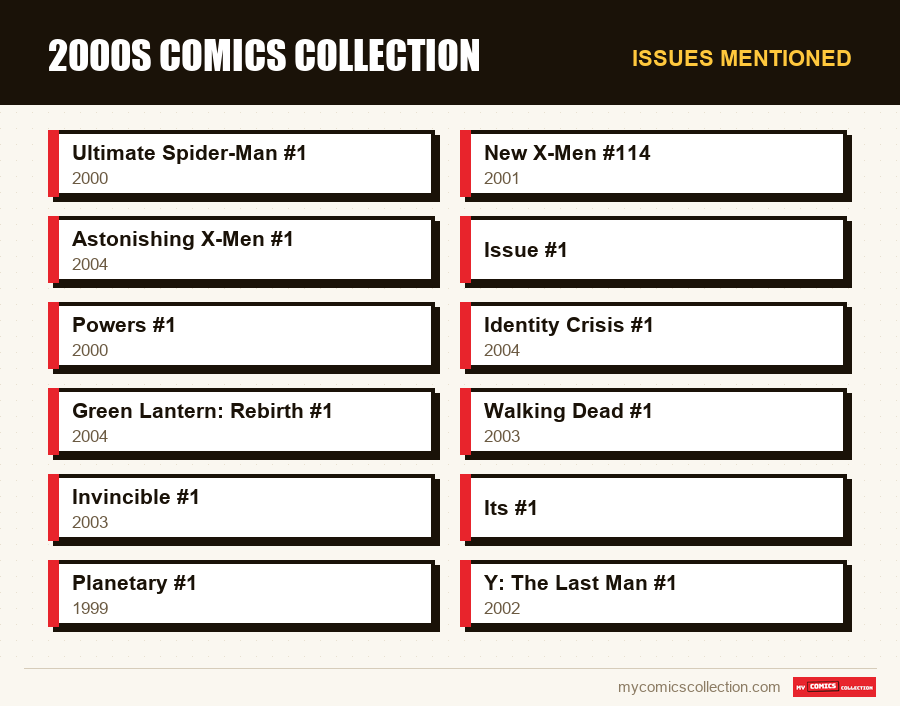
- Ultimate Spider-Man #1 (2000), first Ultimate Marvel issue, first Miles Morales universe origin
- New X-Men #114 (2001), first Grant Morrison issue, X-Men redefined
- Walking Dead #1 (2003), the absolute key issue of the decade, very low initial print run
- Invincible #1 (2003), explosive value increase post-Amazon adaptation
- Identity Crisis #1 (2004), the definitive DC event comic
- Astonishing X-Men #1 (2004), Whedon/Cassaday, iconic run
- Powers #1 (2000), Bendis/Oeming, first issue at Image
- Green Lantern: Rebirth #1 (2004), beginning of the GL renaissance by Johns
- Y: The Last Man #1 (2002), Vertigo, complete series in 60 issues, FX adaptation
- Fables #1 (2002), Vertigo, 150 issues, cult series
Why the 2000s are underestimated by collectors
There's a simple market logic at play: the most active collectors today are often 35-50 years old. Their "nostalgia premium" goes toward the comics they bought as children, Silver Age and Bronze Age for the older ones, the 80s-90s for the rest. The 2000s are the decade of their high school or early college years, a period not yet "vintage" in the collective consciousness.
But this window is closing. The generation that grew up with Ultimate Spider-Man and Walking Dead is approaching forty. Their purchasing power is increasing. Their nostalgia for these comics is intensifying. This is exactly the mechanism that caused 80s comics prices to explode in the 2010s, and 90s comics more recently.
Timing opportunity: Key issues from the 2000s are still accessible at prices that Silver Age and Bronze Age issues no longer see. A raw copy of Walking Dead #1 in NM will cost you between 200 and 400 euros today. In 5 to 10 years, the market may view them very differently.
How to approach collecting from the 2000s
Start with the series you've read
Passion comes before value. If you grew up with Ultimate Spider-Man or Walking Dead, start with those series. You'll have the context to recognize important issues and the motivation to complete your runs.
Target #1s and first appearances
The investment logic remains the same across all decades: #1 issues of major series and first appearances of important characters have the best long-term appreciation. Walking Dead #1, Invincible #1, Powers #1, Ultimate Spider-Man #1 all meet these criteria.
Watch for announced adaptations
Several series from the 2000s haven't been adapted yet. Y: The Last Man got its FX adaptation in 2021. Others, like Planetary or Powers, could be the subject of future announcements. Buying before the adaptation is always the best strategy.
Catalog your collection precisely
Series from the 2000s often have poorly documented variants: 1:10 covers, dynamite editions, reprints that are hard to distinguish from originals. Use My Comics Collection to precisely reference each issue number, edition, and condition.
FAQ, Comics from the 2000s
Catalog your 2000s collection
My Comics Collection lets you precisely reference every issue from your 2000s series, track their estimated value, and identify your most valuable key issues.
Try for freeNo commitment · Instant access · See pricing