On a general US market auction site, the August 30, 2026 statement for the query "Ghost Rider Ghost Rider 1 1973" has 128 unverified listings, from $5.95 to $7,151.00, with a median of $39.48; verified copies are counted separately, 65 listings ranging from $75.00 to $10,100.00 for a median of $645.00. These are not sales concluded but amounts that sellers claim that day. Three of the five cheapest ads add to their wording the mention of a film adaptation and the name of an actor. The other two don't talk about it. They claim the same amounts. Practical conclusion: what is written in an announcement title about a news item does not describe the item sold, and therefore has no place in the inventory sheet.
There is a category of words in ad labels that say nothing about the merchandise. These are neither the title of the series, nor the number, nor the year, nor the declared condition: they are the words added at the end, those which refer to something external to the issue. An expected adaptation, an actor's name, a production rumor. The statement of August 30, 2026 on the query “Ghost Rider Ghost Rider 1 1973” gives a clear example of this, because the advertisements concerned are right next to comparable advertisements which do not bear this mention.
This article does not seek to know if the mentioned adaptation exists, nor who would participate in it, nor when it would be released. I don't know anything about it and I don't have any data on it. What I have are labels from sellers referring to it, and the amounts claimed next to it. It is a sufficient object of observation: it shows what is the use of information which appears in an advertisement without saying anything about what we are buying, and why it should never migrate into a collection sheet.
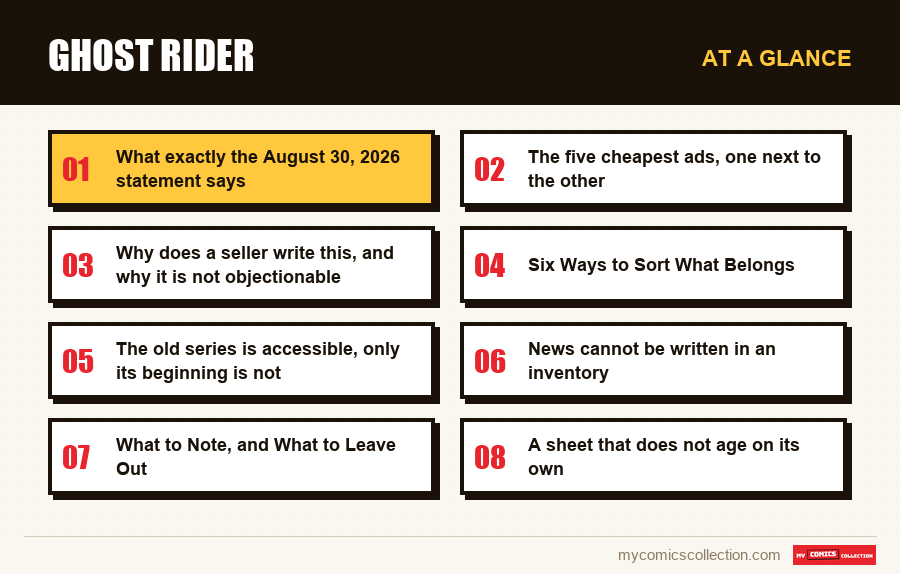
What exactly the August 30, 2026 statement says
Let's take the figures as they are, without making them speak more than they can. The query “Ghost Rider Ghost Rider 1 1973” brings up 128 listings for unverified copies that day. The lowest asks for $5.95, the highest for $7,151.00, and the median is $39.48. At the same time, 65 advertisements concern copies passed by a verification body: they range from $75.00 to $10,100.00, median $645.00. These two sets do not mix, because a verified copy and a copy described by its seller are not the same merchandise, even when it is the same number.
None of these amounts are sales prices. These are sums demanded, displayed at a given moment by people who hope to obtain them. A listing for $7,151.00 proves that a seller typed that number into a form; it does not prove that a buyer ever approached him. And as all this comes from a single day of observation, there is absolutely no movement to be read in this: no increase, no decrease, no trend. A photograph does not show movement. It would take two readings spaced out over time to start talking about it, and I only have one.
The median of unverified, $39.48, is the strongest indication of the lot, because it is based on 128 lines and holds up on both ends. The two maxima each describe one or two precise examples, and nothing else. A maximum is not a market level: it is the amount that an isolated person has decided to ask for. Using $7,151.00 or $10,100.00 as “the price of Ghost Rider” would be a basic misreading.
The five cheapest ads, one next to the other
It's at the bottom of the range that the observation becomes interesting, because the five cheapest listings look very similar. All relate to issues of the same series from 1973. None is the first issue targeted by the request: the site engine brings back neighbors, and these neighbors are late releases of the series. All are between six and eight dollars. Three of them add in their wording the mention of a cinematographic adaptation and the name of an actor; two don't.
Three labels with the mention
A number 59 from the 1973 series, advertised in 9.0, commands $5.99. A number 62 of the same series, announced in 8.0, costs $7.99. A number 65, announced in 9.0, also costs $7.99. The three carry in their title the reference to an adaptation and an actor's name, added after the description of the booklet.
Two labels without the mention
A « Ghost Rider (1973 1st Series) #47 » ad asks $5.95. A « Ghost Rider (1973 1st Series) #52 VF Newsstand Variant » listing asks for $7.99. These titles simply name the series, the year, the number and, for the second, the declared state and the type of distribution.
The connection that counts
Number 62 announced in 8.0 with the mention requires $7.99. Number 52 announced in VF without the mention also costs $7.99. Two comparable copies of the same series, one sold with news attached to the title and the other without, ask for exactly the same amount.
What it doesn't demonstrate
Five announcements are not many. Too little to establish anything about the general effect of this kind of mention. I notice an absence of difference on these five precise lines, on this precise date. I don't deduce any rules from this, either one way or the other.
This rapprochement is the heart of the matter, and it must be handled with caution. Of these five announcements, the mention of an adaptation produced no visible difference in amount. Two comparable copies, one with the mention and the other without, claim the same amount. This is an observation, not a demonstration: five lines do not constitute a sample, and I refuse to draw a general conclusion about the price level of anything. What this observation allows, on the other hand, is to defuse a common intuition: that which would like a title loaded with current affairs to automatically cost more.
None of these five advertisements concerns the number that the request was aimed at. These are all late publications of the same series, brought up by the site's search engine because they share the title and year. In other words: the bottom of a search range almost never describes the object we thought we were looking for.
This is one more reason to never copy an amount seen at the top of the list in an inventory sheet. The number is real, but it relates to another example than the one we have in mind.
Why does a seller write this, and why it is not objectionable
An ad title is a limited space, and each word in it is chosen to be found. A seller who adds the name of an actor or the mention of an adaptation is not lying on his booklet: he described it just before, with its series, its number and its condition. What it does is capture searches from people who type in that name because they've heard of it elsewhere. This is junk SEO, not cheating.
We must be clear on this, because the accusation comes quickly. This practice is widespread, it is visible, it hides nothing. The booklet delivered will be exactly that described in the title and photos. A buyer who receives a 1973 Series 62 in 8.0 declared condition has received what they purchased, whether or not the seller pasted a news story behind it. The mention does not alter the merchandise; it doesn't add anything either.
Symmetrically, it should not be seen as information. An ad that cites news sells an expectation: it offers the reader the opportunity to imagine a future in which the object would matter more. The subject is the same issue as yesterday, printed on the same dates, with the same pagination and the same spine. Nothing material has changed between the version of the wording that mentions the adaptation and the one that does not. Neither deception, nor information: a cover-up.
The reader who wants to understand why a character is particularly attracted to this type of dressing will find useful context in analysis of the title as a showcase: the more a character circulates outside the comic strip, the more the words concerning him become loaded with external references. It is mechanical, and it is independent of the value of the issues themselves.
Six Ways to Sort What Belongs
The practical question is not "should I believe the sellers", but "what portions of a wording describe the thing I will receive". Sorting is simpler than it seems: an item belongs to the object if it is printed on it, measurable on it, or permanently attached to it. Everything else is context, and context changes.
La série et l'année
“Ghost Rider (1973 1st Series)” unambiguously identifies which publication it is. It's printed, verifiable, and it will never move. This is the first thing to remember from an ad, even before the amount.
La date du relevé
An amount without a date means nothing. $39.48 median is August 30, 2026 and not any other day. A collection note which includes a figure must include its date, otherwise it becomes an orphan figure in six months.
L'état déclaré
“9.0”, “8.0”, “VF”: these are assertions by the seller as long as no verification body has intervened. Please note as such, with the mention that this is a declaration and not an independent observation.
Le circuit de distribution
“Newsstand” in the wording of issue 52 describes a physical feature of the print run, not a news item. This is the kind of detail that belongs to the object and deserves a place in the file.
Le numéro exact
47, 52, 59, 62, 65: five different objects, returned by a single request. Confusing the number searched for and the number found is the most common mistake when reading a list of results.
What does not belong to the object
An actor's name, an adaptation announced by sellers, a rumor: none of this is printed on the booklet or attached to it. It stays out, and it should stay out of the inventory too.
Collecting this series?
Track what you own, what you are missing and what your collection is worth. 7 day trial.
Start my trial →The old series is accessible, only its beginning is not
Another lesson emerges from this survey, and it is more useful than it seems. The five cheapest listings charge between $5.95 and $7.99, while the median of all unverified ads reaches $39.48. This gap is not mysterious: late issues of an old series fetch a few dollars, while early issues pull the median upwards. The entire series is accessible; it is its beginning which is not.
For someone building a collection rather than an investment, this is pretty good news. It means that one can read and possess the essence of a title while remaining within single-digit amounts, provided that one refuses to start at the beginning. The constraint is not budgetary overall, it is concentrated on a few specific numbers. This is exactly the kind of arbitration that is detailed the bottom-of-the-range approach.
The gap between the two medians: $39.48 for unverified, $645.00 for verified: describes two markets that do not intersect. The second concerns copies whose condition has been noted by a third party and sealed; it attracts another clientele and other amounts. Comparing the two would be like comparing an object and an object accompanied by an observation, which makes no sense. Each is read in its own column.
It must also be remembered that the distribution of issues in a series is never uniform, and that the reasons for this are documented elsewhere: printed volumes, moments of high distribution, pivotal episodes. THE relationship between peak circulation and rarity and the examination of what precedes a first appearance cover that ground. Here, I am content to note that the late issues are the least expensive of the lot observed, which is consistent with what we expect from a long series.
News cannot be written in an inventory
There remains the practical consequence, which is the only thing truly transposable from this entire statement. A collection sheet is a document intended to last several years. What is written there must remain true throughout this period, otherwise the form will degrade by itself while you are not looking at it. An external news item does not have this property: it will be out of date before the line that contains it.
The test is simple. Before adding information to a record, ask yourself if it will still be accurate in three years without anyone touching it. “Number 52, 1973 series, kiosk distribution” passes the test. “Seen at $7.99 on August 30, 2026” also works, provided the date is written. “Adaptation to come” does not pass muster: in three years, either it will have been released, or it will have been abandoned, or it will have changed form, and in all three cases the line will lie.
This is why a good sheet is boring. It contains the series, the number, the year, the condition with its origin, the distribution circuit, the date of entry into the collection, the amount paid, and possibly time-stamped statements of amounts claimed elsewhere. It contains no hope. Hope is said out loud among collectors; it is not written in a table.
The same discipline applies to already existing adaptations, the comparative reading of which is a content subject in its own right: see the comparison of an adaptation and the fascicles: and the order in which we approach a series, which the reading guide. These topics deserve articles; they do not deserve a column in an inventory, because they relate to analysis and not description.
What to Note, and What to Leave Out
Note the series with its year in parentheses, never the character's name alone. The August 30 statement brings back five different numbers from the same 1973 series under a request which targeted another. Without the year and the exact number, a file becomes impossible to compare to a catalog, and two copies from distinct series end up confused.
Note the declared state and who declares it. The 9.0 and 8.0 of the low advertisements are sellers' assertions, in the same way as the VF of number 52. The 65 verified advertisements fall under another regime, where a third party has observed. A card that writes "9.0" without saying where the number comes from erases the only distinction that counts between $39.48 and $645.00 median.
Note any amount with its date and nature. $5.95, $7.99, $39.48, $7,151.00: these are amounts claimed on August 30, 2026 on a general auction site on the American market, not completed transactions. A number copied without this label becomes in six months a supposed value, and no one will know any more than it ever did.
Note the distribution circuit when the wording indicates it. The mention "Newsstand" on issue 52 describes a characteristic of the physical print, unlike the actor's name which appears on three other advertisements. This is the dividing line to remember: what describes the paper goes into the file, what describes the world around it stays outside.
Never note an adaptation announced by sellers. Three of the five low advertisements bear this mention, and they claim the same amounts as the two which do not. This information did not produce any visible discrepancy here, it does not describe the object, and it will have changed status before the end of the file's life. It belongs in the conversation, not the inventory.
No. The booklet is described before, with its series, its number and its declared condition, and this is the one that will be delivered. The mention is used to be found by people who type this keyword. It adds nothing to the object, but it conceals nothing either. The right reaction is to ignore it, not to be outraged by it.
No, and you shouldn't make him say it. Five announcements observed on a single day is too small a number to establish a rule. We see that a number announced in 8.0 with the mention and a number announced in VF without the mention both charge $7.99. This is a one-off observation, not a demonstration, and it does not authorize any generalization.
Because they are not the same goods. A copy whose condition has been noted by an external organization and sealed is aimed at other buyers than a copy described by its owner. Mixing them would produce a median that would describe neither set. Here, $39.48 on one side and $645.00 on the other: two distinct readings.
That he describes a copy and nothing else. A maximum is the amount a person has decided to request; it does not say what a buyer would be willing to pay, and it has never represented a market level. The same reasoning applies to the $10,100.00 on the verified side. The median, calculated over dozens of lines, is much more informative.
Ask yourself if it will still be accurate in three years without anyone touching it. The number, the year, the distribution circuit pass this test. An amount passes it if it is time stamped and labeled as claimed. External news never passes it: it will have changed status before you reread the line.
A sheet that does not age on its own
My Comics Collection records what belongs to the item (series, year, number, condition and its origin, date of entry, amount paid) and leaves out what will expire before you do. Your statements remain time-stamped, your items remain identified, and nothing changes to assumed value while you look away.