The series launched in 1990 around a new bearer of the Ghost Rider identity arrives right at the time when the industry is printing more booklets than it has ever printed since. This simple calendar seals its material destiny: the volume produced then permanently exceeds the number of people who will one day look for these numbers, and no future demand can reverse this relationship. The statement of August 29, 2026 shows it clearly: one hundred and thirty-three proposals in circulation for unverified copies, a floor under two dollars, a distribution medium under seven dollars. This is not bad news: this is the only period in the history of the medium from which a reader can hope to collect entire series, in excellent condition, without ever deciding between two purchases.
We must first agree on what “peak circulation” means. It is not an accident, nor the whim of an editor: it is a meeting point between several curves which rise at the same time and which, each separately, would have produced a modest effect. When they overlap, they produce a quantity of printed paper that is out of proportion to the population of readers. The 1990 launch falls exactly on this meeting point. It is not the quality of the series that is in question, this text makes no judgment on it, it is its date of birth, and this date is a physical data, not an opinion.
The consequence is brutal to state and liberating to understand. Nothing printed during this window can become rare. Not “is not rare today”: cannot become rare. Rarity is a ratio, not an attribute. It assumes that at a given moment the number of available copies falls below the number of decided buyers. When the initial stock is counted in multiples of the historical readership, and this stock was kept flat, in sleeves, by people who bought precisely so as not to damage it, the ratio never changes. All that remains is the question of what to do with this abundance, and the answer is far more interesting than regret.
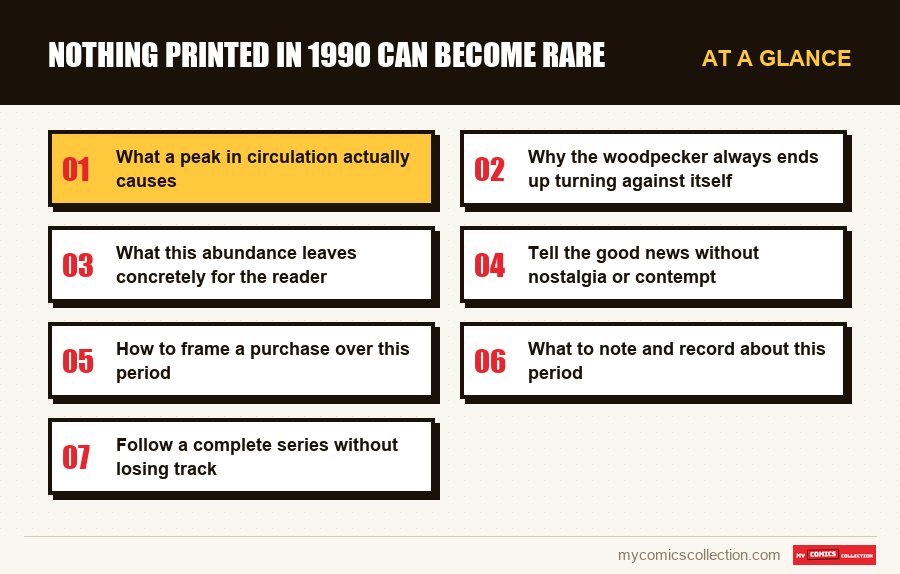
What a peak in circulation actually causes
Two independent movements come together, and it is their simultaneity that counts. The first is a fact of distribution: the network of specialized stores is expanding. Where the booklet depended on a display shared with the general press, with returns and limited exposure, it now finds entirely dedicated points of sale, which command firm and which command large. A firm order changes everything in the head of a publisher: the risk of returns disappears, so the print run ceases to be prudent. Multiplying points of sale not only multiplies distribution, it multiplies the safety stock that each point of sale deems reasonable to keep behind.
The second movement is a behavioral fact: a population of buyers arrives who do not buy to read. She buys to keep. She buys in duplicate, sometimes in triplicate, because an ambient discourse has explained to her that printed paper increases in value as it ages: which was true of the surviving fascicles from times when almost no one kept anything, and becomes false the second everyone keeps it. This new buyer doesn't read the number, doesn't fold it, doesn't leave it in the sun. He creates, without knowing it, the exact opposite of what he thinks he is making: a future source of examples in good condition.
A series launch is when these two curves touch most forcefully. A new series is what the network is ordering most generously, because it doesn't yet know where it will land. This is also what the buyer-curator targets as a priority, because the reasoning is simple to follow: a beginning, a new bearer of a known identity, an object that can be designated later as a starting point. In 1990, a Ghost Rider series built around a new rider checked both of these boxes simultaneously. The resulting circulation no longer has anything to do with how many people will read the story.
We must add a third factor, more discreet and more lasting: the publisher observes success in real time and reprints. What the market sees as proof of desirability, “there were no more on Saturday”, in reality triggers an industrial response which cancels out the observed shortage. Occasional stock shortages and real scarcity are two unrelated phenomena. Confusing the two is the mistake that has cost this generation of buyers the most.
Why the woodpecker always ends up turning against itself
The stock does not wear out
A booklet purchased to be read deteriorates, is lent, or lost. A booklet purchased for preservation does not suffer any of these attritions. The population of copies printed during the peak has survived the decades almost intact, whereas those of earlier periods had been wiped out by ordinary use.
The return is synchronous
These copies are not coming back in dribs and drabs. The generation that bought them gets rid of them at around the same age, for the same reasons: a move, an attic to empty, an inheritance. The supply therefore rises suddenly, in waves, and not in a regular trickle.
Demand has not followed the same curve
The number of readers has never multiplied in the same proportions as the circulation. The gap created at the time of printing has no reason to be filled afterwards: it is transmitted mechanically to all the years that follow.
Careful conservation compounds abundance
The care taken with the copies removes the only mechanism that could restore rarity: disappearance. Properly preserving an item produced in excess does not make it valuable, it ensures that it will remain numerous and in good condition simultaneously.
The right word is therefore not “collapse” but “self-destruction”. The peak contains its own cancellation. What causes it, mass purchasing motivated by the hope of future value, is exactly what ensures that no scarcity value can be established. There was no betrayal, no general bad faith: simply collective reasoning applied on a scale where it ceases to be valid. An intuition that works for an isolated individual backfires when an entire population applies it at the same time.
The amounts quoted here are those that the sellers demanded August 29, 2026, recorded on this date alone. These are posted requests, not concluded transactions: no one guarantees that a buyer has accepted either of these prices. A single reading does not draw any trajectory. I can neither say that these levels are rising nor that they are falling, since I only have one measurement point and a curve requires at least two dates.
On the unverified copies, the number is comfortable: one hundred and thirty-three proposals, from the floor at $1.86 to an isolated request at $99.99, with a midpoint at $6.50. This solitary maximum reflects the hope of a seller and nothing else; it is the median, based on one hundred and thirty-three advertisements, which describes the reality of access. As for the copies verified by an organization, there are only cinq annonces, from $147.76 to $749.99: five observations do not support any conclusion about a price level, and so I will draw nothing from them at all. I only mention them so that it is known that they exist and that they are counted separately.
What this abundance leaves concretely for the reader
Searching becomes easy
With one hundred and thirty-three simultaneous proposals for unverified copies, the question is no longer “where to find one” but “which one to choose”. It is a complete reversal of the collector's posture: we move from tracking to selection.
No emergency
There is no reason to rush into an announcement. Such a comprehensive supply is constantly being replenished; passing up a copy has no real cost. Urgency is a tense market emotion, it has no place here.
The price stops arbitrating
With distribution under seven dollars, price is no longer the criterion that decides what you read. You choose according to your reading desire, not according to what your budget allows you this month.
Status is available
Since these copies were preserved rather than read, the good condition is not an expensive exception: it is the norm of the deposit. You don't have to choose between an affordable copy and a clean copy.
Completeness is achievable
Bringing together an entire suite, without gaps, is a realistic objective over this period. No issue acts as a budgetary lock that holds the entire series up for years.
You can read the copies
The best use of an abundant object is to use it. Opening a booklet for which there are thousands of equivalents does not destroy anything; the cautious attitude no longer has any economic justification.
Collecting this series?
Track what you own, what you are missing and what your collection is worth. 7 day trial.
Start my trial →Tell the good news without nostalgia or contempt
This period is regularly treated with condescension, as if abundance were a moral defect. It is a confusion between two distinct judgments: the quantity printed says nothing about the quality of what was printed. A story is not less good because it has been printed in many copies, just as a pocket book is not inferior to a confidential edition. Contempt for this decade is the reasoning of a disappointed speculator, not a reader.
The symmetrical attitude is just as cumbersome: the nostalgia which presents this era as a lost age, whose fascicles should be pitied. Again, there is nothing to complain about. An object that has not gained market value has lost nothing: it was never promised anything other than what it contains. The only thing that has collapsed is anticipation, and anticipation is not heritage.
The right position is simpler and more useful: this decade is the most generous entry point there is. A reader who discovers the character today can build up, in a few weeks, a coherent, complete and clean reading base, for a budget that most other periods would swallow up in a single purchase. This is a real privilege, and it is directly produced by the mechanism described above. Yesterday's excess is today's accessibility.
There is even a form of justice in this reversal. The copies were carefully protected by people who hoped to sell them at a high price; They land thirty years later in the hands of readers who pay a handful of coins for them and finally open them. The initial intention failed, but the material result (paper in good condition, in quantity, within everyone's reach) is precisely what a readership needs. Few market mechanisms produce an outcome so favorable to the ordinary reader.
There remains one nuance to hold firmly, because it protects against disappointment: this abundance is a fact measured on a date, not a perpetual guarantee. The August 29, 2026 statement describes what a buyer found that day. He doesn't predict anything. The difference between describing and predicting is the only discipline that matters when we talk about numbers, and I stick to it here as elsewhere.
How to frame a purchase over this period
Since price ceases to be the limiting criterion, it must be replaced by another. The most effective is consistency: aim for continuous blocks of reading rather than isolated numbers chosen for their reputation. A set of consecutive numbers is better, for understanding a series, than three famous numbers, each taken in a context that we do not have. Abundance makes this strategy possible; in a tense period, it would be out of reach.
The second criterion is the condition, not to preserve a value that does not exist, but for reading comfort and storage stability. Over this period, requiring good condition costs practically nothing extra. You might as well take advantage of it, knowing that this choice is a matter of pleasure and not an investment: it's a distinction that is better to make once and for all rather than to tell a story.
The third is logistics. Gathering dozens of inexpensive booklets poses a problem that expensive single purchases do not pose: shipping costs and keeping track of what you already have. On a few dollar item, shipping may exceed the price of the item. Grouping purchases from the same seller then becomes the real savings lever, well before negotiating the unit price.
The fourth is the voluntary renunciation of verification by an organization. To certify a copy whose distribution medium is under seven dollars costs structurally more than the object itself. The five verified advertisements noted, too few in number to say anything at a level, do not change this common sense reasoning: over this period, the verification process has no economic justification for a reader.
What to note and record about this period
Note the date of entry into the mass draw window. For each series you follow, remember from which number it belongs to this period of abundant printing. It is this border, not the character's name, that determines whether a booklet will be easy or difficult to find. The same series can have a before and an after, and treating them identically leads to overpaying on one side or worrying unnecessarily on the other.
Record the price paid, not an estimate. On numbers worth a few dollars, the temptation is to not write anything down because “it’s not worth anything”. It is the opposite that must be done: this is precisely where the total escapes perception most quickly, because each purchase seems negligible. Thirty invisible purchases form a perfectly visible expense at the end of the year.
Record shipping charges separately from the price of the item. Over this period, shipping often represents a majority of the actual cost. Tracking that only records the displayed price gives a false picture of what the collection cost, and makes it difficult to see that consolidating orders is the only move that really moves the total.
Mark holes rather than possessions. When completeness is attainable, useful information is no longer “what I have” but “what is missing”. A list of missing issues transforms a scattered collection into a concrete objective, and avoids duplicate purchases, which become statistically probable as soon as cheap copies are quickly accumulated.
Note the condition noted upon receipt, immediately. On abundant batches received in series, the memory very quickly confuses the copies with each other. A condition noted when the package is opened remains usable years later; a reconstructed state of memory is worthless. This is the only survey that cannot be redone later, because a stored issue is never re-examined.
No, and this is the heart of the reasoning. Rarity is not a property of the object, it is a relationship between the number of copies available and the number of decided buyers. When the initial stock sustainably exceeds the population likely to seek out these booklets, no surge in demand reverses this relationship. Increased demand can cause claimed amounts to move, which is another phenomenon; it does not create scarcity where there is none.
Nothing conclusive, and it must be said frankly. Five observations are too small to describe a price level: two optimistic sellers are enough to completely move such a series of figures. The requests noted that day ranged from $147.76 to $749.99, a difference which above all reflects the dispersion of individual hopes. I count them separately and refrain from deducing anything from them.
It means that a seller hoped for August 29, 2026, nothing more. An isolated maximum within one hundred and thirty-three proposals is an extreme point, not an established price: there is no trace indicating that a buyer accepted this amount. The benchmark to remember on this set is the middle of the distribution, at $6.50, which describes the area where the proposals are really concentrated.
It's exactly the opposite. A beginner will find there the only window where he can collect complete sets, in good condition, without deciding between two purchases. The downside, the lack of prospect of resale, is only a problem if you buy to resell. To read, discover a character and build a coherent foundation, no other period offers this comfort.
No, not from what I have. The survey relates to a single date, August 29, 2026: it photographs a state of the market, it does not trace any curve. Affirming a decrease or an increase would require at least two measurements spaced over time, comparable to each other. What I can say is descriptive: that day, access was wide and the distribution environment low.
Follow a complete series without losing track
When missing numbers cost a few dollars each, the real risk is no longer the budget: it is the duplication, the omission and the hole that we no longer see. My Comics Collection keeps track of what you own, reports what's missing, and follows you issue by issue, series by series.