Around Ghost Rider, the original booklet became so expensive that sellers created a whole range of subcategories to sell something else: the third appearance, the fourth, and even an “earlier image” spotted in a neighboring title. The August 30, 2026 statement shows them lined up by asking price (approximately $30, $36, $40) under a reference booklet whose median asking reaches $592.50 among ordinary sellers. These labels do not come from any publisher or authority: they are written by the seller. Knowing them does not say whether you have to pay for them, but avoids buying a distinction you were not looking for.
There comes a time in a person's business life when the booklet that everyone wants falls outside the scope of what everyone can pay for. From there, the market does not stop: it reorganizes itself. Unable to sell the requested object, sellers sell what revolves around it, and to do so they must give it a name. This is how categories are born that did not exist anywhere at the time of publication: the second appearance, the third, the fourth, the appearance on the cover, the mention in an insert, and sometimes an image spotted in a completely different title published a few weeks earlier.
Ghost Rider offers a particularly readable laboratory case. A survey carried out on August 30, 2026 on a general auction site in the American market, for the query “Ghost Rider Marvel Spotlight 5 1972”, gives only 30 unverified advertisements: minimum $20.60, median $592.50, maximum $25,000.00. Copies passed by a verification agency are counted separately and form a separate set of 94 listings, with a minimum of $599.00, a median of $2,174.99, and a maximum of $39,995.00. All these amounts are what sellers asked for that day, not what buyers paid: these are stickers displayed, for which we do not know if they found a buyer. And since it's a single date, none of these values show an increase or a decrease: a photograph does not show a movement.
Thirty ordinary announcements: a number too small to conclude
The first instinct, when faced with a median, is to treat it like a price. Here, we must resist. Thirty unverified advertisements, for such a requested booklet, is a low number. At this level, two or three optimistic sellers are enough to move the center of distribution, and two or three disappearances are enough to move it elsewhere. The median of $592.50 therefore describes the state of a storefront at a specific time, not a market level on which to trade.
There is a second reservation, even more troublesome than the first. This set of thirty advertisements does not contain thirty copies of the booklet sought. The search engine assembles everything that responds to the words in the query, and examining the cheapest ads immediately confirms it: none of the first five is the booklet in question. A median calculated on a heterogeneous basket mixes objects that do not have the same price because they are not the same thing. This is a limitation of the reading, not a market flaw, but it prohibits this figure from being presented as an estimate.
The contrast with the 94 verified listings is worth noting for what it is. There are more than three times as many copies going through verification as there are regular copies offered for sale. For a booklet of this reputation, this reflects a simple thing: when an object reaches this level of asking price, those who hold it have it inspected before putting it on sale, and the current offer shifts almost entirely in this direction. The practical consequence is that the buyer who refuses certification does not find himself before a cheaper market, but before a much narrower market, and, in this case, largely occupied by objects which are not what he is looking for.
The scale of invented categories, as read in the advertisements
The collection, at $20.60
The cheapest listing in the survey is “Marvel Firsts: The 1970s Vol. 1” at $20.60. This is not a period issue but a collection, that is to say a bound reprint. It appears in the results because its content overlaps with the query, and it occupies the bottom of the scale without ever competing with it.
The third appearance, at $29.95
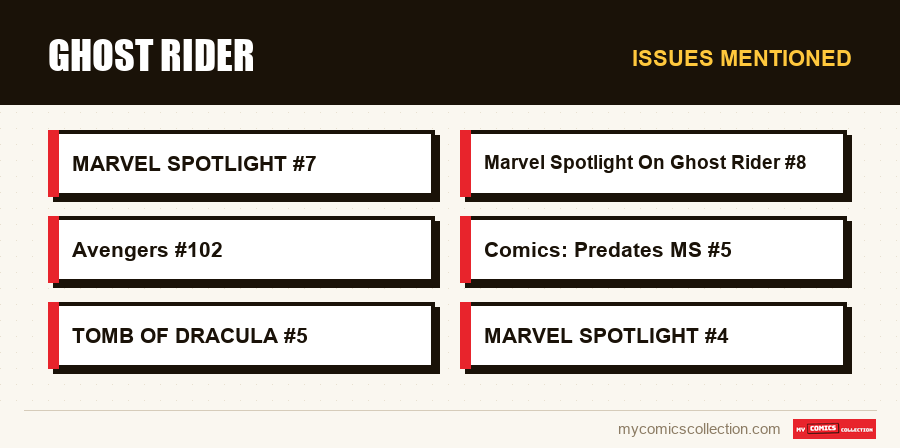
« MARVEL SPOTLIGHT #7 VG/FN 3rd Appearance Ghost Rider 1972 » is priced at $29.95. The seller does not hide that it is another issue: he explicitly sells it as a third appearance, and this mention is the central argument of the ad.
The Fourth Appearance, $35.95
“Marvel Spotlight On Ghost Rider #8 VG+ […] 4th App” asks $35.95. The next rank costs a little more than the previous one, which is the clearest sign that these labels form a range and not isolated mentions.
Previous image, $40.00
« Avengers #102 F+ (7.0) 1972 - 1st Ghost Rider Pic in Comics: Predates MS #5 » is listed at $40.00. The ad sells a booklet with a completely different title, on the grounds that it contains an image of the character prior to the reference booklet, and it states this in black and white in its title.
Read as a whole, this sequence draws a clear scale: around thirty dollars for the third appearance, around thirty-six for the fourth, forty for the “earlier image” category. These are real, encrypted entry points, available on the day of the statement, for those who cannot refer to the reference booklet. It must be reiterated that these are requested amounts: nothing says that these advertisements found a buyer at this price.
These categories are not validated by anyone. No publisher publishes an official list of a character's appearance ranks, and no organization certifies that a number is indeed "the third". These are sellers' assertions, and they can perfectly contradict themselves from one ad to another depending on whether or not you count covers, thumbnails, silhouettes or advertisements.
This does not make it a fraud or a guarantee. A seller who writes "3rd Appearance" is applying a convention that he considers reasonable, and he is writing it clearly rather than hiding it. The correct position is neutral: treat the label as information to be verified yourself, exactly as one would verify an advertised state of conservation.
The lot, the fifth announcement, and what it reveals about the process
The fifth cheapest listing is a bundle combining “TOMB OF DRACULA #5 & MARVEL SPOTLIGHT #4” for $99.99. It belongs to the same family of commercial constructions as the previous ones, but by another mechanism: here, it is not a label which brings together the object of the request, it is an assembly. Two numbers neighboring in date and collection are combined into a single sales item, and the whole appears in a search for a third.
The process is worth understanding because it makes reading prices much more complicated than a simple label. A lot has a global, inseparable price, which no honest calculation allows to distribute between its components. When a basket of thirty advertisements contains lots, its median ceases to describe a unitary object, and the gap between the minimum and the maximum becomes even less interpretable than it already was.
There is a more general lesson to be learned from this about how these statements should be read. A textual query returns objects that share words, not objects that share an identity. The booklet sought, its collection neighbors, the collections which reprint its contents, the subsequent issues sold by their rank of appearance and the lots which contain a fragment all end up in the same bag. Any statistics calculated on this bag are statistics on words, not on a booklet.
This confusion is not an anomaly of this particular character. It appears each time a title concentrates strong demand on a small number of issues, and the case is found identical as soon as we look the periods when the title was printed the most, where abundance produces the opposite effect but the same reading difficulty.
Collecting this series?
Track what you own, what you are missing and what your collection is worth. 7 day trial.
Start my trial →Why these categories appear, and what they are actually used for
Make a secondary object visible
An ad for an ordinary number is not sought by anyone. The same announcement with the mention of an appearance rank goes back in the research done on the character. The label is first and foremost a visibility tool, and its commercial effect does not depend on its veracity.
Exploiter la chronologie
The “prior to the reference issue” argument assumes a comparison of publication dates between two different titles. This is a testable claim in principle, but it relies on a definition of what counts as an appearance that the seller never provides.
Create a rank where there is none
There is no need to stop at the fourth. Once the principle is accepted, the series of ranks is opened, and each following number can receive its label. This is what makes the range expandable without natural limits.
Sell a set rather than an item
The lot allows you to sell a number that is not in high demand by attaching it to a number that is in demand. The buyer does get two booklets, but he will never know what part of the price corresponded to what he wanted.
Making incompatible definitions coexist
Two sellers may refer to two different numbers as the same appearance, simply because they do not count the same things. No arbitrator decides, and the two announcements remain online side by side without anything indicating the contradiction.
Separate reading from possession
The $20.60 collection meets an entirely distinct need: access to content. It does not compete with any of the previous categories because it does not claim any rank, and this is precisely what makes it readable.
This last point deserves to be developed, because it resolves a false dilemma. Twenty dollars and sixty cents is the price of a meal, and that's enough to read the story. Deciding that you want to read, and not own a period object, is a perfectly coherent choice that has nothing to do with renouncing: it's simply another project. Most disillusionment arises from the confusion between the two: we think we are buying a reading and we are paying for a status, or the opposite. Asking the question upfront, before even looking at an ad, solves the problem at the source. Those who prioritize content will find a coherent read path in the reading guide dedicated to the character.
What cinema adds to this mechanism
It is necessary to say a word about a factor external to the booklet market, because it acts on it without ever being visible there. The attention paid to a character does not only depend on its publications: it also depends on its adaptations, which periodically bring in an audience who only knows the filmed version. This audience arrives with a simple question, what is the original booklet, and is immediately confronted with the price, then discovers the range of categories built beneath it.
It's a mechanical sequence, and it explains why these subcategories proliferate around suitable characters rather than around those who don't. The new demand is numerous and poorly informed, it is looking for a gateway, and the sellers are making several at tiered prices. Nothing in this mechanism implies bad faith: it responds to a real request with the means at hand.
For those coming through the films, the useful precaution is to know what the adaptation has preserved and what it has invented, before looking for the corresponding booklet. The two feature films devoted to the character each take liberties that make the connection less direct than it seems, and it's better to know this before you buy than right after. The deviations of the first are detailed in the comparison between the 2007 film and the booklets, those following in analysis of the second film released in 2011.
What to note and record
Write down the exact label, word for word. If you buy an issue sold as a “third appearance”, the line in your collection must bear this mention in full, with the title and number of the issue concerned. A line that only indicates the name of the character makes the copy unidentifiable: neither you nor a future buyer will know what you bought, nor why you paid that price for it.
Record who produced the label. These categories come from the sellers, so the note must clarify that this is a listing mention and not an established fact. This distinction, evident on the day of purchase, disappears in a few months. A year later, a note that says “3rd appearance” without a qualifier will read like a certainty even though it was a commercial statement.
Distinguish a collection from a booklet in the same list. The $20.60 copy is a hardcover reprint, and it has nothing to do with the vintage items listed next to it in the search results. If the two coexist in a collection without the nature of each being indicated, the resulting totals no longer mean anything.
Treat a batch as one batch, never as two encrypted lines. A set purchased at $99.99 does not allow any price distribution between its components. Note the overall price only once, on one of the two, and list the other as part of the same purchase. Any invented distribution becomes a false figure which will contaminate your subsequent evaluations.
Record the date of the amount noted, and its status. The figures cited here are prices asked on August 30, 2026, verified copies counted separately, and not completed transactions. A collection note that keeps the amount without the date and without this precision transforms silently, over time, into an estimate value that it never was.
It is written by the seller and validated by anyone. No publisher publishes an official list of appearance ranks, and two announcements may assign the same rank to two different issues depending on what each decides to count. This is not necessarily false, but it is still a statement to verify yourself before paying for it.
No, for two combined reasons. It is based on only thirty advertisements, a number too small to be stable, and this basket of thirty contains objects which are not the issue sought: a collection, other issues, a lot. A median calculated on heterogeneous objects does not describe any particular object.
The statement includes 94 verified advertisements compared to 30 unverified, or more than triple. At this asking price level, holders have the copy checked before offering it, and the current offer tilts massively in this direction. The buyer who ignores the verification does not therefore find a cheaper market, but a significantly narrower market.
Neither. All these amounts come from a single statement dated August 30, 2026: it is a still image, and a still image does not contain any movement. Establishing a trend would require several comparable measurements spaced over time, which is not the case here.
That's the price a seller was hoping to get that day, nothing more. An isolated maximum has never met a buyer at the time of the survey, and it therefore does not provide information on what the market is willing to pay. It only indicates how high the optimism of a single seller is.
Keep track of exactly what you buy
A “third appearance” noted without its title, its number and the exact mention of the announcement becomes an anonymous copy in a few months. My Comics Collection allows you to save each issue with its description, price paid and date of purchase, so that these distinctions survive your memory of them.