The No Man's Land reading order follows DC's Batman crossover that ran through all of 1999: Gotham is cut off from the world after an earthquake, and the saga runs 80 monthly issues, four specials and a graphic novel across about ten Batman titles. The project's architect is Jordan B. Gorfinkel, with Greg Rucka, Chuck Dixon, Devin K. Grayson and others writing. Read Cataclysm and Aftershock first, then the series month by month, following the cover date of each issue.
No Man's Land does not fit in a miniseries; it takes up twelve months of publication across the Batman books, which makes the reading order a real question of method. Here is a series by series path with the issue ranges, the list of optional extras and a look at the collected editions.
As always in this guide, only verified information (creators, issue numbers, dates) is stated as fact; the analysis is our own, with no reproduction of protected art or dialogue.
What to read first
Here, the prelude is a trio of landmarks: Cataclysm, Aftershock and Road to No Man's Land. Cataclysm tells of the magnitude 7.6 earthquake that strikes Gotham; Aftershock follows its consequences; Road to No Man's Land collects the transition issues that come before the break. All of these stories run in the same series as the crossover, which is why modern collected editions group them into separate volumes.
Readers new to Gotham can get by with little background. It is enough to know Batman's family: Batman himself, Robin, Nightwing, Azrael and Commissioner Gordon, who are the pillars of the story. Character-by-character paths cover the rest: the Nightwing reading guide and the Robin reading guide put those two characters back in their own order.
- Cataclysm: the earthquake, essential to grasp the stakes.
- Aftershock: the immediate follow-up, which sets up the starting situation.
- Road to No Man's Land: the transition issues, useful but easier to skip if you are short on time.
If you only have one evening, read Cataclysm then Aftershock, then move on to the one-shot Batman: No Man's Land #1, cover-dated March 1999, with a cover by Alex Ross.
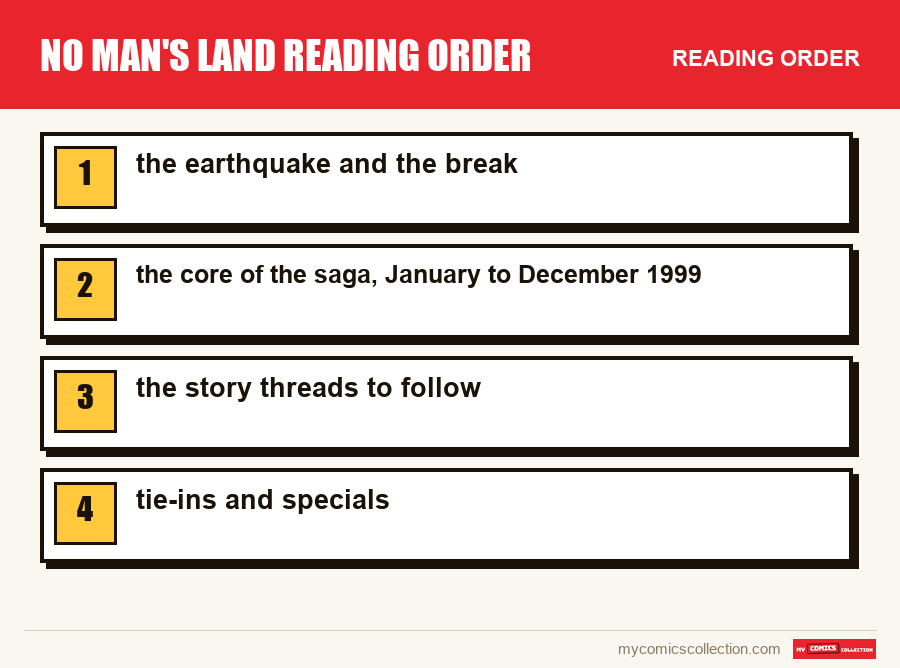
Phase 1: the earthquake and the break
Before the 1999 opening, Gotham is devastated by the earthquake of Cataclysm. The government then decides to cut the city off from the rest of the country, and that isolated-zone status gives the story its title. The monthly series then switch to a shared format: each title tells the story of one corner of the city, and the plots cross.
For this phase, reread the transition issues published just before the launch in the four core titles, which are Batman, Detective Comics, Shadow of the Bat and Legends of the Dark Knight. The exact ranges for each of these series within the crossover are given further on, in the recap section.
Phase 2: the core of the saga, January to December 1999
The heart of the crossover lies in the following series, with the ranges used for the No Man's Land period proper:
- Batman #563 to #574;
- Detective Comics #730 to #741;
- Batman: Shadow of the Bat #83 to #94;
- Batman: Legends of the Dark Knight #116 to #126;
- Azrael: Agent of the Bat #50 to #61;
- Robin #67 to #73;
- Nightwing #35 to #39;
- Catwoman #72 to #77.
The reading principle is simple: pick one series as your backbone, then add the other issues from the same month. Batman and Detective Comics form the main trunk; the other titles develop the characters in their own neighborhood. Since the titles are monthly, a February-dated issue of one series is read before the March issue of the neighboring series.
The writers of this crossover make up a large team: Jordan B. Gorfinkel, Greg Rucka, Chuck Dixon, Scott Beatty, Paul Dini, Bob Gale, Devin K. Grayson, Kelley Puckett, Larry Hama and Bronwyn Carlton. On the art side, you will find Greg Land, Alex Maleev, Dale Eaglesham, Phil Winslade, Dan Jurgens, Mike Deodato and Sergio Cariello, among others. The printed credits of each issue tell you who wrote or drew what.
Phase 3: the story threads to follow
Spoiler warning: this section names stakes that emerge as the story unfolds. If you would rather discover everything as you read, skip to the next one.
Several threads run through the 80 issues, and it helps to spot them so you do not lose the thread from one month to the next:
- Huntress, who makes herself a Batgirl costume and defends a territory, then gives up the costume after losing that territory to Two-Face;
- Harvey Dent, a.k.a. Two-Face, who puts Gordon on trial; Renee Montoya's appeal to the Harvey Dent side of his personality leads to Gordon's acquittal;
- Lex Luthor, who arrives with a plan to rebuild Gotham, behind which hides a property-grab operation; Lucius Fox uncovers the scheme, and Batman unmasks Luthor;
- Cassandra Cain, daughter of David Cain, who saves Gordon's life, earns Bruce Wayne's trust and becomes the second Batgirl.
To follow one of these characters over the long run, dedicated pages exist: the best Two-Face comics, those of Huntress, the page on one Batgirl and the one on Azrael. Lex Luthor also has his own reading guide.
Phase 4: tie-ins and specials
Beyond the regular series, the crossover includes side issues. Here are the ones on the reference list:
- The Batman Chronicles #16 to #18;
- JLA #32;
- Young Justice in No Man's Land #1;
- Batman: NML Secret Files and Origins #1;
- Batman: Harley Quinn, published as a graphic novel;
- Batman: No Man's Land, the opening one-shot, whose numbering ends at #0.
If you read in single issues, keep in mind that the one-shot serves as the starting point for the whole event and that the specials series plays the role of an appendix rather than a backbone.
Do you collect this series?
Track what you own, what you are missing and what your collection is worth. 7-day trial.
Start my trial →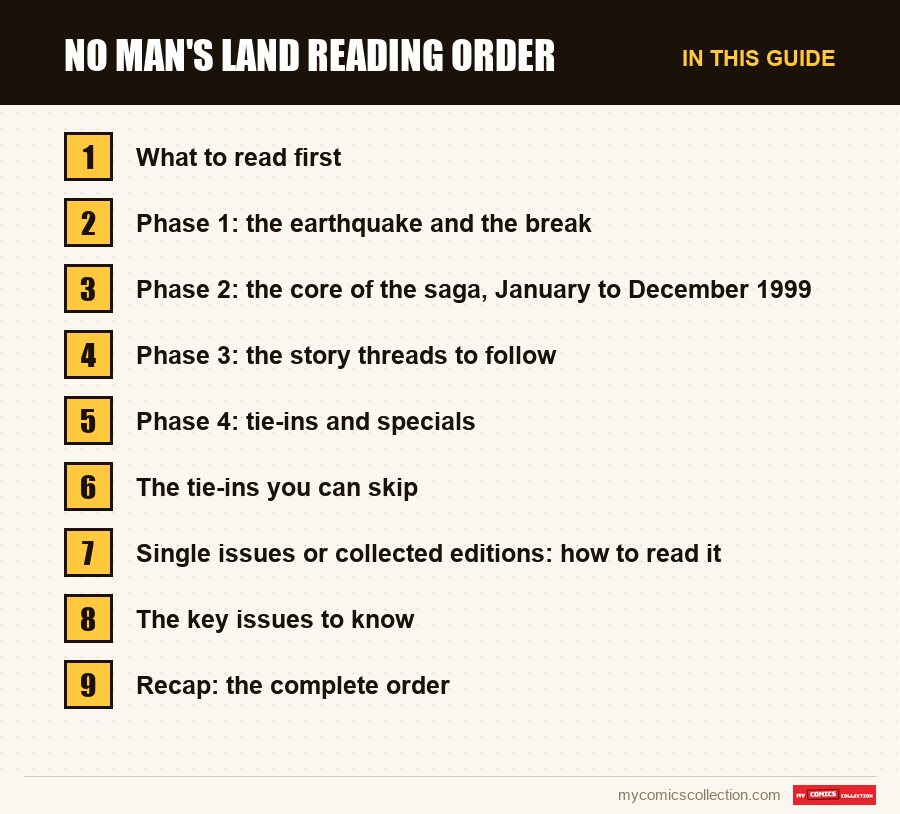
The tie-ins you can skip
A crossover that takes up twelve months across about ten series inevitably carries issues whose contribution is mostly supplementary. That does not make them bad: they simply address readers who already follow the character concerned.
- JLA #32: a single issue of a team book, which looks at the situation from another angle.
- Young Justice in No Man's Land #1: a one-shot centered on other characters.
- The Batman Chronicles #16 to #18: a quarterly anthology, peripheral to the main plot.
- Batman: NML Secret Files and Origins #1: a reference issue more than a story.
If your time is limited, focus on Batman and Detective Comics, then add Shadow of the Bat and Legends of the Dark Knight before venturing into the character books.
Single issues or collected editions: how to read it
The story is huge and its collected editions have changed over time. The original trade paperback line has five volumes that reprint only 40 of the 80 issues, so the full run is not there. In 2011, a new, more complete collection gathered the saga in four No Man's Land volumes, supplemented in 2015 by two Road to No Man's Land volumes devoted to the preludes.
More recently, omnibus editions have appeared: Road to No Man's Land Omnibus in November 2020, No Man's Land Omnibus volume 1 in January 2022, then volume 2 in September 2022. The most economical route for a reader who wants everything in order goes through these omnibus editions, which divide the material into coherent blocks.
To read these 80 issues without getting lost, sort them by cover month rather than by series: No Man's Land moves forward like a chronicle of a Gotham cut off from the world, and every month of 1999 advances several titles at once. A tracking sheet with one column per month and one row per series shows the gaps in your collection at a glance, along with the exact point where you should pick the story back up.
Our method for a collector of single issues: choose one series as your reference, lock in the list of issues above, and check them off one by one. Make sure each issue is in consistent condition, because a mismatched set is harder to resell than a complete lot of the same grade. You can also see our page on building a Batman collection.
The key issues to know
For this crossover, the key issues are defined by their place in the structure and their role as landmarks:
- Batman: No Man's Land #1, the March 1999 one-shot with an Alex Ross cover: the visual entry point of the saga.
- Batman #567 (July 1999): the first appearance of Cassandra Cain, created by Kelley Puckett and Damion Scott. During the saga, a month later, Legends of the Dark Knight #120 shows her under the bat mask: this 1999 pair will interest anyone assembling Gotham's heroines.
- The issues featuring Two-Face and Gordon's trial, in Batman and Detective Comics.
- Batman: No Man's Land #0, the special issue that closes the numbering opened by #1.
- The graphic novel Batman: Harley Quinn, outside the regular series.
A 1999 issue of Detective Comics or Batman is placed by comparing completed sales, at equivalent condition, and by identifying the exact printing. Our tier list of Batman key issues gives the ranking method for the character.
Recap: the complete order
- Cataclysm (prelude: the Gotham earthquake).
- Aftershock (immediate consequences).
- Road to No Man's Land (transition issues).
- Batman: No Man's Land #1 (March 1999), the opening one-shot.
- Batman #563 to #574.
- Detective Comics #730 to #741.
- Batman: Shadow of the Bat #83 to #94.
- Batman: Legends of the Dark Knight #116 to #126.
- Azrael: Agent of the Bat #50 to #61.
- Robin #67 to #73.
- Nightwing #35 to #39.
- Catwoman #72 to #77.
- The Batman Chronicles #16 to #18, JLA #32, Young Justice in No Man's Land #1.
- Batman: NML Secret Files and Origins #1 and the graphic novel Batman: Harley Quinn.
Remember that these series are published in parallel: for a faithful read, interleave them by the cover date of each issue, rather than reading each block in one go.
Frequently asked questions
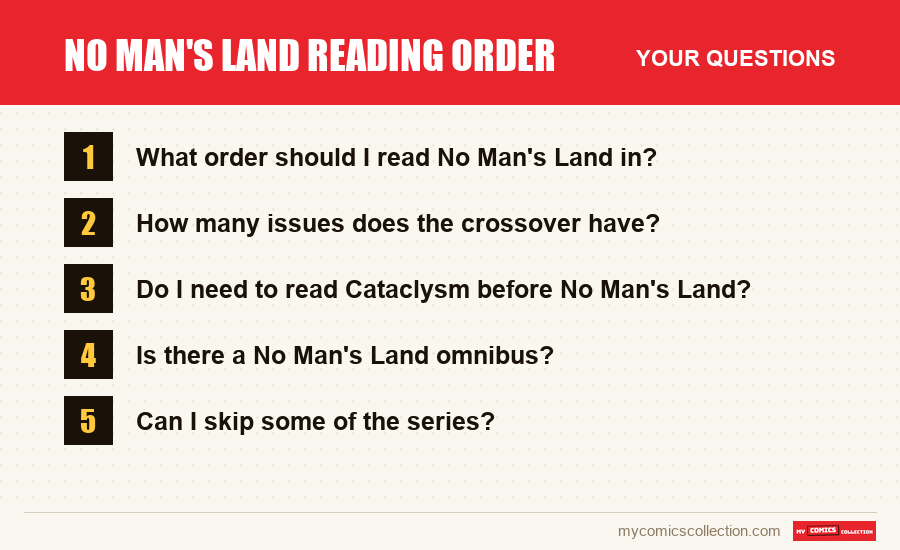
Start with the preludes Cataclysm and Aftershock, then the one-shot Batman: No Man's Land #1 (March 1999). Then read Batman #563-574 and Detective Comics #730-741 as the main trunk, adding the other series according to the cover date of each issue.
The saga amounts to 80 regular monthly issues, plus four specials and the graphic novel Batman: Harley Quinn. It spans all of 1999, and its architect is Jordan B. Gorfinkel, who set its structure as well as the broad outlines of that year's Batman titles.
Yes, it is advised. Cataclysm describes the magnitude 7.6 earthquake that devastates Gotham, and Aftershock follows its consequences. Without them, the city's situation at the start of 1999 feels abrupt. Modern collected editions also gather these preludes in Road to No Man's Land volumes.
Yes: a Road to No Man's Land Omnibus (November 2020), then a No Man's Land Omnibus in two volumes, released in January and September 2022. They gather the material in a coherent format and spare you from hunting for each single issue separately. Do check the table of contents before buying, though.
Yes. If you want the essentials, read Batman, Detective Comics, Shadow of the Bat and Legends of the Dark Knight. The issues of JLA, Young Justice in No Man's Land and The Batman Chronicles are optional extras for the main plot.
Looking to complete your No Man's Land single issues? Estimate the value of the ones you already own.
Estimate my comic