
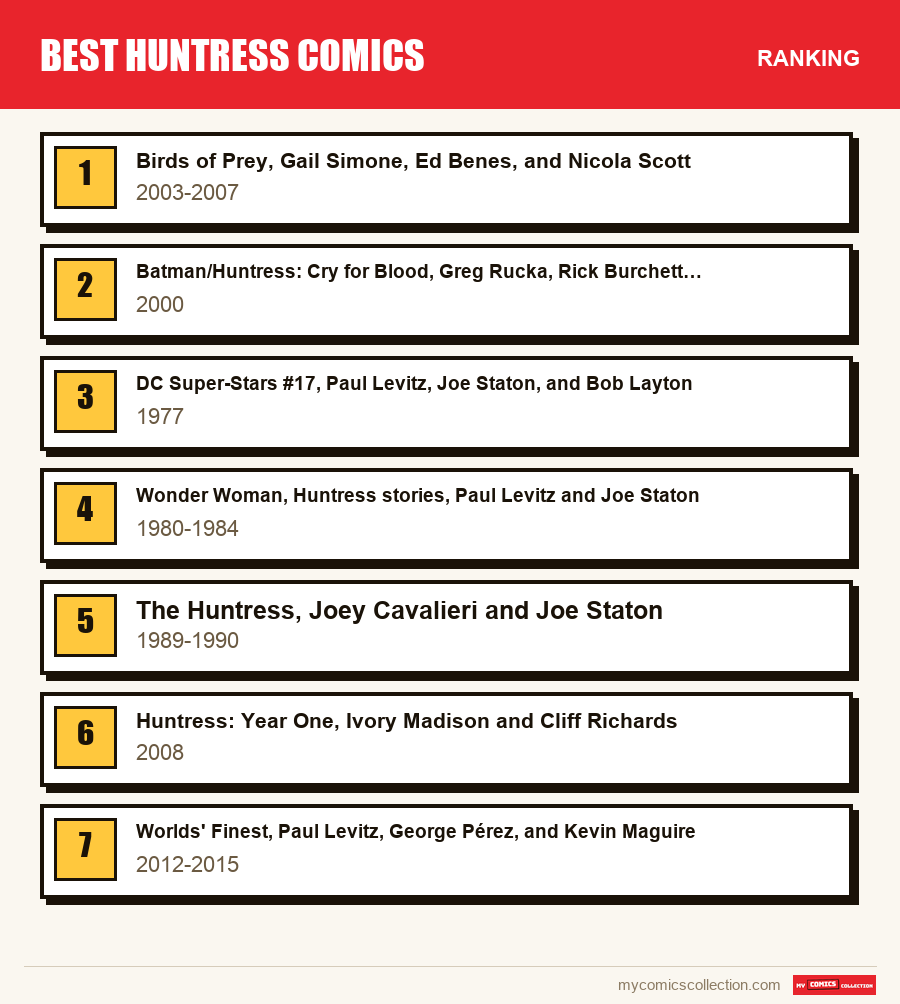
The best Huntress comics depend on which of two heroines you mean. For Helena Bertinelli, read Gail Simone's Birds of Prey (2003-2007) and then Batman/Huntress: Cry for Blood (2000). For Helena Wayne, Batman's daughter from Earth-2, start with DC Super-Stars #17 (1977) and the stories that ran in Wonder Woman beginning with #271 (1980). Every entry in this guide tells you which of the two it covers.
There is not one Huntress but two: a daughter of Bruce Wayne and Selina Kyle, born in 1977 on a parallel Earth, and a mob heiress born twelve years later on the main Earth. Search engines and catalogs mix them up, which skews entire purchases. This ranking keeps them apart, picks seven reads, and tells you which Helena each one belongs to.
As always in this guide, only verified information (creators, issue numbers, dates) is stated as fact; the analysis is our own, with no reproduction of protected panels or dialogue.
Her first appearance
Helena Wayne first appears in All Star Comics #69, cover-dated November-December 1977, in the story "United We Fall!": Paul Levitz writes it, Joe Staton pencils it, and Bob Layton inks it. The same month, DC Super-Stars #17 publishes her origin in the story "From Each Ending... A Beginning!", by the same team. The Huntress is then the Earth-2 daughter of Bruce Wayne and Selina Kyle, and she joins the Justice Society.
Helena Bertinelli is born twelve years later in The Huntress #1, cover-dated April 1989, a series launched by Joey Cavalieri on script and Joe Staton on art. This second Huntress is the daughter of a mob family. She has no blood tie to Batman: her quest is a personal vendetta against organized crime, which leads her to Gotham much later. Joe Staton therefore drew both women, twelve years apart.
1: Birds of Prey, Gail Simone, Ed Benes, and Nicola Scott (2003-2007)
This entry is about Helena Bertinelli. Gail Simone writes the series from Birds of Prey #56 (August 2003) through #108, with Ed Benes as the artist in the early going and Nicola Scott on the last nine issues, starting with #100. The Huntress appears in the title from #57 (September 2003) and becomes a full-time Oracle agent in #68. The arcs to remember are "Of Like Minds" (#57 to #59, September to November 2003), "Between Dark and Dawn" (#69 to #73, September to November 2004), and "Hero Hunters" (#76 to #80, January to May 2005). Each can be read on its own, so you can sample the series before committing to the whole run.
What these issues give Bertinelli: a place in a team, with a livelier tone than her earliest stories. This read is for everyone, including a reader who knows no other Huntress. To see how the team compares with the movie adaptation, check our comparison of the 2020 film and the comics.
2: Batman/Huntress: Cry for Blood, Greg Rucka, Rick Burchett, and Terry Beatty (2000)
This is Helena Bertinelli again. This six-issue miniseries, running from June to November 2000, revises the character's origin: Greg Rucka writes, Rick Burchett draws, and Terry Beatty inks. The title pairs Batman and the Huntress, and the trade paperback came out in March 2002.
The value of this read is that it places Bertinelli in Batman's orbit, with his name right in the title, which the 1989 series did not do. It is for readers who want to understand why a heroine born into the mob ends up alongside the Bat-family. Read it before Birds of Prey if you want to know her motivations before you see her on a team. Our Batgirl reading guide helps place the period: Bertinelli briefly wears that costume starting in Batman: Shadow of the Bat #83 (March 1999), during No Man's Land.
3: DC Super-Stars #17, Paul Levitz, Joe Staton, and Bob Layton (1977)
This entry is about Helena Wayne. This issue, cover-dated November-December 1977, holds three stories, and the last one, thirteen pages long, is the Huntress story. Paul Levitz writes it, Joe Staton pencils it, and Bob Layton inks it. Helena's origins are told there in flashback, with Batman, Catwoman, and Commissioner Gordon, in an Earth-2 Gotham.
What this story gives you: the very meaning of the character, heir to a couple of crimefighters who no longer exist on the main Earth. It is for Bronze Age collectors, and for anyone who wants to know why this Helena no longer exists in DC continuity. The Huntress story only takes up the end of the issue, so those last pages are where you will find what you are looking for.
4: Wonder Woman, Huntress stories, Paul Levitz and Joe Staton (1980-1984)
Once again, this is Helena Wayne. Starting with Wonder Woman #271 (September 1980), the Huntress gets a backup story in each issue, a format that runs through #321 (November 1984). Paul Levitz writes most of these chapters and Joe Staton pencils them. They come just before Crisis on Infinite Earths, which erases Earth-2 and the Huntress from main continuity.
These chapters spread over more than four years, and this is where Wayne stops being one Justice Society member among many and becomes a heroine in her own right. They are for Bronze Age readers who like short formats, like the ones we cover in our best Wonder Woman runs. They are not easy to read in sequence: hunt them down by issue number, because they are scattered through the single issues of another heroine's book.
Do you collect this series?
Track what you own, what you are missing and what your collection is worth. 7-day trial.
Start my trial →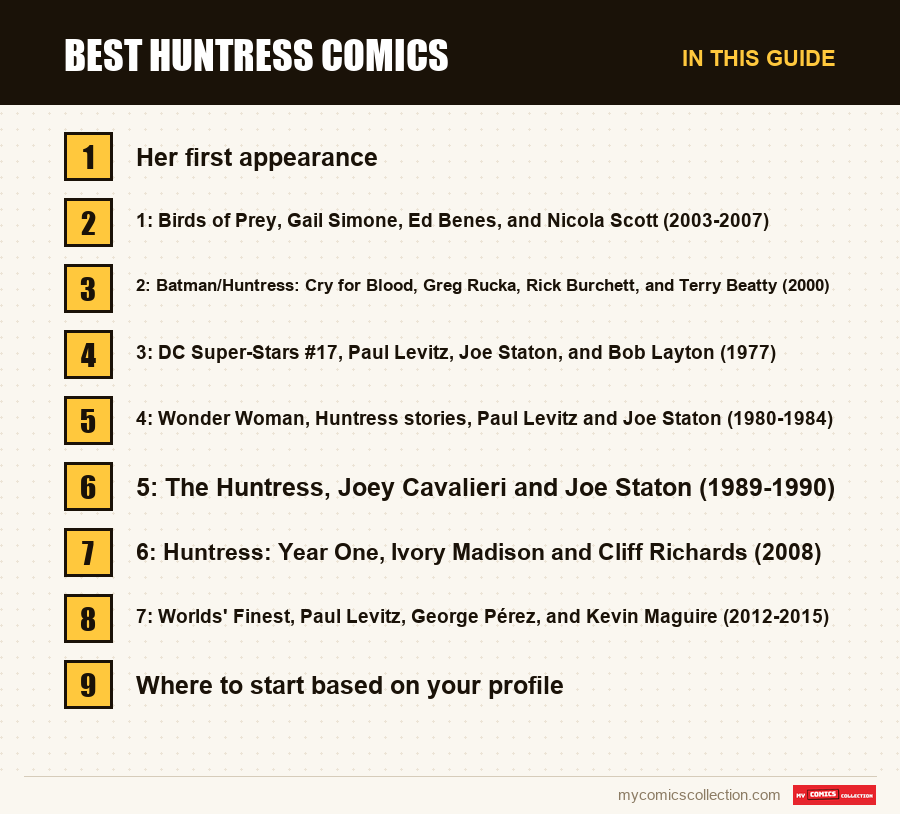
5: The Huntress, Joey Cavalieri and Joe Staton (1989-1990)
This entry is about Helena Bertinelli, in the series that introduces her. It runs nineteen issues, from April 1989 to October 1990. Joey Cavalieri and Joe Staton launch the series; Bob Smith on inks and Robbie Busch on colors are credited in the first issue. The titles of the early chapters, such as "Code of Silence" for #1, point to an urban vigilante book more than a superheroine saga.
It gives Bertinelli a mob origin story and a voice of vengeance, far from the setting Gotham will later give her. It is for readers curious about the character's history and for collectors chasing a first appearance. As a reading experience, it comes after entries 1 and 2, because the stories still sit in a New York setting that later books revised.
6: Huntress: Year One, Ivory Madison and Cliff Richards (2008)
Helena Bertinelli once more. This six-issue miniseries ran from May to July 2008 on a twice-monthly schedule, with Ivory Madison on script and Cliff Richards on pencils, Art Thibert inking. It takes up the character's origin, which had already been revised in 2000, and tells it again. A trade paperback followed in January 2009.
This story is for readers who want a clean version of Bertinelli's beginnings without going through the 1989 series. Above all, it gives you a continuous read in one volume. Reviews at the time were split: one saw a more successful reinterpretation than the previous one, another a string of clichés. Save it for a second read.
7: Worlds' Finest, Paul Levitz, George Pérez, and Kevin Maguire (2012-2015)
This last entry is about Helena Wayne, back in the relaunched universe of 2011. The series, which stars the Huntress and Power Girl, launched with an issue cover-dated July 2012 and ended in 2015. Paul Levitz, who co-created Helena Wayne thirty-five years earlier, writes the series. George Pérez and Kevin Maguire split the art on the first issue, one for the present-day action, the other for the flashbacks.
It gives this Helena a second career, in a tone more modern than the 1980s. It is for readers who enjoy team-ups and who already know Power Girl. Still, you should know that this Helena is not the one from 1977: the context has changed and will not require you to know the original.
Where to start based on your profile
If you are looking for the "modern" Huntress, go with Bertinelli: Cry for Blood, then Birds of Prey. If you love the history of the medium, go with Wayne: DC Super-Stars #17, then the Wonder Woman stories. Readers who discover the character after a movie or a TV show will find what they want in Birds of Prey, which is also the easiest way into the rest of Gail Simone's catalog.
For fans of team-ups, Worlds' Finest remains the best recent choice. For a self-contained version of the beginnings, Huntress: Year One is enough. And if you want to understand what became of Helena Wayne after 1985, read the feature on the key issues of the Crisis before you tackle the 2012 series.
One last reading landmark: the disappearance of Helena Wayne in Crisis on Infinite Earths (1985) cleanly separates her two periods. Before 1985, she lives in the Earth-2 single issues, with the Justice Society and the Wonder Woman stories; after 2011, she returns in a reworked continuity. Bertinelli belongs to the post-1985 era: her series is born in 1989, her origin is revised in 2000 in Cry for Blood, then told again in 2008 in Year One. Reading in publication order is therefore the simplest approach, as long as you know which Helena you are talking about.
The key issues to know
The landmarks fall into two columns, one per Helena. On the Wayne side: All Star Comics #69 and DC Super-Stars #17, both cover-dated November-December 1977, which form her double first appearance; next come Wonder Woman #271 (September 1980), the start of her run of backup stories, and Worlds' Finest #1 (July 2012), her modern return.
On the Bertinelli side: The Huntress #1 (April 1989), her first appearance, Batman: Shadow of the Bat #83 (March 1999), where she becomes Batgirl, Batman/Huntress: Cry for Blood #1 (June 2000), and Birds of Prey #57 (September 2003), her debut on Gail Simone's team. A tip: before you buy, check the listing description to see which Helena it is, then compare sold listings for the same issue in the same condition.
Frequently asked questions
This guide covers two: Helena Wayne, the daughter of Batman and Catwoman on Earth-2, who debuted in 1977, and Helena Bertinelli, born into a mob family, who debuted in The Huntress #1 in April 1989. They share a first name and a code name, but not the same story or the same era.
The Huntress #1, cover-dated April 1989. The series was launched by Joey Cavalieri on script and Joe Staton on art, and it ran nineteen issues through October 1990. This Huntress is the daughter of a mob family, with no family tie to Batman.
For the best-known version, start with Batman/Huntress: Cry for Blood (2000), then read Gail Simone's Birds of Prey. For Batman's daughter, the entry point is DC Super-Stars #17, cover-dated November-December 1977, followed by the Wonder Woman stories.
Yes, briefly. Her entry into that role is in Batman: Shadow of the Bat #83, cover-dated March 1999, during the No Man's Land arc. Our Batgirl reading guide details the other women who wore the costume and the issues where they appear.
She vanished from main continuity with Crisis on Infinite Earths (1985), then came back in the relaunched universe of 2011, notably in Worlds' Finest, a series launched in 2012. That version is a new interpretation, and it does not retell the 1977 stories exactly.
Do you own All Star Comics #69 or The Huntress #1? Have its condition and value appraised, and specify which Helena it is.
Appraise my comic