
The third wearer of the Batgirl mask had, at the end of the 2000s, a brief series, closed before having met a large audience, and whose reputation has continued to grow since. This reputation is not reflected in the ads. As of the August 29, 2026 statement, one hundred and seventy-five uncertified bids were asking between $1.76 and $199.99, with a midpoint at $7.25; opposite, four verified copies only, claimed from $44.00 to $179.99, median $67.50. A readership can love a series without being numerous enough to price it: below a certain number, affection produces loyalty, not demand.
There is a category of series that the market does not know how to deal with: those that everyone says good things about and that almost no one looks for. The third bearer of the Batgirl identity is a textbook case. His series, launched in the late 2000s, stopped for the most banal reason possible, not enough buyers when it came out, and immediately began a second life made of private recommendations, discussion threads, advice given in hushed tones to anyone who asked how to enter this corner of the universe. Twenty years of positive word of mouth later, the second-hand section treats it exactly like any issue from the same period: as volume.
This discrepancy is not a market anomaly, it is its normal functioning. A price does not measure the perceived quality of a work, it measures the pressure that a number of buyers exerts simultaneously on a number of available copies. A series can be excellent, unanimously defended, cited as an example, and never cross the threshold of numbers from which this defense becomes a purchasing movement. It is this threshold that we are going to describe, based on the only material available to us: a count of announcements, carried out on a single date, which says nothing about an evolution but says a lot about a structure.
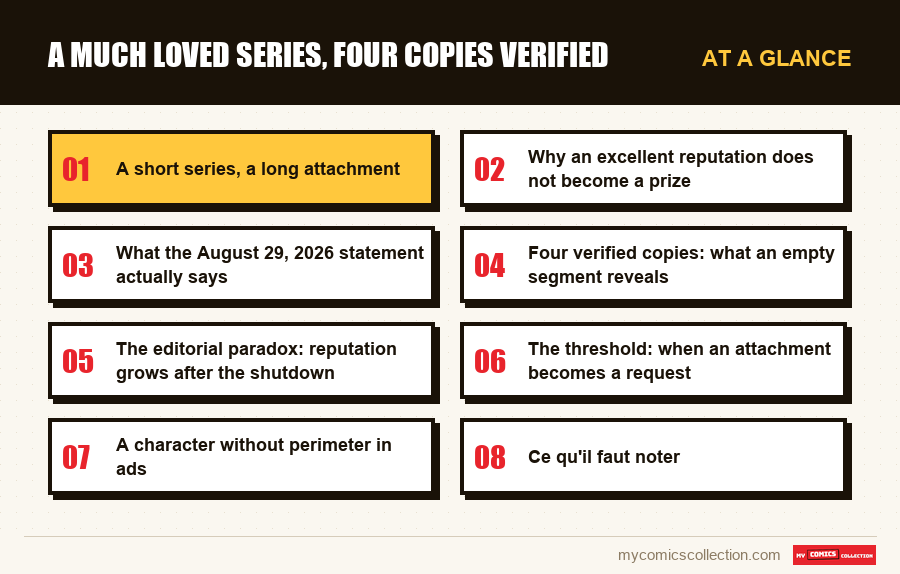
A short series, a long attachment
Series of this nature share the same profile: an editorial lifespan insufficient to establish a purchasing habit, but sufficient to leave a clear impression. The reader who followed it at the time has a precise memory of it, because it was a chosen reading and not one that was forced upon them: no one followed this series out of inertia, we followed it because we had decided to do so. This selection at the entrance mechanically produces a satisfied audience: those who were not interested in the tone had already withdrawn. The satisfaction rate of the remaining readership is therefore very high, and it is precisely this flattering statistic which then deceives everyone about the real size of the group.
What such a public produces is not a request, it is a transmission. People who liked this series recommend it, but they recommend it individually, in conversations, to people who won't necessarily buy. A recommendation is not an order. Between the moment someone says "this is really good" and the moment they open an ad, look at the condition, compare two sellers and pay, there is a considerable distance, and this distance eliminates the vast majority of intentions. A work can thus accumulate thousands of favorable opinions and generate a few dozen actual purchases.
The result can be seen in the way these booklets are put on sale. They are not offered as identified pieces, with an argument; they are offered in batches, as fillers, in general inventories which liquidate entire boxes from the same decade. The seller does not know that he has a famous series, and he has no reason to know it, since nothing in his sales history has ever informed him of this. Reputation circulates in a channel, that of readers, to which the commercial channel is not connected.
Why an excellent reputation does not become a prize
A price is a number phenomenon
The amount someone is willing to pay depends on the fear of not getting the copy. This fear only exists if other buyers are visibly looking for the same thing. When there are too few of them, everyone can wait: nothing escapes them. Generalized expectation keeps requested amounts at the stock level, not at the desire level.
Loyalty is expressed only once
A reader attached to this series buys it, then never returns to it: he owns it. Loyalty is a unique act per person, while demand presupposes a renewed flow. A small and loyal group therefore exhausts its own needs in a few years, after which it continues to speak well of it without buying anything more.
Praise does not flow where one buys
Recommendations live in reading spaces; prices are formed in transaction spaces. Nothing automatically transports one to the other. A series can therefore be celebrated for years in an environment that sellers do not frequent, and remain invisible in the one they do.
The offer aligns with the seller's memory
A seller sets his amount by remembering what he sold, not by evaluating what he holds. If these booklets always went for a few dollars, he puts them back for a few dollars. The reputation of the series never enters into its calculation, as it never produced a commercial signal that it could have recorded.
These four mechanisms reinforce each other. The absence of pressure keeps amounts low; low amounts prevent the series from appearing in conversations about value; this lack of conversation prevents the arrival of new buyers; and the absence of new buyers confirms the absence of pressure. The circuit is closed, and it can remain so indefinitely without the quality of the work having the slightest effect on it. What would break the circuit is not an excess of admiration: it is an excess of people.
All data cited here comes from an ad count conducted on August 29, 2026. These are amounts that sellers claimed that day, not completed transactions. A requested amount is only binding on the person who displays it.
An observation made on a single date cannot describe any trajectory. Nothing in this reading allows us to say that something is rising, falling or stabilizing: it gives a photograph of the supply, and a photograph does not contain movement.
What the August 29, 2026 statement actually says
A very low midpoint
Out of one hundred and seventy-five advertisements without certification, the central amount requested was $7.25. This is the level of an ordinary second-hand booklet, the one at which we sell off a stock without paying any particular attention to it. No tension is reflected in this figure.
One date, no trend
This count is a snapshot. It cannot be compared to anything since no previous survey has been carried out under the same conditions. Any sentence like "it's climbing" or "it's weakening" would be a pure invention: the measurement simply does not have the form it would need to answer this question.
Quatre exemplaires vérifiés
Faced with the one hundred and seventy-five raw offers, the certified segment had four announcements. Four. At this scale, there is no verified market for this series: there are four particular situations, from which nothing general can be inferred.
An isolated maximum is not a price
The high of the uncertified segment was $199.99, compared to a low of $1.76. This amplitude does not describe a range of values: it describes the freedom that everyone has to write what they want. The highest amount expresses a seller's hope, nothing else.
The verified is around $67.50
The four certified listings ranged from $44.00 to $179.99, with a midpoint of $67.50. The gap with the raw segment mainly measures the cost and rarity of the certification process, not a higher intrinsic value of the copies concerned.
Aucun périmètre propre
The research brings up a number of issues from other series from the same period and the same universe. This character does not have a separate space in the advertisements: its production is absorbed by the editorial group to which it belongs, and is treated at the rate of this group.
Four verified copies: what an empty segment reveals
The ratio of four to one hundred and seventy-five is the most telling fact of the entire survey. Having a fascicle certified costs money and takes time; no one incurs this expense without anticipating that it will be covered by the resale price. When only four people, out of all those offering these booklets, considered that the operation was worth it, this means that almost all of the holders concluded the opposite. This is not a judgment on the series, it is an economic calculation, and this calculation is the same for almost everyone.
The absence of a verified segment has a practical consequence: there is no upper reference for this series. For works in high demand, certified copies act as a beacon; everyone knows roughly what the peak is worth, and the gross amounts are positioned in relation to this benchmark. Here, this benchmark does not exist, or rather it is based on four announcements, which amounts to the same thing. The raw segment therefore floats freely, which explains both its very low floor and its occasional bouts of fantasy.
This configuration creates a stark contrast. A reader sold on the series may read dozens of rave reviews, then find that a copy can be found for a few dollars. He often concludes that the market “hasn’t figured it out yet.” This is a false reading: the market understood perfectly, it counted the buyers. What the reader interprets as an injustice is simply the numerical translation of an effect. To delve deeper into how these amounts are read from one carrier to another, our analysis of the value of Batgirl comics détaille le raisonnement.
The editorial paradox: reputation grows after the shutdown
Here is the most counterintuitive point of this file. A series discontinued for insufficient sales almost systematically sees its esteem increase in the years following its discontinuation. This is not a coincidence, nor is it a late recognition of talent. It's a structural effect: an interrupted series can no longer disappoint. It is removed from the main risk that awaits any long publication, that of declining, of changing teams, of contradicting one's own promises, of extending beyond one's idea. It remains frozen at its best known state.
The mechanism also relies on the selection of those who speak about it. Those who abandoned the series are silent; they have no reason to comment on a reading they dropped. Those who finished it are, by construction, those to whom it suited. Over time, public discourse on this work purified until it contained only favorable voices. A long-running and popular series keeps its detractors in full view; a short and confidential series ends up being defended only by its supporters. The unanimity observed is therefore not the sign of superior quality, it is the residue of sorting.
There is also an emotional dimension: grievance. A readership whose series has been interrupted feels frustration, and this frustration fuels the defense of the work. Defending this series also means contesting the decision that deleted it. Praise becomes an argument in an old editorial discussion, and it gains in intensity what it loses in neutrality. A work that is considered to have been wronged is always praised a little more highly than a work that has had its chance.
The result is a scissor. Reputation rises because the group speaking becomes tighter and more heated; demand depends on the group that buys, and this group does not expand. The more the series is celebrated, the more the gap with the observed amounts seems shocking, while the two curves simply do not measure the same population. We compare the intensity of a small number to the power of a large number, and these quantities are not commensurable.
Collecting this series?
Track what you own, what you are missing and what your collection is worth. 7 day trial.
Start my trial →The threshold: when an attachment becomes a request
There is a number below which no amount of enthusiasm produces a measurable effect on prices. This threshold is not a universal figure, it depends on the quantity of copies in circulation, but its principle is constant: for an amount to rise, two buyers must compete for the same object at the same time. A single buyer, even an enthusiast, buys at the displayed price. Two simultaneous buyers create an auction. The entire formation of prices lies in this passage from one to two, repeated often enough to become a habit that sellers record.
A series printed on an industrial scale and read by a limited audience is very far from this threshold. The number of copies produced at the time far exceeds the number of people seeking it today, ensuring that no competitive encounters will occur. Each interested buyer finds his copy without opposition, pays what is asked, and disappears from the population of buyers. The stock hardly moves; the demand dissolves as it manifests itself.
This dynamic explains why an increase in reputation, with a constant workforce, changes nothing. Multiplying by ten the number of people who find the series excellent only has an effect if a significant fraction of them take action simultaneously. However, recommendations spread slowly, through individual contact, which spreads purchasing intentions over years. A spread flow never generates tension; only a brutal convergence achieves this. This is why an adaptation, a relaunch or an external event can move a market in a few weeks where two decades of praise have produced nothing: these events synchronize buyers, they do not convince them better.
We must draw an uncomfortable but clear conclusion: in this domain, being loved and being in demand are two independent properties. You can combine both, have neither, or only have one. The third carrier falls into the third case. His series has a readership, it has no market, and these two observations do not contradict each other. Comparing several periods of this character from this angle sheds light on many things: our selection of meilleures périodes de Batgirl explicitly distinguishes what the criticism retains from what the announcements record.
A character without perimeter in ads
The third observation of the survey deserves attention, because it sheds light on a practical problem. By searching for this series, we massively obtain booklets of other titles, from the same period and from the same editorial universe. Sellers describe their lots by the family to which they belong rather than by the precise title, which is rational from their point of view: it is the family that attracts visitors, not the title. A confidential title therefore benefits from the traffic of the whole, but in exchange it loses its identity.
This dissolution has a cost for the buyer. He cannot isolate the offer that interests him, he must sort it by hand from a heterogeneous mass. This sorting work discourages some potential buyers, and this discouragement removes a few more units from an already insufficient number. The search difficulty thus acts as an additional filter, which pushes the market a little further from the threshold instead of bringing it closer to it.
It also has an effect on the amounts. When an ad is written for the set and not for the title, the price is based on the average value of the set. The issues of this series therefore inherit the generic rate of all the production of the period, regardless of what they are. The very low midpoint observed on August 29, 2026 is not only the expression of weak demand: it is also the direct consequence of a classification which does not distinguish this series from others. We cannot sell dearly what we have not named.
Ce qu'il faut noter
The count only describes one day. The one hundred and seventy-five raw offers and the four verified advertisements were noted on August 29, 2026, and these are sums claimed by sellers, never sums collected. Nothing in this file allows us to say that these levels have moved, in one direction or the other: there is no second measurement point with which to compare them.
The median is the only readable benchmark here. In a population where everyone displays what they want, the average would be distorted by extreme announcements and the maximum would say nothing at all. The $7.25 gross segment and the $67.50 verified segment are the only two numbers that are reasonable to keep in mind; the floor at $1.76 and the peak at $199.99 measure the magnitude of hopes, not the magnitude of trades.
The certified segment is too thin to mean anything. Four announcements do not constitute a deal, they constitute four individual decisions. This rarity is in itself the most solid information: it indicates that almost no holder considered the certification profitable for this series, which is a collective verdict much more reliable than the amounts themselves.
The reputation of this series does not predict any future amount. The critical esteem and readership attachment are real and documented by word of mouth, but they relate to a group whose size has never reached the level where buyers compete with each other. Waiting for “the market to catch up with quality” amounts to waiting for a phenomenon for which no mechanism ensures its occurrence.
Accurate identification takes precedence over all other precautions. Since the ads mix this series with the editorial ensemble from which it comes, the first difficulty is not to evaluate, it is to know what we are watching. Checking the exact title, the carrier concerned and the period of publication in the catalog before any decision avoids the most frequent error on this character: thinking you are buying this series and acquiring a neighboring issue.
No, and this case shows it. Critical rating depends on those who have read; the amounts depend on who is buying at the same time. When the second group remains too small, no amount of appreciation creates tension on the available copies. The link between esteem and price assumes a number of buyers that many series never reach.
Because certification represents an expense that the resale price must cover. Given the level of the amounts requested on the raw segment on August 29, 2026, almost all of the sellers concluded that the operation was not profitable. This rarity is not a statistical accident: it is the same decision made independently by almost all holders.
Let it provide information about its author and not the series. An isolated requested amount, without a transaction behind it, expresses a seller's expectation. In a population of one hundred and seventy-five offers with a central point at $7.25, this peak is an outlier, not an exploitable upper bound.
Impossible to say, and it must be said clearly. The reading covers a single day, that of August 29, 2026. A single measurement has no direction: it can neither confirm nor deny progression. Any claim of evolution made from these figures alone would be fabricated.
Because sellers classify their stock by editorial family rather than by title: it is the family that attracts visitors. This series therefore does not have its own section in the advertisements, and it inherits the generic price applied to all the production of its period. Sorting is up to the buyer, who must check what they are looking at themselves.
Track what you actually own, title by title
When a series dissolves into the editorial group to which it belongs, the only protection is an inventory which names each issue unambiguously. My Comics Collection relies on the catalog to precisely identify your copies, distinguish successive carriers of the same identity and keep track of what you are missing.