
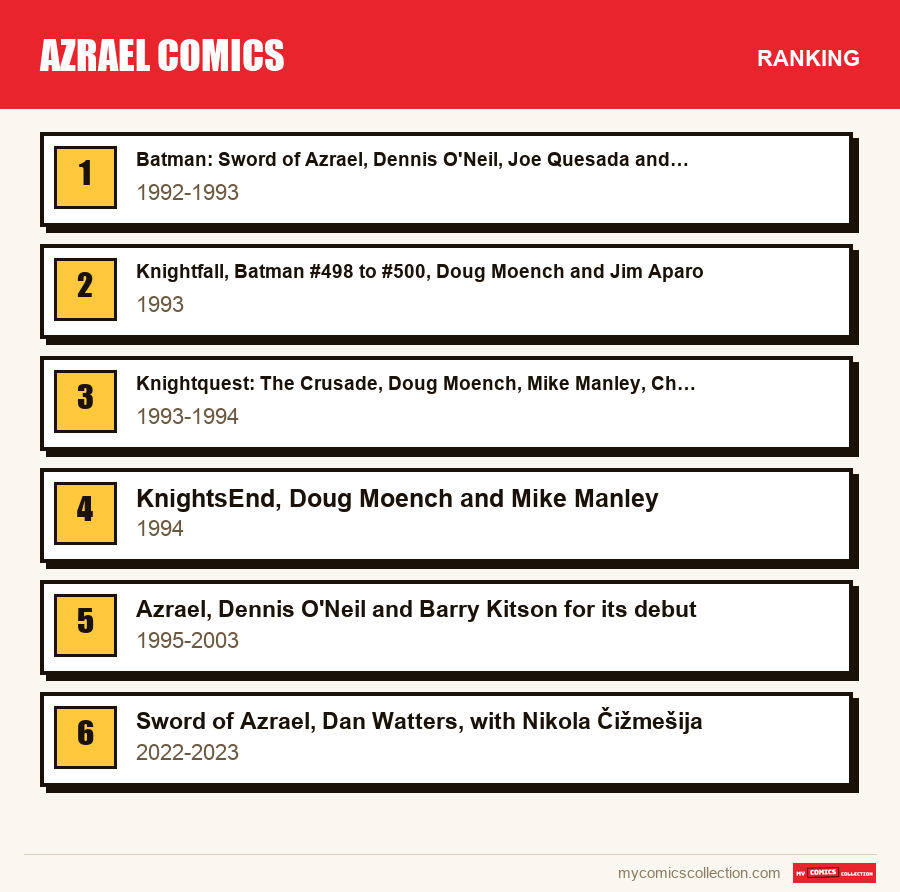
The best Azrael comics to start with begin with the miniseries Batman: Sword of Azrael (1992-1993) by Dennis O'Neil, Joe Quesada and Kevin Nowlan, which is his debut. Follow it with Batman #498 to #500, where Jean-Paul Valley takes over as Batman, then Knightquest: The Crusade and KnightsEnd (1993-1994). Finish with the Azrael series, launched in 1995, and Dan Watters's Sword of Azrael (2022).
Azrael poses a rare problem for a comics reader: his most famous story is the one where he is not the hero of his own series, but Batman's replacement at the heart of a giant event. So you have to sort. This guide singles out six reads where Jean-Paul Valley sits at the center of the action, from his birth in 1992 to his return in 2022, and says for each who it is for and how to approach it.
As always in this guide, only verified information (creators, issue numbers, dates) is stated as fact; the analysis is our own, with no reproduction of protected artwork or dialogue.
His first appearance
Azrael is born in Batman: Sword of Azrael #1, cover-dated October 1992. Dennis O'Neil writes the story, Joe Quesada pencils it and Kevin Nowlan inks it. The miniseries runs four issues, published from October 1992 to January 1993, and it was collected in a trade paperback as early as 1993. The character goes by the name Jean-Paul Valley: a Gotham student whom the Order of St. Dumas has shaped to become its armed hand, and whom Batman crosses paths with as the plot unfolds.
This first issue matters for two reasons. First, it sets up the religious mythology that all the later stories pick up: a sect, a costume, an imposed legacy. Second, it came out a few months before Knightfall, so a reader in 1993 already knew Valley when Bruce Wayne handed him the cowl. Even today, Batman's replacement reads better when you know where his replacement comes from.
1: Batman: Sword of Azrael, Dennis O'Neil, Joe Quesada and Kevin Nowlan (1992-1993)
This is the natural entry point, and it reads in a few hours. Dennis O'Neil sets against Gotham's vigilante a disturbing double, born of an armed religious tradition. Joe Quesada on pencils and Kevin Nowlan on inks give it a nervous look, very far from the Aparo pages that will frame the 1993 saga.
The miniseries gives the character his whole setting, from the costume to the quest, before the crossovers take hold of him. It suits readers who want to understand Valley before watching him become Batman, and it assumes no knowledge of Gotham. Look for the 1993 trade paperback if you don't want to chase four single issues: the reading order is laid out in it, and the book has stayed easier to find than the originals.
2: Knightfall, Batman #498 to #500, Doug Moench and Jim Aparo (1993)
The Knightfall crossover runs nineteen chapters spread across Batman and Detective Comics; Valley is not at the center of all of them. The three Batman issues that matter for him are written by Doug Moench and penciled by Jim Aparo, joined by Mike Manley on #500. In Batman #497 (July 1993), inked by Dick Giordano, Bane breaks Bruce Wayne's back, on a Kelley Jones cover. In Batman #498 (August 1993), inked by Rick Burchett, Bruce asks Jean-Paul Valley to take the costume during his convalescence.
In Batman #499 (September 1993), inked by Scott Hanna, Valley strikes a deal with the crook Tough Tony Bressi to get to Bane, and he fights Bird, Trogg and Zombie using custom gauntlets; Robin worries about his methods. Batman #500 (October 1993), inked by Terry Austin and Mike Manley, sees Valley, in a mechanical suit of armor, beat Bane. Read in one go, this triptych shows an effective replacement whose methods already worry those close to him: the whole thing sets up the slide that follows.
This read suits any Batman fan. To go through the whole saga, follow the order in the Knightfall issue guide; to follow Valley, these three issues are enough, once you know #497.
3: Knightquest: The Crusade, Doug Moench, Mike Manley, Chuck Dixon and Graham Nolan (1993-1994)
After the victory over Bane, Valley stays Batman while Bruce Wayne recovers and then searches for Jack Drake and Shondra Kinsolving; this is the thread the crossover calls The Crusade. It runs through Detective Comics #667 to #675 and Batman #501 to #508, plus issues of Shadow of the Bat and two of Catwoman. The two series each have their own team, which changes the tone from one issue to the next: Doug Moench writes and Mike Manley draws Batman, while Chuck Dixon writes and Graham Nolan draws Detective Comics.
Take Batman #501 (November 1993), "Code Name: Mekros." Valley has a vision of St. Dumas, saves the mob boss Don Mercante from an assassination attempt, then uses that debt; the assassin Mekros ends up killing Mercante instead of Batman. At the other end of the run, Batman #508 (June 1994), "Mortal Remains," inked by Josef Rubinstein, shows Valley letting Abattoir fall into a vat of molten metal before Robin's eyes. In between, Batman #505 (February 1994), "Blood Kin," is inked by Bob Wiacek.
On the Detective Comics side, #667 (October 1993), "Wild, Wild East," inked by Scott Hanna, pits Valley against the Trigger Twins, and Batman tries out the Subway Rocket, an equipped subway train. Detective Comics #675 (June 1994), "Midnight Duel," brings together the same team. This part suits readers who have read Knightfall and want to know why trust comes apart: you follow a slide, issue after issue. It reads best in a collection, because the order of the single issues across the series is tricky.
4: KnightsEnd, Doug Moench and Mike Manley (1994)
The final movement of Batman's replacement, KnightsEnd, is split between Batman #509 and #510, Shadow of the Bat #29 and #30, Detective Comics #676 and #677, Legends of the Dark Knight #62 and #63, Robin #8 and Catwoman #12. For Valley, the essentials play out in the two Batman issues, written by Doug Moench and penciled by Mike Manley.
Batman #509 (July 1994), "Spirit of the Bat," inked by Dick Giordano, shows Bruce Wayne training with Lady Shiva, while Batman follows the trail of arms dealers, one of whom reminds him of Carlton LeHah, an old enemy. Batman #510 (August 1994), "Return of the Bat," is inked by Joe Rubinstein: two Batmen fight over the costume on the roof of Penn Selkirk's building, with Catwoman, Robin and Nightwing caught in the brawl. The dramatic engine is that Valley refuses to give in.
This read suits those who want the resolution, not the epic. It makes little sense without the previous part: #510 is the seventh installment of KnightsEnd and assumes six chapters upstream.
Do you collect this series?
Track what you own, what you are missing and what your collection is worth. 7-day trial.
Start my trial →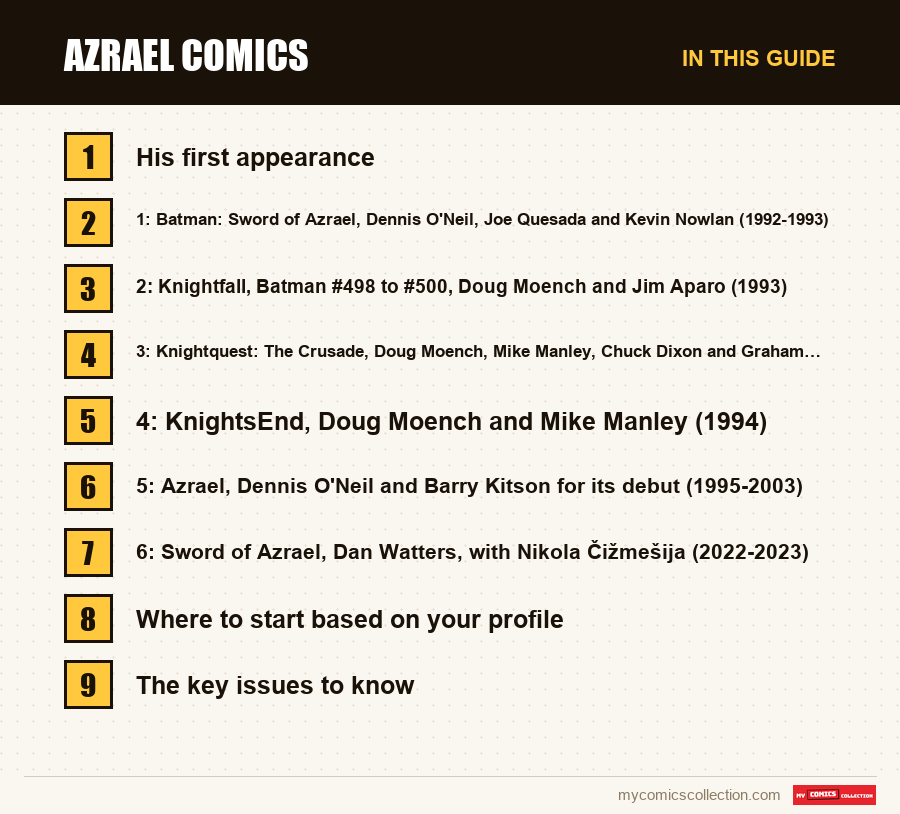
5: Azrael, Dennis O'Neil and Barry Kitson for its debut (1995-2003)
When the ongoing series starts, cover-dated February 1995, Valley is no longer Batman. Azrael #1, whose first chapter is titled "Fallen Angel," is written by Dennis O'Neil, penciled by Barry Kitson and inked by James Pascoe, with a cover by Kitson. #2, cover-dated March 1995, continues with the same team and the chapter "...Some Say In Ice...".
The series reaches one hundred issues and ends in 2003. From #47, it takes the title Azrael: Agent of the Bat. Dennis O'Neil conceives it on the model of the Arthurian legends, with Azrael's quest recalling that of the Grail. It is the read on this list that sets Valley outside Bruce Wayne's shadow for the long haul, and the longest one: count on a lot of single issues.
Beginners can settle for the trade paperback Azrael Vol. 1: Fallen Angel, which collects the first seven issues along with the 1992 miniseries and Showcase '94 #10. Enthusiasts can go further, notably through most of the issues #51 to #61 of Agent of the Bat, which appear in the volumes devoted to No Man's Land, the storyline where Gotham is cut off from the world.
6: Sword of Azrael, Dan Watters, with Nikola Čižmešija (2022-2023)
Thirty years after the character's debut, DC devotes a six-issue miniseries to him once more. #1 comes out in August 2022, with a cover date of October 2022. Dan Watters writes it, Nikola Čižmešija is the credited artist on the first issue, and Marissa Louise handles the colors. The story finds Valley withdrawn in a monastery in Europe, seeking peace, far from the mask he has worn.
A three-chapter prelude appeared in Batman: Urban Legends and was collected in the one-shot Dark Knight of the Soul. This read suits today's readers who didn't live through the 1990s: it assumes you remember that Valley wore Batman's costume in 1993-1994. It works as an epilogue, and it shows that the character can still carry a story.
Where to start based on your profile
If you're coming from Knightfall, read Sword of Azrael first, then reread Batman #498 to #500 knowing where Valley comes from. Our page on Bane covers the other side of the saga.
If you want to broaden your reading to Batman's family, go from the saga to the best Damian Wayne comics, which follow another character in Bruce's circle. If you prefer arcs about heroes who lose themselves, read The Crusade and KnightsEnd back to back. If you're looking for a character to follow for the long haul, move on to the 1995 Azrael series. And if you only want one recent story, Dan Watters's miniseries reads without heavy preparation. To place these reads in the timeline, our history of Batman in comics serves as a guiding thread.
The key issues to know
The hierarchy follows the usual logic of first appearances and turning points. The baseline landmark is Batman: Sword of Azrael #1 (October 1992), the character's first appearance. Next come Batman #497 (July 1993), where Bruce Wayne's back is broken, Batman #498 (August 1993), where Valley receives the costume, and Batman #500 (October 1993), where he beats Bane. Detective Comics #667 (October 1993) opens the Detective Comics side of The Crusade.
The turning points that follow: Batman #508 (June 1994), the moral tipping point, and Batman #510 (August 1994), the clash of the two Batmen. Finally, Azrael #1 (February 1995) marks the character's entry into a series that belongs to him. Our guide to Batman key issues places these issues among the series' other landmarks.
The collecting method is the same for everyone: first identify what you want to read, then what you want to own as single issues. First appearances of supporting characters are hunted as single issues; the 1993-1994 crossovers, scattered across about ten series, are easier to own in collections. Always compare several sold listings of the same issue before buying, and check the condition of the spine and corners, because 1990s single issues were printed in large numbers and are set apart mostly by their condition.
Frequently asked questions
In Batman: Sword of Azrael #1, cover-dated October 1992, written by Dennis O'Neil, penciled by Joe Quesada and inked by Kevin Nowlan. The miniseries runs four issues and ends in January 1993, a few months before the Knightfall crossover.
No. For Jean-Paul Valley, the three issues Batman #498 to #500, written by Doug Moench and penciled by Jim Aparo, are enough as an entry point. #497 gives the context, and Knightquest: The Crusade then picks up the thread when Valley stays Batman.
One hundred issues, from February 1995 to 2003, plus three annuals. It takes the title Azrael: Agent of the Bat from #47. The trade paperback Azrael Vol. 1: Fallen Angel collects the first seven issues and the original miniseries, the simplest way to start.
No. Michael Lane, introduced in Batman #665 (June 2007) by Grant Morrison and Tony S. Daniel, has also worn the costume. An Azrael series written by Fabian Nicieza ran from 2009 to 2011, in eighteen issues, and does not follow Valley.
Yes: Sword of Azrael, a six-issue miniseries written by Dan Watters, with #1 cover-dated October 2022. It is preceded by the one-shot Dark Knight of the Soul, which collects a story that appeared in Batman: Urban Legends.
Do you own a copy of Batman #500 or Sword of Azrael #1? Get it appraised before deciding whether to keep it.
Appraise my comic