
To meet Commissioner Gordon at the center of a story, read Batman #404 to #407 first, the Year One arc by Frank Miller and David Mazzucchelli from 1987, where a cop from Chicago collides with Gotham's corruption. Continue with the miniseries Gordon's Law (1996-1997), then Gotham Noir (2001) and Batman #41 to #45 (2015), where he puts on the suit. His first appearance dates to Detective Comics #27, in May 1939.
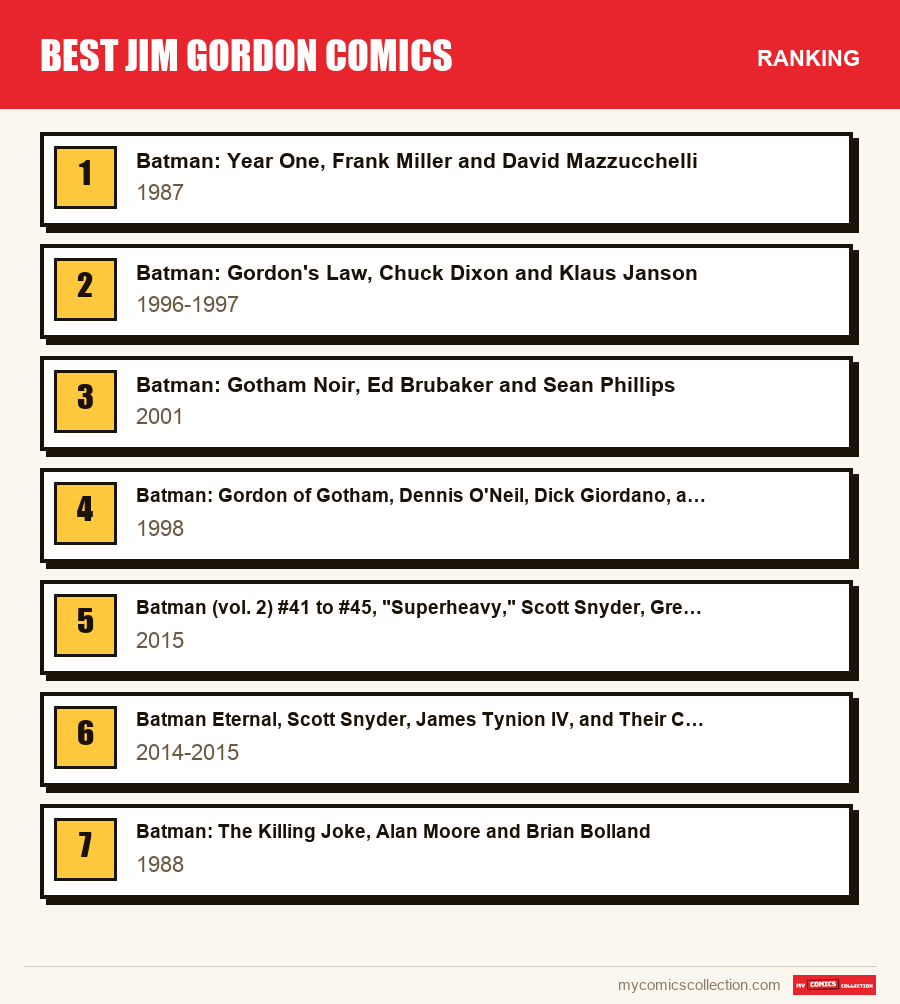
Commissioner James Gordon runs through almost every Batman story, and he is rarely read for his own sake. Yet a handful of tales put him front and center: a cop facing his corrupt chain of command, a young Chicago officer tempted by brutality, a private eye drowning in alcohol, a middle-aged man in a mechanical suit. This guide ranks seven reads where he plays the lead or a driving role.
As always in this guide, we only state verified facts (creators, issue numbers, dates); the analysis is our own, with no reproduction of protected art or dialogue.
His First Appearance
May 1939: Detective Comics #27 introduces Batman to the public, and the future commissioner is already there, in the very first panel of the story "The Case of the Chemical Syndicate." He goes only by "Commissioner Gordon," with no first name. The character is the work of Bill Finger, on script, and Bob Kane, on art, the creators of Batman. Our page on this landmark issue details what it contains.
For a collector, the distinction is clear: Detective Comics #27 is hunted for Batman, and Gordon's presence changes nothing there. He remains a bit player. What turns him into a protagonist comes much later, in 1987, with a complete rewrite of his beginnings.
None of the seven entries below belongs to the Golden Age: all date from 1987 or later, because that is when writers started telling Gordon's story for its own sake.
1: Batman: Year One, Frank Miller and David Mazzucchelli (1987)
The arc fills Batman #404 to #407, from February to May 1987. Frank Miller writes, David Mazzucchelli draws, Richmond Lewis colors and Todd Klein letters, under the direction of Dennis O'Neil. The four chapters are titled "Who I Am - How I Come to Be," "War Is Declared," "Black Dawn," and "Friend in Need."
The story follows two men who arrive in Gotham the same year: Bruce Wayne, who is preparing his vigilante identity, and Jim Gordon, a cop from Chicago who arrives with his wife Barbara, then pregnant. Gordon discovers a precinct dominated by Commissioner Gillian Loeb, whose authority rests on corruption; Loeb eventually resigns when Harvey Dent obtains evidence against him. Later, Gordon's wife and newborn are taken hostage by Johnny Viti. The arc also shows his affair with his colleague Sarah Essen, which he ends out of guilt before confessing to Barbara.
The arc gives Gordon a past, flaws, and a home, when until then he had been merely a function in Batman's backdrop. No prior knowledge of Gotham is required, and this is the entry we put first. It is short: four single issues to read in one go. For French-language editions, see our page on the French editions of Year One.
2: Batman: Gordon's Law, Chuck Dixon and Klaus Janson (1996-1997)
This four-issue miniseries ran from December 1996 to March 1997, under the titles "Dirty Deal," "Suspicious Minds," "Night Country," and "The Broken Men." Chuck Dixon writes; Klaus Janson draws. The starting point is a bank robbery carried out with no regard for human life, which Gordon witnesses. The case haunts him, he investigates it doggedly, and he doesn't want Batman getting involved.
It's a police procedural in which the commissioner leads the investigation and the vigilante stays in the background. What it contributes is showing Gordon at his job, with his methods and his limits.
It suits a reader who enjoyed Year One and wants that same noir crime tone again. It is easy to read on its own. A collecting detail: it appears in the trade paperback Batman: Gordon of Gotham (2014), alongside two other miniseries from the 1990s. One of them, G.C.P.D., focuses mostly on detectives Harvey Bullock and Renee Montoya, and Gordon has only a minor role in it: so don't count it as a Gordon story.
3: Batman: Gotham Noir, Ed Brubaker and Sean Phillips (2001)
This Elseworlds one-shot, released in March 2001, is written by Ed Brubaker and drawn by Sean Phillips, with Dave Stewart on colors and Bill Oakley on letters. It is 1949, in a film noir Gotham. Jim Gordon is no longer a cop: an alcoholic, separated from his wife Sarah and his daughter Barbara, he works as a private detective. Selina Kyle, who runs a nightclub and with whom he had an affair, hires him to escort a friend to a party. The friend, Rachel, is murdered, and Gordon becomes the perfect suspect for a corrupt mayor tied to organized crime.
The story is out of continuity, which frees the writer: Batman appears only intermittently, the Joker and Harvey Dent run through the plot, and Gordon carries the story. It's a chance to see what the character is worth without a uniform or an office, reduced to his perseverance and his weaknesses.
The entry is for those who love Gordon for his human side and who enjoy postwar crime fiction. It reads in one sitting. For the writer, see the Ed Brubaker page; for Selina Kyle, the Catwoman hub.
4: Batman: Gordon of Gotham, Dennis O'Neil, Dick Giordano, and Klaus Janson (1998)
Four issues, from June to September 1998. Dennis O'Neil writes; Dick Giordano draws, with Klaus Janson. The story takes place during Gordon's early years on the Chicago police force, long before Gotham, and closes with an epilogue in the series' present day.
The young cop is paired with a brutal partner and drawn into a morally dubious atmosphere, before an intervention keeps him from tipping over. The entry completes Year One from upstream: you see where his refusal to give in comes from.
This miniseries is for those who already know Gordon and want to go back to his youth. It isn't the entry point: read it after Year One. Dennis O'Neil was also the editor of Year One, as his creator page notes.
Do you collect this series?
Track what you own, what you are missing and what your collection is worth. 7-day trial.
Start my trial →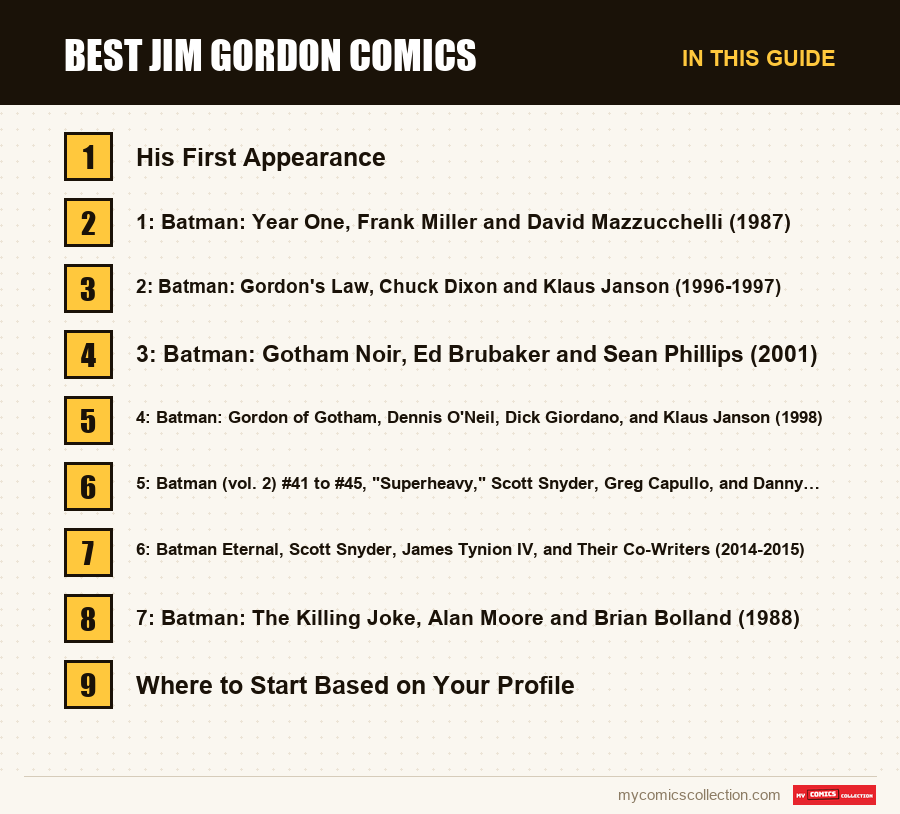
5: Batman (vol. 2) #41 to #45, "Superheavy," Scott Snyder, Greg Capullo, and Danny Miki (2015)
"Superheavy" opens with Batman #41, on sale June 10, 2015 and cover-dated August, and runs through issue #45. Scott Snyder writes, Greg Capullo draws, Danny Miki inks, FCO Plascencia colors, and Steve Wands letters. After Bruce Wayne's disappearance, it is Jim Gordon who takes up the mantle of Batman, in a mechanical suit.
The idea rests on a reversal: the cop whose only weapon was his conscience ends up in armor, charged with defending the city under a mask. The arc poses a question to the character that Year One had barely touched: what becomes of an honest man when he wears someone else's symbol?
The read suits those who follow modern Batman and want to see another face under the cowl. It is more divisive than the earlier entries; a reader attached to Miller's Gordon will find a sharp contrast here. You'll read it in the context of Snyder's run: see the Scott Snyder page to place it in his body of work.
6: Batman Eternal, Scott Snyder, James Tynion IV, and Their Co-Writers (2014-2015)
This 52-issue weekly series ran from April 2014 to April 2015. Scott Snyder and James Tynion IV lead it, with John Layman, Ray Fawkes, Tim Seeley, and later Kyle Higgins among the writers. Jason Fabok, Dustin Nguyen, Andy Clarke, and others share the art. Let's be clear about Gordon's role: this is an ensemble story, where he is one of the driving characters and the plot starts with him.
The first issue sees him chasing Professor Pyg; a bullet fired at a henchman hits a transformer, the explosion causes two trains to collide, and the police arrest him. Gordon is sent to Blackgate to await trial. We later learn that mind-control technology was used to manipulate him.
The story tests the character as the reverse of Year One: the man who denounced corruption is himself accused. It's for a patient reader, ready to follow fifty-two single issues and several writers. Don't expect a portrait of Gordon alone: take it for his chapters, and save the others for another day.
7: Batman: The Killing Joke, Alan Moore and Brian Bolland (1988)
Alan Moore provides the text and Brian Bolland the art for this 48-page volume, released in March 1988 in prestige format; John Higgins did the original colors and Richard Starkings the letters. The Joker wounds Barbara Gordon, the commissioner's daughter, and kidnaps Gordon himself. He puts him through an ordeal in an abandoned amusement park, intending to prove that an ordinary man can be broken in a single day.
Gordon's role needs to be pinned down precisely: he is not the title character, but he is the subject of the ordeal and the one who endures it. The story shows a man who holds his moral line and who demands that the Joker be arrested by the book. That is what makes it valuable for this ranking, even though it belongs as much to the Joker and Batman as to him.
It is short and harsh, and aimed at an adult audience. Barbara fans will also see a turning point here, developed on our Batgirl hub. For the market, see our page on the Killing Joke key issue.
Where to Start Based on Your Profile
If you're new to Gordon, start with Year One and pause for a moment: it's the foundation for everything else. If you already like him and want investigation, follow up with Gordon's Law, which keeps that precinct discipline. If you prefer period crime fiction, Gotham Noir is the choice furthest from continuity, and reads with no prerequisites.
If you follow Batman, jump straight to Batman #41 to #45 to see Gordon in the suit, then to Batman Eternal if you like ensemble stories. If you're after the harshest ordeal, The Killing Joke is made for you, provided you accept that it belongs as much to the Joker as to Gordon.
One more landmark: in Batman: The Long Halloween, which Jeph Loeb writes and Tim Sale draws over thirteen issues (1996-1997), Gordon forms a trio with Batman and district attorney Harvey Dent against Carmine Falcone. He plays an essential role there without being the center; we therefore haven't ranked it, but the Year One reader will find that trio again there. See also our page on Two-Face, the other half of that alliance.
The Key Issues to Know
Here are the landmarks that matter for this character, in chronological order:
- Detective Comics #27 (May 1939): Gordon's first appearance, alongside Batman, by Bill Finger and Bob Kane.
- Batman #404 (February 1987): the first chapter of Year One, which reinvents his beginnings.
- Batman: The Killing Joke (March 1988): Gordon's kidnapping and the attack on his daughter.
- Batman: Gotham Noir (March 2001): the Elseworlds one-shot by Brubaker and Phillips.
- Batman Eternal #1 (2014): Gordon's arrest that launches the weekly series.
- Batman #41 (cover-dated August 2015): the opening of "Superheavy" and Gordon as Batman.
To buy one of these issues, three checks are enough. First, identify the exact single issue, with its number and year, because Batman has several series carrying the same title. Next, tell the original comic apart from the trade paperback that reprints the same story. Finally, compare copies in equivalent condition before judging a price.
Frequently Asked Questions
The right entry point is the four issues of Batman numbered 404 to 407, published from February to May 1987 under the arc title Year One, with Frank Miller and David Mazzucchelli at the helm. Four issues are enough to understand where he comes from, what he faces in Gotham, and why he becomes Batman's ally. Then move on to Gordon's Law (1996-1997) to watch him run an investigation.
In Detective Comics #27, cover-dated May 1939, which also introduces Batman. He is called "Commissioner Gordon" there, with no first name, and appears from the very first panel of the story "The Case of the Chemical Syndicate." Bill Finger writes the story, Bob Kane draws it.
Yes, in Batman (vol. 2) #41 to #45, the "Superheavy" arc by Scott Snyder, Greg Capullo, and Danny Miki, published in 2015. After Bruce Wayne's disappearance, Gordon takes on the role in an exoskeleton. This story is separate from Year One and reads better after it.
This four-issue miniseries (June to September 1998), written by Dennis O'Neil and drawn by Dick Giordano with Klaus Janson, is set during Gordon's early years on the Chicago police force. It doesn't tell a Gotham story: it explains where his sense of ethics comes from, and reads after Year One.
It isn't necessary to understand the character, but it puts him to the test: the Joker kidnaps Gordon after wounding his daughter Barbara. Alan Moore and Brian Bolland published it in March 1988 at 48 pages, for an adult audience. Read it after Year One, once you already know the man the Joker wants to break.
Do you own a single issue of Year One or a copy of Detective Comics featuring Gordon? Get its condition and value appraised.
Appraise My Comic