
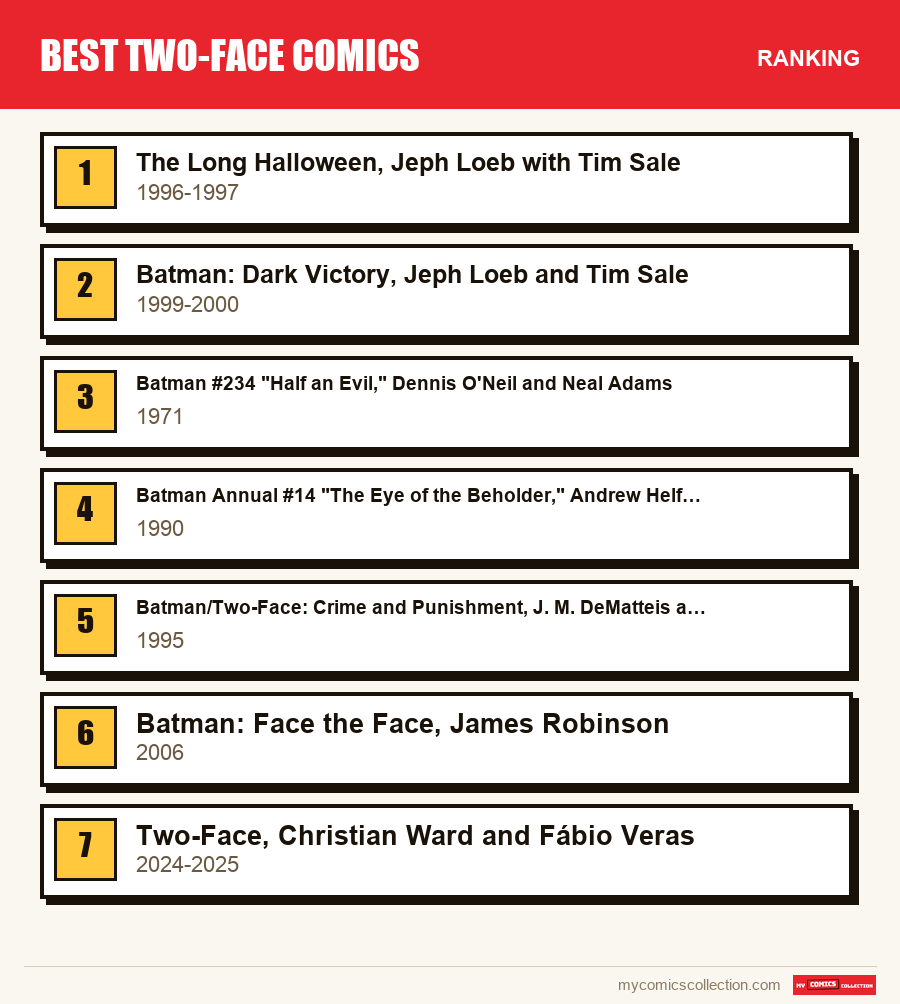
For the best Two-Face comics and where to start, begin with Batman: The Long Halloween (1996-1997) by Jeph Loeb and Tim Sale, which tells the fall of Harvey Dent, then read its sequel Batman: Dark Victory (1999-2000). Then go back to the character's first appearance in Detective Comics #66 (August 1942), by Bill Finger and Bob Kane, and to the key issue Batman #234 (1971), his big comeback.
Two-Face is the Batman enemy who most resembles him: a Gotham district attorney, an ally before he is an adversary, whose life tips over in a single hearing. Every writer who takes him on must answer the same question: is he a monster, a victim or a man who still makes choices? The answers vary from decade to decade, and that is what makes his bibliography so rich to explore.
As always in this guide, we only state verified facts (creators, issue numbers, dates); the analysis is our own, with no reproduction of protected art or dialogue.
His first appearance
The character is born in Detective Comics #66, dated August 1942, in a story titled "The Crimes of Two-Face." Bill Finger writes the story and Bob Kane signs the art. At this point the district attorney is not yet named Dent: he appears under the name Harvey Kent, a surname that will be replaced by Dent starting with Batman #50 (1948). This change of name explains why some listings and catalog entries hesitate between the two spellings for the earliest stories.
The dramatic mechanism set up in 1942 has barely moved since: a man of the law disfigured during a hearing, a coin that becomes his oracle, and half a face that can no longer inspire trust. A single issue from that era belongs to the Golden Age key issue market, with rare, fragile and fiercely contested copies; to read the character, you have no need to own it. The stories below are all available in collected editions, and that is where you should start.
1: The Long Halloween, Jeph Loeb with Tim Sale (1996-1997)
This thirteen-issue miniseries ran from December 1996 to July 1997. Jeph Loeb writes, Tim Sale draws, and Gregory Wright handles the colors. It extends the universe of Batman: Year One and follows an entire year in Gotham, from Halloween to Halloween, during which a killer strikes on every holiday on the calendar. Harvey Dent is a district attorney there and an ally of Batman and Captain Gordon against the Falcone family: the story shows by what stages this ally ends up becoming Two-Face.
It is the most obvious entry point, because it does what few stories manage: you mourn the man before you fear the monster. It is aimed at any crime-fiction reader, even without knowledge of Batman, and Tim Sale's angular art gives it the tone of a film noir. Read it in one go in a collected edition. Our guide on the comparison with the animated film details what the adaptation keeps of the structure, and the one on the French editions helps you choose a volume.
2: Batman: Dark Victory, Jeph Loeb and Tim Sale (1999-2000)
The direct sequel ran from November 1999 to December 2000 in fourteen issues, counting a #0. Same team, same register. The center of gravity shifts to Two-Face himself: he wages a turf war against what remains of the Falcone mob, led by Sofia Falcone, while a new killer nicknamed the Hangman targets the police. Dent becomes the ideal suspect, which accentuates his decline.
Where The Long Halloween tells a fall, Dark Victory explores its consequences. It suits the reader who loved the first volume and wants to see Two-Face treated as a gang boss rather than a victim. Avoid it if you have not read The Long Halloween: the story assumes you know its events. Read it immediately afterward, in the same spirit, in a collected edition, so as not to lose the thread of the holidays and the murders.
3: Batman #234 "Half an Evil," Dennis O'Neil and Neal Adams (1971)
It is in Batman #234, under the title "Half an Evil," that Two-Face makes his comeback: the pen is Dennis O'Neil's, the pencil Neal Adams's. This issue belongs to the series' dark renewal in the early 1970s, when O'Neil and Adams steered Batman back toward a graver register after the years of fantasy. Two-Face's return is part of that movement: the character becomes a credible threat again rather than a mere archive fixture.
This read is for fans of the character's history and of the Bronze Age, less for someone seeking a self-contained story. It can be found in collections devoted to those years, and it is appreciated above all as a milestone: without it, you cannot understand how Two-Face stayed in Gotham's landscape through the 1990s. To place the two creators, see the hubs for Dennis O'Neil and Neal Adams.
4: Batman Annual #14 "The Eye of the Beholder," Andrew Helfer and Chris Sprouse (1990)
This 68-page special, released in July 1990, gives the character a modern origin. Andrew Helfer writes, Chris Sprouse pencils, Steve Mitchell inks, and the cover is by Neal Adams. The story establishes the idea that Two-Face is a second state of Harvey Dent, afflicted with dissociative identity disorder. It is the psychological reading that runs through most later stories.
The format is unusual: an annual, so a separate single issue that one rarely looks for among the ongoing series. It is aimed at those who want to understand the character's inner workings rather than his fights. It is easy to read on its own, with no prerequisites, but it turns up in themed collections that are worth consulting before you hunt for the original single issue.
Do you collect this series?
Track what you own, what you are missing and what your collection is worth. 7-day trial.
Start my trial →
5: Batman/Two-Face: Crime and Punishment, J. M. DeMatteis and Scott McDaniel (1995)
Published in 1995, this standalone story written by J. M. DeMatteis and drawn by Scott McDaniel looks at Harvey Dent's childhood and the influence of his father on his personality. It is one of the few stories that puts Two-Face's psychology ahead of the action, which gives it a different tone from the monthly series of the time.
It suits readers who have already enjoyed the angle of The Eye of the Beholder and want to see it extended. It is a one-shot: it reads in one evening, without knowing the Batman series then running. On the other hand, it is harder to find than the great classics, which makes it a second-wave read more than an entry point.
6: Batman: Face the Face, James Robinson (2006)
Published from May to August 2006, this story spans two series at once, Detective Comics #817 to 820 and Batman #651 to 654, with James Robinson writing. It marks Batman's return to Gotham a year after the events of Infinite Crisis. Harvey Dent, who has undergone surgery and appears cured, has watched over the city during Batman's absence. Murders committed with his double-barreled gun nonetheless put him back at the center of the investigation.
The strength of this arc is that it raises the question of redemption after so many relapses: can you trust a repaired Dent? It is aimed at the reader already familiar with the broad outlines of Batman, who will appreciate the police investigation and the handling of secrecy. Read it in a collected edition, in published order, because the arc alternates between the two series and it is simpler to go through the edition that groups them.
7: Two-Face, Christian Ward and Fábio Veras (2024-2025)
This six-issue series begins in December 2024 under the pen of Christian Ward with Fábio Veras on art: a miniseries entirely centered on Harvey Dent, a rare thing for a Batman enemy. It puts Harvey Dent back in a courtroom, which reconnects with his original function as district attorney, and it has been collected in the volume Trial Separation.
This is the contemporary read of the ranking. It will please those who want a recent Two-Face, with modern staging, and it reads without much preparation. It does not have the historical weight of the earlier entries, but it shows that the character can now carry a series project on his own, which was not a given for an enemy long confined to supporting roles.
Where to start depending on your profile
If you are discovering Batman, open The Long Halloween then Dark Victory: these two collections form a block and require no prior reading. If you like origin stories, start from Batman Annual #14 then Crime and Punishment, and then read Batman: Year One to meet Harvey Dent alongside Gordon before his fall (our guide on Batman #404 details its first issue).
If you prefer the police investigation, Face the Face is the right choice. If you want what the character offers today, take Christian Ward and Fábio Veras's series. Fans of the Bronze Age and classic art will finally start with Batman #234, which shows Two-Face's return in a pivotal period of the title's history. The 2008 film The Dark Knight popularized the character with a wide audience; our comparison with the comics points to the reads that shed light on it.
The key issues to know
The first landmark is Detective Comics #66 (August 1942), the first appearance, one of the Golden Age single issues where condition makes all the difference. Next come Batman #50 (1948), where the surname becomes Dent, then Batman #234 (1971), which marks his return to the series. For the modern period, Batman Annual #14 (1990), the first issue of The Long Halloween (December 1996) and that of Dark Victory (November 1999) are the landmarks readers cite most.
The method is the same for each: identify what the issue actually brings to the character, check the edition (original single issue or reprint), then compare several completed sales before deciding. A modern issue, printed in quantity, is judged by the condition of the copy, whereas a 1940s issue is judged by its rarity and any restoration. In every case, reading the story in a collected edition before buying the single issue keeps you from paying a lot for an object that gives you nothing more.
Frequently asked questions
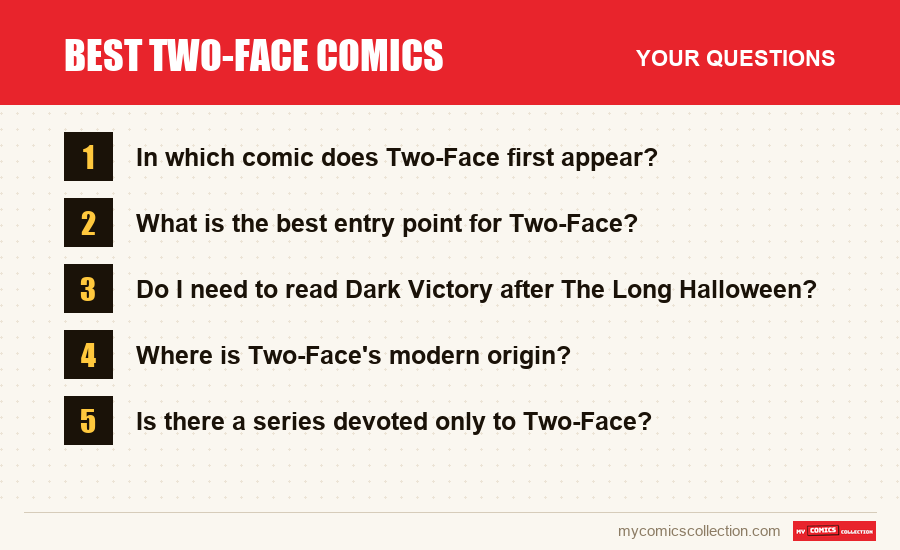
He appears in Detective Comics #66, dated August 1942, in the story "The Crimes of Two-Face." Bill Finger is the writer and Bob Kane the artist. The district attorney is still called Harvey Kent there; the name Dent takes hold starting with Batman #50, in 1948.
Open Batman: The Long Halloween, a thirteen-issue miniseries that Jeph Loeb and Tim Sale published from December 1996 to July 1997. The story reads on its own and shows Harvey Dent's transformation. Follow it with Dark Victory, its sequel, which then explores the gang boss he becomes.
Yes, because Dark Victory is a direct sequel, published from November 1999 to December 2000 by the same team, Jeph Loeb and Tim Sale. The story picks up the consequences of the first and assumes you know them. Read them back to back, with no other prerequisite.
It is in Batman Annual #14, "The Eye of the Beholder," released in July 1990. Andrew Helfer wrote it and Chris Sprouse penciled it. The issue presents Two-Face as a second state of Harvey Dent, afflicted with dissociative identity disorder, a reading since taken up by many stories.
Yes, a six-issue series by Christian Ward and Fábio Veras began in December 2024; it is a miniseries entirely devoted to Harvey Dent. It has been gathered in a collection titled Trial Separation, and it reads without prior knowledge of Batman.
Do you own a Two-Face single issue, from Batman #234 to The Long Halloween? Get it valued before selling it or having it graded.
Value my comic