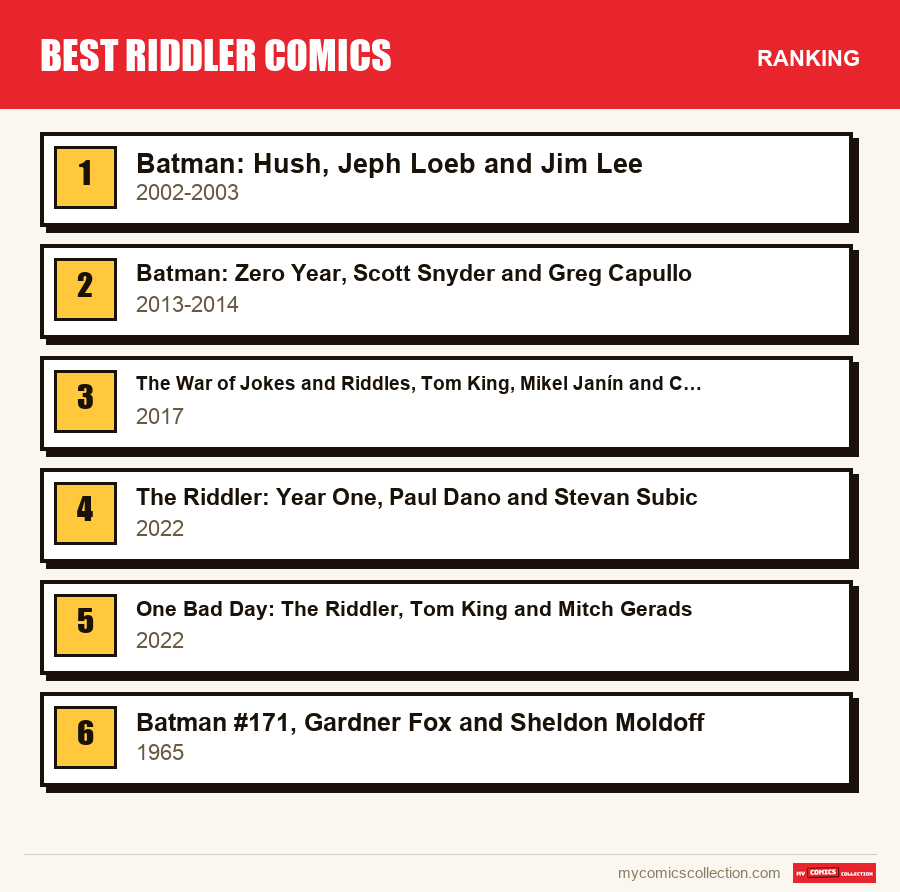
The best Riddler comics to start with are Batman: Hush (2002-2003), where Edward Nygma plays a decisive role, then Batman: Zero Year (2013-2014) for his most spectacular version, and The Riddler: Year One (2022) for his most intimate portrait. The character was born in Detective Comics #140 (October 1948), by Bill Finger and Dick Sprang.
The Riddler is the only major Batman enemy whose main weapon is a question. Where the Joker sows chaos and Two-Face rules on a coin flip, Edward Nygma needs to be understood and, above all, to be recognized as smarter than the detective. That obsession has given writers an unusual playground: stories built like puzzles, and turns that make him by turns a prankster and a chilling strategist.
As always in this guide, only verified facts (creators, issue numbers, dates) are stated as fact; the analysis is our own, with no reproduction of protected art or dialogue.
His first appearance
Edward Nygma appears in Detective Comics #140, dated October 1948, with Bill Finger writing and Dick Sprang drawing. The character is a direct creation of the team that was building the Batman universe after World War II. His origin in that first story is that of a young boy who cheats at a school puzzle contest, discovers that cheating pays, then turns that mechanism into a criminal way of life. He becomes a man who deliberately leaves riddles before each crime, as if demanding to be caught intelligently.
This 1948 issue is a Golden Age book, so one whose preservation stays fragile: acidic paper, flaking covers, frequent spine creases. For a reader who wants the character rather than the object, an archive collection is more than enough. For a collector, it is a landmark to understand before hunting it, because a character who first appeared in a series the size of Detective Comics ends up scattered between his first appearance, his returns and his modern retellings. We come back to this in the last section.
1: Batman: Hush, Jeph Loeb and Jim Lee (2002-2003)
The Hush arc runs twelve issues of the Batman series, #608 to #619, with Jeph Loeb writing and Jim Lee drawing. It is read above all for its central mystery: a masked adversary seems to know Batman from the inside and upends his life through his usual enemies. The Riddler plays a background role more than a leading one, but it is a role that changes his standing in Batman's universe. He is the one who pieces together, from clues others overlooked, the truth about the vigilante's identity, and that moment gives a generation of readers the image of a mind able to truly rival Batman.
Who is this entry for? Almost everyone. It is one of the most widely read entry points in all of Batman's bibliography, and Jim Lee's art makes it visually immediate. To read it, a single trade paperback is enough if you want the complete story; if you want to understand why the start of the arc has its own standing among single-issue collectors, our guide to Batman #608 details the structure, and the one on the value of Hush explains how to evaluate a copy.
2: Batman: Zero Year, Scott Snyder and Greg Capullo (2013-2014)
In the Batman series by Scott Snyder and Greg Capullo, the Zero Year arc rewrites Batman's early days for the modern era, and this is where the Riddler gets his biggest moment on stage. Edward Nygma is an engineering genius who takes Gotham hostage: he cuts the city's power, plunges it into darkness and issues a public challenge to all its inhabitants, with a storm bearing down on the metropolis in the background. The Riddler stops being a theatrical thief and becomes a master of collective panic, and the city itself becomes his riddle.
This read suits those who already know Batman and want to see the Riddler treated with unusual seriousness. It suits less anyone who has never opened a Batman comic, because the story assumes familiarity with the setting. The simplest route is the collected edition of the arc, which gathers the issues in reading order. For the same team's other work, notably the Owls saga, our guide to the key issues of Court of Owls is a useful complement.
3: The War of Jokes and Riddles, Tom King, Mikel Janín and Clay Mann (2017)
In the Batman series relaunched in 2016, Tom King devotes a long arc to an unexpected gang war: the Joker and the Riddler fight over Gotham, forcing the other criminals to pick a side. The story takes place largely in the past, like a memory Batman recounts, which lets Tom King alternate pure noir entertainment with chapters of great sadness. Mikel Janín and Clay Mann split the art across chapters, and that is one of the reasons for the arc's reputation: two very different art styles serving a single story.
The Riddler appears here as a warlord, cold, methodical, almost military, far from the green-suited clown of television. The arc is ideal for a reader who enjoys structured stories and shifts in tone. It is for those who already have a reading base on Batman, because it plays with the character's memory and relationships. A trade paperback read is the most natural, since the arc was conceived as a single narrative block. To place its author, the Tom King hub gathers his other work.
4: The Riddler: Year One, Paul Dano and Stevan Subic (2022)
This six-issue miniseries is written by Paul Dano, the actor known for playing the character on screen, with Stevan Subic on art. It tells the story of Edward Nygma's youth, his childhood, his isolation, his taste for games and secrecy, then the slide into crime. It is the most intimate portrait of the character, and the only one on this list that reads without knowing Batman: Gotham is merely a backdrop, and the vigilante stays largely offscreen.
It is not a story of a duel but a psychological study. It will please those who prefer origin stories to showdowns, and those who want to understand what the character is really after behind his riddles. It reads in six single issues or as a trade paperback, and the order poses no difficulty since the miniseries is self-contained. It is also a good entry point if you want a recent read that is easy to find and independent of any continuity.
Do you collect this series?
Track what you own, what you are missing and what your collection is worth. 7-day trial.
Start my trial →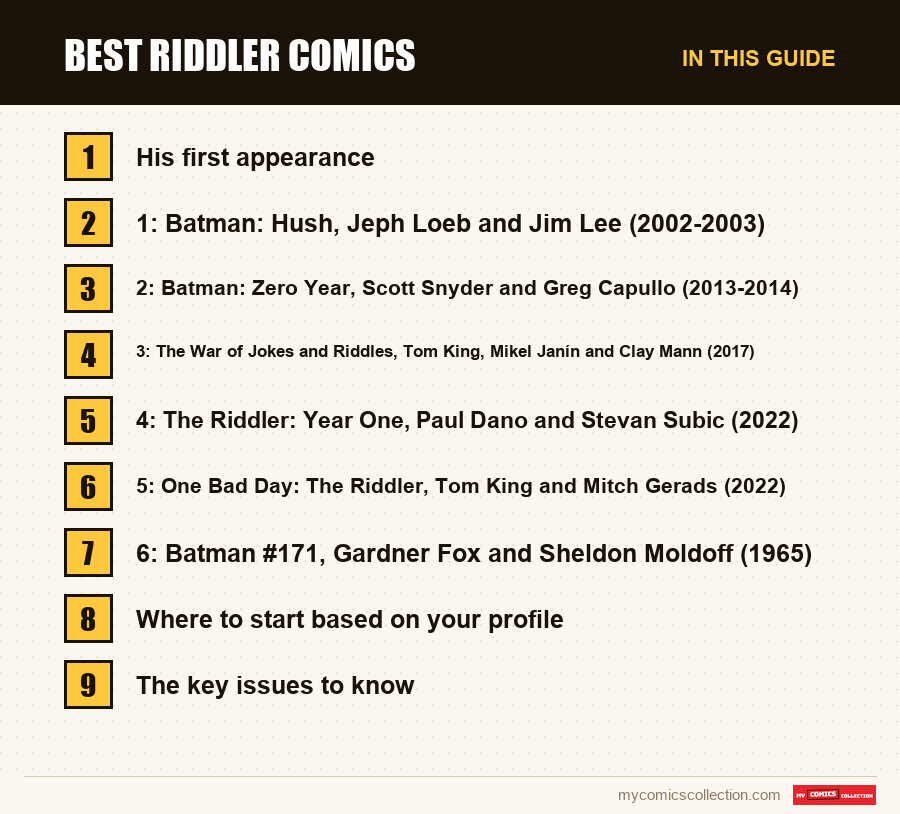
5: One Bad Day: The Riddler, Tom King and Mitch Gerads (2022)
DC published a series of one-shots under the title One Bad Day, which imagines each major Batman enemy through a day that goes wrong. The Riddler's is by Tom King on script and Mitch Gerads on art, the duo who had already worked together on the Batman series. The format, a single volume, is an asset: you hold a complete story with nothing else to read before or after.
It is for a reader who has already tasted the character and wants to see what two creators can do with him when they are no longer constrained by the schedule of an ongoing series. The angle is dark, the storytelling tight, and you find Mitch Gerads's touch in his handling of light and faces. Fans of prestige formats will look for it in hardcover or as a single issue depending on taste, and neither option changes the reading experience.
6: Batman #171, Gardner Fox and Sheldon Moldoff (1965)
After several years away, the Riddler returns in Batman #171, dated May 1965, with Gardner Fox writing and Sheldon Moldoff drawing. This return fits into the context of the so-called Silver Age, when DC restored the luster of Golden Age figures. The issue is a historical landmark: it puts the character back on the board of Batman's enemies and sets up, in time, his popularity with the general public.
This entry is aimed first at historians of the medium and single-issue collectors, much more than at readers after a great story. The read is pleasant but dated, with the bubbly tone and puzzle mechanics of the era. It is best read as an archive, in a retrospective collection, before considering hunting the original issue. For this kind of book, the condition of the paper and spine matters as much as the year printed on it.
Where to start based on your profile
If you are new to Batman and want a spectacular entry point, start with Hush, then follow with Zero Year. Both arcs give an immediately readable picture of the Riddler, one as a discreet mastermind, the other as a master of urban panic. If you like auteur-driven stories, favor The Riddler: Year One and Tom King's one-shot, which are about the character rather than his fights.
If you want the most contemporary vision of a dangerous Riddler, The War of Jokes and Riddles is the natural choice, provided you have read a few episodes of Tom King's series to know its characters. And if you want to understand the character's genealogy, read Detective Comics #140 and Batman #171 as archives, which takes little time and gives a solid reference point for appreciating everything else. To place these reads in the setting of the period, the page on Batman #404, Year One offers a good counterpoint on how Gotham became a city of realistic drama.
The key issues to know
The first appearance, Detective Comics #140 (October 1948), is the obvious anchor point. It is a character key, but it sits in a series whose overall standing pulls up every Golden Age issue: the average copy is scarce, a copy in good condition far more so, and most buyers settle for a mid-grade copy documented by sharp photos. The second landmark, Batman #171 (May 1965), marks the character's return and reads as his second act.
Then come the modern turning points: the start of Hush with Batman #608, the opening of Zero Year in Scott Snyder's series, and the first issue of The Riddler: Year One. These are recent single issues, easy to find, whose appeal lies more in the reading than in scarcity. Our method stays the same for all of them: first identify what the issue really contributes to the character, then check whether there are multiple printings or variant covers, before comparing copies in the same condition.
For a collector building a thematic set around Edward Nygma, the soundest approach is to compose a path: a 1948 archive, a 1965 single issue, a modern arc in single issues, then the recent miniseries in trade paperback. This setup covers more than seventy years of publication without requiring an exceptional purchase, and it tells the character's evolution coherently. If one of your copies intrigues you, our free appraisal tool can give you a first read before you decide.
Frequently asked questions
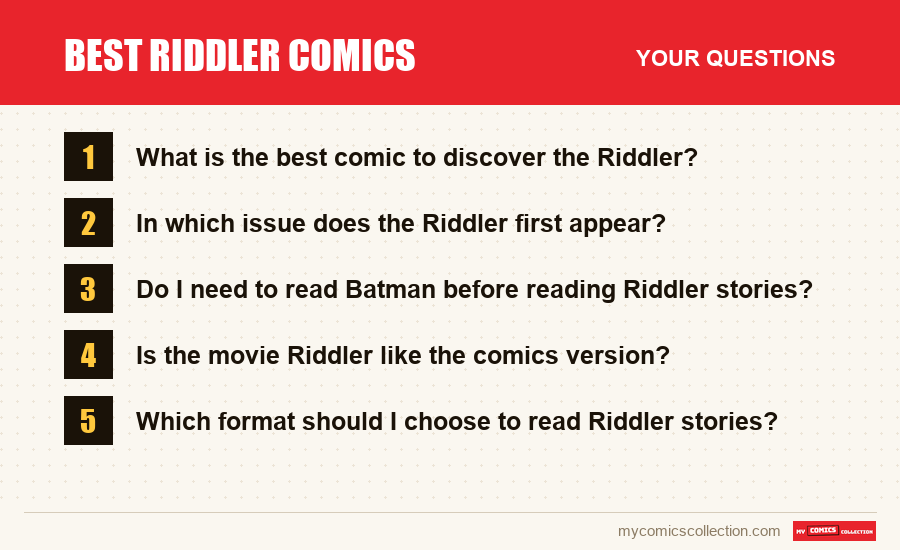
For a first contact, Batman: Hush remains the most accessible: the arc is complete, beautifully drawn by Jim Lee, and the Riddler plays a decisive role in it. If you prefer a portrait centered on him, The Riddler: Year One reads with no prior knowledge of Batman, in six self-contained issues.
Issue 140 of Detective Comics, published with an October 1948 cover date, carries the credits of Bill Finger and Dick Sprang. Edward Nygma is introduced there as a man who announces his crimes through riddles. The issue has since been reprinted in archive collections, far more affordable than the period single issue.
It depends on the story. The Riddler: Year One is self-contained, as is the one-shot from the One Bad Day line. By contrast, Zero Year and The War of Jokes and Riddles gain a lot from being read after a few episodes of Scott Snyder's or Tom King's series, whose themes they extend.
The movie character borrows from several comics eras, but each adaptation makes its own choices. To find the psychological vein, The Riddler: Year One, written by Paul Dano, is the closest read. For the big urban criminal vein, turn to Zero Year.
For reading, trade paperbacks are almost always enough, since the arcs by Scott Snyder, Tom King and Jeph Loeb exist in collected volumes. For collecting, single issues make sense mainly for first appearances and historic returns, where the condition of the copy weighs in the decision.
Do you own a vintage Detective Comics or a Batman issue featuring the Riddler? Get a first read on its condition and appeal.
Appraise my comic