As of October 1st, 2026, no cosmic character is announced in the cast of Avengers: Doomsday (December 18, 2026) or in that of Avengers: Secret Wars (December 17, 2027). The only cosmic characters actually seen on screen recently are Galactus (Ralph Ineson) and a Silver Surfer named Shalla-Bal (Julia Garner), in The Fantastic Four: First Steps, released on July 25, 2025. Everything else comes either from the press or from reader deduction. The only official cosmic lead still open is a Nova film in development, with no title, no date and no cast. This article serves to tell apart three statuses that the market constantly mixes up: announced, mentioned, deduced. That distinction is worth more than any list of issues to watch.
There is a sentence that comes back every fall for about a decade, in one form or another: "cosmic is the next wave." It has sometimes been right. It has often been wrong. And above all, it has almost never been verifiable at the time it was uttered, because it mixed information of completely different natures: a studio press release, a line in a press article, and a reader's reasoning about what a plot should logically lead to.
This article does not offer a list of bets. It offers a sorting grid. Two and a half months from Avengers: Doomsday and fourteen months from Avengers: Secret Wars, it is the most useful tool a collector can give themselves, because the period now opening will produce a considerable volume of claims, only a small part of which will rest on a fact.
Everything that follows is dated October 1st, 2026 and contains no estimate of future price guide values. The release dates, creative teams and casts cited are those made public. When a piece of information is a rumor, it is named as such, and no issue is recommended on that basis alone.
Why cosmic draws anticipation more than any other segment
Three structural reasons, and none has to do with the quality of the stories.
The first is the size of the reservoir. Marvel's cosmic side has several hundred named characters, a majority of whom have never been brought to the screen and never had a lasting solo series. Faced with a largely exhausted urban catalog, where almost all the marketable names have already had their film, cosmic still offers the illusion of virgin territory. Each new announcement can therefore in theory point to any of these names, which makes the guessing game both practicable and endless.
The second is the entry price. Cosmic first appearances have the particularity of often being scattered across issues that nobody collected for them. A character introduced in an anthology series issue, in a back-up, in an annual or in an episode in the middle of a long run stays accessible far longer than a first appearance put on the cover of a flagship title. The speculator sees a favorable risk-reward ratio: the stake is small, so the error seems cheap. That is true at the scale of one issue, and perfectly false at the scale of a collection of thirty issues bought on a rumor.
The third is the most insidious. Cosmic plots work by escalation: one event calls for a bigger one, one threat announces another, and each story's end explicitly opens a door. This narrative grammar mechanically produces deductions. If a plot talks about incursions between universes, the attentive reader thinks of certain specific characters. If a film shows a world devourer, they think of those historically associated with him. These reasonings are often clever and almost always insufficient, because a studio does not write following the logic of the source material but the logic of its calendar, its contracts and its production costs.
Announced, mentioned, deduced: the only classification that matters
Before buying anything, you need to know which of these three boxes the information motivating the purchase falls into. The three are not equal, and the difference is not a matter of probability but of nature.
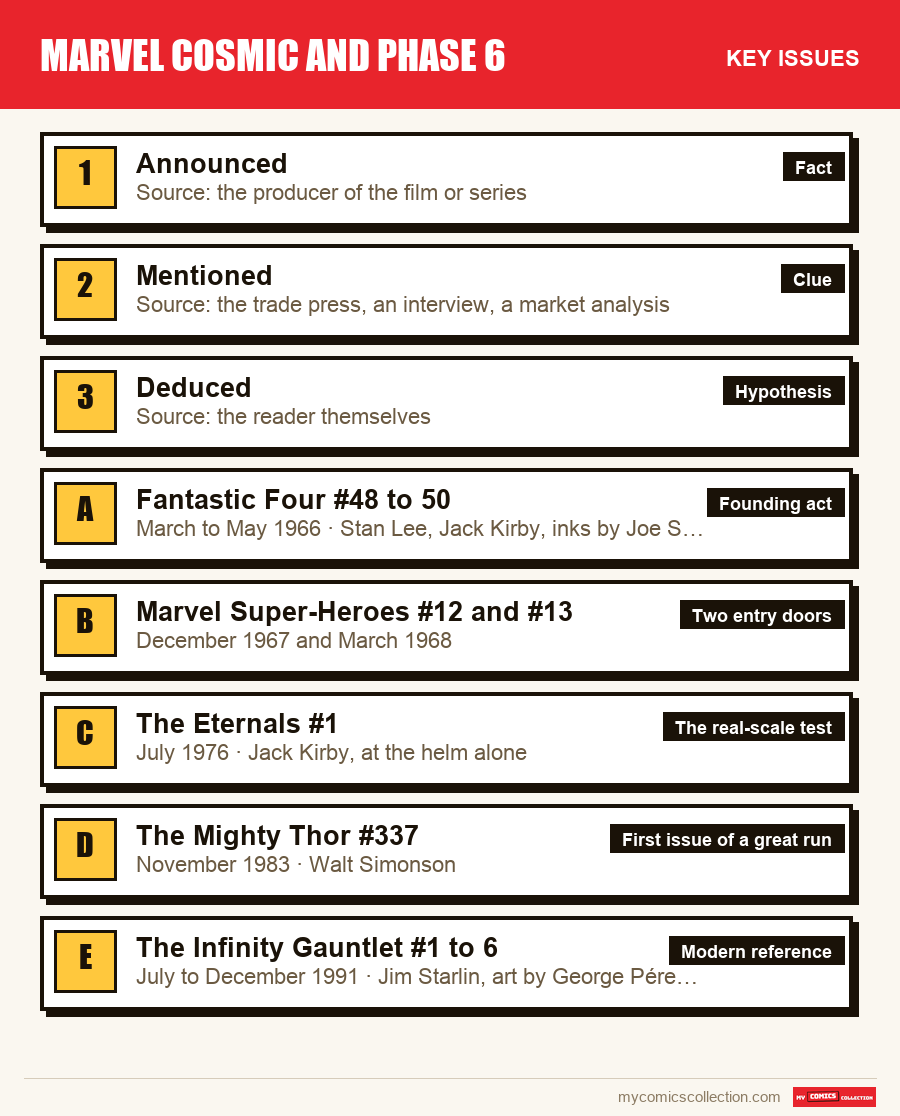
Announced
The character appears in a cast made public, or the project has a title and a release date. It is the only status that rests on a commitment by whoever makes the work. An actor named for a named role is information of a different species than a press article, because it implies a signed contract and a planned shoot.
Mentioned
The name circulates because a journalist reports behind-the-scenes information, because a creator alludes to it in an interview, or because a market analysis cites it among possible arrivals. This category is the most deceptive, because it has all the appearances of fact: an identifiable outlet, a publication date, sometimes a cited source. But it describes the state of a project, not a decision.
Deduced
Nobody has said anything, but the plot makes it plausible. The reasoning is of the type: this story adapts such an arc, so such a central character of that arc should appear. It is the most widespread category and the only one that contains no outside information. Its value is purely argumentative.
The practical consequence is simple. A purchase motivated by status 1 can be reasoned as a collecting purchase with a known calendar. A purchase motivated by status 2 is a bet whose failure must be accepted in advance. A purchase motivated by status 3 should only be made if the issue interests you for itself, in which case the deduction is just a pleasant pretext.
The inventory as of October 1st, 2026: what is announced, and that is all
Here is the state of the facts, without commentary, so that everyone can do the sorting themselves.
What is already out. The Fantastic Four: First Steps, directed by Matt Shakman, came out on July 25, 2025. This film brought two major cosmic figures into the studio's continuity: Galactus, played by Ralph Ineson, and a Silver Surfer named Shalla-Bal, played by Julia Garner. Added to these are Franklin Richards and Harvey Elder, a.k.a. the Mole Man, entrusted to Paul Walter Hauser. These facts are settled, and that is precisely why they no longer offer anticipation: they are behind us. The pieces devoted to the first appearance of Galactus and to the Silver Surfer key issues treat these two cases in detail.
Avengers: Doomsday, December 18, 2026. Directed by Anthony and Joe Russo, written by Michael Waldron, Stephen McFeely, Chris McKenna and Erik Sommers. The cast was unveiled in March 2025 then completed during 2026. It notably brings together Robert Downey Jr. as Doctor Doom, Chris Evans, Chris Hemsworth, Pedro Pascal, Vanessa Kirby, Ebon Moss-Bachrach, Joseph Quinn, Paul Rudd, Anthony Mackie, Florence Pugh, Sebastian Stan, Letitia Wright, Simu Liu, Channing Tatum, Kathryn Newton, Danny Ramirez, Wyatt Russell, David Harbour, Winston Duke, Hannah John-Kamen, Hayley Atwell, Tom Hiddleston, Lewis Pullman, Tenoch Huerta Mejía, Mabel Cadena, as well as Ian McKellen, Patrick Stewart, James Marsden, Rebecca Romijn, Alan Cumming and Kelsey Grammer on the mutant side. The detail of this cast is covered in our piece on the casting and comics of Doomsday.
Read this list looking for a cosmic character. You will not find one. Thor is Asgardian, Namor and Namora are Atlantean, and Bob Reynolds, played by Lewis Pullman, is a character of immense power but of Earth origin, introduced into the studio's continuity by a 2025 film. The difference between "cosmic power" and "cosmic character" is exactly the kind of slippage that fuels bad anticipations.
Avengers: Secret Wars, December 17, 2027. Same pair of directors, project in pre-production to date. No complete cast has been published, and no cosmic character is announced there. Our comparison between the 2027 film and the printed sources details what is known about the adapted material.
What is dated beyond. Three films have a date for 2028: an untitled X-Men film directed by Jake Schreier on May 5, Ghost Rider by Shawn Levy with Ryan Gosling on July 28, and Black Panther III by Ryan Coogler on December 15. Three 2029 slots are reserved without titles. None of these projects is cosmic.
What is in development without a date. Three film projects are identified as in development: Armor Wars, a Shang-Chi sequel, and an untitled Nova film. The latter is the only officially open cosmic lead, and it has no title, no date, no cast and no announced director. Richard Rider's key issues are the subject of a separate article in this batch, and there is nothing to add here beyond this statement of status.
On the series side. The dated titles are Wonder Man on January 27, 2026, the second season of Daredevil: Born Again on March 24, 2026, VisionQuest on October 14, 2026, the second season of the animated Spider-Man series in January 2027 and the third season of Daredevil: Born Again in March 2027. Zodiac is among the projects in development. No cosmic title is dated.
Conclusion of the inventory: the totality of the cosmic anticipations in circulation today falls under status 2 or status 3. Not a single one falls under status 1. This is not a judgment, it is an observation anyone can redo in half an hour.
Three cosmic precedents, and what they really taught
The recent past provides three documented cases that cover exactly the three statuses. They are worth more than any forecast.
Adam Warlock: the announcement that held, but over six years
Adam Warlock first appears under the name "Him" in Fantastic Four #66-67 (September and October 1967), by Stan Lee and Jack Kirby. He becomes Adam Warlock in Marvel Premiere #1 (April 1972), under the pen of Roy Thomas and the pencil of Gil Kane, before Jim Starlin builds the Magus saga in Strange Tales #178 to 181 (February to August 1975).
The character was teased at the end of the second Guardians of the Galaxy film, released in May 2017. James Gunn then confirmed he would appear in the third installment. Will Poulter was officially hired in October 2021. The film came out on May 5, 2023. That is nearly six years between the first public signal and the actual arrival on screen, including four and a half years between the director's confirmation and the release.
The lesson is not "announcements come true." It is: even a solid announcement stretches over a duration nobody anticipates. A collector who buys at the moment of the signal ties up their money for several years, during which the price of an old issue mostly follows the real scarcity of copies in good condition, not a studio's calendar.
Beta Ray Bill: the textbook case of the "almost" character
Beta Ray Bill first appears in The Mighty Thor #337 (November 1983), created by Walt Simonson. He is one of the few cosmic characters whose first appearance coincides with the start of a famous run, which gives him an interest of his own.
The verifiable fact is this: the character was in an early version of the Thor: Ragnarok script and was removed from the film. Kevin Feige explained publicly that the sequence was too brief and did not do the character justice, and that it was better to deal with him later. We are in 2026, the "later" has not come, and the character is announced in no dated project.
That is what status 2 looks like in real life: accurate, verifiable information, from the best possible source, and which has nonetheless produced nothing in nearly ten years. A character cut from an edit is information about the past, not a promise about the future.
Kang: when even status 1 is not enough
Kang first appears under the identity of Rama-Tut in Fantastic Four #19 (October 1963), then as Kang the Conqueror in The Avengers #8 (September 1964), in both cases by Stan Lee and Jack Kirby. The character enjoyed everything a collector could wish for: a portrayal in a series in 2021, a main antagonist role in a 2023 film, and above all a film title in his name announced in 2022, Avengers: The Kang Dynasty. It was status 1 in the strongest sense: a title, a slot, an actor.
All of this was erased. The performer's contract was terminated in December 2023 after his conviction, and Kevin Feige indicated that the studio had concluded, even before the 2023 film's release, that the character was not up to the stakes. Doctor Doom took over the role of central antagonist and the film was renamed Avengers: Doomsday.
The lesson is the most important of the three: status 1 reduces narrative uncertainty, it does not cancel risk. What brought Kang down was neither a question of writing nor a question of market, but an outside event that is unpredictable by definition. No analysis grid protects against that. The hierarchy of statuses nonetheless remains useful: it keeps you from losing money on three-quarters of the bets, not on all of them.
And a deduction that got the detail wrong
One last, finer example. For years, the most widespread deduction about cosmic came down to one sentence: a Fantastic Four film will eventually bring the Silver Surfer, so its bearer will be Norrin Radd. The first half of the reasoning was right, and the 2025 film did introduce a Silver Surfer. The second half was wrong: the board went to Shalla-Bal.
It is the costliest trap of deduction, because it never presents itself as a complete failure. You are right about the franchise, right about the era, right about the concept, and wrong about the issue to own. A deduction that is 80% right produces a purchase that is 100% wrong.
The five criteria of a defensible anticipation
An anticipation is not condemnable in itself. It becomes a problem when it is not defensible. Here are the five questions to which you must be able to answer yes before committing money.
Can you name the source and its date?
Not "I read somewhere," but: who said it, when, and in what setting. If you cannot reconstruct that line, you are in status 3 without knowing it. Write the source in your acquisition record at the time of purchase, not after.
Does the issue interest you without the adaptation?
It is the decisive test, and the only one that depends on no one but you. If the project is abandoned tomorrow morning, are you glad to own this issue for its author, its place in a run, its cover? If the answer is no, you are not buying a comic, you are buying a rumor with paper around it.
Do you know precisely which milestone you are buying?
In cosmic, a character often has four or five distinct milestones: background appearance, full appearance, first cover, first solo title, sometimes the first version taken up on screen. Buying "the first appearance" without knowing which of these milestones you hold is the most frequent error of the segment, and the one that deduction encourages most.
Are you buying before the attention or during it?
Cosmic demand concentrates in short peaks around announcements, then ebbs for long months. Buying during the peak means paying for the market's conviction at the moment it is most expensive. If you arrive after the name has circulated everywhere, the anticipation is no longer an anticipation: it is a waiting line.
Do you accept a duration of three to six years?
The Adam Warlock case gives the real order of magnitude between a public signal and a release. A cosmic anticipation is a long commitment. If your horizon is a few months, you are not anticipating, you are trading an illiquid object, which is the worst possible combination.
The cosmic issues that hold without any adaptation
Here is the other half of the subject, and by far the most solid. Some cosmic issues have a collecting interest that depends on no film, because it rests on creative authorship, on place in the medium's history or on the scarcity of well-preserved copies. These are the ones you never regret buying, precisely because the question of a studio's calendar does not enter the equation.
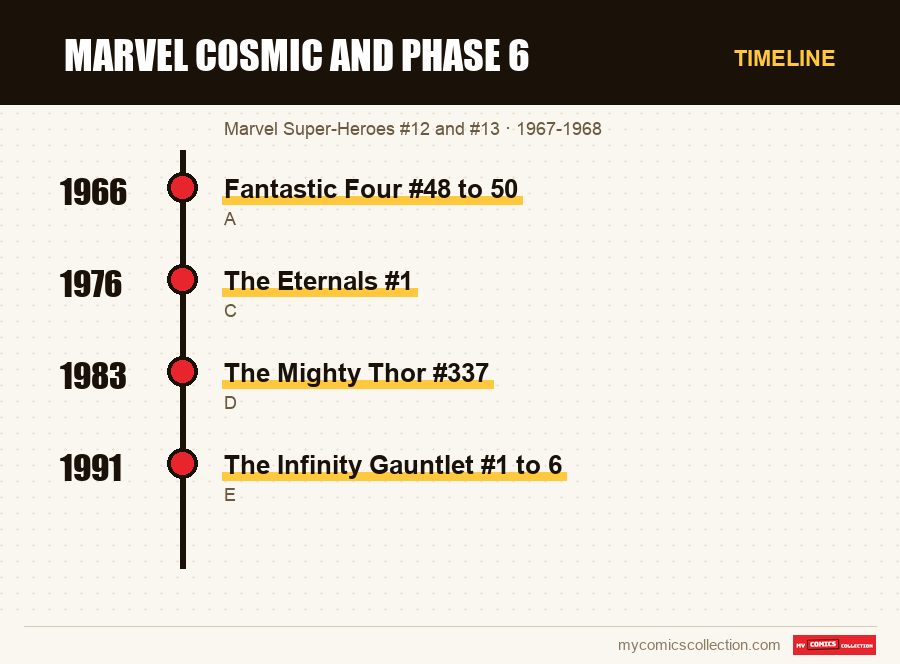
Fantastic Four #48 to 50
The three-issue sequence that introduces Galactus and the Silver Surfer, and ends with the latter taking humanity's side against the former. Its status does not come from an adaptation but from the fact that it invented the cosmic scale as the medium has practiced it since. The three issues are collected as a set, and the last is often neglected even though it carries the resolution.
Marvel Super-Heroes #12 and #13
Issue 12 carries the first appearance of Mar-Vell, by Stan Lee and Gene Colan. Issue 13, three months later, carries that of Carol Danvers, by Roy Thomas and Gene Colan. Two characters who successively carry the same code name, introduced in the same anthology series a quarter apart: an exemplary case of how cosmic scatters its milestones.
This issue is interesting twice over. First for what it is: a late Kirby, written and drawn by him, that sets up an entire cosmogony in one issue. Then for what it went through: the November 2021 film gave it considerable visibility, and no sequel has been announced since. The anticipation character therefore played out entirely, from signal to fallout, before the market's eyes.
First appearance of Beta Ray Bill, and above all first issue of Simonson's run, one of the most respected in the catalog. It is exactly the sought-after profile: an issue whose interest lies in its author and its place, and whose speculative dimension is an optional extra. The fact that the character was cut from a film in 2017 took nothing away from the issue's value as a reading object.
The Infinity Gauntlet #1 to 6
Six issues, a single writer, two artists who take turns from the fourth. It is the matrix of almost all large-scale cosmic produced since, and the story to which all later adaptations are compared. A collector who wants a modern cosmic foundation often starts there, and the complete series remains easier to assemble than any equivalent set from the 1960s.
You will notice what these five entries have in common: in each case, an author's name is enough to justify the purchase. It is the most reliable criterion of cosmic, because it never moves. A studio can give up on a character; it cannot take away from Kirby, Simonson or Starlin the authorship of what they did.
Keeping an anticipation list without telling yourself stories
The practical difficulty of anticipation is not having ideas, it is remembering six months later the exact reason you bought. Without that record, a status 3 purchase gradually turns, in memory, into a status 1 purchase, and you end up convinced you had information you never had.
Three reflexes are enough. First, note the status at the time of acquisition, with the source and its date, in the record's comment field. A purchase whose motive is not written down is a purchase whose motive will be reinvented. Second, separate in your collection tracker what you own to read from what you own as a bet: these are two sets that do not obey the same preservation criteria or the same resale decisions. Third, date your reviews of the situation. An anticipation taken in October 2026 must be re-examined after December 18, 2026, because what a film shows changes the status of all adjacent bets in a single evening.
For those who want to go further on the market mechanics themselves, rather than on sorting information, the market cycles tied to the phase calendar and the question of cameo or full appearance status extend this reasoning from another angle. And for an overview of the segment, the overview of cosmic first appearances and the selection of the best cosmic stories remain the two most direct entry points.
What to remember
As of October 1st, 2026, Marvel's cosmic side is in a paradoxical situation: it has never been so present in anticipation discussions, and it has never had so few announced projects. Two Avengers films arrive back to back, in December 2026 then December 2027, without a single cosmic character in the casts made public. The only official lead is a film with no title and no date.
That does not mean nothing will arrive. It means that everything circulating today on the subject is either press information or reader reasoning, and that neither category justifies buying an issue you would not want to keep for itself. The good news is that cosmic is full of issues that pass this test with no difficulty, signed by three or four authors whose reputation depends on no studio. Buying them amounts to making the only bet that cannot be canceled by a press release.