How many Flash comics are there? The Flash has eight main series since 1940, and every volume counted adds up the same way. The longest is the 1987 series, with 247 issues, narrowly ahead of the 246 of the 1959 series, which runs from #105 to #350 and continues Flash Comics (#1 to #104). Legacy numbering adds these series together: #750 arrives in May 2020, #800 in August 2023, and then the 2023 series restarts at #1 while also carrying legacy #801. For Flash, the #0 issues, the decimals, the annuals and the thirteen issues of Fastest Man Alive stay out of these totals.
The Flash counter spans eight decades: an anthology magazine from 1940, a series that picks its counter back up at #105 in 1959, a return to #1 in 1987, and in the end a #750 that swallows the whole history. To know how many issues exist, you have to know which door you are walking through, because every relaunch changes the rules of the game.
As always in this guide, only verified information (creators, issue numbers, dates) is stated as fact; the analysis is our own, with no reproduction of protected art or dialogue.
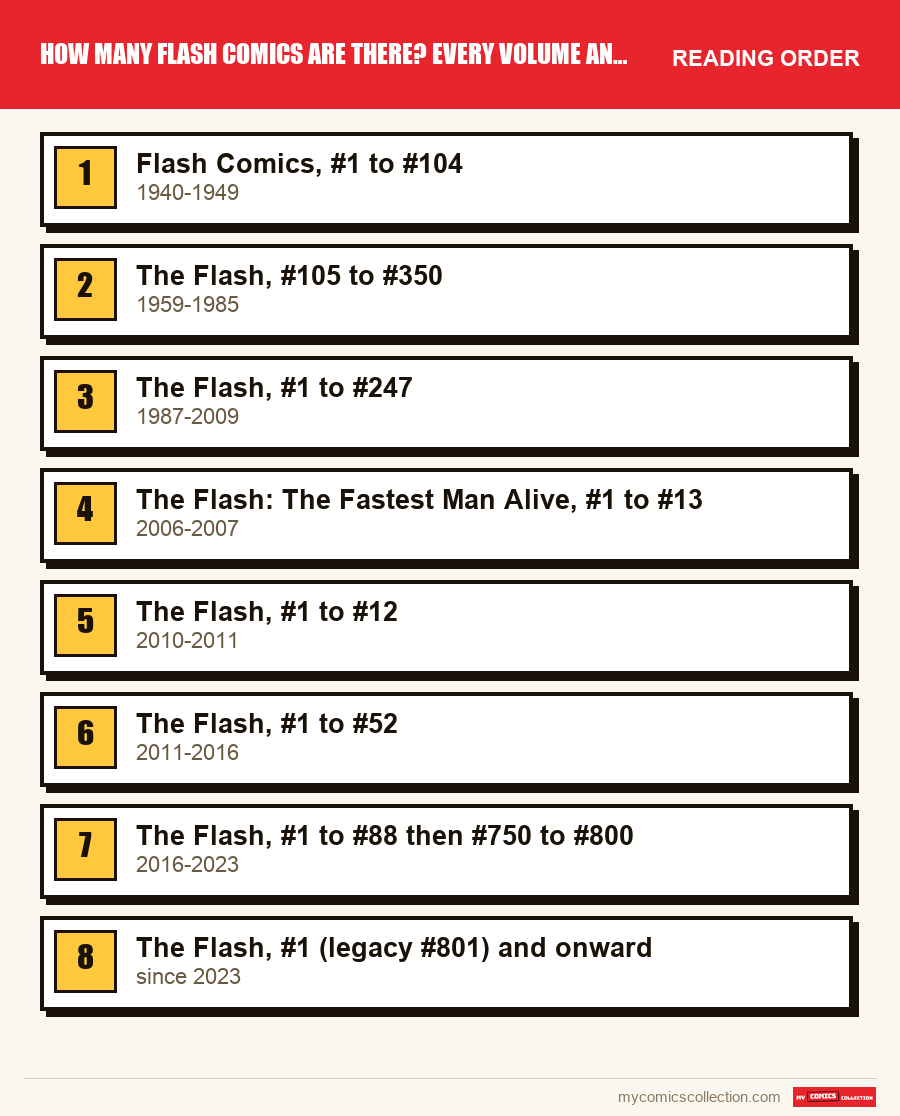
Series 1: Flash Comics, #1 to #104 (1940-1949)
The series first carries the name of an anthology magazine: Flash Comics runs from #1, dated January 1940, to #104, dated February 1949. Gardner Fox writes and Harry Lampert draws the debut of Jay Garrick in #1. Hawkman appears in all one hundred four issues, Johnny Thunder in the first ninety-one, and Black Canary, who first appears in #86 in a Johnny Thunder story, gets her own feature from #92 to #104.
The publisher of the day is All-American Publications, and then National Periodical Publications. The series stops in 1949 at #104: it is this number, and not a relaunch #1, that anchors what follows, as we will see with the 1959 series. To place this period in the character's story, see our page on the history of Flash.
Series 2: The Flash, #105 to #350 (1959-1985)
In 1959, the follow-up resumes the numbering at #105 under the title The Flash, with Barry Allen as the new Flash. There is therefore no #1 here: the counter continues that of Flash Comics, so the one hundred four issues of 1940 and those of 1959 belong to a single chain of numbers. For the tryout issue that comes before, see Showcase #4 and its value.
The series reaches #350, dated October 1985, for two hundred forty-six issues. John Broome, Gardner Fox, Cary Bates and Martin Pasko are among the writers of these years, while Carmine Infantino, Irv Novick and Dick Dillin are among the artists. Kid Flash, Wally West, first appears in #110, created by John Broome and Carmine Infantino, and he is the one who will later take over Barry Allen's costume.
In the maxi-series Crisis on Infinite Earths, #8 removes Barry Allen from the scene, and the 1959 series ends at #350 the same year. For a collector, #350 is a clean boundary: the counter stops there, then DC starts from zero with another hero under the mask.
Series 3: The Flash, #1 to #247 (1987-2009)
Wally West puts on the costume in 1986, and The Flash restarts at #1 in June 1987: it tops the 1959 series by one issue, with two hundred forty-seven issues from #1 to #247. Mike Baron writes issues 1 to 14, William Messner-Loebs writes issues 15 to 28 and then 30 to 61, and Len Strazewski writes #29.
Mark Waid then takes the series from #62 to #129, joined by Brian Augustyn on issues 118 to 129, and returns with him from #142 to #159; there he develops the Speed Force and the marriage of Wally West to Linda Park. Mark Millar writes issues 130 to 141, with Grant Morrison on issues 130 to 138. Geoff Johns then signs issues 164 to 225, with Howard Porter, Mike Wieringo and Paul Pelletier among the artists of the series.
The series goes through a pause in 2006-2007, during which The Flash: The Fastest Man Alive is published, and then it resumes in 2007 with Mark Waid on issues 231 to 236, Tom Peyer on issues 238 to 243 and Alan Burnett on issues 244 to 247, until February 2009. It also has a #0 and a #1,000,000 in addition to its two hundred forty-seven regular issues. Our page on Wally West in comics tells this story in detail.
Series 4: The Flash: The Fastest Man Alive, #1 to #13 (2006-2007)
After Infinite Crisis, DC gives Bart Allen the role of the fourth Flash in a series with a different title, The Flash: The Fastest Man Alive. It has thirteen issues and spans 2006 and 2007.
The title is a search trap, because a list that only says "Flash" forgets it. Its thirteen issues do not enter the legacy sum described below: the total comes out right without them, which confirms they are filed on a separate line.
Series 5: The Flash, #1 to #12 (2010-2011)
In 2009, The Flash: Rebirth brings back Barry Allen, after his return in Final Crisis. A series then restarts at #1 in 2010 under Geoff Johns, with Francis Manapul and Scott Kolins on art. It has twelve issues and ends in 2011.
It is short, but it counts fully in the legacy chain: twelve more issues, added to the two hundred forty-seven of the 1987 series. The Geoff Johns hub gathers this series and his other titles at DC.
Series 6: The Flash, #1 to #52 (2011-2016)
After Flashpoint, the New 52 line relaunches The Flash at #1 in 2011. Francis Manapul and Brian Buccellato write issues 1 to 25, Christos Gage writes #26, and then Brian Buccellato returns on issues 27 to 29. Robert Venditti writes #30 to #49, and Van Jensen #30 to #52; Brett Booth and Jesus Merino are among the artists.
The count demands precision: fifty-two regular issues, but also a #0 and three decimal issues (#23.1 to #23.3), for fifty-six issues in all, plus four annuals. Only the fifty-two regular issues go into the legacy sum. For the context of the event, see our Flashpoint key issues.
Do you collect this series?
Track what you own, what you are missing and what your collection is worth. 7-day trial.
Start my trial →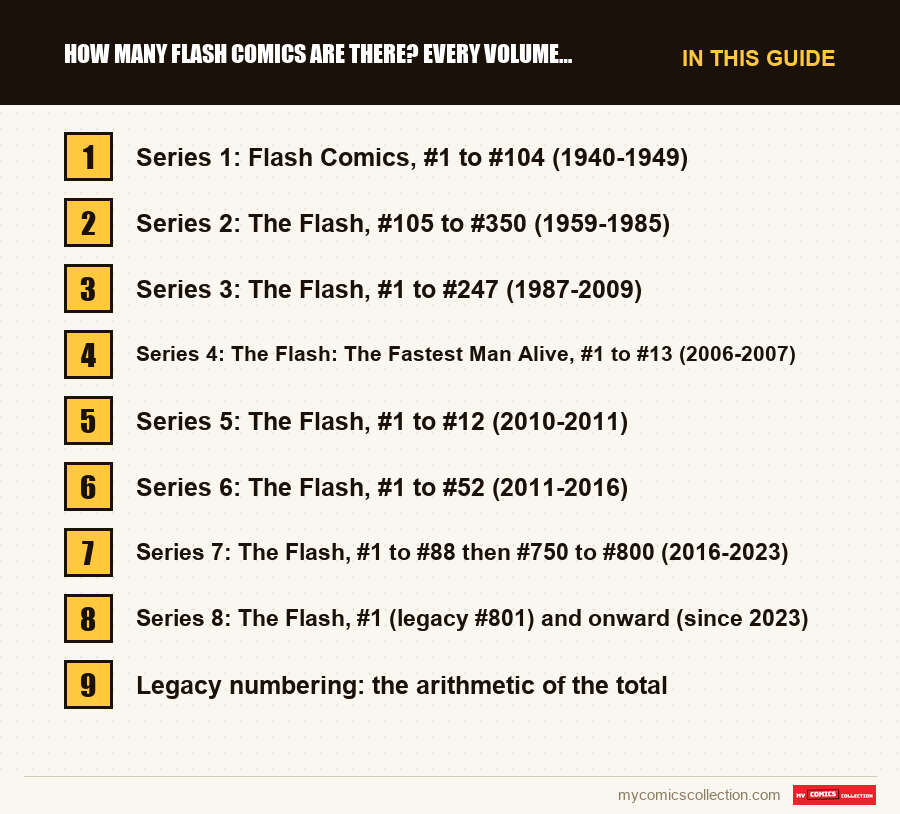
Series 7: The Flash, #1 to #88 then #750 to #800 (2016-2023)
Rebirth relaunches the title at #1 in 2016 and entrusts the series to Joshua Williamson, who writes it from #1 to #88 and then from #750 to #762. Carmine Di Giandomenico is among the artists of the series. In this period, DC returns to legacy numbering: #88 is followed by #750, dated May 2020.
After Joshua Williamson, Kevin Shinick writes issues 763 to 766, Andy Lanning and Ron Marz write #767, and then Jeremy Adams writes issues 768 to 800. #800 dates from August 2023. This period has five annuals, and one hundred thirty-nine regular issues when you add the first eighty-eight to the fifty-one from #750 to #800.
Series 8: The Flash, #1 (legacy #801) and onward (since 2023)
Under the Dawn of DC banner, the Wally West Flash receives a new #1 in late 2023, printed with the legacy number #801: one issue, two numbers. Simon Spurrier writes the first twenty-five issues of this period, then Mark Waid and Christopher Cantwell write a five-issue stretch, and Ryan North takes the series from the following issue.
The series is not finished: no end boundary can be written. A collector who buys it month by month can log it under its series number or as a continuation of #800; the key is to pick just one of the two counters in your list.
Legacy numbering: the arithmetic of the total
The 2020 #750 is rebuilt like this: one hundred four issues of Flash Comics, two hundred forty-six from the 1959 series (#105 to #350), two hundred forty-seven from the 1987 series, twelve from 2010, fifty-two from 2011 and eighty-eight from Rebirth. The total is seven hundred forty-nine regular issues, hence the #750 that follows.
The sum is exact because the #0 issues, the #1,000,000, the decimals #23.1 to #23.3 and the annuals are set aside, as are the thirteen issues of The Flash: The Fastest Man Alive. If you add them, the figure goes well past seven hundred fifty, and the idea of a single chain collapses. After #750, the chain continues without interruption to #800, and beyond.
In practical terms, a "#300" necessarily belongs to the 1959 series, since the 1987 series stops at #247. An issue from #105 to #350 files under the 1959 series, and an issue from #750 onward in the legacy chain.
Annuals and spin-off series
The 2011 series has four annuals and the 2016 series has five. The most sought-after are reviewed in the page on Flash annuals and specials. Their counter is separate, and this page's totals leave them out.
Spin-off series make no claim to completeness here: The Flash: The Fastest Man Alive and The Flash: Rebirth are already mentioned, and other titles featuring the character still exist. Each has its own list of issues, and it is best to keep them separate from the main chain.
A clear inventory therefore distinguishes four blocks: Flash Comics, the main series with their boundaries, the annuals and the spin-off titles. This separation avoids counting an issue twice or missing one because its title differs.
Completing the series: where to start
Start by choosing a period rather than the whole run: the one hundred four issues of Flash Comics are not collected like the eighty-eight issues of Rebirth. Then draw up the exact list for one series, with its boundaries, its #0 issues, its decimals and its annuals, before buying anything.
The most reliable method is to complete by runs: Mark Waid from #62 to #129, Geoff Johns from #164 to #225 or Joshua Williamson from #1 to #88 each offer a bounded goal. To know what exists in each run, the Mark Waid reading order serves as a map.
The complete collecting guide details the pitfalls of each era, the ranking of the best runs helps you set a target, and the first appearance of Flash explains where the chain starts. Save the boundary issues (#104, #247, #350, #52) for last, since they are often the hardest to track down.
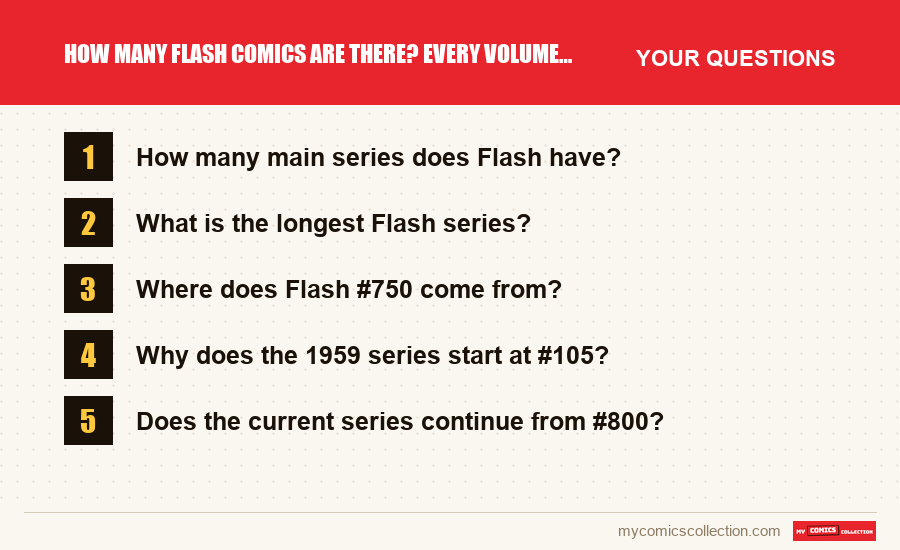
Frequently asked questions
Eight main series by our count: Flash Comics, the 1959 series, the 1987 series, The Fastest Man Alive, the 2010, 2011 and 2016 series, and then the 2023 series, numbered #1 and legacy #801. Annuals and spin-off titles are counted separately.
The 1987 series, from #1 to #247, with two hundred forty-seven issues. It beats the 1959 series by one issue, which has two hundred forty-six issues from #105 to #350. The one hundred four issues of Flash Comics come before, under another title, and open the same chain of numbers.
It comes from adding up the regular issues of Flash Comics, the 1959, 1987, 2010 and 2011 series, and Rebirth, for seven hundred forty-nine issues. The next one carries the number 750 and comes out in May 2020. The sum ignores the #0 issues, the decimals and the annuals.
Because it continues the numbering of Flash Comics, which stopped at #104 in February 1949. Barry Allen, who debuted in Showcase #4, takes the lead of his own series with this #105. The number therefore marks no anniversary but a continuity of counter, which legacy numbering later folded into its calculation.
Yes, in part. After #800, dated August 2023, the series restarts at #1, but this #1 also carries the legacy #801: the chain continues alongside the new counter. Simon Spurrier writes the first twenty-five issues of this period, then Mark Waid and Christopher Cantwell, then Ryan North.
Have a 1959 or 1987 Flash to place in the chain? Estimate the value of your copy before completing the rest of the series.
Estimate my comic