To follow Mark Waid's Flash reading order, start with volume 2 #62 (1992), continue with The Return of Barry Allen (#74 to #79, 1993), slip in Impulse and Terminal Velocity before #100, read the first stretch up to #129 (1997), then the second from #142 to #159 through 2000. The 2007-2008 return reads separately. Wally West is the hero of this entire journey.
Mark Waid's run is often cited as the most complete read on the character of Wally West, but it is poorly marked: it spans several years, a stretch of other writers, two neighboring series and a return in the 2000s. This guide lays out a step-by-step path, with exact issue numbers where they are established and no invented boundaries where they are not.
As always in this guide, we only state verified information (creators, issue numbers, dates); the analysis is our own, with no reproduction of panels or protected dialogue.
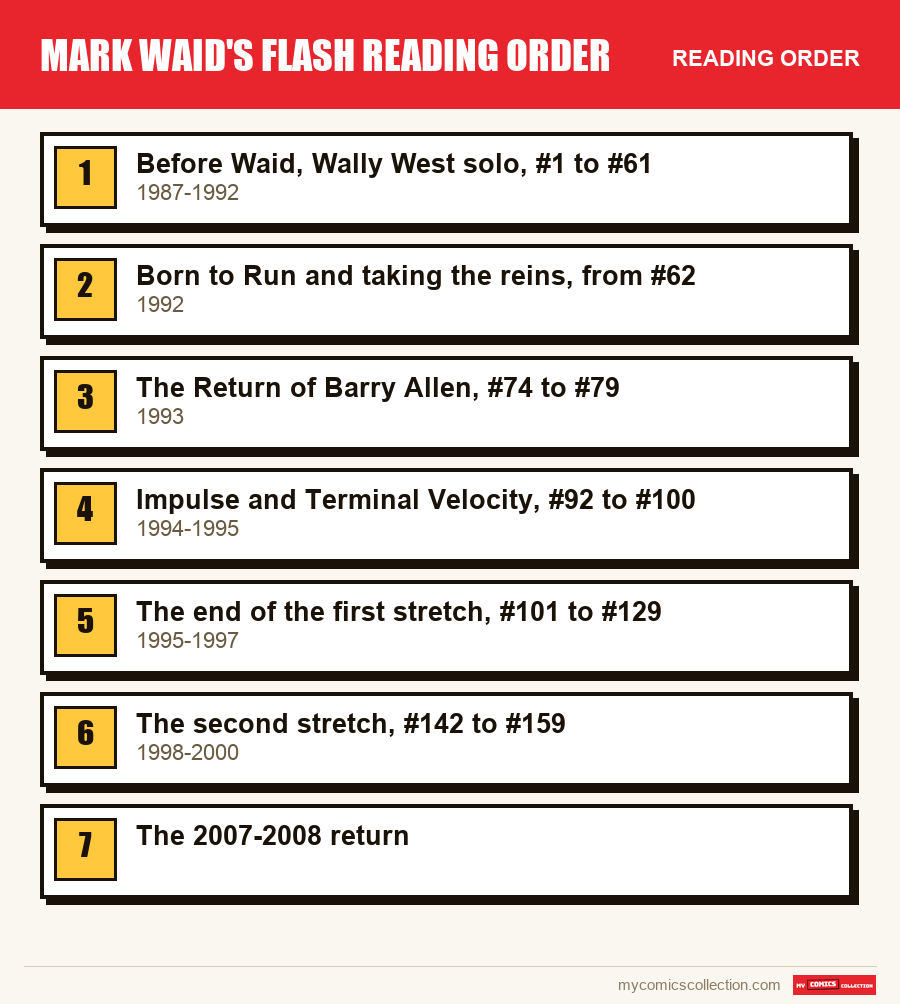
Stage 1: Before Waid, Wally West solo, #1 to #61 (1987-1992)
This prelude is optional, but it explains what Waid picks up. When Barry Allen sacrifices himself in Crisis on Infinite Earths #8 (1985), the mask passes to Wally West. This young man had debuted in 1959, in The Flash #110, under the name Kid Flash. The volume 2 series starts in 1987 with Mike Baron, then moves to William Messner-Loebs. Wally is a broke, impulsive hero there, and slower than his predecessor, which creates the imbalance Waid will exploit.
If you are short on time, read only #1 and the last arc before the change of creative team from this stage, to gauge the contrast in tone. Readers who are just discovering Wally West can also start with the complete history of the character, which gives the context before #62.
Stage 2: Born to Run and taking the reins, from #62 (1992)
#62 from 1992, "Born to Run", is the official entry point of Mark Waid's run. Greg LaRocque handles the art, and the promise is clear: Wally is no longer the one trying to resemble Barry Allen, he is the Flash, full stop. It is the best issue to pick up for a reader who does not want to go back to 1987.
The issues that follow set up the foundations the rest depends on: a circle of loved ones around Wally, antagonists who gain depth and an idea of speed as a source of anxiety as much as of power. The balancing point of this stage is the relationship between Wally and Linda Park, which stretches across the whole run and ends in a wedding later. Read this stage without skipping an issue, because the arcs are short and answer each other from one issue to the next.
Stage 3: The Return of Barry Allen, #74 to #79 (1993)
This is the most-cited arc of the period. A seemingly resurrected Barry Allen comes back into Wally's life, and the story revolves around what you do with a lost role model when he suddenly returns. The truth behind this return rests on Eobard Thawne, the Reverse-Flash, and makes these six issues a story about identity more than a simple speed duel.
This stretch is one of the few in the run that can be read in isolation, in a collected edition, with very good understanding. It works because it sets two conceptions of the character against each other: that of the 1956 Barry Allen, a flawless hero, and that of Wally, who doubts. If you can only read one stage of this guide, this is the one, provided you have read at least #62 to know the cast.
This arc holds a place apart in the history of the title; we do not go back over the details of the market's key issues here.
Stage 4: Impulse and Terminal Velocity, #92 to #100 (1994-1995)
The next period introduces two elements that matter for what follows. First Impulse: Bart Allen, created by Mark Waid and Mike Wieringo, appears for the first time in #92 (1994) and serves as a comic, high-strung counterpoint to a steadier Wally. He gets his own series, Impulse, whose #1 comes out in 1995, written by Mark Waid and drawn by Humberto Ramos.
Then Terminal Velocity, which culminates with #100. Waid develops the Speed Force there, the energy field that explains the powers of all the speedsters in the DC universe. It is the most lasting idea of the run: every later writer picks it up, including Geoff Johns.
How do you read this stage? Put the Impulse series next to the main series only if you want to follow Bart: it is not essential to understanding Terminal Velocity. For a first pass, stay on The Flash and come back to Impulse afterward.
Stage 5: The end of the first stretch, #101 to #129 (1995-1997)
This stage is the densest in episodes, with artists succeeding one another, including Mike Wieringo and Paul Pelletier. It deepens the ties between Wally, his loved ones and the community of other speedsters, with no single event to sum it up. It is the part readers get through fastest, because it does not require knowing other titles.
Mark Waid's first stretch on the series ends at #129, in 1997. That same year comes The Life Story of the Flash, a story by Mark Waid drawn by Peter Krause: a standalone album that traces Wally West's career in retrospective mode. Place it after #129, because it works as a summing-up and is best read once you know the characters.
A tip on method: do not try to read everything here. If you are short on time, read #100 and then #129 to gauge how far things have come, and move on to the next stage.
Do you collect this series?
Track what you own, what you are missing and what your collection is worth. 7-day trial.
Start my trial →
Stage 6: The second stretch, #142 to #159 (1998-2000)
Between Mark Waid's two stretches, other writers hold the title from #130 to #141. This interlude is not needed to understand what follows, and you can skip it on a first pass: #142 picks up at a clear entry point, with the wedding of Wally and Linda Park.
This second stretch goes up to #159, in 2000, and closes the loop of the run. Wally is a settled adult there, with responsibilities that were not his at #62. It is also the last run of issues before Geoff Johns arrives, whose run begins at #164 in 2000: if you want to go further, go straight to Johns's run to continue.
Stage 7: The 2007-2008 return
Mark Waid returns to the volume 2 title in 2007, for a short stretch that ends with the last issue of the series, #247, in 2008. It is an epilogue more than a direct sequel: the editorial context has changed, the characters have evolved since the late 1990s and the reader arrives with the memory of the first run.
Read this stage last, once you know the six previous ones. It is for readers who loved the original run and want to see how the writer extends it ten years later. The reader who only wants to understand Wally West can skip it without losing the thread. If Bart Allen interests you, our page on the history of Kid Flash extends that lead.
To fix this journey in time, keep three landmarks that frame everything else: #62 in 1992 opens the run, #129 in 1997 closes the first stretch, and #159 in 2000 closes the second. Between #62 and #159, only the interlude of issues #130 to #141 escapes Mark Waid's pen, which makes the period a coherent whole of more than eighty issues, to be read in small blocks.
One last reading tip concerns pacing. The arcs of this run are short, from one to six issues, and almost always end on a concrete change for Wally West: a loved one who enters or leaves his life, a power that changes nature, an adversary who evolves. Reading one stage per evening is enough; attention tires when you plow through the thirty issues of the fifth stage in one go.
Single issues or collected editions: how to read it
The original single issues are the collector's route: they give you the paper, the ads and the feel of monthly reading. Their cost of entry depends on the issue. The pivotal issues (#62, the start of The Return of Barry Allen, Impulse's #92) are fought over more than the transitional issues, which are easy to find. When you collect, buy the entry points of each stage first, then fill in the gaps.
Collected editions suit you if you want to read the run before building it. DC has reissued Mark Waid's work on The Flash in several bound volumes, and the famous arcs, The Return of Barry Allen and Terminal Velocity, also exist in separate trade paperbacks. Reading in collected editions, however, does not take into account the volumes of the Impulse series or The Life Story of the Flash; add them to your list if you want the complete journey.
A mixed approach works well: read in collected editions to find out what you like, then buy the issues that matter to you as single issues. To build the collection of a title this long, our general reading guide gives the hierarchy of eras and saves you from starting out of order.
Recap: the complete order
- The Flash vol. 2 #1 to #61 (1987-1992): Wally West before Waid, optional;
- The Flash vol. 2 #62 (1992): "Born to Run", start of the run;
- The Flash vol. 2 #74 to #79 (1993): The Return of Barry Allen;
- The Flash vol. 2 #92 (1994): first appearance of Impulse;
- The Flash vol. 2, Terminal Velocity, up to #100;
- Impulse #1 (1995): series to read in parallel, optional;
- The Flash vol. 2 #101 to #129 (through 1997): end of the first stretch;
- The Life Story of the Flash (1997): standalone album, to read after #129;
- The Flash vol. 2 #142 to #159 (through 2000): second stretch;
- The Flash vol. 2, 2007-2008 return, up to #247.
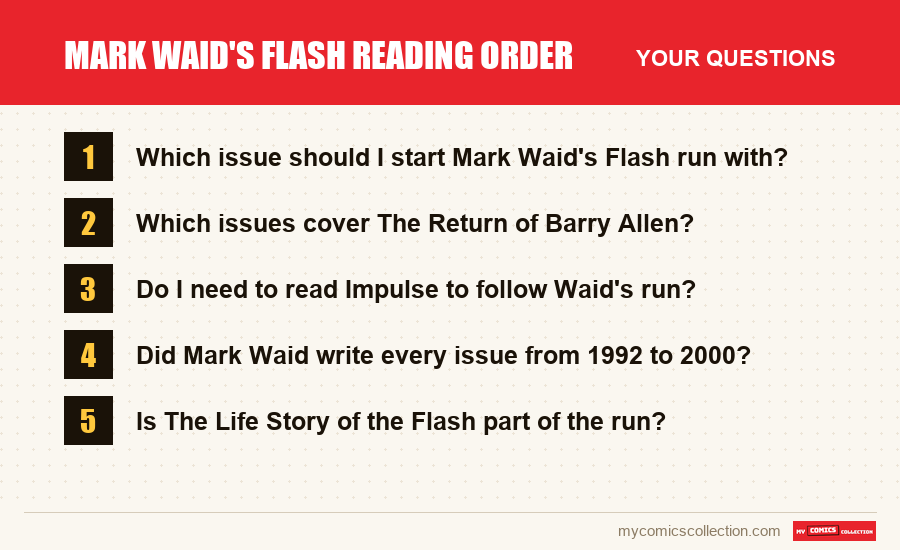
Frequently asked questions
With volume 2 #62, dated 1992, "Born to Run". It is the official start of the run and the entry point intended for new readers. You do not need to read the earlier issues, even though Mike Baron's prelude sheds light on Wally West's background.
Issues #74 to #79 of volume 2, in 1993. The arc tells the apparent return of Barry Allen and reads well in isolation, in single issues or a collected edition. Still, read #62 before it, to know Wally West's circle of loved ones and grasp what Barry's return puts back in play.
No. Impulse appears in The Flash #92 and gets his series in 1995, but the run makes sense without it. Read it afterward if you like Bart Allen: it is a supplement with a lighter tone, not a required stop on the main path.
No. The first stretch runs from #62 to #129, in 1997, and the second from #142 to #159, through 2000. In between, other writers hold the title from #130 to #141. Those issues are not needed to follow Wally West through Waid's run.
It is a separate 1997 album, written by Mark Waid and drawn by Peter Krause, outside the volume 2 numbering. It works as a summing-up of Wally West's career. Read it after #129 rather than at the start, because it assumes you know the characters.
Did you find an issue from Waid's run in your boxes, anywhere from #62 to #159? Appraise it before deciding whether to keep it or sell it.
Estimate my comic