Issue #123 of The Flash came out in September 1961: "Flash of Two Worlds" was born from the collaboration between writer Gardner Fox and artist Carmine Infantino. By vibrating too hard, Barry Allen lands on the world of Jay Garrick, the Flash of the 1940s, in a parallel world that later stories would call Earth-Two. The story opens the door to the DC multiverse, and it is that idea, far more than the meeting itself, that makes this issue a key of the Silver Age.
In the pantheon of DC keys, The Flash #123 holds a singular place: it is the first appearance of no major character, and yet its name comes up in every conversation about the Silver Age. The collector hunting for it is buying an idea, that of neighboring worlds crossing paths, and must learn to tell that idea apart from the physical issue that carries it, with its print runs, reprints and the fragility of 1961 paper.
As always in this guide, only verified information (creators, issue numbers, dates) is stated as fact; the analysis is our own, with no reproduction of protected artwork or dialogue.
The Flash #123: Date, Creators and the Story of "Flash of Two Worlds"
This issue is the September 1961 entry of the first The Flash series. Its numbering is inherited from an older title, Flash Comics, which explains why Barry Allen's solo series starts at #105 rather than #1. The title's editor is Julius Schwartz, the same man who had relaunched the character five years earlier. The script is by Gardner Fox, one of the two creators of Jay Garrick in 1940. The art is by Carmine Infantino, inked by Joe Giella.
The premise fits in a few lines, with no need to spoil how it unfolds. During a charity show, Barry Allen performs a vibration act to entertain the crowd. He goes past the planned threshold and vanishes. He reappears in a world where Keystone City replaces Central City, and where a runner in a winged helmet exists in the flesh. That runner is Jay Garrick, whom Barry only knew as a comic book hero. The two men join their speed against criminals, then each returns to his own Earth.
On a reread, the device is striking: the story takes the publisher's own fiction seriously. In Barry's world, Jay Garrick's adventures were published as comics, and it was by reading them that Barry chose his hero name. Fox turns this detail into a cosmological explanation, and thereby reconciles two generations of readers.
The Editorial Context: What DC Was Publishing in 1961
In 1961, DC lived on the formula Schwartz invented with Showcase #4: reinvented, science-minded heroes with carefully crafted civilian identities. Barry Allen's Flash got his own series in 1959, after four appearances in Showcase, and sold well enough that the publisher multiplied relaunches: Green Lantern, Hawkman, the Atom. The heroes of the Justice League first came together in February-March 1960, in issue #28 of The Brave and the Bold.
In this landscape, the heroes of the 1940s were absent from the newsstands, and young readers in 1961 knew them only by hearsay. Bringing Jay Garrick back was therefore a two-sided bet: flatter the memory of older readers, and offer younger ones an ancient legend. The cover, with its two red-and-yellow silhouettes side by side, announced the meeting without explanation.
Jay Garrick himself was born from Fox's pen and Harry Lampert's pencil, in Flash Comics #1 of January 1940, before leaving the newsstands in 1949. That the same writer signs the 1961 meeting makes the story consistent from within, and it is an argument for ranking this issue above a mere wink.
Why This Issue Became a Key
The key status comes from what the story permits. Before September 1961, having two versions of a hero coexist required an ad hoc explanation, a dream, an imaginary story. "Flash of Two Worlds" sets up a reusable mechanism: two Earths, two continuities, a crossing by vibration. Two years later, DC reused the device to pit and then unite the teams of the two worlds: Justice League of America #21 and #22, August and September 1963, again written by Fox.
The terminology "Earth-One" and "Earth-Two" was fixed through these stories, and sources differ on how explicitly the vocabulary appears in #123 itself: check it on the copy rather than trusting collective memory. What is beyond dispute is the lineage: the DC multiverse, with its dozens of Earths, its crises and its reboots, descends from this issue. The saga Crisis on Infinite Earths, twelve issues published from 1985 to 1986, is its distant consequence: it remakes all those worlds a quarter of a century after the door Fox left ajar.
For a collector, the distinction is useful: an issue that introduces a character gains value with the character, whereas an issue that introduces a concept gains value with the history of the medium. #123 belongs to the second category. Demand for it depends on no movie; it renews with each return of the multiverse on screen or in bookstores, and it is driven by Silver Age fans more than by speculators.
What Moves the Value of #123: Condition, Provenance, Comparable Sales
On a 1961 issue, condition weighs more than any other factor. The paper of the era yellows, the edges chip, the spine creases as soon as you page through it, and the staples rust when a copy has sat in a damp cellar. A copy at the top of the grading scale differs from an average copy by gaps counted in multiples, not percentages. One grade step at the top can double the market value, while in the middle of the scale the progression stays more linear.
The auction records for this issue, documented by the specialist houses, concern certified copies in very high grades and say nothing about an ordinary copy. Never start from a record. Look instead for completed sales at the same certification level as yours, over a recent period, and accept finding only a few: #123 rarely comes up for sale, and a median based on three or four transactions remains a range to handle with caution.
Provenance matters too: a copy from a documented collection inspires more confidence than an issue pulled from an anonymous lot. No period alternate version is recorded in our sources: here, condition is what separates copies.
Telling the Original from a Reprint or a Facsimile
The 1961 original is printed on aged newsprint, matte and slightly rough. A modern reproduction shows whiter, smoother paper and a sharpness of printing that the 1961 process could not achieve.
The stories of the period have been reprinted many times: bound volumes of the black-and-white Showcase Presents line, color archive collections, omnibus editions. These books cannot be confused with anything. The risk comes from facsimile editions, which reproduce the cover and pagination of an old issue: DC has published them for several Silver Age issues. Check whether such an edition exists for #123, and look for the facsimile mention on the cover. Its presence disqualifies the copy as an original.
Foreign editions call for the same care: they circulated with sometimes cropped covers, have their own interest, but are not worth as much as the original American edition.
Do you collect this series?
Track what you own, what you're missing and what your collection is worth. 7-day trial.
Start my trial →
Buying Pitfalls
First pitfall: restoration. On 1961 paper, tears are filled, cover fragments are glued back, colors are touched up. Restoration is not a hidden flaw if it is declared, but a restored copy sells well below an unrestored copy of the same appearance. On this subject, our guide to the restoration label and its discount explains how to read that mention.
Second pitfall: the marriage, that is, the cover of one copy glued onto the pages of another. Third pitfall: the vague listing that promises a "Flash 123" with no year, which could refer to #123 of the series relaunched in 1987, published later. Demand the cover date, September 1961, and a photo of the first interior page.
Fourth pitfall: hasty reading of a grade. A number does not say what caused it: page defects, spine crease, color loss. Compare the photos before comparing the prices. To read the certification statistics of a rare issue, see our guide to the census of graded copies.
Neighboring Issues That Matter Too
#123 cannot be understood alone. Showcase #4, from 1956, sets up Barry Allen; you will find its file in our analysis of Showcase #4. In the solo series, #105 inaugurates the first regular run and #110 brings Kid Flash, while #139, dated September 1963, introduces the Reverse-Flash, whose history is traced in our dedicated article. These issues form the backbone of a Silver Age Flash collection.
On the side of the meeting of worlds, Justice League of America #21 and #22 give the direct sequel to the 1961 idea, with two teams facing each other. Further back, Flash Comics #1, January 1940, remains the first appearance of Jay Garrick, with a market value out of all proportion to that of #123, to the point that it is considered only in another budget category. If the starting point interests you more than the meeting, that is the issue to aim for.
The Fox and Infantino stories from 1960 to 1963 form a block you can approach through collected editions before buying single issues. The series reading guide, our Flash path, tells you where to start depending on the era.
What Grading Changes
Certification freezes condition, any restoration and authenticity in a sealed case. For an issue whose top copies number in the dozens, this fixity has value: it makes sales comparable with one another, and it protects the issue from repeated handling. It also has a cost and a drawback: the paper can no longer be paged through, and a copy in a case reads poorly.
If you are aiming at resale, the grade is indispensable: it determines liquidity. If you want an issue to read and show, an ungraded copy in decent condition, bought from a trusted seller, offers a better balance between enjoyment and cost. The colored labels each have their meaning, which our article on label colors details.
On 1961 paper, two neighboring grades hide a real gap: ask for sharp photos of the four corners, the spine and the inside of the cover.
How to Track It in a Collection
#123 is shelved as a pivot. In a Flash collection organized by era, it opens the block of "multiverse" issues and precedes the 1963 meeting of the two teams. For each copy, note the cover date, whether it is restored or not, the certification level and the price paid with its date: for a piece that rarely trades, the history of your own purchases is useful data.
If you do not own the original yet, build the reading before the piece: a collected edition of the Fox and Infantino period gives you the full story, and lets you wait for the copy that suits you rather than buying under pressure. The character's overall history is traced in our Flash history article, which places this issue among the other turning points.
Conclusion: An Issue Worth What It Made Possible
The Flash #123 does not need a first appearance to carry weight in a catalog. In September 1961, Gardner Fox and Carmine Infantino gave DC a storytelling tool that structured its publications for a quarter of a century, and that the publisher has never stopped reopening. For the collector, the right approach comes down to three moves: check the date and the edition, read the condition before the grade number, and compare sales of the same level rather than an isolated record.
Frequently Asked Questions
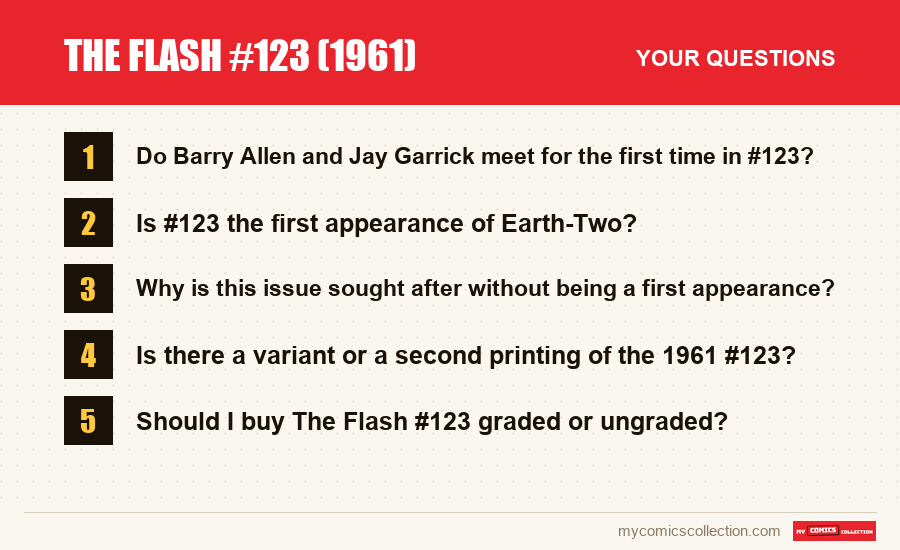
Yes, it is their first meeting in publishing history, with "Flash of Two Worlds," dated September 1961. Jay Garrick had existed since Flash Comics #1 of January 1940, and Barry Allen since Showcase #4 of 1956, but no story had made them cross paths before this issue by Gardner Fox and Carmine Infantino.
It is Barry Allen's first visit to Jay Garrick's Earth, and therefore the birth certificate of the concept. The labels "Earth-One" and "Earth-Two" settle mostly with the following stories, including Justice League of America #21 and #22 from 1963; check the exact wording in the copy you are after.
Because it introduces a concept, the DC multiverse, and not a character. That idea fed the annual team-ups starting in 1963 and then the 1985 series Crisis on Infinite Earths. Demand therefore comes from Silver Age fans and enthusiasts of the medium's history more than from speculation on screen adaptations.
Our sources mention no period alternate version for this issue: condition, any restoration and provenance make the difference between two copies. Modern reproductions, such as facsimile editions or collections, can be recognized by their paper, their printing and the edition mention.
Graded if you are thinking of resale or investment, because the grade makes sales comparable and guarantees authenticity. Ungraded, from a trusted seller with complete photos, if you want to read and show the issue. In both cases, check that there is no undeclared restoration.
Do you own a copy of The Flash #123 or another Silver Age issue of Barry Allen? Get a range based on current listings.
Estimate my comic