The Fantastic Four join Avengers: Doomsday, scheduled for December 18, 2026 in the United States and December 16 in the United Kingdom, directed by Anthony and Joe Russo. The quartet is played there by Pedro Pascal (Reed Richards), Vanessa Kirby (Sue Storm), Joseph Quinn (Johnny Storm) and Ebon Moss-Bachrach (Ben Grimm), all introduced in The Fantastic Four: First Steps, released on July 25, 2025. Facing them, Robert Downey Jr. as Doom. Yet Doom is not originally an Avengers adversary: he was born in Fantastic Four #5, dated July 1962, from Stan Lee's pen and Jack Kirby's pencil. This article rereads sixty-four years of this rivalry through its issues, and explains what their transfer to an Avengers poster changes for a collection.
There are few hero-villain pairs whose birth can be dated to the month and whose trajectory can be followed without a gap. This one is among them. The quartet appears in November 1961, the man in the iron mask six issues later, and since then they have practically never parted. Nothing comparable exists elsewhere in the publisher's catalog: the rivalry is contemporary with the house itself, and it served as a testing ground for almost everything superhero comics have invented since.
What happens in December 2026 is therefore a curiosity. The film bearing this villain's name is not a Fantastic Four film: it is an Avengers film, where the quartet is among several assembled groups. The historic enemy of a family of four becomes the antagonist of a coalition. This shift is not a casting detail, it says something precise about how franchises are ranked today, and it has readable consequences on the secondhand market.
The approach taken here is bibliographic. No plot summary, no forecast about what the film will show: a rereading of the rivalry through the issues that built it, with dates and creators, then a cold reading of what a character's position in the franchise hierarchy does to demand for their old issues.
July 1962: the rivalry is born with the villain
The date to remember is the cover date: July 1962, for an issue put on sale on April 10 of the same year. Fantastic Four #5 is signed Stan Lee on script and editing, Jack Kirby on art and co-plotting. It is the character's first appearance, and also, mechanically, the first clash between him and the quartet. The two events are the same event.
This point deserves emphasis because it is rare. Many great antagonists were created for another hero, or in an anthology series, before being reassigned. Here, the villain exists only as an adversary of that particular family: he is conceived from the start as their counterpoint. A genius against a genius, a loner against a family, a monarch against four civilians. The rivalry did not come to graft itself onto a preexisting character, it is the character.
Consequence for the collector: there is no earlier issue to aim for. No cameo appearance, no silhouette in a previous issue, no prototype in an anthology series. On many characters, the question "full first appearance or first appearance at all?" splits the market in two and complicates the purchase. Here, the question does not arise, and that is what makes this issue so clear-cut. We detail the issue itself in our first appearance sheet, and the condition criteria in the issue's grading guide.
Two years late: the origin told after the fact
The character debuts in July 1962, but his personal history is told only in 1964, in Fantastic Four Annual #2. Two years apart. During those two years, readers therefore faced an adversary whose provenance, face and motives they did not know.
This gap is an editorial fact, and it explains a good part of the market's structure on this character. On most Silver Age figures, a single issue concentrates the value: the first appearance's. Here, two issues share the role, because they do not tell the same thing. The first establishes the adversary, the second establishes the man. A collector who wants the complete file on the rivalry needs both, and the market has known it for a long time.
There is a second consequence, less often noted. By telling the origin after the fact, the publisher gave itself the freedom to write it based on what the character had become, and not the reverse. The accident, the disfigurement, the resentment toward Reed Richards: all of this was built to retroactively justify a hatred already installed in the pages. This is why this rivalry has aged better than many others. It was not deduced from an origin, it produced its origin. The character's psychological driver is treated separately in our article on the opposition of the two scientists.
The clashes that made history
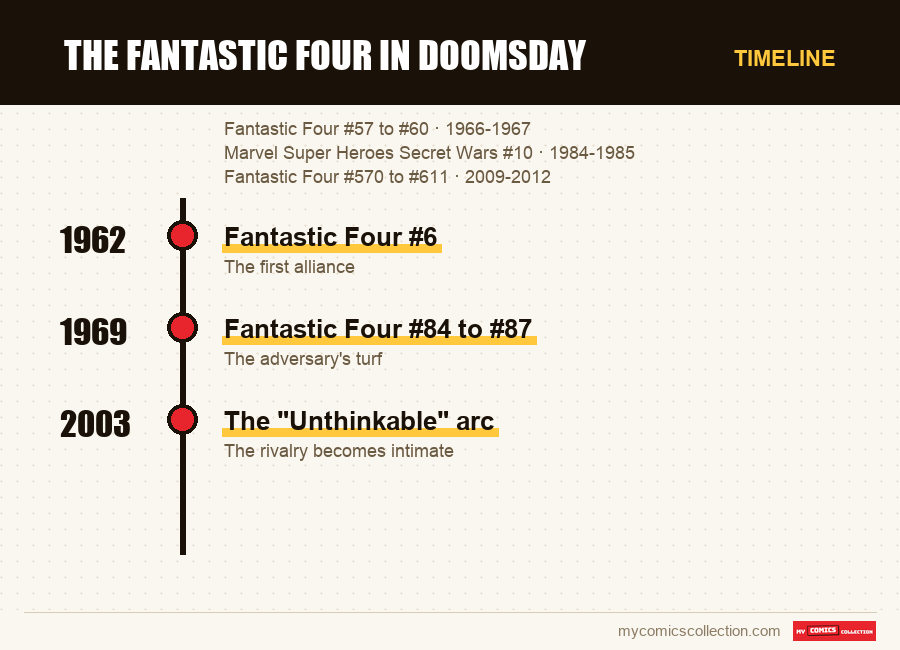
Between 1962 and today, the rivalry has had a handful of moments that changed its scale. Here they are in chronological order, with what is verifiable on each.
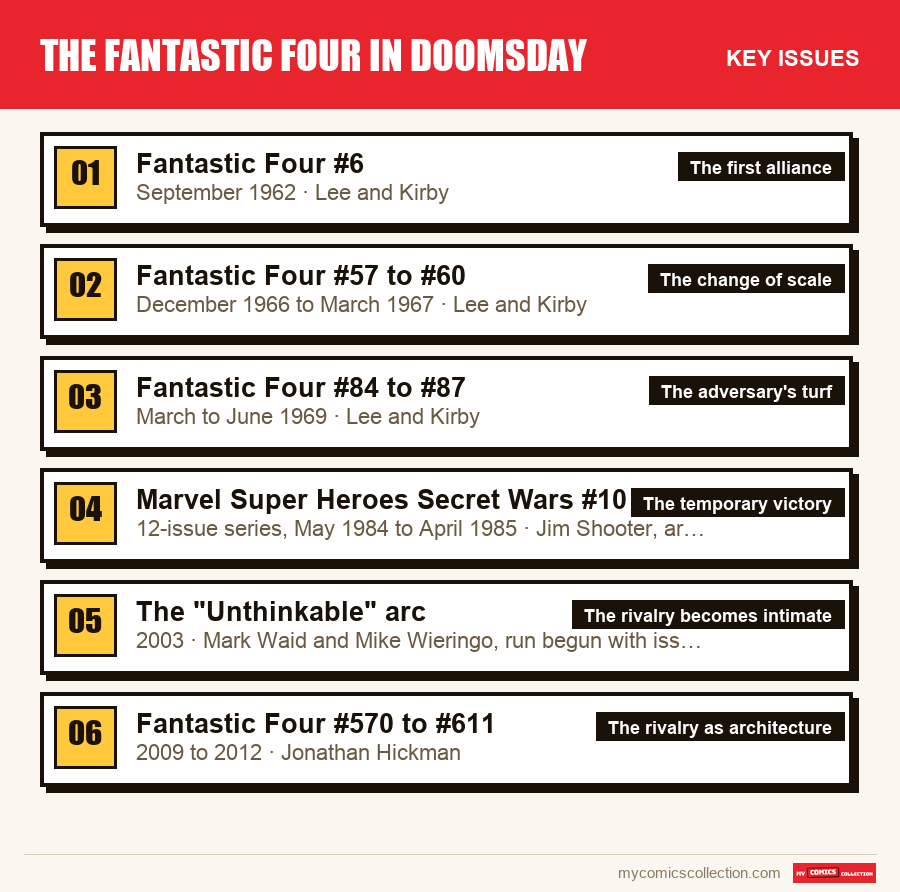
Fantastic Four #6
Two months after his appearance, the villain is already back, and he comes back accompanied: he attempts an alliance with Namor against the quartet. It is the publisher's first villain team-up of its new era, and the model for everything that follows. What matters is not the plot but the precedent: from the second clash, the writers understood that this character served as a pivot, able to connect other franchises to his own.
Fantastic Four #57 to #60
Four consecutive issues where the villain appropriates the Silver Surfer's power. It is the moment when the rivalry leaves the register of the skirmish for that of the cosmic threat. Before this arc, the adversary was a dangerous genius; after, he is a character able to manipulate forces of universal scale. Everything the movies retain of the character today, his boundless ambition and his ability to rival entities, is decided in these four issues.
Fantastic Four #84 to #87
For the first time, the quartet faces its enemy at his home, in a four-part story set in Latveria. The inversion is capital: until then, the adversary came to get them in New York. Here, they are the intruders, and he the legitimate sovereign on his own soil. This idea that the villain has a country, a population and political legitimacy is one of the rivalry's lasting contributions to the whole medium.
Marvel Super Heroes Secret Wars #10
In the tenth issue of the publisher's first big crossover series, the villain steals the Beyonder's power. He does not keep it: in the twelfth issue, he loses it and is set aside. But the gesture remained as the demonstration that he could win, for at least two issues, against all the heroes combined. It is also the first precedent of a story where the Fantastic Four's adversary becomes the antagonist of a collective cast, exactly the configuration of the December 2026 film.
The "Unthinkable" arc
The Waid-Wieringo run goes from issue 60 of October 2002 to issue 524 of May 2005, and "Unthinkable" is its peak. The adversary partly gives up technology for magic there, and goes after the family rather than the team. It is the moment the rivalry stops being a duel of geniuses and becomes a domestic affair, with the cruelty that implies. To understand why the character still frightens readers used to cosmic threats, this is where to read.
Fantastic Four #570 to #611
Hickman writes the main series from issue 570 to issue 611, as well as the twenty-three issues of the parallel series FF between 2011 and 2012. His contribution to the rivalry is structural rather than spectacular: he treats the two men's opposition as a design problem, where each is the solution the other refused to consider. He is the same writer who will then write the 2015 crossover series, whose title the 2027 film will take up.
Why the enemy of a family of four carries an Avengers film
Here is the fact that grounds the anomaly. In the movies, the character has been played five times in live action: by Joseph Culp in the 1994 film, by Julian McMahon in the two films of 2005 and 2007, by Toby Kebbell in 2015, and by Robert Downey Jr. in The Fantastic Four: First Steps in July 2025. The first four performances all belong to Fantastic Four films. The fifth appears in a mid-credits scene of a Fantastic Four film, then carries the title of an Avengers film.
Sixty-four years of bibliography say this adversary belongs to this family. The December 2026 calendar says he now belongs to the collective cast. Both statements are true, and their coexistence is not a contradiction: it is a decision of hierarchy.
The logic is simple to reconstruct. An Avengers film mobilizes several franchises and addresses the broadest audience; a Fantastic Four film mobilizes one franchise and addresses its audience. When a studio has an antagonist of this caliber, it places him where the largest number of viewers will see him. The tradeoff is made for the benefit of the broadest poster, not for the benefit of bibliographic fidelity.
The precedent also exists in the comics themselves, and it is old. The 1984 crossover series had already made this adversary the threat to a collective cast, thirteen years before superhero cinema existed in its current form. The movies therefore do not betray the bibliography: they apply a recipe the publisher tested first. The difference is one of scale, not of nature.
One question remains that collectors often ask and that the bibliography answers poorly: does this transfer weaken the Fantastic Four? In the pages, no, because none of the rivalry's keys ceases to exist. In the movies, it is another matter, and we have no reason to speculate before release. What is verifiable, however, is that the quartet arrives in this film with a single film of its own, released July 25, 2025, whereas the other groups on the poster arrive with more seniority. For the viewer who will discover the character in December 2026, the order of importance will therefore be the reverse of the historical order.
What the franchise hierarchy changes for a collection
There is a fairly constant market rule on old issues: demand follows exposure, not bibliography. In other words, it is not the most important issue that rises, it is the one the largest number of new buyers can identify after seeing a film.
Applied to this rivalry, the rule produces an asymmetric effect. The adversary's keys are nameable: a beginner collector leaving a theater knows he is looking for the first appearance of the villain in the mask, and there is only one issue to look for. The family's keys are more diffuse: you would need to know that there is a team first appearance, a cosmic arc, a wedding issue, and arbitrate among them. Demand therefore concentrates where identification is simplest.
Second effect, more interesting to exploit. A character promoted onto a collective poster draws attention to his own keys, but leaves in the shade the issues where he is only half the story. The four issues of the 1966-1967 arc, the four Latverian issues of 1969, the tenth issue of the 1984 series: these are rivalry issues, not first-appearance issues, and they are rarely cited in the lists that circulate after a film announcement.
Third effect, the one to anticipate with the most composure. A December release produces a fallout period in the following first quarter, during which many copies bought in a rush return to the market. It is not a price prediction, it is a market behavior observed at every big release for some fifteen years. The best opportunities on an old rivalry rarely come the week of release.
Finally, a point of vigilance that has nothing to do with speculation: the more an old issue is sought, the more reprints circulate presented as originals. On a 1962 key, checking the edition is the first thing to do, before even discussing condition. Our reprint guide lists the physical markers to check.
Which issues to aim for by budget
Three paths, from the most accessible to the most demanding. None assumes owning the two founding keys, and that is deliberate: a rivalry collection can be coherent without them.
Tight budget: the modern rivalry
Start with the 2003 arc and the 2009 to 2012 run. These are issues printed in quantity, recent, easy to find in good condition and with no risk of a misleading reprint. They have a decisive teaching advantage: they tell the rivalry as a contemporary writer understands it, and therefore as the movies draw from it. For someone discovering the subject before December 2026, it is the best ratio between spending and understanding.
Mid budget: the late Silver Age arcs
Aim for the four Latverian issues of 1969, then the 1966-1967 arc if the budget follows. These are issues from the golden age of the Lee-Kirby duo, so authentically old, but located after the series' tightest price zone. A practical tip: buy the arc in order and all at once if you find it complete, because assembling an arc issue by issue over several months almost always costs more than buying it grouped.
Substantial budget: the two founding keys
The July 1962 issue and the 1964 annual, in that order. Two rules on this segment. First, condition is discussed before price: on a comic over sixty years old, a low grade correctly described is worth more than a middling grade on a copy restored without notice. Second, at this level of spending, certification is not a luxury but insurance on the edition's authenticity. Our complete list of the character's key issues places these two pieces in the whole of his bibliography.
In all cases: record before buying the next one
A rivalry collection is built on two series, three numberings and six decades. This is exactly the case where you buy again by mistake an issue already owned, or believe an arc complete when the third episode is missing. Note each copy with its series, number, edition and condition on the day of purchase, in the app or elsewhere, but note it.
Where to read before December 2026
If the goal is to understand the character before release rather than to build a collection, the efficient order is not chronological. Read the 2003 arc first, which gives the version closest to the one the movies exploit. Then go back to the 1964 annual for the origin, then to the July 1962 issue to see where it all starts. Finish with the four issues of 1966-1967, which explain the scale at which the character is now treated.
Four steps, about twenty issues in all, and the essentials of the rivalry are covered. For a broader path on the family itself, our reading guide offers a complete itinerary, and the group's hub gathers our articles. The film's production and distribution details are gathered in our dedicated sheet.