
For Fantastic Four #5 (first appearance of Doctor Doom ), dimming CGC is almost essential given the value at stake. We explain the scale of grades, what level to aim for according to your budget and your objective, the economics of grading and the precautions (pressing, restoration, labels): to purchase this key to the Silver Age in complete safety.
Buying a Fantastic Four #5 without a guarantee of condition or authenticity is risky. CGC gradation provides this security. Complete guide to approaching this key issue through the prism of grading. Decryption.
As always in this guide, only verified information is stated; the analysis is ours, without reproduction of plates or protected dialogue. No numerical estimate is put forward.
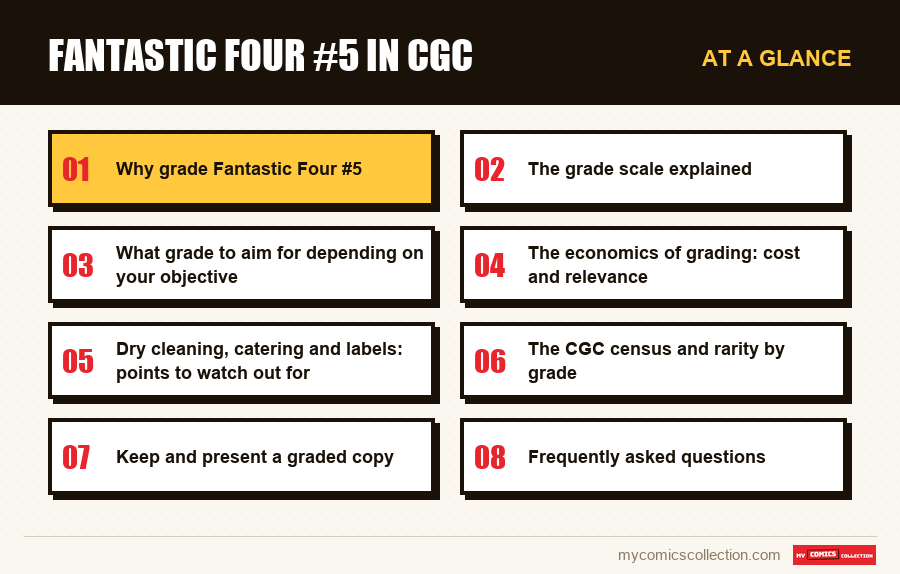
Why grade Fantastic Four #5
Grading involves having a comic evaluated by an independent professional service, which assigns a condition grade on a standardized scale, authenticates the copy and seals it in a protective case. For an issue as old and valued as Fantastic Four #5, this approach has major advantages. It first guarantees authenticity, avoiding the risk of acquiring a reissue or a doctored copy. It then provides an objective assessment of the condition, essential for a number whose value strongly depends on its quality of conservation. Finally, the case permanently protects the copy from damage. For a key of this importance, gradation has thus become a quasi-standard on the market.
It should be noted that grading is not limited to assigning a grade: it is accompanied by a thorough verification of the copy, including the detection of possible restorations, retouching or missing pages. This expertise, carried out by professionals, provides a guarantee that is difficult to obtain otherwise, particularly valuable for an old and coveted number, where attempts at fraud or embellishment are not rare. The service seal thus certifies not only the condition, but also the integrity of the copy.
The most common grading service is CGC (Certified Guaranty Company), whose sealed enclosures are a benchmark on the international market. A copy graded by CGC benefits from greater recognition and liquidity: its grade is accepted by collectors around the world, which facilitates purchase and resale. For Fantastic Four #5, opting for a graded copy provides valuable peace of mind, both in terms of authenticity and condition. This security justifies the approach, despite its cost. For the collector, understanding the benefit of grading is the first step to calmly approach the acquisition of a key as major as the first appearance of Doctor Doom.
The grade scale explained
The gradation is expressed on a numerical scale ranging from 0.5 (very degraded condition) to 10 (perfect condition, called “Gem Mint”). This scale makes it possible to precisely locate the condition of an item. Low grades (up to approximately 4.0) correspond to copies marked by wear, but complete and readable: these are “reading copies” or entry-level copies. Average grades (around 5.0 to 7.0) designate examples in good condition, with moderate wear. High grades (8.0 and above) correspond to very well preserved examples, increasingly rare and sought after as you go up the scale. For a 1962 issue, each tier represents a significant jump in rarity and value.
Understanding this scale is essential to target your purchase. For Fantastic Four #5, each grade level corresponds to a very different market reality: a low grade copy is accessible, while a high grade copy reaches heights. Rarity increases sharply in higher grades, as few copies of a comic over sixty years old have survived in excellent condition. The CGC “census”, the census of the number of examples graded at each level, gives a valuable indication of this relative rarity. For the collector, knowing the scale of grades allows them to define a realistic objective, based on their budget and expectations. Our dedicated guides to grading, in the Fatalis hub, detail how this scale works.
What grade to aim for depending on your objective
The choice of grade to aim for depends above all on the collector's objective. For those who simply want to own the first appearance of Doctor Doom, at a lower cost, a low or medium grade copy is an excellent entry point: it offers the pleasure of holding this iconic key without the investment of a high grade. For those looking for a beautiful example, both attractive and in good condition, a medium to high grade (around 6.0 to 8.0) often represents the best compromise between quality and budget. For the discerning investor or collector, the highest grades are the most sought after, but also the most expensive and rare.
This choice must take into account the considerable price gap between grades. For Fantastic Four #5, moving from one rank to a higher rank can represent a significant jump in value, particularly at high levels where rarity increases. A popular strategy consists of aiming for the best grade accessible within your budget, favoring a copy with a balanced appearance. It is also advisable to define your objective (reading, pleasure, investment) before positioning yourself, because this determines the relevant grade. For the collector, no grade is objectively “the right one”: everything depends on expectations and means. The main thing is to make an informed choice, based on real recent sales for each targeted grade.
The economics of grading: cost and relevance
There is a cost to getting a comic graded, which includes service fees, shipping, and insurance. For a low value number, this cost may exceed the benefit of the approach; but for a key as valued as Fantastic Four #5, gradation is almost always relevant, as it secures and enhances the copy. A graded Fantastic Four #5 is resold more easily and often at a better price than an equivalent non-graded copy, because the buyer benefits from the guarantee of authenticity and condition. The economics of grading therefore lean clearly in favor of the approach for this number, the value of which largely justifies the investment.
However, the question of choice arises: buy an already graded copy, or have a raw copy graded? Buying already graded provides immediate security, with no surprises on the condition. Having a rough copy graded yourself can be advantageous if you are confident about its condition, but carries a risk: the grade awarded may be lower than expected. For a key of this importance, caution often leads to favoring the purchase of examples already graded by a recognized service, except for experienced collectors. For the collector, understanding the economics of grading allows them to optimize their acquisitions and avoid unpleasant surprises. Our guides dedicated to gradation detail these decisions.
Collecting this series?
Track what you own, what you are missing and what your collection is worth. 7 day trial.
Start my trial →Dry cleaning, catering and labels: points to watch out for
Several technical points deserve particular attention when purchasing a Fantastic Four #5 grade. “Pressing”, which consists of reducing certain defects (folds, marks) through physical intervention, can improve the grade of a copy without being considered a restoration. Restoration, on the other hand (the addition of material, retouching) is indicated by a specific label and generally affects the value downward: collectors favor unrestored examples. Grading services use different types of labels to signal the condition and characteristics of an item, which is essential to understand before purchasing.
A standard label indicates an unrestored copy, while other labels indicate restorations, specific defects or authenticated signatures. For Fantastic Four #5, checking the type of label is essential: an unrestored copy is more sought after and better valued than a copy that has undergone interventions. Demanding collectors favor examples in their original condition, without restoration. Understanding these nuances allows you to make an informed purchase and avoid overpaying for a product whose value is affected by undetected interventions. For the collector, mastering these points of vigilance (pressing, restoration, labels) is essential to calmly approach the acquisition of this major key. The Fatalis hub brings together our guides on dimming to delve deeper into these technical aspects.
The CGC census and rarity by grade
A valuable tool for the collector is the CGC “census”, that is to say the census of the number of examples graded at each level. For Fantastic Four #5, this census reveals an important reality: copies in high grades are significantly rarer than those in low or medium grades. This scarcity at the top of the scale explains the surge in prices for the best examples, the number of which is limited. Consulting the census allows you to appreciate the relative rarity of a given grade and to better understand the value of a copy. A high grade, of which few examples exist, justifies a value that is all the greater as supply is restricted in relation to demand.
This information on rarity by grade is an asset for refining your acquisition strategy. A collector can, for example, aim for a grade just below the threshold where rarity causes prices to jump, thus obtaining a fine example at a more reasonable cost. Conversely, the investor seeking maximum rarity will turn to the highest grades, despite their cost. For Fantastic Four #5, understanding the distribution of graded copies informs purchasing decisions. The census evolves with the new gradations, but generally reflects the increasing difficulty of finding copies in excellent condition for a 1962 issue. For the collector, this tool is essential to assess the rarity and value of a given copy, in addition to actual recent sales.
Keep and present a graded copy
Once acquired, a graded Fantastic Four #5 deserves careful conservation. The sealed housing of the grading service already protects the copy from manipulation and external attacks, but certain precautions remain useful. The case should be kept away from direct light, humidity and temperature variations, which can damage the comic in the long term, even when protected. Vertical storage, in a stable environment, preserves the copy in the best conditions. For a piece of such value, these precautions are a minimal investment considering the stakes involved, guaranteeing the preservation of the copy and its value.
The question of presentation also arises for collectors wishing to exhibit their piece. The sealed case lends itself to secure display, allowing you to admire the cover while protecting the comic. Specific supports and frames exist to present graded specimens in good conditions. However, as prolonged exposure to light is not recommended, a thoughtful display is essential. For the collector, preserving and presenting a graded Fantastic Four #5 is the culmination of an important acquisition: an exceptional piece, the first appearance of Marvel's greatest villain, deserving attention commensurate with its value. The Fatalis hub brings together our guides on the conservation and presentation of collectible comics.
Frequently asked questions
For such an old and valuable key, grading is almost essential: it guarantees authenticity, provides an objective assessment of the condition and protects the copy. A graded Fantastic Four #5 is resold more easily and often at a better price than an ungraded equivalent.
It depends on the goal: a low or medium grade to simply own the key at a lower cost, a medium to high grade (6.0 to 8.0) for a nice balanced example, or the highest grades for investment. Aim for the best grade accessible within your budget.
It ranges from 0.5 (very degraded) to 10 (perfect). Low grades (up to 4.0) are reading exemplars; middle grades (5.0-7.0) are in good condition; high grades (8.0+) are very well preserved and increasingly rare. For a 1962 issue, every level counts.
Yes, generally downward. Restoration (addition of material, retouching) is indicated by a specific label, and collectors favor unrestored examples. Pressing, which reduces certain defects without adding material, is not considered a restoration.
For a key of this importance, buying already graded by a recognized service provides immediate security. Having a rough copy graded yourself can be advantageous if you are confident about its condition, but carries the risk of a lower grade than expected.
Do you own Fantastic Four #5 graded or are aiming for this key? Estimate its value for free with our tool based on current eBay listings.