
The Darkseid comics history begins with the tyrant of Apokolips, created by Jack Kirby for DC's Fourth World, from his cameo in Superman's Pal Jimmy Olsen #134 (December 1970) to his first full scene two months later in The Forever People #1. His goal has never changed: to possess the Anti-Life Equation, which would bend every will to his own. More than half a century later, he remains the great cosmic adversary of the DC universe, from the Legion of Super-Heroes to the Justice League.
Few villains have a publishing history that reads like a series of handoffs between creators. Darkseid is one of them: born under a single author's pencil within a few months, abandoned, then relaunched every five or ten years by a writer who saw something different in him than the one before. This guide follows the life of the character rather than that of his adversaries, era after era.
As always in this guide, only verified information (creators, issue numbers, dates) is stated as fact; the analysis is our own, with no reproduction of protected artwork or dialogue.
His first appearance
In 1970, Jack Kirby left Marvel for DC with a project for a long but finite saga spread across several titles. He did not yet have a series of his own, so he took over Superman's Pal Jimmy Olsen, whose issue #133 dated October 1970 marks his debut. Issue #134, dated December 1970, is where Darkseid makes a cameo. Kirby thus planted his tyrant in a neighboring magazine before giving him pages of his own.
The first full appearance dates from February 1971: The Forever People #1. The first New Gods, dated February-March 1971, does not count among his appearances in the strict sense: it founds the title that carries the myth and introduces Orion, Highfather and Metron. All three issues, from the winter of 1970-1971, get sold as "the first appearance" by dealers who are not talking about the same object; our guide to Darkseid's key issues puts that hierarchy back in order.
Kirby gave his face the features of actor Jack Palance, and drew on the personalities of Hitler and Nixon for his character. A tyrant who does not impose himself through cunning but through the certainty of being right: that trait, more than the stone costume, explains the character's longevity.
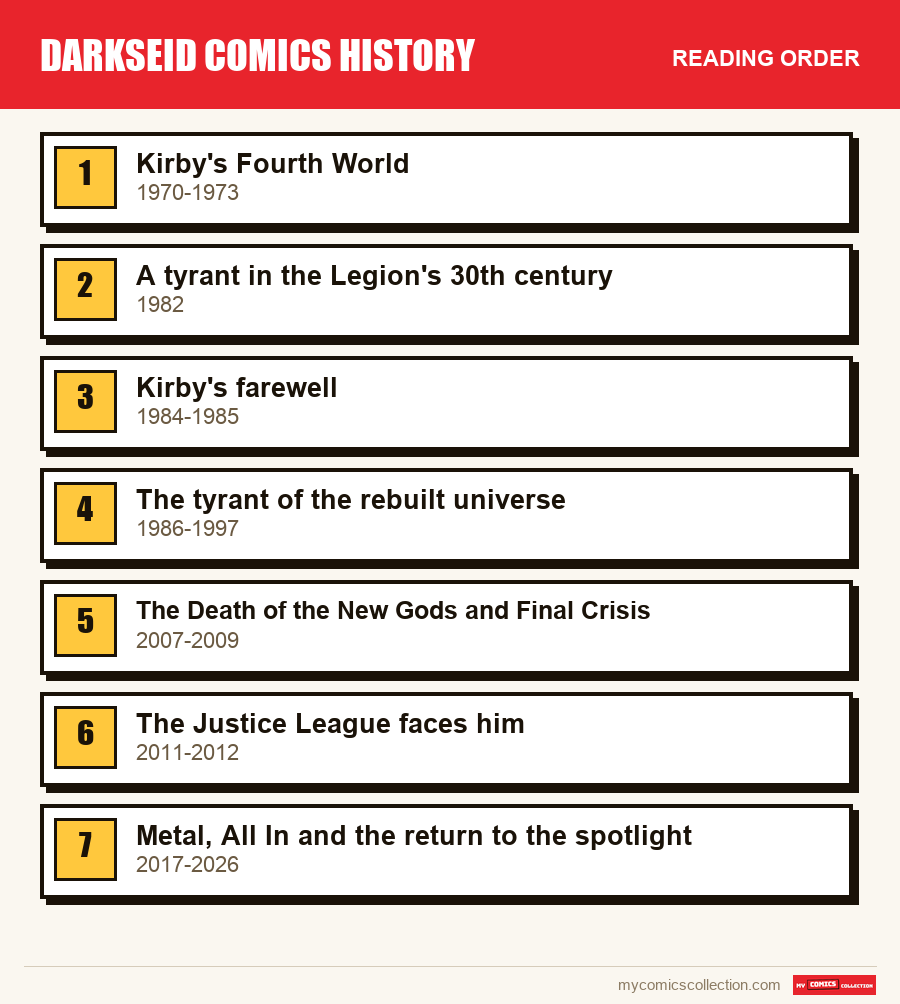
Era 1: Kirby's Fourth World (1970-1973)
Kirby spread his project across four magazines. He took over Superman's Pal Jimmy Olsen at issue #133 and did issues #133 to #139 and #141 to #148; he launched The Forever People and The New Gods, eleven issues each, then Mister Miracle, eighteen. In total: 55 issues from his hand, published between late 1970 and 1973. Our Fourth World reading guide details the publication order.
Face to face stand two twin worlds born from the end of the old gods: the luminous New Genesis, under the authority of Highfather, and Apokolips, a planetary factory ruled by Darkseid. A truce rests on an exchange of children. Orion, Darkseid's son, grows up with the enemy; Scott Free, Highfather's son, grows up in the orphanages of Apokolips, escapes to Earth and becomes Mister Miracle. Everything we say about Darkseid afterward flows from this family arrangement.
Darkseid searches for the Anti-Life Equation. The character does not need a visible army to be menacing: a metaphysical goal is enough, and that is what sets him apart from the ordinary conquerors of the period. New Gods #7, dated February 1972, gives his origin; Kirby writes and draws it, with Mike Royer on inks. The series stopped before the saga reached its conclusion, however, and that silence fed every revival to come.
Era 2: A tyrant in the Legion's 30th century (1982)
After Kirby's series, the character's big return comes from a title where nobody expected him: Legion of Super-Heroes vol. 2, #290 to #294, from August to December 1982, the arc readers call The Great Darkness Saga. Paul Levitz writes, Keith Giffen pencils and Larry Mahlstedt inks. Darkseid is not in his Apokolips setting here: he threatens the distant future of the young Legion heroes.
This editorial choice has a lasting consequence: it makes the character an adversary who can be moved from one corner of the DC universe to another, and no longer just the ruler of a closed world. Legion readers do not necessarily know Kirby; the tyrant is presented to them as a threat you sense is older than the story. This five-issue run remains one of the most cited entry points for anyone who wants to read Darkseid outside Kirby, and we come back to it below in the reading suggestions.
Era 3: Kirby's farewell (1984-1985)
Kirby had never closed his saga, and DC gave him the chance to do so. He first delivered "Even Gods Must Die," an unpublished story printed in New Gods #6 (1984), then the graphic novel The Hunger Dogs (1985). These two volumes are the real conclusions of the Fourth World, written by its creator himself, and they read better after the eleven original issues.
For the character, it is a particular moment: Darkseid is seen by his own author with more distance than in 1971. He is no longer just the threat of a serial, but the culmination of a line of thought about power. For a collector, The Hunger Dogs is a different object from the newsstand single issues: a squarebound album, designed for the specialty comic shop.
Era 4: The tyrant of the rebuilt universe (1986-1997)
After Crisis on Infinite Earths, the DC universe was relaunched and Darkseid had to find his place in it again. The Legends event (1986) features him, and John Byrne, then at the helm of Superman, uses him in Superman vol. 2 #3 (March 1987), "Legends From the Darkside," drawn with Terry Austin on inks. For the first time since Kirby, a major Superman creator brings Darkseid into the daily life of the Man of Steel, and not only into the New Gods series.
Ten years later, John Byrne took up the Fourth World in person: the series Jack Kirby's Fourth World (1997), written and drawn by him, revisits in particular the origin of Darkseid, born Uxas, and his seizure of power. It is proof that by the end of the 1990s the character belonged less to a single author than to a lineage of authors who reread one another. To understand Byrne's arrival at DC, our history of Superman gives the context of the 1986 relaunch.
Do you collect this series?
Track what you own, what you are missing and what your collection is worth. 7-day trial.
Start my trial →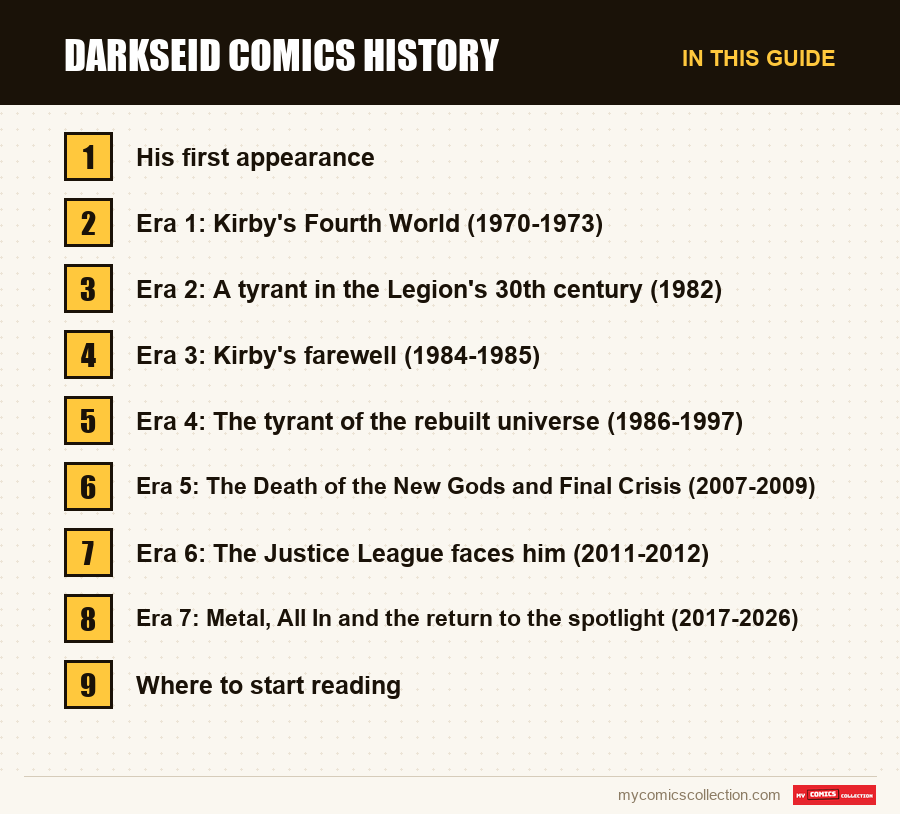
Era 5: The Death of the New Gods and Final Crisis (2007-2009)
In the mid-2000s, DC finally closed the saga in an adult register. The Death of the New Gods, written and drawn by Jim Starlin with Art Thibert on inks (2007-2008), unfolds the end of the divine lineage; in issue #6, dated April 2008, Darkseid feels Orion's death. The character is observed there from the viewpoint of an author who knows the cosmic well and is not afraid to kill.
Larger still, Final Crisis, by Grant Morrison, ran from May 2008 to January 2009: seven oversized issues drawn by J. G. Jones, with Carlos Pacheco, Marco Rudy and Doug Mahnke on some issues, plus a large number of tie-ins. Warning, spoiler: Orion tears out Darkseid's heart, whose essence survives and is reborn as Boss Dark Side. Batman hits him with the radion bullet that killed Orion, while an Omega beam hurls the Dark Knight into the past; Wonder Woman then binds the tyrant with her lasso, and Superman destroys his essence. For the complete reading order, see our Final Crisis guide. On the author, see the Grant Morrison page.
Era 6: The Justice League faces him (2011-2012)
After the 2011 reboot, Darkseid returns in another form. Justice League vol. 2, #1 to #6 (November 2011-April 2012), written by Geoff Johns, drawn by Jim Lee and inked mainly by Scott Williams, tells the heroes' first joint mission against an invasion from Apokolips. Darkseid here is more violent and more direct than Kirby's tyrant, but his goal remains: the world must bend.
To understand the author, see the page devoted to Geoff Johns and his reading guide.
Era 7: Metal, All In and the return to the spotlight (2017-2026)
Since 2017, Darkseid has regularly come back to the front line. He appears in Dark Nights: Metal #2 (November 2017), by Scott Snyder, Greg Capullo and Jonathan Glapion. Wonder Woman vol. 5, #31 to #37 (November 2017-February 2018), written by James Robinson with several artists, features him again. Justice League Odyssey #1 (November 2018), written by Joshua Williamson and drawn by Stjepan Šejić, brings him back in a cosmic setting. The DC All In Special (2024) is co-written by Williamson and Snyder.
In that DC All In Special, Darkseid merges with the Spectre through the Miracle Machine, lets the Justice League kill him, and corrupts another universe, which becomes the Absolute Universe. In March 2026, a variant cover of DC K.O. #5, drawn by Javier Fernández, put him in the spotlight again. When a publisher puts an old character back in the spotlight, copies from his past become more sought after: you are better off getting your Fourth World books in order before that wave. To place this turning point within the relaunch, open the DC All In reading guide.
Where to start reading
There are many possible entry points; here are five doors depending on your reader profile.
- The Kirby purist: New Gods #1 to #11, then The Forever People and Mister Miracle, in the publication order described by our Fourth World guide. It is the only reading that gives the exchange of sons its full meaning.
- The event-saga reader: Final Crisis by Grant Morrison and J. G. Jones. It is not an easy way in, but it is the end of the story.
- The reader who wants a short, complete arc: Legion of Super-Heroes vol. 2 #290 to #294, the The Great Darkness Saga arc, five issues written by Paul Levitz.
- The Superman reader: Superman vol. 2 #3 (1987) by John Byrne, then the reading of the League saga.
- The Justice League reader: Justice League vol. 2 #1 to #6 (2011-2012) by Geoff Johns and Jim Lee, for a first modern encounter with the character.
The key issues to know
The collecting method is to tell apart the three statuses of "first appearance," then the major turning points. No price appears here: values vary too much from one sale to the next.
- Superman's Pal Jimmy Olsen #134 (December 1970): the cameo, hence the priority. The issue shows little, but it carries the earliest date.
- The Forever People #1 (February 1971): the character's full first appearance.
- New Gods #1 (February-March 1971): the founding issue of the mythology's main title, with Orion, Highfather and Metron.
- New Gods #7 (February 1972): Darkseid's origin, written and drawn by Kirby.
- Legion of Super-Heroes vol. 2 #290 to #294 (1982): the arc by Paul Levitz and Keith Giffen.
- The Hunger Dogs (1985): the conclusion written by Kirby, a format of its own.
- Final Crisis (2008-2009): the end of the character, in seven issues.
- Justice League vol. 2 #1 (November 2011): the Darkseid of the relaunch.
For a complete table of these statuses, see our Darkseid key issues. On single issues from 1970 and 1971 printed on fragile paper, condition decides everything: always compare copies by issue and by grade, not by title.
Frequently asked questions
Two issues share the answer, both by Jack Kirby: a cameo in Superman's Pal Jimmy Olsen #134 (December 1970), then the full debut in The Forever People #1 (February 1971). New Gods #1 is the founding issue of the title, not an appearance in the strict sense.
Jack Kirby, when he left Marvel for DC in 1970. The character is the main adversary of the Fourth World, the saga he spread across four series. Kirby modeled his face on actor Jack Palance, and his character on Hitler and Richard Nixon.
It is Darkseid's goal in Kirby's saga: a formula that would let him control every will in the universe. It makes him a tyrant whose ambition is metaphysical rather than territorial, which sets him apart from the classic conquerors of the comics of the time.
Yes, in Kirby's saga. To seal a truce, Darkseid and Highfather exchanged their sons: Orion grew up on New Genesis, and Scott Free, Highfather's son, grew up on Apokolips before escaping to Earth under the identity of Mister Miracle.
It depends on your profile. For the source, read Kirby's New Gods #1 to #11. For a short arc, pick Legion of Super-Heroes vol. 2 #290 to #294. For a modern encounter, turn to the first year of Justice League vol. 2 by Geoff Johns and Jim Lee.
Do you have a Fourth World or Darkseid saga issue in your boxes? Get it appraised before you sell it.
Appraise my comic