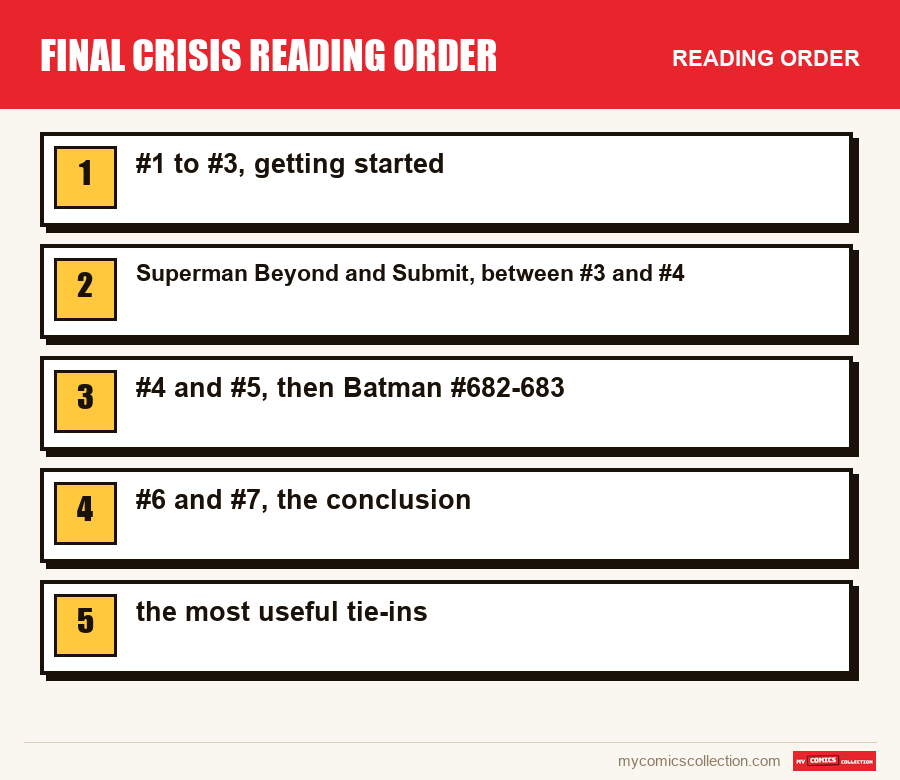
Final Crisis is Grant Morrison's DC event, and its reading order is easy to get wrong: 7 monthly issues, May 2008 to January 2009, with art by J. G. Jones, Carlos Pacheco and Doug Mahnke. The order given by the author is: #1-3, Superman Beyond #1-2, Submit, #4-5, Batman #682-683, then #6-7. Read Batman #676-681 beforehand if you want the cleanest handoff.
The trap in this event is not its size but its layout: decisive chapters are published outside the main series, and a Batman two-parter slots in between #5 and #6. This guide gives a clean, ordered path without retelling the story.
As always in this guide, we only state verified information (creators, issue numbers, dates); the analysis is our own, with no reproduction of protected pages or dialogue.
What to read before
Unlike other events, Final Crisis does not require any prep miniseries. Three reads are still worth knowing about, at very different levels of importance.
- Batman #676-681 (2008), the Batman R.I.P. arc, by Grant Morrison with art by Tony Daniel. This is the most useful prior reading: Batman #682-683 and then Final Crisis #6 pick it up directly. Spoiler warning: this arc has direct consequences for Batman's fate in Final Crisis, so do not look up the ending before you have read it.
- Seven Soldiers, the Grant Morrison series that Final Crisis was conceived as a thematic sequel to, alongside 52. The link is real, but it is thematic: you can read the event without having opened those series.
- Countdown to Final Crisis, a 51-issue weekly series designed as a follow-up to 52. It ends on its #1, and the planned #0 became the one-shot DC Universe #0, sold at a reduced price and narrated by Barry Allen. Only that one-shot has a direct bearing on the event; the 51-issue series is not necessary.
For readers discovering the author, our guide Grant Morrison: where to start offers gentler entry points than this event. If you have just read Infinite Crisis, you will notice that the structure is completely different: here, a single writer drives the main series and the most important tie-ins.
Phase 1: #1 to #3, getting started
The main series launches on May 28, 2008. Grant Morrison writes the entire series; J. G. Jones draws the first six issues, with Marco Rudy on #5 and #6 and Carlos Pacheco on pencils for #4 to #6, then Doug Mahnke on pencils for #6 and #7. For the first three issues, then, the art is J. G. Jones alone.
We do not summarize the plot. One reading tip is enough: the first three issues read in a single sitting, and it is best not to interleave any tie-ins before #3. A one-shot, DC Universe: Last Will and Testament, was meant to sit at the junction between #3 and #4; it is not needed to follow the thread.
Phase 2: Superman Beyond and Submit, between #3 and #4
This is the point readers miss most often. Superman Beyond is a 2-issue miniseries, also written by Grant Morrison, which the author places between Final Crisis #3 and #4. If you skip it, you lose a piece of the path the author intended.
Final Crisis: Submit is a one-shot that the author's reading order places after #3. We suggest reading it right after Superman Beyond to keep the original order.
The order for this stretch is therefore: #3, then Superman Beyond #1-2, then Submit, then #4. Readers who follow the Man of Steel's stories will get a lot out of our Superman reading guide and the list of major Superman crossovers.
Phase 3: #4 and #5, then Batman #682-683
Issues #4 and #5 are where the art changes hands: Carlos Pacheco steps in on pencils from #4, and Marco Rudy on #5 and #6. It is also right after #5 that the Batman R.I.P. thread returns to the foreground, by way of the Batman series.
After #5, read Batman #682 and #683, two issues titled "Last Rites," written by Grant Morrison. These two single issues skim over the character's career and lead straight into Final Crisis #6. Our list of key issues from Morrison's Batman run places these issues within the whole of his output.
Another Grant Morrison two-parter, Batman #701 and #702, published later, also counts among the event's tie-ins. It reads after the main series rather than before, so as not to break the rhythm.
Phase 4: #6 and #7, the conclusion
The last two issues are drawn by several hands: #6 brings together J. G. Jones, Carlos Pacheco, Marco Rudy and Doug Mahnke, and #7 is drawn by Doug Mahnke. The series wraps in January 2009. We do not go into the content: rereading the whole thing a second time, in the order the author gave, remains the best way to measure the gap with the monthly release.
Do you collect this series?
Track what you own, what you are missing and what your collection is worth. 7-day trial.
Start my trial →
Phase 5: the most useful tie-ins
Outside the core reading order, several titles carry the event's mark. Here are the ones we recommend, along with what the event's references say about them:
- Final Crisis: Legion of 3 Worlds #1-5, by Geoff Johns with art by George Pérez, completed in 2009. It is the most substantial tie-in, mostly useful to readers of the Legion of Super-Heroes.
- Final Crisis: Rage of the Red Lanterns: a one-shot written by Geoff Johns, whose follow-up reads in Green Lantern #36-38. Read it alongside our Green Lantern reading guide.
- Final Crisis: Revelations #1-5: Greg Rucka writes five issues around the Spectre and the Question.
- Final Crisis: Rogues' Revenge #1-3, a three-issue miniseries by Geoff Johns and Scott Kolins centered on the Flash's adversaries; it will interest readers of the Flash reading guide.
- The one-shots Final Crisis: Requiem, Final Crisis: Resist and Final Crisis: Secret Files.
After the event, Final Crisis Aftermath: Dance #1-6, by Joe Casey with ChrisCross, follows the Super Young Team. It is a sequel, not a prelude, and it is not read before the main series.
The tie-ins you can skip
Most of the tie-ins on this list can be skipped on a first read: the main series is written to lean on Superman Beyond, Submit and Batman #682-683, and on nothing else. Rogues' Revenge, Revelations, Requiem, Resist and Secret Files are not needed to follow the thread, and they mainly serve readers of the characters involved or those completing a collection.
The case of Legion of 3 Worlds is separate: this miniseries has its own appeal, and it reads as a self-contained five-issue story. Readers who mainly want to understand Final Crisis can set it aside; the rest will find a full read in its own right.
Single issues or trade paperbacks: how to read it
A trade paperback does not always reproduce the author's intended order: the one that collects the seven issues of the series does not necessarily contain Superman Beyond, Submit or Batman #682-683. There are hardcover and softcover collections, as well as the Absolute Final Crisis edition and an omnibus released in 2018; for each, read the table of contents before buying and compare it with the list in this guide.
Our method is as follows: spot the titles included, then spot the ones that are missing. If Superman Beyond and Batman #682-683 are absent from the trade, you will have to track them down separately, as single issues or in another volume. For single issues, publication order is simpler to follow, since the Batman issues can be bought one at a time.
If you collect single issues, be aware that J. G. Jones and the artists who replaced him partway through did not draw the same pages: a series whose artists change within the same issue (#6, for example) offers several possible signatures. For signings, find out who the artist is on each issue before arranging a session.
The key issues to know
We reason by role in the story, not by assumed scarcity, and we cite no prices:
- Final Crisis #1 (May 28, 2008): the opening issue of the main series. Check the cover credit on the single issue.
- Final Crisis #6 and #7: the two concluding issues, drawn by several hands. Issue #7, drawn by Doug Mahnke alone, closes the series in January 2009.
- Batman #682 and #683: two issues that link two events, which makes them interesting for anyone who already owns Batman R.I.P..
- Superman Beyond #1-2: a Grant Morrison miniseries that collectors often leave off their want lists.
- DC Universe #0: a prep one-shot, narrated by Barry Allen, useful for putting together a complete set of the event.
To judge a 2008 single issue, look at the corners and the spine, then compare its condition against completed sales. For a series whose art changed hands along the way, also check that the issue in hand is the original printing and not a reprint. Our free valuation helps place a copy without relying on asking prices alone.
Recap: the complete order
- Optional: Batman #676-681 (Batman R.I.P., 2008)
- Optional: DC Universe #0
- Final Crisis #1-3 (from May 2008)
- Optional: DC Universe: Last Will and Testament
- Final Crisis: Superman Beyond #1-2
- Final Crisis: Submit
- Final Crisis #4-5
- Batman #682-683
- Final Crisis #6-7 (through January 2009)
- Optional: Batman #701-702
- Optional: Legion of 3 Worlds #1-5, Rage of the Red Lanterns, Revelations #1-5, Rogues' Revenge #1-3, Requiem, Resist, Secret Files
- Optional: Final Crisis Aftermath: Dance #1-6
Frequently asked questions
The order given by Grant Morrison is: #1-3, Superman Beyond #1-2, Submit, #4-5, Batman #682-683, then #6-7. Beforehand, Batman #676-681 is the most useful prior reading.
The main series has 7 monthly issues, published from May 2008 to January 2009. With Superman Beyond (2 issues), Submit and Batman #682-683, the core reading the author laid out comes to about a dozen single issues.
It is strongly recommended. Batman #676-681 (2008), by Grant Morrison and Tony Daniel, comes before the event, and its sequel runs through Batman #682-683 and then issue #6 of the main series. Without that arc, the stretch through Batman #682-683 will be harder to place.
J. G. Jones draws the first six issues, with Marco Rudy on #5 and #6 and Carlos Pacheco on pencils for #4 to #6. Doug Mahnke handles pencils on #6 and #7 and draws all of #7. Grant Morrison writes the entire series.
No, it is not necessary. This 51-issue weekly series continues 52, but Grant Morrison's series reads fine without it. Only the one-shot DC Universe #0, which replaces the planned #0, has a direct bearing on the event.
Do you own single issues by Grant Morrison or from Batman R.I.P.? Get your copies valued before you shelve them.
Value my comic