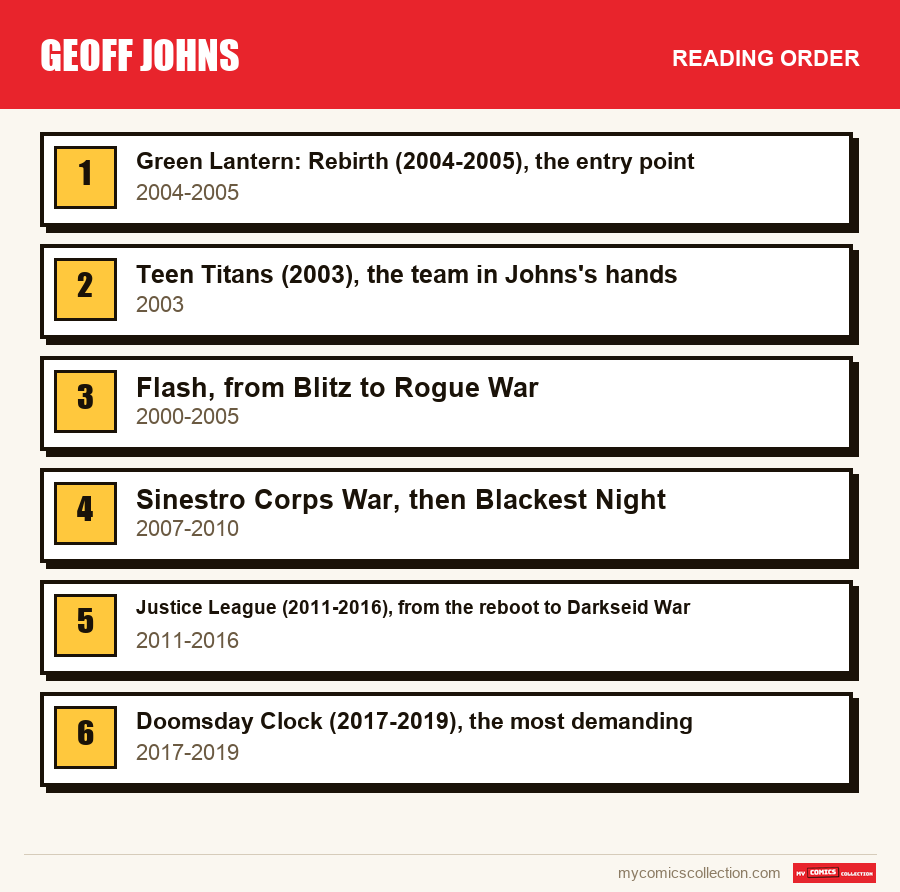
To read Geoff Johns without getting lost, start with Green Lantern: Rebirth (2004-2005), a six-issue miniseries that requires no prior reading. Follow it with Teen Titans (2003) or the Scott Kolins Flash run, then the Sinestro Corps War and Blackest Night, before tackling the 2011 Justice League with Jim Lee. Save Doomsday Clock (2017-2019) for the end: this Watchmen sequel is best enjoyed after the rest of the path.
Johns has written dozens of series over more than twenty years, and that is exactly what puts people off: which title do you pick up first, and in which direction do you move? This guide answers in six steps, from the most approachable to the most demanding, based on what each block assumes you have read before it.
As always in this guide, only verified information (creators, issue numbers, dates) is stated as fact; the analysis is our own, with no reproduction of protected pages or dialogue.
A word on method before we set off. The criterion used here is neither a title's fame nor its market value, but the cost of entry for the reader: how much prior reading does the story need before it makes full sense? Johns tends to build over several years, with clues planted early and paid off much later. A useful path therefore has to respect the chains of cause and effect without requiring you to read everything.
Step 1: Green Lantern: Rebirth (2004-2005), the entry point
Rebirth is the obvious front door for a simple reason: Johns on script, Ethan Van Sciver on art, six issues in total, and Hal Jordan getting his Green Lantern ring back after the fall from grace the 1990s had dealt him. The story explains what you need to know and then it ends. In a single volume you get the writer's signature: an old hero put back in the saddle without betraying his past, revelations about the nature of fear in the Lantern universe, and big-spectacle pacing.
Why it matters in the path: the entire rest of the Lantern saga flows from it. The ongoing series that follows, Green Lantern (volume 4) from 2005, picks up directly where Rebirth leaves off, and it is there that Johns builds, step by step, the emotional spectrum that will culminate in Blackest Night. Reading Rebirth first means understanding the architecture before you tour the floors.
On the practical side, a six-issue miniseries is easy to gather in single issues, and a collected edition holds it in one block. If you simply want to read, take the collection. If you like original issues, check the printing noted on the credits page before buying, because successful miniseries got reprints.
Step 2: Teen Titans (2003), the team in Johns's hands
Teen Titans #1 came out in 2003 with Mike McKone on art. The team brings together Tim Drake as Robin, Superboy (Kon-El), Bart Allen as Kid Flash after his stint as Impulse, and Cassie Sandsmark as Wonder Girl, joined by older faces: Cyborg, Raven, Beast Boy and Starfire. It is our second step because the series is as accessible as Rebirth, but in a different register: a team chronicle, young heroes facing the previous generation, with short arcs that nearly stand alone.
It teaches something about Johns's method: attention to relationships between characters before cosmic stakes. Many readers discover the writer this way, especially those who arrived through the animated adaptations. Our ranking of the team's runs places this cycle third in the best Teen Titans runs. Where exactly does Johns's involvement in the series end? Sources disagree, so be wary of an end point quoted in a classified ad, and check the table of contents of the collected edition instead.
Who this step suits: readers who prefer characters to events, or who want to test Johns without committing to a ten-year saga. For collecting, these are single issues from the 2000s with no supply problems; the challenge is keeping the series complete rather than hunting a rare issue.
Step 3: Flash, from Blitz to Rogue War (2000-2005)
Johns took over The Flash from issue 164 in 2000, with Scott Kolins as lead artist on the most frequently cited arcs. Two landmarks structure the reading. Issue 197 launches "Blitz," which introduces Zoom (Hunter Zolomon); issues 220 to 225 make up "Rogue War," in which the Rogues, the criminals Flash has fought since the 1950s, become full characters with their own code and loyalties. Captain Cold gains a depth the series had never explored.
This step is a notch above the first two because it assumes familiarity with the rogues' gallery and with the legacy of Wally West, who was wearing the costume at the time. You can still approach it cold: Johns recaps what you need. The benefit is mostly comparative. With Flash, the reader sees the writer working with a speedster hero and a gallery of supporting players, where Green Lantern plays the cosmic card. The natural follow-up, Flash: Rebirth (2009, six issues, Ethan Van Sciver), brings back Barry Allen and reads better once this groundwork is in place.
Our ranking of Flash runs places this cycle among the greatest in the series. For collectors, #197 is the issue to hunt first, while the rest of this run is easy to catch up on in bargain bins or collected volumes.
Step 4: Sinestro Corps War, then Blackest Night (2007-2010)
Here is the heart of the body of work, and the first step that requires having read step 1. A special issue dated June 27, 2007 launches the Sinestro Corps War, which continues in Green Lantern #21 to 25 (drawn by Ivan Reis) as well as in Green Lantern Corps #14 to 19, which Johns co-writes with Peter Tomasi, with Dave Gibbons handling some issues. The premise: Sinestro, Hal Jordan's longtime adversary, raises an army powered by fear. For the first time, the Guardians authorize lethal force.
Two years later, Blackest Night (2009-2010) picks up the threads: eight main issues drawn by Ivan Reis, a prologue in Green Lantern #43 and more than sixty tie-in titles. The dead of the DC universe return as Black Lanterns under Nekron's command. The classic trap is wanting to buy everything. To follow the story, the main miniseries and the Green Lantern issues are enough; the tie-ins can be read according to your favorite characters.
Why this block is more demanding: you need to have followed the Green Lantern series between Rebirth and 2007 to grasp the scale of the fallout, at least through a catch-up collection. In return, it rewards you with a rare coherence for an event this size. Most readers who like Johns put his peak here.
Do you collect this series?
Track what you own, what you're missing and what your collection is worth. 7-day trial.
Start my trial →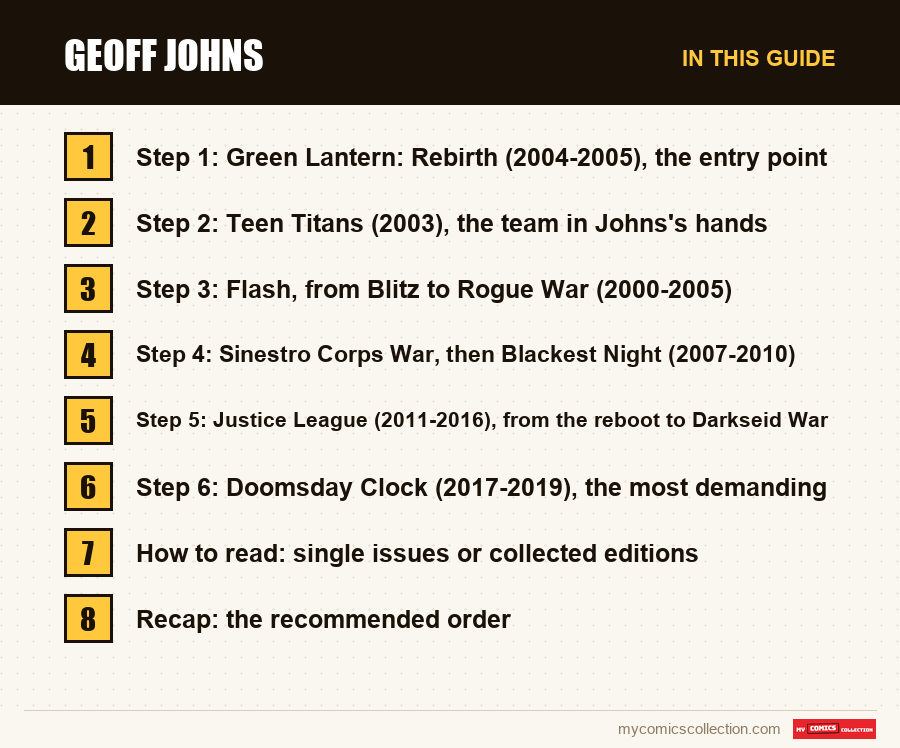
Step 5: Justice League (2011-2016), from the reboot to Darkseid War
In 2011, DC relaunched its entire line, and Johns wrote Justice League #1 with Jim Lee on art. The first arc, Origin, tells of the team's first meeting in the face of Darkseid. What follows is a chain of linked events: Darkseid War closes out the path, after Throne of Atlantis (where Aquaman takes center stage), Trinity War and then Forever Evil. For the exact period of Johns's writing, take Justice League #1 to 50 as a landmark, and we set no end number beyond that: boundaries vary between editions.
This step comes late because it serves a universe that was reset: the characters are presented as new, which eases entry but reduces the reach of the references Johns weaves elsewhere. It is a good block for anyone who already knows the writer's style and wants to see it at the scale of a top-tier team. A useful point of comparison is in our ranking of Justice League runs, which places this cycle fourth, behind the runs of Morrison, of Giffen and DeMatteis, and of Fox.
For collecting, the 2011 first issue draws most of the attention; the rest can be completed at an ordinary single-issue cost. Collections follow the arcs, but some Trinity War and Forever Evil tie-ins outside the main series appear only in dedicated volumes: check the contents before assuming a set is complete.
Step 6: Doomsday Clock (2017-2019), the most demanding
Johns and Gary Frank deliver a twelve-issue maxiseries that extends Watchmen by tying it to the DC universe: Doctor Manhattan versus Superman. It is the most demanding step, for two reasons. First, it assumes you know Watchmen by Alan Moore and Dave Gibbons, and, more loosely, modern DC mythology. Second, the ambition of the project has divided readers; you should approach it knowingly, as an author's proposition and not as a consensus classic.
Our rundown of the key issues of Doomsday Clock covers the series from the collecting side. From the reading side, remember that it draws its flavor from the path that precedes it: most of Johns's themes, legacy, the lineage between generations of heroes, the temptation to repair history, find a kind of conclusion there.
How to read: single issues or collected editions
It all depends on your goal. If you want to read, go for collections: miniseries like Rebirth and Flash: Rebirth each fit in one volume, and the Flash, Teen Titans and Justice League arcs follow in order. Availability in French is uneven from title to title, and some blocks are only available in the original language: check the publisher's catalog before buying, rather than assuming everything exists.
For collecting, the original single issues from the 2000s remain easy to assemble. Two precautions apply. The hit events (Sinestro Corps War, Blackest Night, Justice League #1) saw reprints and alternate covers: read the credits page to identify the printing. And the numbering is confusing, with several Green Lantern, Flash and Teen Titans series carrying the same title years apart: always state the volume as well as the number in your searches.
Off the main path, a few reads round out the picture if you feel like it: JSA, in which Johns wrote a tribute to the Justice Society from 1999; Superman: Secret Origin (2009-2010, with Gary Frank) for a condensed version of Clark Kent's beginnings; Action Comics #844 to 846, written with Richard Donner; and Batman: Three Jokers (2020, Jason Fabok), published outside current continuity. None of them is necessary to the main thread.
Recap: the recommended order
- Step 1: Green Lantern: Rebirth (2004-2005), six issues, no prerequisites.
- Step 2: Teen Titans (2003), for the characters and the short arcs.
- Step 3: Flash, from Blitz (#197) to Rogue War (#220-225).
- Step 4: Sinestro Corps War in 2007, followed by Blackest Night in 2009-2010.
- Step 5: Justice League (2011), from Origin to Darkseid War.
- Step 6: Doomsday Clock (2017-2019), after reading Watchmen.
If you only have time for one block, take step 1. If you want two, add step 4: Rebirth, Sinestro Corps War and Blackest Night together form the backbone of the body of work.
Frequently asked questions
Start with Green Lantern: Rebirth (2004-2005), with Ethan Van Sciver. It is a six-issue miniseries that reads on its own, shows the writer's approach and opens the Lantern saga. If the cosmic universe does not appeal, Teen Titans (2003) with Mike McKone offers a character-centered way in.
It is strongly recommended. Blackest Night picks up elements established since Rebirth and the Sinestro Corps War: the mythology of the colored corps, the role of Hal Jordan and the Guardians. Without that foundation, the event remains readable but loses a large part of its impact, hence the value of keeping to the order.
Technically yes, but it is not ideal. The 2017-2019 maxiseries with Gary Frank extends Watchmen by Alan Moore and Dave Gibbons and reuses its characters. Read Watchmen first, then the Johns path, to gauge what Doomsday Clock is trying to do.
No. The eight-issue main miniseries and the Green Lantern episodes carry the story. The more than sixty tie-in titles are read by affinity, depending on the characters you care about. For an author-focused path, they count as a bonus and not an obligation.
For some of them, but the offering is not uniform and changes by title and reissue. Check the exact contents of a volume before buying it: the issues included, the original volume and the presence of any tie-ins vary from one edition to the next.
Found a Green Lantern #43, a Blackest Night #1 or a Flash #197 in your boxes? Get an estimate based on current listings.
Estimate my comic