Issue #134 of Superman's Pal Jimmy Olsen (December 1970), entirely by Jack Kirby, shows Darkseid for the very first time, but only as a cameo. The tyrant does not truly enter the stage until The Forever People #1, February 1971. So #134 is sought for its priority, not for the importance of the role: it is the second issue of Kirby's takeover of the series, and the nuance between cameo and full appearance weighs on its price.
Here is an issue whose commercial label promises more than the page delivers. "First appearance of Darkseid": the phrase is accurate, and yet the buyer who opens the issue hoping to find the tyrant of Apokolips in all his majesty will be disappointed. The whole point of #134 lies there, between a real priority and a tiny presence, and that gap is what the market is slowly learning to price.
As always in this guide, only verified information (creators, issue numbers, dates) is stated as fact; the analysis is our own, with no reproduction of protected artwork or dialogue.
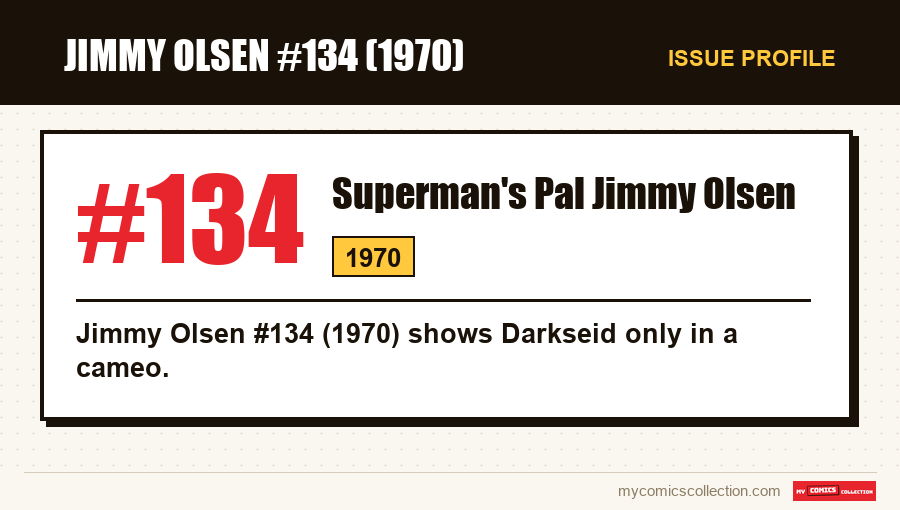
Superman's Pal Jimmy Olsen #134: A Cameo Dated December 1970
The issue belongs to Superman's Pal Jimmy Olsen, a series launched in 1954 around the young Daily Planet photographer. #134 is dated December 1970 and comes right after #133 of October 1970, in which Jack Kirby took over the series after leaving Marvel. Kirby is at once writer, artist and, in effect, art director of the project: he brings into the title his own ideas, his own characters, and the mythology he is preparing elsewhere.
Darkseid shows up briefly, without the plot revolving around him. It is not an exposition scene but an element of narrative scenery, understood in hindsight. For a reader in 1970, nothing marked him as the main enemy of the saga to come; it is the following issues, in other titles, that give him flesh and name. Hence the label of cameo, which catalogs accept without controversy on the status, while the debate concerns the hierarchy of value.
Keep the vocabulary distinction in mind: a cameo is a brief, partial or barely identifiable presence, whereas a full appearance places the character in the action, with his role. In this case, the two labels apply to two different issues, published two months apart, which is unusual.
The Context: Kirby Arrives at DC and Picks a Title That Is Not His Own
In the fall of 1970, Kirby left Marvel after co-creating, with Stan Lee, a considerable part of the house's universe. He joined DC with a project of great scale, a saga of gods spread across several series. But those series did not exist yet when he began working, and DC offered him a place in an existing title: Jimmy Olsen, whose sales were considered fragile.
This choice has a major editorial consequence: the first sign of Darkseid appears in a light-hearted, fun title devoted to a supporting character of the Superman universe. The issue carries the marks of this double identity. On one side, Superman and Jimmy, figures from the house catalog; on the other, the Newsboy Legion, the Guardian and Project Cadmus, which Kirby recycles from his own prewar and postwar work. To borrow the term used among collectors, it is a hinge issue, between two editorial universes.
Our article on the history of Jack Kirby traces this departure and its aftermath. Keep the practical point here: #134 does not look like the series Kirby would launch a few weeks later, and its content remains, for the most part, a Jimmy Olsen adventure.
A Tiny Role, a Key Anyway: The Reasons
The first reason is chronological. In collectors' logic, a character's first appearance is the reference piece, and here it goes to #134 without ambiguity. Anyone drawing up a list of Darkseid "firsts" must start with this issue, whether they consider it essential or secondary.
The second reason lies in the character's importance. Darkseid became one of DC's most lasting antagonists, from Kirby's serial to the crossovers of the 1980s and 2000s, and then on screen. Any issue that carries his name on a list inherits this reputation, even when the character takes up only a few panels.
The third reason is relative scarcity. Copies of Jimmy Olsen from 1970 were not treated as carefully as those of a major hero title: read, folded, slipped into boxes. The paper of the early 1970s is brittle. As a result, copies in very fine condition are few, and the demand from Darkseid collectors targets a narrow supply. On the matter of statuses, you will find the general reasoning in our analysis of the value of a first appearance versus a cameo.
What Moves the Value: Condition, Status and Reading the Market
The value of #134 results from three forces that do not pull in the same direction. Condition first: on an issue from this period, the gain from one grade to the next is significant, and a copy with no spine crease and bright colors can be worth a multiple of an ordinary copy. Then status: the market tends to pay more for the full first appearance than for the cameo, because it is easier to justify at resale. Finally the character's fame: the value of this issue moves with Darkseid's news, in film, on TV and in bookstores.
The nuance matters: this issue is not the most expensive of the Fourth World, nor is it for Darkseid. Market sources often place New Gods #1 higher, because it combines several character debuts. A value therefore cannot be deduced from a single criterion, and the safest course is to rebuild it from completed sales at the same certification level, accepting that there will be few.
The recent editorial context counts too. A major issue announced at DC for late October 2026, DC All In Saga: Darkseid vs. The World #1, has revived interest in the character's whole catalog. This kind of revival rarely lasts; wait for it to subside before judging a market value.
Telling the Original Edition from a Reprint
The American original of December 1970 is a stapled issue on yellowed newsprint, whose cover carries the December date and the number 134 in the banner. Several reprints exist: the content of the Kirby period has been gathered in bound volumes, including the four-volume omnibus devoted to the Fourth World, which follows publication order, as noted in our reading guide to the saga. These collections are excellent ways to read, but none replaces the single issue for a collector of period pieces.
For an issue from that year, the check covers the cover date, the quality of the paper and the printing of the colors. The series mention ("Superman's Pal Jimmy Olsen") and the publisher mention must match the 1970 format. Foreign editions exist, sometimes with reworked covers, and sell separately: they are not comparable to the original. No period alternate version appears in our sources, and any doubt is settled with a photo of the cover and the first page.
Do you collect this series?
Track what you own, what you're missing and what your collection is worth. 7-day trial.
Start my trial →
Buying Pitfalls
The main pitfall is confusing issue numbers. #133, dated October 1970, does not contain Darkseid; it is the start of the Kirby period, and it is sometimes sold in the same conversation. #135 and the following issues are not first appearances. Read the number and the date, never just the character's name in the listing title.
Second pitfall: the cameo sold as a full appearance. A seller can write "first appearance of Darkseid" without lying, but without specifying that the appearance is a cameo. The wording is accurate. Simply ask that the status be written out, so as not to pay the price of a full appearance. The case of cameo versus full appearance for Doomsday shows how this debate plays out on another character.
Third pitfall: the faces. According to sources, the faces of Superman and Jimmy Olsen were redrawn by other artists in the first issues of the period, to bring them closer to the characters' usual look. This feature is not a defect of the copy, but it surprises a buyer who compares with Kirby's own pages. Fourth pitfall: restoration, common on papers of this era, which must be declared.
Neighboring Issues That Matter Too
Earlier in the timeline, #133 of October 1970: Kirby's arrival, Project Cadmus, a starting point to shelve next to #134. Next come, in publication order, The Forever People #1 of February 1971, which carries the first full appearance of Darkseid, The New Gods #1 of February-March 1971, which founds the central title, and Mister Miracle #1 of April 1971.
Two issues of thematic interest complete the list: New Gods #7, which tells the pact at the origin of the war, and Mister Miracle #4, which introduces Big Barda. Their demand comes from the body of work more than from speculation. To place each of these entries relative to one another, see the overview sheet on Darkseid's key issues.
For reading order, the simplest remains publication order: Jimmy Olsen #133, #134, then the first issues of the three other titles, interleaving them. One standalone issue in the series, #140, is a reprint with no new Kirby story and is not part of the saga.
What Grading Changes
On a 1970 issue, a grade freezes the condition and authenticates the copy. For an issue whose value rests on a contested status, certification also provides an indirect reading of the market: the number of graded copies in each tier shows how rare the very high grades are. Learn to read these data before paying, as explained in our guide to the census of copies.
A graded copy costs more than its ungraded equivalent, sometimes by large margins, but it resells more easily. If you buy for reading, an ungraded copy in honest condition is enough, and the collected edition of the Kirby period already gives you the story. If you buy for heritage storage, prefer a graded copy, checking that the label does mention issue 134 and the December 1970 date. The grading scale itself is explained in our guide to the grading scale.
How to Track It in a Collection
Shelve #134 in its chronological place, between #133 and the first issue of The Forever People, rather than at the head of a "Darkseid" binder. This choice avoids confusing it with a full appearance, and it respects the order in which Kirby rolled out his saga. Record in your inventory the status (cameo), the cover date, the condition, whether there is a restoration and the price paid.
If you are after the character rather than the period, build the trilogy of beginnings: the cameo in #134, the full appearance in The Forever People #1, the founding issue New Gods #1. Each piece tells a different stage, and their values are not interchangeable. The Superman hub gathers the titles of the universe this series belongs to.
Conclusion: A Cameo That Remains the First Trace
#134 is the oldest witness of Darkseid, and it will remain so whatever the market does. But it hardly shows him. The informed collector buys it for its chronological rank and its scarcity in condition, not for the story; shelves it next to #133 and The Forever People #1, and keeps in mind that the first full appearance is elsewhere. It is this clear-headedness, more than luck, that keeps you from overpaying.
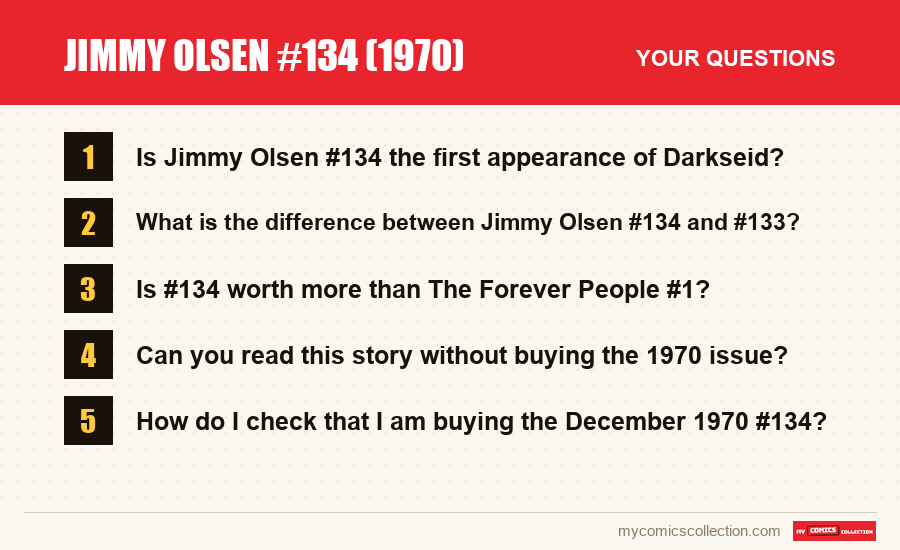
Frequently Asked Questions
Yes, but as a cameo, dated December 1970. The character's full entrance is in The Forever People #1 (February 1971), two months later. Both issues are therefore billed as the "first appearance," with a nuance of status that you should have written out in the listing.
#133, dated October 1970, is Jack Kirby's first issue on the series: it sets up Project Cadmus and the change of tone, but Darkseid does not appear in it. #134, dated December 1970, brings the cameo. The first is a starting issue, the second the priority issue.
There is no fixed rule: the market tends to favor the full appearance, which is easier to justify at resale, but the condition and scarcity of each copy weigh as much as the status. Compare completed sales at the same certification level for each of the two issues, rather than assuming a hierarchy.
Yes, the stories of the Kirby period have been reprinted in bound volumes, notably the four-volume Fourth World omnibus, which follows publication order. The period issue remains a collectible, but reading does not require it, and a collected edition costs a fraction of the price of a graded copy.
Check the cover date, the full title Superman's Pal Jimmy Olsen, the number 134 and the paper type. Ask for a photo of the first interior page. Be wary of listings that only cite Darkseid's name: they may refer to #133, #135 or another Kirby title.
Do you own Superman's Pal Jimmy Olsen #134 or another issue from the Kirby period? Get a range based on current listings.
Estimate my comic