The Carol Danvers comics history, from Ms. Marvel to Captain Marvel, begins with a former US Air Force officer turned superhero. Carol Danvers debuts in March 1968 in Marvel Super-Heroes #13 (Roy Thomas, Gene Colan), then becomes Ms. Marvel in 1977 with Gerry Conway and John Buscema. After stints as Binary, Warbird, and an Avenger, she takes the name Captain Marvel in 2012 with Kelly Sue DeConnick, and has since become one of Marvel's central figures.
Few characters have changed names, costumes, and status as often as Carol Danvers without ever losing the thread of their story. She starts as a military supporting player, becomes a heroine in her own right, goes through a controversial episode that lastingly marked her reception, then reinvents herself as a leader. This page follows her life as a character, era by era, and flags what a collector can look for in each one.
As always in this guide, we state only verified facts (creators, issue numbers, dates); the analysis is our own, with no reproduction of protected artwork or dialogue.
Her first appearance
Carol Danvers bursts onto the scene in Marvel Super-Heroes #13, dated March 1968, an issue written by Roy Thomas and drawn by Gene Colan. She appears there as a US Air Force officer, in the circle of a Kree hero called Captain Marvel, the Mar-Vell of the early years. At this stage she wears no costume: the character is only a supporting role in a series that belongs to someone else.
The rest of her story rests on this link. An explosion of a Kree device injures her, and Captain Marvel saves her. This event, which later writers have revisited and reinterpreted, makes her a woman whose abilities and identity are tied to Kree culture from the very beginning. To understand this galactic backdrop, our Kree-Skrull War reading order lays out the background on the two peoples.
The distinction is worth making right now: Captain Marvel is first of all a different character. Carol Danvers only takes that name in 2012, and it will be the pivot of part of her publication life.
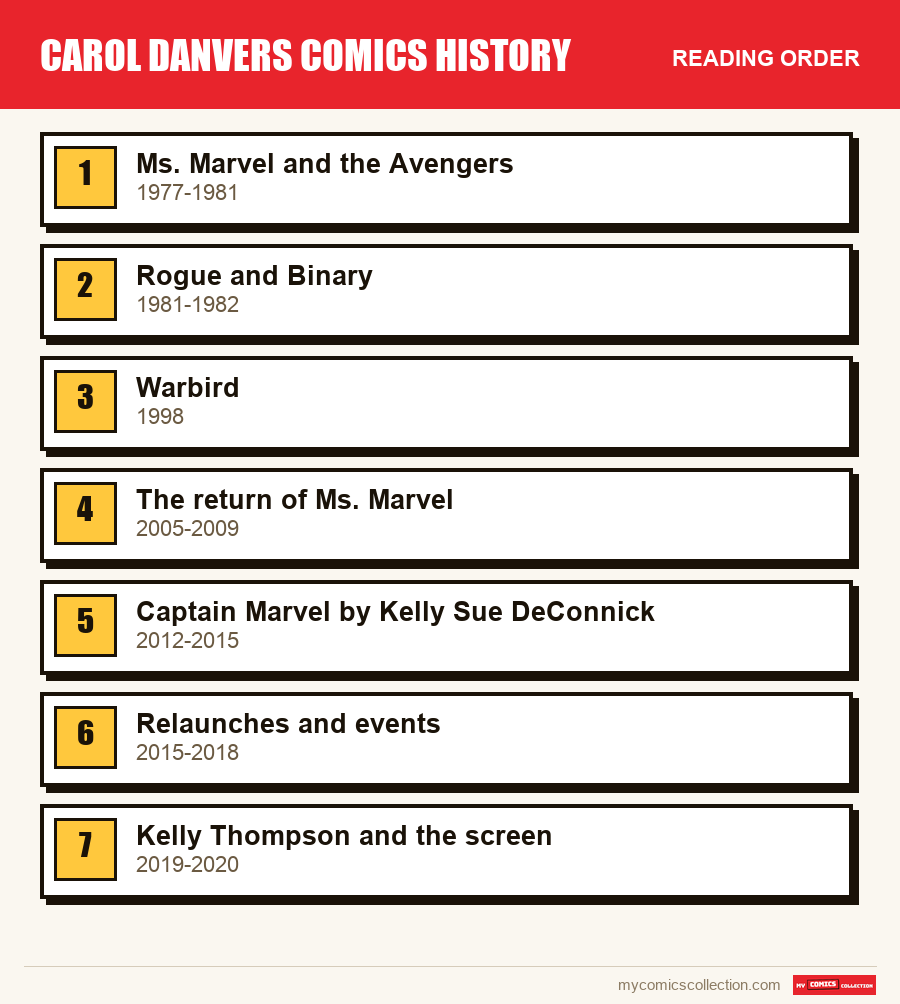
Era 1: Ms. Marvel and the Avengers (1977-1981)
Ms. Marvel #1 comes out in January 1977. The Ms. Marvel identity is created by Gerry Conway and John Buscema; Conway writes the first issues, then Chris Claremont takes over the series. Carol becomes a heroine with powers of her own, a former US Air Force officer, and she later joins the Avengers.
This phase matters to collectors, because it sets the character's identity before the 2012 revolution: a costume, a name, and an Avengers status that 2012 will shake up.
Spoiler warning: the most debated episode of these years is The Avengers #200, cover-dated October 1980. Marcus kidnaps Carol and the Avengers let the matter drop, without grasping the conditioning she underwent. In the credits of this anniversary issue, the script is shared between Jim Shooter, George Pérez, Bob Layton, and David Michelinie. The follow-up, The Avengers Annual #10 (1981), is written by Chris Claremont.
To place Carol within her team, see our history of the Avengers in comics, which covers the group rather than this character.
Era 2: Rogue and Binary (1981-1982)
In the 1981 Annual #10, Claremont makes Carol Danvers the victim of an encounter with Rogue, who absorbs her powers and memories. The character of Rogue remains marked by this appropriation for years, and fragments of Carol's mind resurface later in her. For the Rogue side of the story, we point to her history in comics.
Carol's second life opens under Claremont's pen in The Uncanny X-Men #164, from December 1982. After experiments carried out by the Brood, Carol becomes Binary: she now draws her energy from a white hole, and her power leaves the scale of the neighborhood hero and enters the cosmic. To place this turning point, see the history of the X-Men in comics.
This transformation is the most striking of the period, because it clearly separates Carol Danvers from her original version. It comes with a change of tone: from earthbound adventure to space opera.
For the practical tracking of such a collection, keep in mind that the issues from 1977 to 1982 form a coherent block: a series in her name, a controversial team issue, its follow-up, and the cosmic transformation. Keeping them together in one binder lets you read the character's evolution without mixing it with the 2000s or 2010s, which follow other publishing logics.
Era 3: Warbird (1998)
In the late 1990s, Carol returns under a new name. In the third volume of The Avengers, issue #4 (May 1998) introduces her as Warbird. The period is associated with Kurt Busiek on script and George Pérez on art.
This phase is often played down compared with 1977 or 2012, but it has value as a landmark: it shows a character who has to reflect on her limits, her resources, and her place in a team. For a collection, it is a moment to place as a stage of its own, distinct from the 1977 and 2012 identities.
For anyone who wants to understand how the team evolved around these years, the history of the Avengers page remains the best anchor, and the Avengers hub gathers the guides by period.
Era 4: The return of Ms. Marvel (2005-2009)
In 2005, Carol Danvers appears in the House of M miniseries, an event that redefines the landscape of Marvel's heroes. For this period, see the House of M reading order. She then takes back the Ms. Marvel name in a second series in her name, which Brian Reed concludes with the "War of the Marvels" arc.
The 2006-2007 period puts her at the heart of Civil War, where she becomes one of the main defenders of the Superhuman Registration Act. The event's landmarks appear in the Civil War key issues.
After Secret Invasion in 2008, the setting changes: Carol flees Norman Osborn's Avengers and becomes second-in-command of the New Avengers, while Osborn hands the Ms. Marvel name to Moonstone; Carol eventually takes her title back. During Dark Reign, she finds support in Spider-Man, and she confesses her feelings to him. For the event that comes before, see our page Secret Invasion versus the comics.
This era is when Carol becomes a leading face at Marvel, before her career enters the phase that will make her known to a much wider audience.
Do you collect this series?
Track what you own, what you are missing and what your collection is worth. 7-day trial.
Start my trial →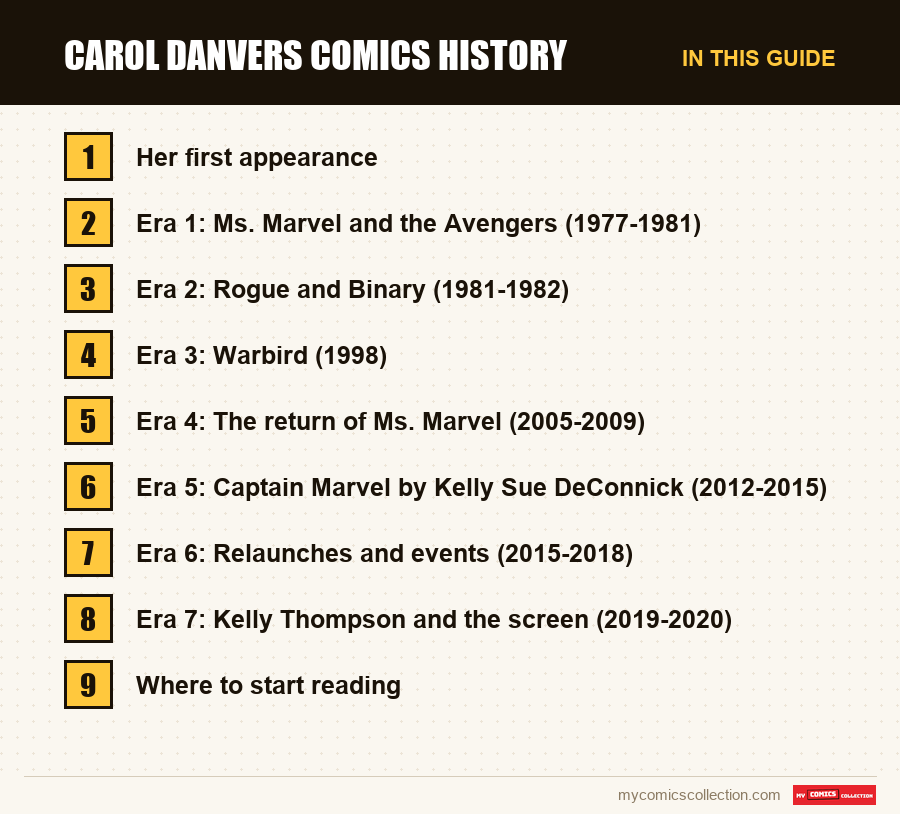
Era 5: Captain Marvel by Kelly Sue DeConnick (2012-2015)
In July 2012, Carol Danvers takes the name Captain Marvel, in a series written by Kelly Sue DeConnick and drawn by Dexter Soy. Jamie McKelvie redesigns her costume, and the change from Ms. Marvel to Captain Marvel reorients the character toward a more assertive figure as a pilot and a leader.
In this first Captain Marvel series, issues #14 (August 2013) and #17 (November 2013) hold the cameos of Kamala Khan; our guide devoted to these issues details this passing of the torch, and the selection of the best Kamala Khan comics extends the lineage. A new volume then starts in March 2014, still with Kelly Sue DeConnick, this time with David López on art.
In 2015, Captain Marvel and the Carol Corps, a Secret Wars tie-in, is written by Kelly Sue DeConnick and Kelly Thompson, with David López on art. The series title pays tribute to the community of readers that formed around the character.
Era 6: Relaunches and events (2015-2018)
In October 2015, a ninth volume of Captain Marvel opens, written by Tara Butters and Michele Fazekas with Kris Anka on art. In 2016, Civil War II by Brian Michael Bendis and David Marquez puts the character at the center of a new clash between heroes.
The series The Mighty Captain Marvel, by Margaret Stohl and Ramon Rosanas, then extends this period. In July 2018, the miniseries The Life of Captain Marvel, by Margaret Stohl and Carlos Pacheco, begins, revisiting the character's life and serving as a landmark ahead of the movie adaptation.
For a reader discovering Carol through these years, the most useful approach is to pick one writer and follow them over the long run, rather than skimming the relaunches out of order.
Era 7: Kelly Thompson and the screen (2019-2020)
In early 2019, Kelly Thompson writes the tenth volume of Captain Marvel, with Carmen Carnero on art. The release comes alongside the movie about the character, on which we have a dedicated page: the movie versus the comics.
In 2020, Empyre, by Al Ewing and Dan Slott, brings together several Marvel teams in a space event, and Carol finds her place among the heroes. The result is a character whose presence in the Marvel universe no longer depends on a single title, but on a set of series, teams, and relaunches.
For collectors, this is the period when demand for Carol's early issues may have shifted with the character's visibility. If you are aiming for those issues, line them up by condition before setting a budget: a movie's visibility does not carry over to every copy in the same way.
Where to start reading
- You are discovering the character: Captain Marvel by Kelly Sue DeConnick, starting in 2012, for the most accessible version.
- You prefer the classics: Ms. Marvel from 1977 with Gerry Conway and Chris Claremont, to understand the starting point.
- You like cosmic stories: The Uncanny X-Men #164 (1982) for the birth of Binary, by Chris Claremont.
- You are coming from the movie: Kelly Thompson's tenth series with Carmen Carnero, published from 2019.
- You like events: Civil War and Secret Invasion, to see Carol on the team rather than alone.
The key issues to know
The landmarks come down to a few issues: Marvel Super-Heroes #13 (March 1968) for the first appearance, Ms. Marvel #1 (January 1977) for the launch, The Uncanny X-Men #164 (December 1982) for Binary, The Avengers (third volume) #4 (May 1998) for Warbird, and the first issue of the 2012 series for the switch to Captain Marvel.
The method is the same for each one: identify the issue's function (appearance, launch, transformation), check the condition of the copy, then compare several completed sales for an equivalent grade. Avoid mixing eras in a single calculation, because a first appearance from 1968 and an issue from 2012 do not follow the same logic. For a reading list rather than a biography, open the ranking of the best Carol Danvers comics.
Frequently asked questions
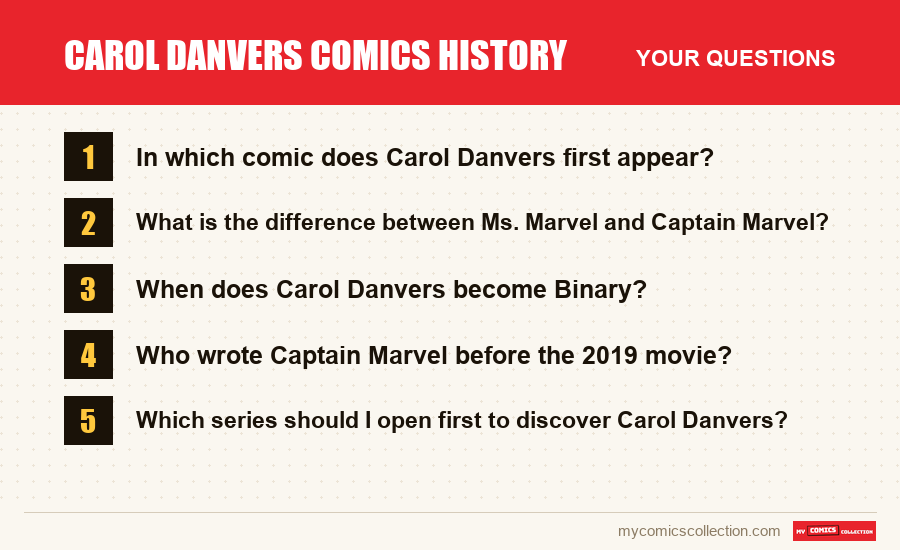
In Marvel Super-Heroes #13 (March 1968), an issue by Roy Thomas and Gene Colan. She is a US Air Force officer there. She becomes Ms. Marvel in 1977, in a series launched by Gerry Conway and John Buscema.
Ms. Marvel is the identity Carol Danvers carries from 1977. She takes the name Captain Marvel in July 2012, with the series by Kelly Sue DeConnick and Dexter Soy. Captain Marvel previously referred to the Kree hero Mar-Vell, who had saved her.
The step happens in The Uncanny X-Men #164 (December 1982), an issue written by Chris Claremont. After experiments carried out by the Brood, she draws her energy from a white hole. This cosmic form remains a landmark for X-Men and Carol collectors.
Kelly Sue DeConnick writes the series from 2012, with Dexter Soy and then David López. Tara Butters and Michele Fazekas take over in 2015, then Margaret Stohl extends the period. Kelly Thompson then writes the tenth volume, in 2019, with Carmen Carnero.
Start with the Captain Marvel series by Kelly Sue DeConnick, which begins in 2012. It reads without knowing the character's past and covers the essentials. If you like the classics, work your way back to Ms. Marvel from 1977 and to Binary.
A 1977 Ms. Marvel or a 2012 Captain Marvel issue in your boxes? Get it appraised before going any further.
Appraise my comic