
The best Carol Danvers comics start, for a modern reader, with Kelly Sue DeConnick's Captain Marvel (2012), where she takes the title of Captain Marvel. Then go back to Ms. Marvel #1 (January 1977) by Gerry Conway and John Buscema, and to her X-Men stint in Uncanny X-Men #164 (1982). Her first appearance, the key issue to know, is Marvel Super-Heroes #13 (March 1968), by Roy Thomas and Gene Colan.
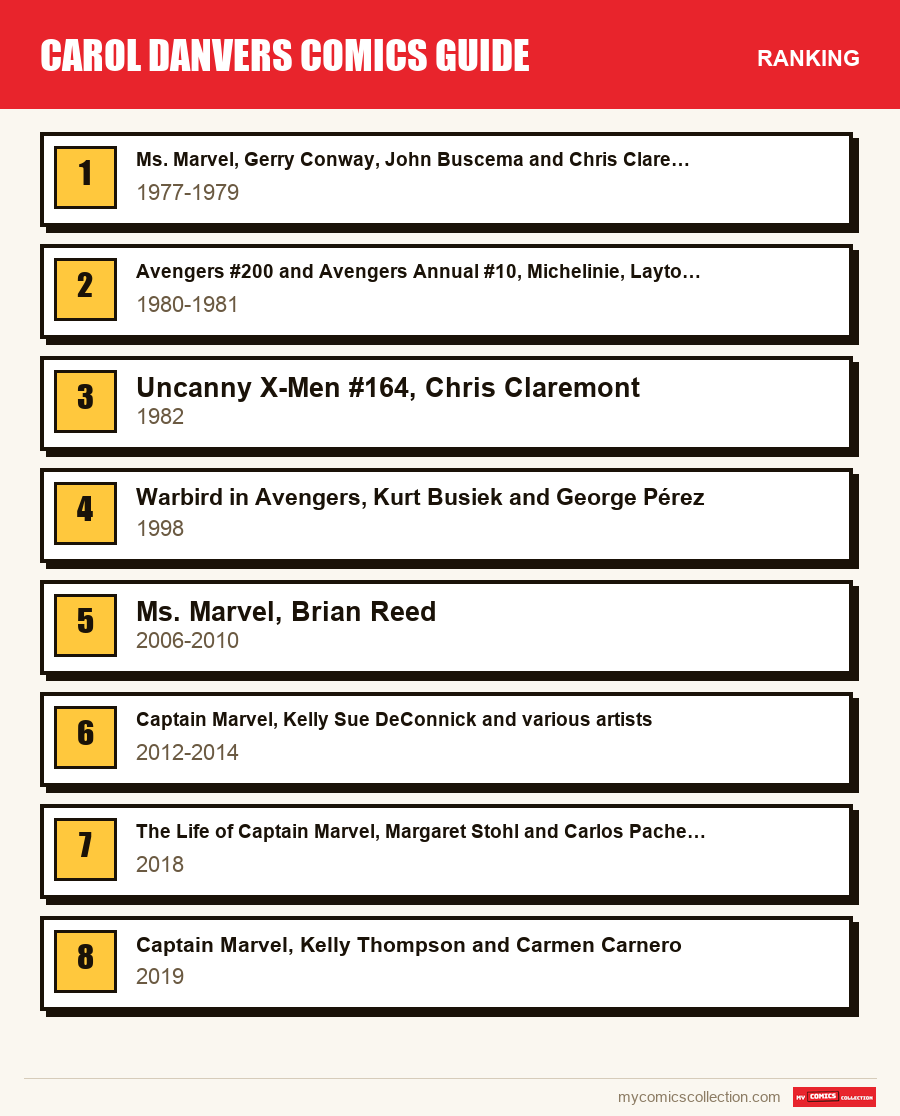
Carol Danvers has worn five identities in half a century: security officer, Ms. Marvel, Binary, Warbird, then Captain Marvel. Each one matches an editorial era, certain writers and a way of imagining the heroine. The 2019 movie made her name a mainstream landmark, but the bibliography is far more tangled than what the screen retains. This guide ranks eight reads, says what each one brings and who it is for.
As always in this guide, we only state verified facts (creators, issue numbers, dates); the analysis is our own, with no reproduction of artwork or protected dialogue.
Her first appearance
Roy Thomas on script and Gene Colan on art deliver Carol in Marvel Super-Heroes #13, cover-dated March 1968. She has no powers there: she is an Air Force officer in charge of base security, who crosses paths with the Kree Captain Marvel, Mar-Vell, whose own debut dates back to issue #12 of the same series. The character is thus first a supporting player, not a heroine.
For the details of this debut and its links with the movie, we devoted a page to the comparison between the 2019 movie and the comics; it covers the Kree origin and what the screen rearranges, which spares us from going back over it here. For the collector, remember that this issue is sought after for two different reasons, depending on whether you are looking for Mar-Vell or Carol, so the reader decides on the angle before looking for a copy.
1: Ms. Marvel, Gerry Conway, John Buscema and Chris Claremont (1977-1979)
With Ms. Marvel #1, in January 1977, Carol gets her own series: Gerry Conway writes, John Buscema draws. Chris Claremont later takes over the writing. This is the period when she receives her superhero identity, with a costume and a name that will mark the character for decades, and when the series looks for its tone between adventure and questions of independence.
This read is for fans of 1970s comics, comfortable with a dated pace and dated conventions. It is valuable for understanding what is foundational about the character, more than for the quality of any single story. A reader in a hurry will take it in a trade paperback, and keep single issues for era-by-era collecting.
2: Avengers #200 and Avengers Annual #10, Michelinie, Layton, Pérez and Claremont (1980-1981)
The Avengers #200, from October 1980, is credited to Bob Layton, David Michelinie, George Pérez and Jim Shooter. Carol is abducted and taken to another dimension there, and the plot, which casts her as a victim of violence, was sharply criticized, notably by the historian Carol A. Strickland in a famous essay. Chris Claremont answers this issue in Avengers Annual #10, in 1981, where Rogue absorbs Carol's powers and memories.
It is a historical read more than an enjoyable one: it shows a controversial episode of the character and the response another writer gives it. It is for readers interested in Marvel's editorial history. The George Pérez hub places the artist within his body of work, and our Avengers reading guide gives the context of the team.
3: Uncanny X-Men #164, Chris Claremont (1982)
In Uncanny X-Men #164, dated December 1982, Carol becomes Binary following experiments carried out by the Brood, which linked her to a white hole. Chris Claremont is writing the series at that point, and it is he who moves the character from the Avengers universe to that of the mutants, with a cosmic power that changes her scale.
This entry point is meant for readers who want the cosmic Carol, heroine of space adventures, and it assumes a minimum of knowledge of the X-Men of the time. Our guide to the key issues of Uncanny X-Men helps you spot the neighboring single issues that matter.
4: Warbird in Avengers, Kurt Busiek and George Pérez (1998)
The third volume of Avengers relaunches the team in 1998 under the pen of Kurt Busiek, with George Pérez on art, and it is in issue #4, from May 1998, that Carol goes by the name Warbird. The name marks a new stage for the character, in a relaunch team that leans on the historic figures.
This period is for readers who like classic Avengers and the team stories of the late 1990s. It reads in trade paperbacks, in series order, and remains easy to approach without knowing Carol's history in detail.
5: Ms. Marvel, Brian Reed (2006-2010)
The new Ms. Marvel series starts in 2006 and is written by Brian Reed. It makes Carol a frontline heroine in the stories of the time, including during Civil War, where she backs the superhero registration law before facing the opponents led by Captain America. This is a more political, more compromised Carol than the one from earlier decades.
It suits those who enjoy team and event books, and who care about Carol's role in the big sagas of the period. Reading the series without knowing the event is possible, but less illuminating.
Do you collect this series?
Track what you own, what you are missing and what your collection is worth. 7-day trial.
Start my trial →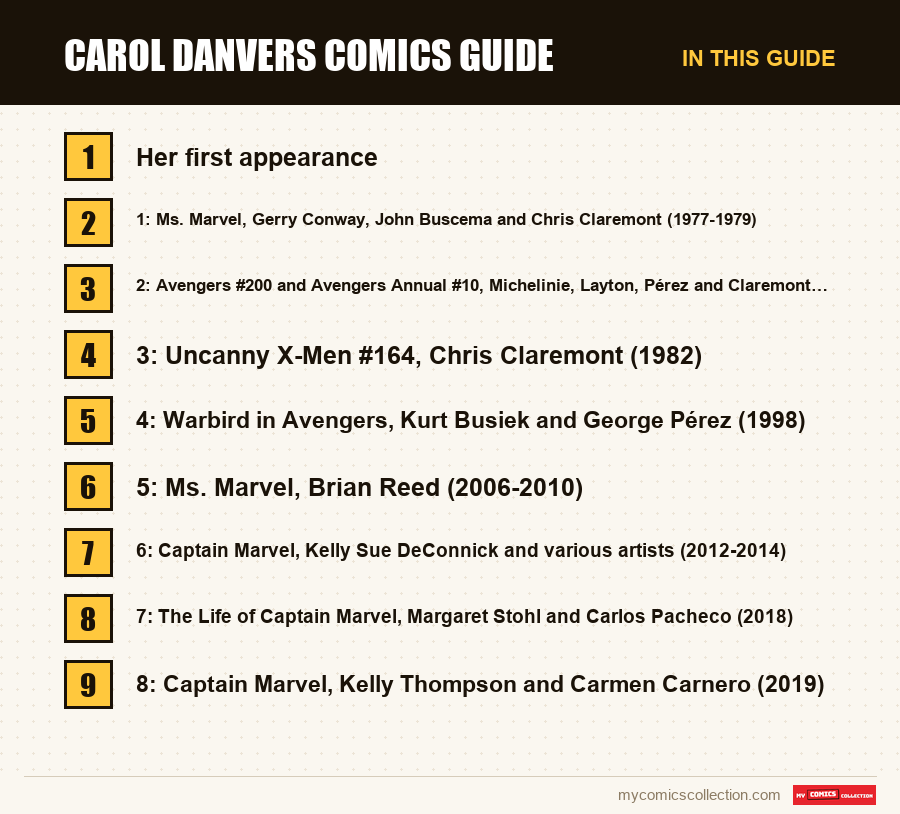
6: Captain Marvel, Kelly Sue DeConnick and various artists (2012-2014)
In 2012, Carol Danvers takes the title of Captain Marvel in a series written by Kelly Sue DeConnick. The first cycle is drawn by Dexter Soy, with Emma Rios and Filipe Andrade depending on the issue, and Jamie McKelvie redesigns her costume. In 2014, a new series picks up under DeConnick's pen, illustrated by David López, and its first trade paperback is titled Higher, Further, Faster, More.
This is the recommended entry point for a reader discovering Carol, because it fixes the character as the general public knows her: a pilot, determined, looking to the future. It also gave birth to the fan community called the "Carol Corps". Both series read in trade paperbacks, in order. For the follow-up on the younger-reader side, our pages on Kamala Khan show how Carol serves as a role model for another heroine.
7: The Life of Captain Marvel, Margaret Stohl and Carlos Pacheco (2018)
Launched in July 2018, The Life of Captain Marvel is a miniseries written by Margaret Stohl and drawn by Carlos Pacheco. It goes back over Carol's origins and her past, as the 2019 movie approaches, and offers a retelling that ties her different eras into a single thread.
It is for those who want a condensed portrait before committing to a long series. Its brevity makes it an easy read, in one sitting. It lends itself equally well to a trade paperback read or a complete run in single issues.
8: Captain Marvel, Kelly Thompson and Carmen Carnero (2019)
The Captain Marvel series launched in early 2019 is written by Kelly Thompson, with Carmen Carnero on art. The last entry in the ranking, it extends the portrait of Carol at the moment when the movie makes her visible to a wider audience. The Kelly Thompson hub and the page Kelly Thompson: where to start place this series within a wider path.
It is for readers who want a contemporary Carol, in a series in mid-cycle. Like any ongoing series, it is judged over time, and you are better off reading it by arcs in trade paperback than issue after issue in single issues.
Where to start depending on your profile
If you come from the movies and want the character as she is published today, open Kelly Sue DeConnick's Captain Marvel, then Kelly Thompson's series. The movie is detailed in our page on The Marvels, which places Carol in a trio with Monica Rambeau and Kamala Khan.
If you like the classics, go through Marvel Super-Heroes #13, Ms. Marvel (1977) and Uncanny X-Men #164, to see the character go from officer to cosmic heroine. If you prefer team stories, the Kurt Busiek and George Pérez period gives a Carol integrated into the Avengers. To understand the character's editorial history, the sequence Avengers #200 then Avengers Annual #10 is a useful document, to be read with eyes open.
The key issues to know
The first landmark is Marvel Super-Heroes #13 (March 1968), the first appearance of Carol Danvers. The second is Ms. Marvel #1 (January 1977), her first issue as Ms. Marvel. The third is The Avengers #200 (October 1980), both a historical landmark and a controversial episode. The fourth is Uncanny X-Men #164 (December 1982), where she becomes Binary. The fifth is The Avengers (1998) #4 (May 1998), with the name Warbird.
On the modern side, Captain Marvel (2012) #1 marks the taking of the Captain Marvel title, and The Life of Captain Marvel #1 (July 2018) serves as a synthesis. Before buying, ask yourself what the single issue changes in Carol's trajectory, spot any variant covers, then only compare copies in the same grade.
An old first appearance is not judged like the first issue of a recent series: the first is bought for history, the second for use or reading. Do you already own one of them? The free appraisal gives you a first reference point before any decision.
How to read in trade paperbacks or single issues
For Carol, trade paperbacks are the simplest route: the Kelly Sue DeConnick and Kelly Thompson series are published in volumes that follow publication order. The 1970s and 1980s are found in bulkier omnibuses, where the reading spreads across several series.
If you collect single issues, set yourself one landmark per era rather than aiming for the complete series: an issue from the 1970s, one from the X-Men period, one from the 1998 Avengers, and a copy of the 2012 series. This method gives you a coherent, readable collection, and above all one suited to what you like to read.
Frequently asked questions
She debuts in Marvel Super-Heroes #13 (March 1968), the work of Roy Thomas and Gene Colan. She is an Air Force security officer there, without powers. She gets her own title in 1977 with Ms. Marvel #1, by Gerry Conway and John Buscema.
The modern entry point is Kelly Sue DeConnick's Captain Marvel (2012), which fixes the character's current image. For a more recent version, read Kelly Thompson's series launched in 2019. For the classics, start with Ms. Marvel #1 (1977). Each series reads without the others.
No. She was an officer, then Ms. Marvel from 1977, Binary in 1982 in Uncanny X-Men #164, then Warbird in 1998. She takes the Captain Marvel title in 2012, in Kelly Sue DeConnick's series. The original Captain Marvel is Mar-Vell.
It is not essential for reading her recent series. The Avengers #200 (October 1980) is mostly a historical landmark, because its plot was heavily criticized. Chris Claremont responds to it in Avengers Annual #10 (1981). Read them as a document of their time, not as an entry point.
They are two distinct heroines. Carol Danvers first appeared in 1968 and took the Captain Marvel title in 2012. Kamala Khan, created by G. Willow Wilson and Adrian Alphona, debuts in 2014 in Ms. Marvel and looks up to Carol. Their series read independently.
Is a single issue of Ms. Marvel or the Avengers sleeping in your boxes? Get a first reference point before deciding what to keep.
Estimate my comic