
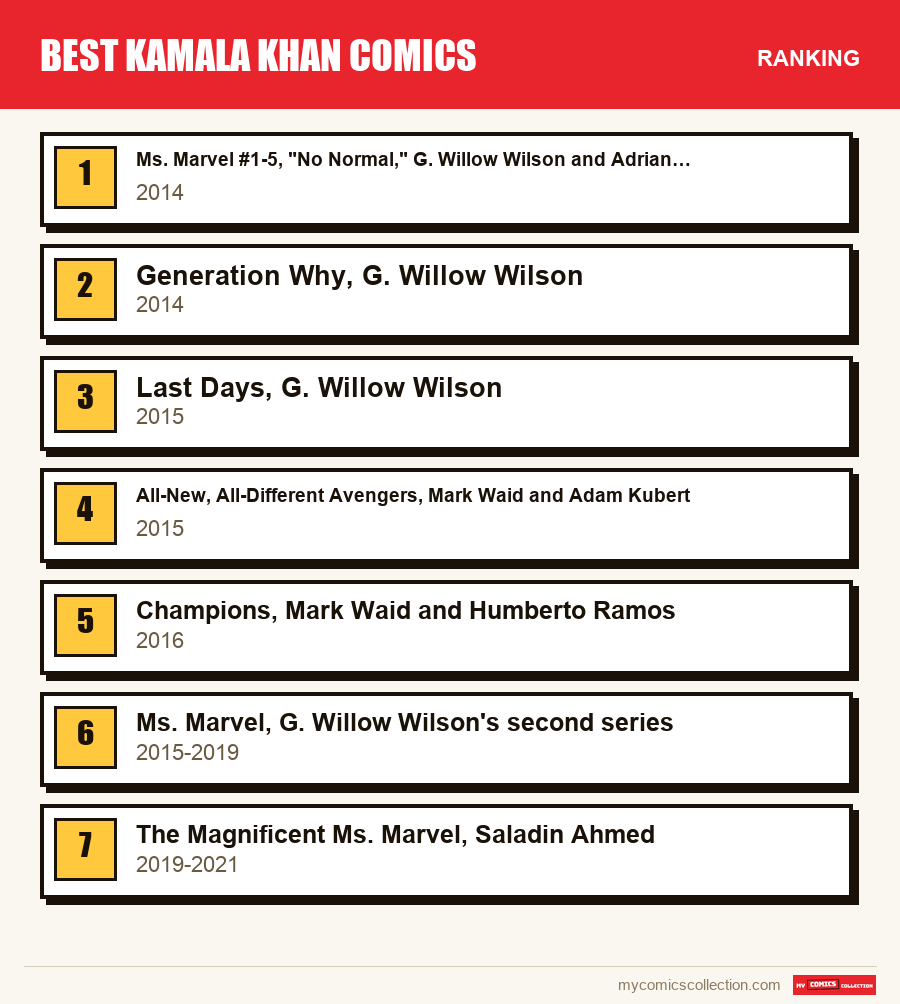
The best Kamala Khan comics start with the first Ms. Marvel collected edition (No Normal, 2014), written by G. Willow Wilson and drawn by Adrian Alphona: it stands on its own. Continue with Generation Why and the rest of the Wilson run, then move to the team books (Avengers, Champions) and Saladin Ahmed's run. For collectors, her first appearance is Captain Marvel #14 (cameo) and #17 (full appearance).
Born in 2013, Kamala Khan has given her name to a series, sat on two teams and drawn readers to Marvel who were not coming before. That success rests on a series of precise editorial choices, and their order matters for the reader as much as for the buyer of single issues: a teenager from Jersey City, a first issue that talks about family before it talks about powers, then a career as a teammate in the shared universe.
As always in this guide, only verified facts (creators, issue numbers, dates) are stated as fact; the analysis is our own, with no reproduction of protected art or dialogue.
Her first appearance
Kamala Khan first appears in Captain Marvel #14, in 2013, written by Kelly Sue DeConnick: a brief appearance, which the market files among cameos. She returns in full in Captain Marvel #17, the last issue of that volume, where she is named, identifiable and plays a role of her own. The character is credited to Sana Amanat, G. Willow Wilson and Adrian Alphona.
These two single issues are not what you should read first, though: they serve as landmarks for the key-issue hunter, not as an entry point. Kamala's story truly begins with Ms. Marvel #1, dated April 2014 and on sale as early as February. The cover is by Sara Pichelli, the color by Ian Herring. This launch, heavily reprinted, calls for a careful look at the credits page when you buy.
1: Ms. Marvel #1-5, "No Normal," G. Willow Wilson and Adrian Alphona (2014)
This is the obvious entry point, and it is rare for a ranking of this kind to be so undebatable. The first five issues, collected under the title No Normal, set Kamala in her neighborhood, among a family attached to its rules, friends like Bruno and Nakia, and a marked taste for Avengers fan fiction. The power, here, only arrives after the setting: the teenager discovers she can change the shape of her body and must decide which kind of heroine she wants to become.
What this brings to the character is an identity that depends on no inherited costume: Kamala chooses the name Ms. Marvel out of admiration for Carol Danvers, but the story is hers. Alphona's expressive line, which makes the high school scenes as readable as the action scenes, does the rest. The collected edition won a Hugo Award, which places it beyond the circle of superhero readers alone.
Who is it for? The general public: a reader who has never opened a Marvel single issue finds their way without effort. How to read it? As a trade paperback, in one sitting: the arc is designed as a coming-of-age novel, and reading in single issues adds nothing, unless you are hunting #1 as a collectible.
2: Generation Why, G. Willow Wilson (2014)
The series' second collected edition confirms that Wilson did not write a mere launch. Kamala faces an antagonist who speaks to her generation, which lets the writer hold up a mirror to connected youth without preaching, and the city of Jersey City becomes a real serial backdrop, with its neighbors and shops.
This is where you gauge whether the series suits you. Readers who came for the fights will find little spectacle; those who loved No Normal for its tone will find the same warmth, with a surer rhythm. The reading order is simple: immediately after the first collected edition, still in volumes, because the episodes answer one another from issue to issue.
3: Last Days, G. Willow Wilson (2015)
Kamala's first series ends in 2015, just as Marvel closes its universe in the Secret Wars event. The Last Days arc uses this end of the world as an intimate frame: what does a teenager do when she knows everything is about to disappear? Wilson's answer runs through family and friends, not through a feat.
Why include it? Because it shows what sets Kamala apart from other "young" heroes: the story does not try to prove she is worthy of her name, it is interested in what she protects. It is for the reader already attached to the character, because the effect depends on the first two collected editions. Read it as a volume, after Generation Why and the intermediate collections, before moving to the series relaunched in the fall of 2015.
4: All-New, All-Different Avengers, Mark Waid and Adam Kubert (2015)
In 2015, Kamala leaves the frame of her own series to join the main team. In All-New, All-Different Avengers, Mark Waid and Adam Kubert place her alongside Miles Morales, a female Thor and a renewed Captain America, in a team designed to reflect the America of today's readers. For Kamala, it is recognition that the teenage dream of becoming an Avenger was serious.
This entry mostly brings a test: how does this neighborhood character hold up in a large-scale setting? The answer is not always as nuanced as in the solo series, because the team story has to make room for several voices. The volume is therefore for the reader who wants to place Kamala in the Marvel universe, not for the one looking for her best writing. Read it after Last Days; Miles Morales, present on the same team, sheds light on the rest of the portrait.
Do you collect this series?
Track what you own, what you are missing and what your collection is worth. 7-day trial.
Start my trial →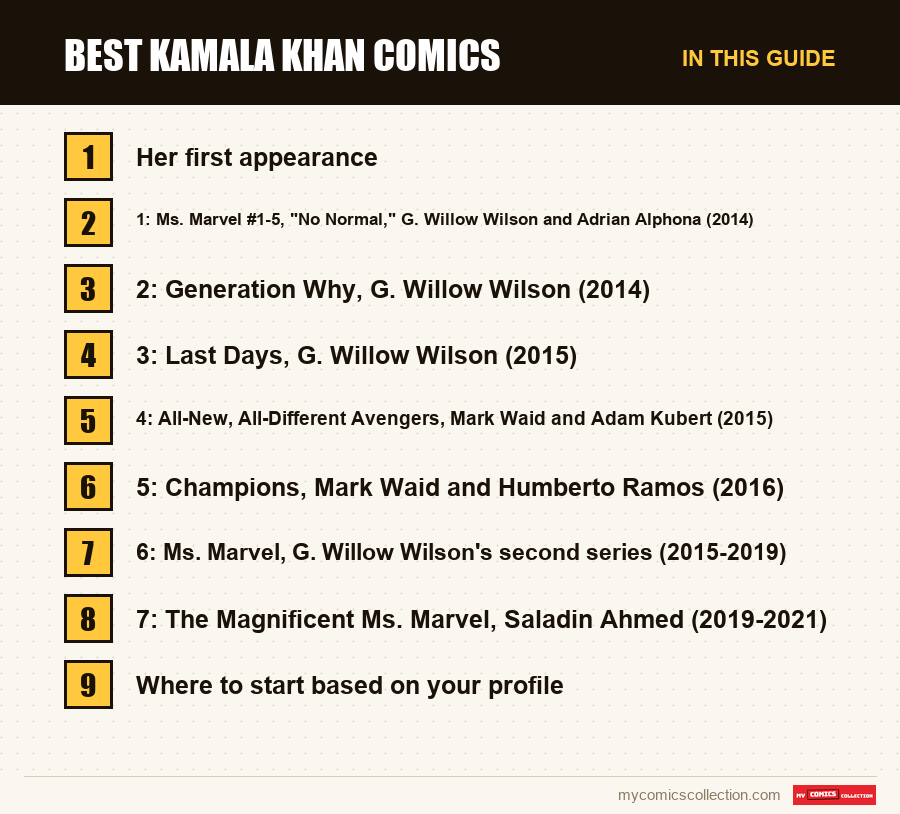
5: Champions, Mark Waid and Humberto Ramos (2016)
Launched in 2016, Champions gathers around Kamala young heroes who decide to stop waiting for the elders' approval, among them Miles Morales and Amadeus Cho. Mark Waid writes, Humberto Ramos draws, and the title reads like a generational serial: the ambition is to fix what the old heroes failed to fix.
The contribution to Kamala is twofold. On one side, the series extends her taste for the collective, already visible in the fan fiction of the first collected edition; on the other, it places her as a linchpin of a group, with a voice that counts. Reserve this title for the reader who has finished the solo arc; it reads well in trade paperbacks, even if you can settle for the first volume to judge the whole.
6: Ms. Marvel, G. Willow Wilson's second series (2015-2019)
Relaunched after Secret Wars, the series keeps its writer until 2019. The collected editions carry titles that each have their own color: Super Famous, Civil War II, Damage Per Second. You follow Kamala having become famous, then facing the consequences of an event that sets the old and young heroes against each other, with Carol Danvers among the figures involved.
It is the best demonstration of what Wilson can do over the long haul, but the level is more uneven than in the first two collected editions: some volumes are worth it mainly for their link to an editorial event. If you are short on time, read Super Famous and Civil War II before quitting or continuing. To place the writer's whole body of work beyond Kamala, see our reading order devoted to G. Willow Wilson.
7: The Magnificent Ms. Marvel, Saladin Ahmed (2019-2021)
In 2019, the series changes creative team: Saladin Ahmed writes The Magnificent Ms. Marvel, with Minkyu Jung on art. The run takes over from G. Willow Wilson without breaking with her tone: Kamala remains an Inhuman, rooted in Jersey City, and it is the natural sequel for anyone who has finished the previous series.
This step is for the reader who knows the first period well, because much of the interest lies in what is changed. It is also for the collector, because its 2019 #1 starts a new numbering, a handy landmark for sorting the series. Read it in trade paperbacks, following the Wilson period, and stick to the logic of one volume after another: the series reads poorly issue by issue.
Where to start based on your profile
If you have never read a Marvel comic, open No Normal and read nothing else before you know whether the tone suits you. If you come from the TV series, the same collected edition remains the right start, and you can then compare with the text devoted to Ms. Marvel on this site. If you like teams, go from No Normal to Champions, then to All-New, All-Different Avengers.
The reader who wants to read everything follows publication order: Wilson's two series, the team books in parallel, then Ahmed's run. The collector mostly interested in single issues does well to read a collected edition first, then decide what deserves hunting in separate issues; a wish list that is too broad builds up fast, and does not fill in as fast.
The key issues to know
The list is short, which is good news for anyone building a collection with method.
- Captain Marvel #14 and #17 (2013): the cameo and the full appearance; each buyer must decide which definition they adopt.
- Ms. Marvel #1 (2014): the launch of the solo series, to be identified printing by printing.
- All-New, All-Different Avengers #1 (2015): the entry into the main team.
- Champions #1 (2016): the birth of the young heroes' team.
- The Magnificent Ms. Marvel #1 (2019): the start of Saladin Ahmed's run.
The method applies to all of them: first note the cover date and the on-sale date, then read the printing notice before comparing two listings. For the most reprinted issues, identifying the printing weighs more than the condition, and it is the first check to make. Cameos and first appearances, for their part, only gain value if the character lasts; Kamala Khan has been demonstrating this for a decade.
Frequently asked questions
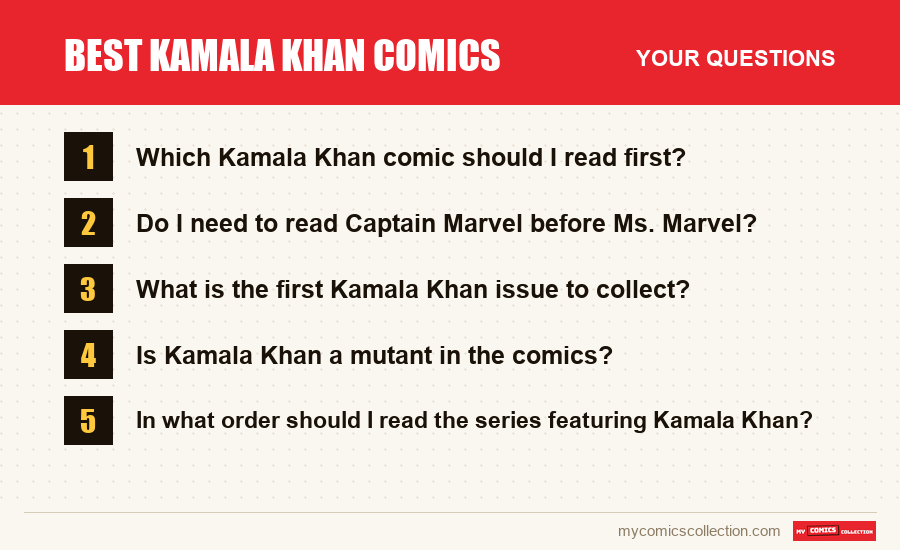
The first Ms. Marvel collected edition, titled No Normal (2014), written by G. Willow Wilson and drawn by Adrian Alphona. It collects the first five issues, is understood with no knowledge of the Marvel universe and is the best entry point, whether you are a beginner reader or a collector who wants to judge the series before buying single issues.
No. Issues 14 and 17 of Captain Marvel, published in 2013, mostly interest collectors, because they contain Kamala's first appearances. The 2014 solo series introduces the character from scratch: no knowledge of Carol Danvers is required to understand it.
Two issues compete for the title: Captain Marvel #14, for the earliest but brief appearance, and Captain Marvel #17, for the full appearance. Ms. Marvel #1 (2014) is the first issue of her solo series. The choice depends on the definition you adopt, not on a single truth.
She was first presented as an Inhuman, after her exposure to the Terrigen mist in the 2014 series, and remained one in the runs of G. Willow Wilson and then Saladin Ahmed. Her mutant status only comes much later, in 2023, through a story about her death and her return among the X-Men: that recent change is what to keep in mind to read her series in order.
Follow publication order: G. Willow Wilson's series (2014-2019), slotting in All-New, All-Different Avengers (2015) and Champions (2016) as you come to them, then Saladin Ahmed's The Magnificent Ms. Marvel (2019-2021). Trade paperbacks are enough for a first complete run-through.
Did you find a copy of Ms. Marvel #1 or Captain Marvel #17 in your boxes? Get it appraised before putting it up for sale.
Appraise my comic