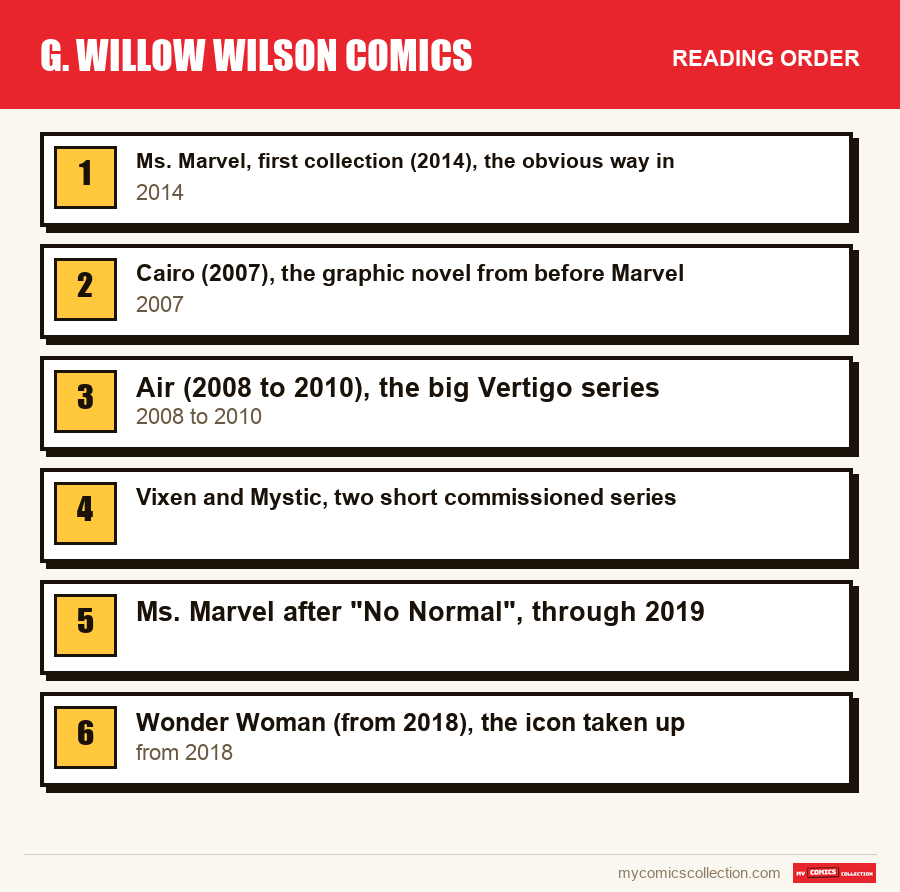
To read G. Willow Wilson, first open the first Ms. Marvel collection (2014, with Adrian Alphona), then the graphic novel Cairo (2007) and the series Air (2008 to 2010) at Vertigo. Move on to the short series Vixen and Mystic, keep following Ms. Marvel to the end of the Wilson period, and finish with Wonder Woman, starting with issue 58 in 2018. The order runs from the self-contained to the serial tied to continuity.
Many readers know G. Willow Wilson only through Kamala Khan and assume the rest of the work resembles it. It does not: Wilson has written political fantasy set in Cairo, an aerial and mystical adventure, a second-tier DC heroine, then the princess of the Amazons. This guide therefore offers a reading order, not a portrait.
As always in this guide, only verified information (creators, issues, dates) is stated as fact; the analysis is our own, with no reproduction of protected panels or dialogue.
Step 1: Ms. Marvel, first collection (2014), the obvious way in
Launched in early 2014, the Ms. Marvel series brings together G. Willow Wilson on writing and Adrian Alphona on art, with Ian Herring on colors. The first five issues make up the collection "No Normal". Kamala Khan, a high schooler from Jersey City, discovers that she can change the shape of her body, and the story is as interested in her family and her friends Bruno and Nakia as in her powers. The first collection won a Hugo Award, a detail often cited to show that the series reaches beyond the comics audience.
Why start here? This collection is the most direct route into the entire body of work: nothing to catch up on before opening the book, the tone is warm, and Alphona draws with an expressive line that keeps both teenage scenes and fight scenes readable. If this first step leaves you cold, there is no need to continue the series; but you can still try the later steps, which have almost nothing in common with it.
For collecting, issue 1 from 2014 is one of the most reprinted first issues of the decade. The sheet on Ms. Marvel #1 details how to tell the printings apart; remember here that the collection is enough for reading, and that the single issue should only be bought after checking the printing line.
Step 2: Cairo (2007), the graphic novel from before Marvel
Cairo came out in 2007 at Vertigo, drawn by M.K. Perker. It is a single graphic novel, read in one evening. Wilson stages the contemporary Egyptian capital, where Wilson lived as a journalist, and blends it with a touch of the supernatural: figures from Near Eastern tales run through an adventure and thriller plot. The book is the best proof that Kamala Khan is not an accident in Wilson's career: the eye for a culture, the precision of the setting and the humor come from further back.
This book asks for a little more effort than Kamala Khan, not because of its complexity, but because the costume is absent. A reader expecting a costume and a battle cry risks being thrown. Those who like stories where the fantastic slips into ordinary life will find a solid starting point for what follows.
On the collecting side, this is a hardbound volume rather than a serial: no issues to complete, no variants to watch, and an original English edition that is easier to find used than new. Check the catalog to see whether a French edition exists before hunting for the original.
Step 3: Air (2008 to 2010), the big Vertigo series
Air came out at Vertigo starting in 2008, again with M.K. Perker, and runs twenty-four issues according to the usual lists. The heroine, Blythe Hayes, is a flight attendant who suffers from vertigo, which is not the least of the book's paradoxes. The plot draws her into a universe where aviation is almost magic, with airlines, routes and maps that no longer obey ordinary geography.
This is where you measure Wilson's ambition before Marvel: a long story that shifts register along the way, from the everyday work of a crew to the fantastic. The series assumes a patient reader. The first issues set up a world that has to be accepted without understanding everything, and the reward comes in the second half of the story.
For reading, favor the collected editions: the series was reprinted in volumes, and you gain nothing by chasing twenty-four single issues of a Vertigo series the market does not seek out. For collecting, the complete series is an affordable project, precisely because demand is low; that is a reason to read it rather than speculate on it.
Step 4: Vixen and Mystic, two short commissioned series
Before Wilson's name was tied to Kamala Khan, Wilson signed two miniseries for major publishers. Vixen: Return of the Lion came out at DC in 2008, with CAFU on art, and follows Mari McCabe, a heroine with an animal totem that lets her reproduce the abilities of animals. Mystic, at Marvel in 2011, with David Lopez, picks up a universe inherited from the publisher CrossGen and brings it to life over a few issues.
These two series read quickly and show how Wilson works within an imposed framework. Vixen gives a glimpse of a taste for heroines tied to a tradition and a family; Mystic prepares the fantasy writing that will return later. They are aimed mostly at the reader who enjoyed the two previous steps and wants to see how the classic commissions turn out.
For collecting, these are miniseries with no value stakes: the question is not price but availability. They are found mainly in collected form, sometimes out of print, and it is better to look for them as soon as you come across them than to wait. As for Mystic, the exact length of the series varies by the lists consulted: count the issues on the copy before buying.
Do you collect this series?
Track what you own, what you are missing and what your collection is worth. 7-day trial.
Start my trial →
Step 5: Ms. Marvel after "No Normal", through 2019
Once the foundations are laid, the long Ms. Marvel series becomes readable as an author-driven serial. The second collection, "Generation Why", widens Kamala's world, and the "Last Days" period in 2015 takes place during the end of the world of the Marvel universe of the time, which gives the young heroine stakes on her own scale. The series then restarts with new numbering in the fall of 2015 and stays under Wilson's pen until 2019, with several artists, including Takeshi Miyazawa.
This is the longest step. It rewards the reader who enjoyed the first collection and who is willing to follow a character through editorial events, such as crossovers and creative team changes. The pleasure is one of continuity: Kamala grows up, so do her friends, and the choices she makes at the start drive others fifty issues later.
To place these issues, the single issue Captain Marvel #17 comes before the series and serves as a landmark for collectors of first appearances, while the comparison with the screen adaptation is in our article Ms. Marvel, the TV series versus the comics. Sources differ on the total number of issues written by Wilson; remember the order of the volumes rather than a precise figure.
Step 6: Wonder Woman (from 2018), the icon taken up
The last step is the one most tied to continuity: Wilson takes over Wonder Woman starting with issue 58 of the series launched in 2016, in 2018, with Cary Nord then Xermanico among the artists. The run extends from 2018 to 2019, from issue 58 to issue 81, before the series passes to other writers. The first arc, cited under the title "Just War", confronts Diana with a conflict in which the gods intervene.
Why at the end of the path? Because this run assumes you already know Diana, her Amazons and the Greek pantheon she depends on, and because you have to accept a story that moves forward as a serial at DC. On the other hand, a reader who has followed Kamala Khan finds the same attention to faith, to family and to the way a heroine carries a legacy.
To go further into the character, the Wonder Woman hub gathers the sheets, and the Wonder Woman reading guide shows where this run fits between the better-known periods. The ranking of Wonder Woman runs places it among the periods undervalued by the market, a judgment of analysis and not a fact.
How to read: single issues or collected editions
To read Wilson, collected editions are the right format as soon as a story runs longer than one arc. Cairo exists in a single volume, Air in several, and Ms. Marvel in about ten books that follow publication order. A collected edition spares you from checking the numbering between the old 2014 series and the one that restarts in 2015, and saves you the crossover arcs that add nothing to the main thread.
For collecting, single issues are justified only for a few landmarks: the first issue of Ms. Marvel, the start of the Poison Ivy series launched in 2022 (Wilson's other major recent project, covered in our article on the run), and issue 58 of Wonder Woman. Remember two habits: read the indicia to identify the printing, and note the cover letter before buying. If you already hold one of these issues, the free estimate is based on its actual condition, with no amount shown here.
Recap: the recommended order
The path comes down to six steps. First the first Ms. Marvel collection (2014) for the tone, then Cairo (2007) for the writer before Marvel, then Air (2008 to 2010) for the big Vertigo story. Next come Vixen (2008) and Mystic (2011) for the short commissions, the rest of Ms. Marvel through 2019 for the serial, and Wonder Woman from 2018 for DC continuity.
Beyond that, several paths open up. Invisible Kingdom, published by Dark Horse in 2019 with Christian Ward, is a science fiction series that can be read with no prerequisites. Poison Ivy, launched in June 2022 with Marcio Takara, extends the work on an ambiguous heroine and is still running; the history of the character explains where she comes from. The Dreaming: Waking Hours finally ties Wilson to the Sandman universe, and sources differ on its publication year.
Frequently asked questions
Start with the first Ms. Marvel collection, published from 2014 with Adrian Alphona. It requires no knowledge of the Marvel universe, it reads in a few hours, and it gives a faithful sense of Wilson's tone. If you prefer a book closed in on itself, choose Cairo, a 2007 graphic novel at Vertigo.
No. The 2014 series is understood without having read anything else, and Kamala Khan is introduced from the first pages. Captain Marvel #14 and #17, where the character appears before her own series, matter mostly to collectors, not to readers who simply want to follow the story.
Yes. Cairo and Air assume neither knowledge of the region nor prior reading of Vertigo. Wilson slips in elements of tales and mythology, but the story explains what is needed. Cairo is the shorter of the two; Air asks for more patience, with its twenty-four issues.
Not strictly, but the effect is stronger if Diana, the Amazons and the Greek gods are already familiar. The run begins with issue 58 of the series launched in 2016, with Cary Nord on art for the first episodes. The Wonder Woman reading guide helps pick an entry point.
The usual landmarks are Ms. Marvel #1 from 2014, issue 58 of Wonder Woman and the first issue of Poison Ivy in 2022. For the first, check the printing, because it was reprinted several times. For the other two, the difficulty is spotting the right cover, not finding a copy.
Is a 2014 Ms. Marvel #1 sleeping in a box? Estimate it from its actual condition and its printing number before deciding whether to keep it.
Estimate my comic