Wonder Woman is one of the rare comics characters whose editorial history spans all four major eras, from the Golden Age (1941) to the present, with landmark creative teams at every stage. The best entry point for a new reader remains the George Pérez run (1987-1992, vol. 2, #1-62), but the most valuable keys for the collector date back to 1941: All Star Comics #8, Diana's first appearance, sold for $1,620,000 (CGC 9.4, Heritage Auctions, June 2022).
Created by William Moulton Marston (writer) and Harry G. Peter (artist), Wonder Woman debuted in All Star Comics #8 in December 1941, then took the cover of Sensation Comics #1 in January 1942 before headlining her own solo title:Wonder Woman vol. 1: from summer 1942 through issue #329 in 1986. This guide is strict about the distinction between verifiable data (eBay medians from our estimator, June 2026; documented records from Heritage Auctions and GoCollect) and anything that can only be stated qualitatively.
A critical note on Wonder Woman #1: there are two, radically different in value. The vol. 1 #1 from 1942 is a Golden Age grail (documented record: $291,100 for a CGC 9.0, Heritage 2016). The vol. 2 #1 from 1987, the post-Crisis George Pérez relaunch, is an accessible, widely available issue. Our eBay estimator returns only 5 listings for the wonder-woman series issue #1: too thin for a reliable median, confirming that vol. 1 (1942) copies almost never appear on the mainstream eBay market. Never conflate the two.
The Golden Age keys (1941-1942): collector grails
Wonder Woman's heritage value rests on two issues outside the wonder-woman series proper:
- All Star Comics #8 (Dec. 1941): first appearance of Diana of Themyscira, by Marston & Peter. Documented record: $1,620,000 for a CGC 9.4 (Heritage Auctions, June 2022). The only known copy graded above CGC 9.0 among 191 CGC-graded examples.
- Sensation Comics #1 (Jan. 1942): first cover feature and lead role. Documented record: $399,100 for a CGC 9.6 (Heritage Auctions, 2017).
For readers, both issues are accessible only in reprint or TPB form. For collectors, they are museum pieces whose values belong in the major auction houses rather than on eBay.
Silver Age and Bronze Age: vol. 1 key issues
| Issue | Significance | eBay data (all grades) | Record / note |
|---|---|---|---|
| WW vol. 1 #1 (1942) | 1st solo Wonder Woman (Golden Age) | 5 listings: signal too thin | $291,100 (CGC 9.0, Heritage 2016) |
| WW vol. 1 #7 (1943) | Golden Age Marston & Peter run | Median €9 · high €9 · 96 listings | |
| WW vol. 1 #98 (1958) | 1st Silver Age issue: new origin (Kanigher/Andru) | Median €9 · high €10 · 63 listings | $9,999 (CGC 8.0, 2019) |
| WW vol. 1 #179 (1968) | "Diana Prince" era: powers removed (Bronze Age) | Median €9 · high €22 · 14 listings | Thin market |
| WW vol. 1 #204 (1973) | Powers restored, classic costume returns | Median €9 · high €24 · 28 listings | |
| WW vol. 1 #200 (1972) | Bronze Age anniversary issue | Median €22 · high €46 · 22 listings |
Record sources: Heritage Auctions, GoCollect, CGC Census.
Recommended entry point: George Pérez (1987-1992)
The George Pérez run on Wonder Woman vol. 2 (#1-62, 1987-1992) is the unanimous consensus among specialists as the best starting point for a new reader. Pérez completely re-established Diana's foundations in the post-Crisis on Infinite Earths era: meticulous Greek mythology, believable Amazons, and Diana portrayed as diplomat as much as warrior. The opening arc, Gods and Mortals (#1-7), is available in TPB and in the Absolute edition (2023). Note that Pérez co-plotted with Greg Potter on the early issues before taking full writing control.
On the collector side, Wonder Woman vol. 2 #1 (1987) is an accessible issue: our eBay estimator returns only 5 listings (signal too thin for a reliable median), but raw VF/NM copies of this 1987 issue are routinely found well below €20 on the secondary market, making it a low-risk acquisition for any Wonder Woman collection.
Greg Rucka, first run (2003-2006): Wonder Woman as ambassador
Greg Rucka took over Wonder Woman vol. 2 from issue #195 (2003) and steered the title through #226 (2006). His approach is as political as it is mythological: Diana serves as Themyscira's official representative to the United Nations, and the book's conflicts unfold through diplomatic and religious frameworks. Highlights: the one-shot The Hiketeia (2002, recommended first), Eyes of the Gorgon (#205-213), and Mission's End (#219-226), which closes the run on a consequential editorial note.
Our eBay estimator for this period: WW #195: median €9, high €22, 29 listings; WW #219: median €9, high €17, 35 listings. A liquid market at low entry price, ideal for building a complete run.
Gail Simone (2007-2010): Wonder Woman's longest-running female writer
Gail Simone took over with Wonder Woman vol. 3 #14 (2007) and ran the title through #44 (2010): she remains to date the woman who has written the most consecutive Wonder Woman issues. Her opening arc, The Circle (#14-19), uncovers a deadly secret about Diana's birth that a faction of Amazons had tried to bury. Simone's run is frequently described as more physically intense and emotionally varied than its predecessors. Our eBay estimator: WW #600 (the renumbered transition issue, 2010): median €10, high €24, 18 listings.
Brian Azzarello & Cliff Chiang: New 52 (2011-2014): the most radical run
With DC's New 52 relaunch in 2011, Brian Azzarello (writer) and Cliff Chiang (artist) made a deliberate break: Diana is reimagined as the biological daughter of Zeus and Hippolyta (not shaped from clay), and the series pivots to a dark mythological thriller with horror undertones. Their 36-issue run (vol. 4 #1-35 + #0) forms a perfectly self-contained narrative block: an excellent entry point for readers who want to start without prior canon knowledge. Collected in six TPB volumes (Blood, Guts, Iron, War, Flesh, Bones) or as an omnibus.
Greg Rucka, second run: Rebirth (2016-2017): the dual-timeline structure
Rucka returned for DC Rebirth (2016-2017) with an original narrative device: odd-numbered issues form The Lies (present day, art by Liam Sharp), Diana discovering that her memories of Themyscira have been fabricated, while even-numbered issues tell Year One (art by Nicola Scott), a fresh retelling of her origins. Both storylines read independently or in alternation. TPBs available: Vol. 1: The Lies (issues #1, 3, 5, 7, 9, 11 + Rebirth one-shot) and Vol. 2: Year One (issues #2, 4, 6, 8, 10, 12, 14).
Recommended reading order
For a collector starting from scratch:
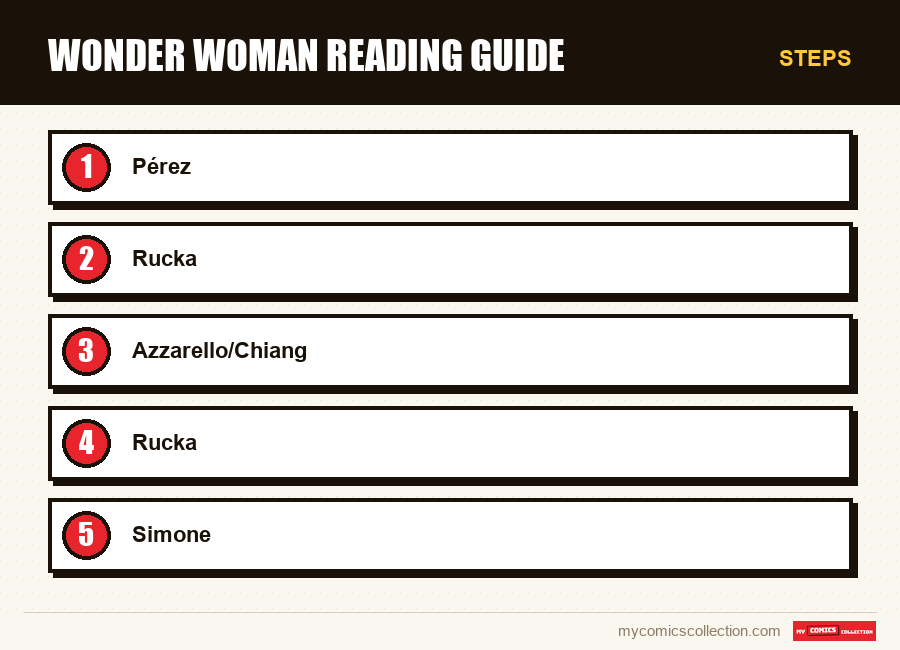
- Pérez: Gods and Mortals (WW vol. 2 #1-7, 1987): the post-Crisis foundation, complete origin story.
- Rucka. The Hiketeia + vol. 2 #195-226 (2002-2006): Diana as ambassador, contemporary stakes.
- Azzarello/Chiang: New 52 #1-35 (2011-2014): self-contained run, Greek mythology reinvented.
- Rucka: Rebirth (2016-2017): for readers wanting the dual Year One / The Lies narrative.
- Simone. The Circle and beyond (vol. 3 #14-44): to deepen your connection with the character after the above runs.
Adaptations have consistently renewed interest in the character: the TV series starring Lynda Carter (1975-1979) remains a cultural touchstone, and Patty Jenkins 's film with Gal Gadot (June 2017) grossed $824 million worldwide, establishing Wonder Woman as DC's leading heroine on screen.
Own a Wonder Woman issue? Get a free valuation with our tool based on real eBay sales to find its low, median, and high value.
Frequently asked questions
George Pérez's run on Wonder Woman vol. 2 (#1-62, 1987-1992) is the specialists' consensus for a new reader. Its first arc, Gods and Mortals (#1-7), lays the post-Crisis foundations of Diana and exists as a trade paperback and in an Absolute edition.
Two, very different ones. The 1942 vol. 1 #1 is a Golden Age grail, while the 1987 vol. 2 #1, George Pérez's relaunch, is an accessible and widely available issue.
All Star Comics #8 (December 1941), by William Moulton Marston and Harry G. Peter. Sensation Comics #1 (January 1942) is the first issue to put her on the cover and in the lead role.
Pérez (Gods and Mortals, 1987), then Greg Rucka (The Hiketeia and vol. 2 #195-226), Azzarello and Chiang (New 52, #1-35), Rucka's Rebirth (2016-2017), and finally Gail Simone (vol. 3 #14-44). Each run can be read on its own.
Brian Azzarello and Cliff Chiang's (2011-2014), a perfectly self-contained narrative block. Diana is presented as the biological daughter of Zeus and Hippolyta, in a dark mythological thriller.