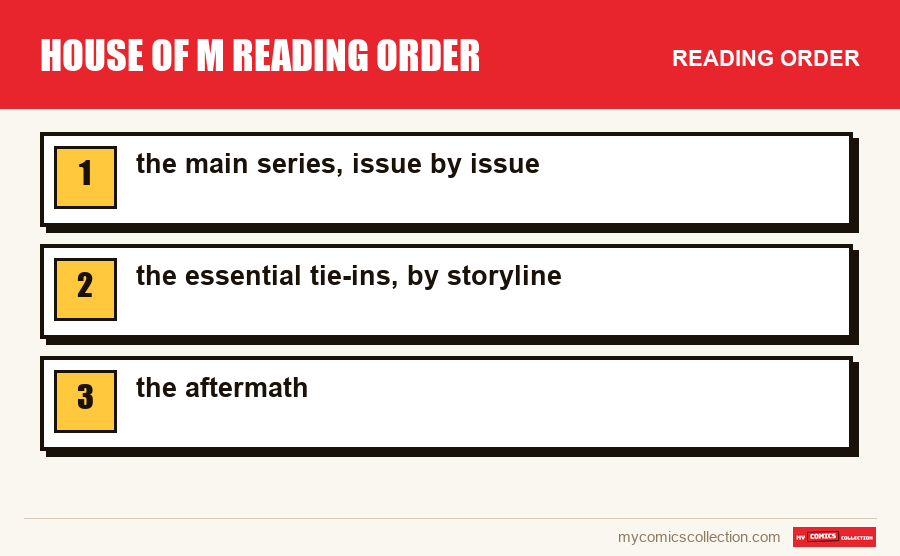
The House of M reading order is short at its core: eight issues, one year (2005), one writer (Brian Michael Bendis) and one artist (Olivier Coipel). Read Avengers Disassembled first (Avengers #500-503 and Avengers Finale), then the 8 issues of the main series, then, depending on your appetite, the character-focused tie-in miniseries and the aftermath with Decimation: House of M, The Day After. The tie-ins flesh out the alternate world, but the main series stands on its own.
Few Marvel events left as lasting a scar on the mutant catalog as House of M. Here is a dated path from the prelude to the aftermath that separates the essential from the comfort reading.
As always in this guide, we state only verified information (creators, issue numbers, dates); the analysis is our own, with no reproduction of protected pages or dialogue.
What to read before House of M
The main series assumes you know about the upheaval that came before it. House of M takes place six months after Avengers Disassembled, and the writing credit is the same, since Brian Michael Bendis wrote both. The prelude therefore boils down to two blocks, plus an optional detour on the mutant side.
The most useful block comes down to two entries: the Avengers #500-503 arc by David Finch, then the epilogue Avengers Finale #1, which gathers many artists on a single story. Without that arc, Wanda Maximoff's situation at the start of House of M loses its weight. Spoiler warning: the arc tips this character's mental state, and that shift drives everything that follows.
Second block: the first issues of New Avengers, the series that replaces Avengers with Bendis and Finch at the helm. It sets up the team you will meet from the very first pages of the event, and its issues #16-20 will later serve as an epilogue.
Third block, on the mutant side: House of M follows directly from Excalibur (vol. 3) #13-14, and the collected edition House of M: Excalibur, Prelude (July 2005) gathers issues #11 through #14. You can read it first, or save it for later if you would rather jump straight into the main story. The Avengers reading guide places these two entries within the team's long history.
Phase 1: the main series, issue by issue
The main series, House of M #1-8, ran from June to November 2005. Brian Michael Bendis writes it, Olivier Coipel draws it, and four inkers share the pages: Tim Townsend, Rick Magyar, Scott Hanna and John Dell. The cover of issue #1 is by Esad Ribić.
Read all eight issues in one sitting, in order. We do not go through the plot: the appeal of the story is that the reader discovers the world at the same time as the characters, and a summary would spoil exactly that pleasure. Just keep in mind that the story unfolds on a planet-wide scale, and that the central role goes to Magneto's family, which explains the links to the pages for Magneto and Quicksilver.
A tip on method: do not stop at issue #5 or #6 to go read tie-ins. The series is built for continuous rising tension, and the satellites assume you already know the ending.
Before moving on to the satellites, a word of caution: a single event is spread here across some twenty series, and the release dates overlap. Do not try to reconstruct the exact 2005 newsstand release order. The most reliable approach for a reader is to finish the main series, then treat each family of tie-ins as an independent read, with its own beginning and end, without going back.
Phase 2: the essential tie-ins, by storyline
The event includes some twenty linked titles. Rather than list them all, here are the ones that carry a story of their own, grouped by family of characters. Each miniseries or arc is read as a block, after the main series.
The mutants
The mutant books of the time are directly part of the event. Uncanny X-Men #462-465, New X-Men #16-19 and Excalibur (vol. 3) #11-14 form the foundation. Wolverine (vol. 3) #33-35 is the tie-in to prioritize if that character is your common thread, and Exiles #69-71 offers an offbeat take, since that team travels between realities. The X-Men reading guide helps you place these series in their continuity.
The iconic heroes
Several miniseries give one hero's point of view in the alternate world: Spider-Man: House of M #1-5, Iron Man: House of M #1-3, Fantastic Four: House of M #1-3 and House of M: Avengers #1-5. If you can only pick one, take the hero you already follow: it does not depend on the others.
The ongoing series
Some ongoing series devote a few issues to the event: Incredible Hulk #83-86, Black Panther #7, Captain America (vol. 5) #10, Cable & Deadpool #17, New Thunderbolts #11 and The Pulse #10. These are breathers, to read if you already follow the series in question.
The parallel stories
The miniseries House of M: Masters of Evil #1-4 and Mutopia X #1-5 extend the alternate-world universe from a darker angle. They will mostly interest those who liked the main series enough to want to stay there longer.
Phase 3: the aftermath
The immediate follow-up is in Decimation: House of M, The Day After #1, a one-shot that serves as a bridge. Next come several series that measure the event's effect on the mutant community: Son of M, Generation M and New Excalibur, which relaunches Excalibur. In the same wake come X-Men: Deadly Genesis, X-Men: The 198, Sentinel Squad O*N*E, Ms. Marvel and a new X-Factor series. On the Avengers side, New Avengers #16-20 serves as the epilogue.
Suggested order: The Day After first, then the series that matches your favorite character among those listed. There is no need to read everything to understand the Marvel universe of the following years.
Do you collect this series?
Track what you own, what you are missing and what your collection is worth. 7-day trial.
Start my trial →
The tie-ins you can skip
No tie-in is mandatory. The eight-issue main series tells its complete story, which makes it a workable entry point even if you have not followed the mutant books. The ongoing series, in particular, devote a few issues to the event, but their overall story continues elsewhere; read them if you collect the series in question, skip them otherwise.
Titles published later under the event's banner, for example House of M: Warzones (2015) or Giant-Size House of M (2025), belong to other editorial eras: they revisit the idea without being necessary to understand the 2005 series. The same goes for What If? House of M #1 and What If? Spider-Man: House of M #1-2, variations for readers already familiar with the story.
Single issues or trade paperbacks: how to read it
With single issues, you get the advantage of the original covers, including Esad Ribić's on issue #1, and you can recreate the 2005 release rhythm. The main series is only eight issues long; the difficulty comes instead from the tie-ins, which are numerous and scattered across different series.
With collected editions, the simplest method is to buy a volume that contains the main series, then add the tie-in collections by theme (mutants, heroes, ongoing series). The Excalibur, Prelude collection mentioned above gathers Excalibur #11-14, and the 2022 House of M omnibus adds the Director's Cut of issue #1 and the series' sketchbook. Always check the table of contents for the list of included issues before buying: the same title exists in several formats, and some volumes contain only the main series.
For the French edition, follow the same logic: find the starting and ending issue of the volume, then compare them with the list in this guide. The Scarlet Witch reading guide shows how to place the event within the character's overall journey.
The key issues to know
Among the issues collectors hunt for, issue #1 of the main series takes first place: it is the entry point to the event, with its Esad Ribić cover, and its sales passed 233,000 copies. Issue #8 closes the series; it ranked third in sales for November 2005, with 135,462 copies, which makes it the natural second benchmark for a collector.
Strong sales do not mean a copy that is easy to find in excellent condition: the series is recent, but the corners and spines of 2005 single issues show wear quickly. Look for sharp corners and a spine without creases, and rely on completed sales rather than asking prices. Issue #1 variants (alternate cover, the associated sketchbook) should be identified by code and date rather than by impression: the "Director's Cut" label, for example, designates a reprint of issue #1.
On the tie-in side, the issues that matter most to collectors are those whose interest goes beyond the event itself. An issue only holds lasting value if it belongs to a series you follow; for spotting candidates, see the guide to key issues of events and crossovers and the page on Scarlet Witch key issues.
Recap: the complete order
- Avengers #500-503, the David Finch arc
- Avengers Finale #1
- New Avengers (first issues, Bendis and Finch)
- Excalibur (vol. 3) #11-14 (prelude on the mutant side, #13-14 leading into the series)
- House of M #1-8 (Brian Michael Bendis, Olivier Coipel)
- Uncanny X-Men #462-465 and New X-Men #16-19
- Wolverine (vol. 3) #33-35 and Exiles #69-71
- Spider-Man: House of M #1-5, Iron Man: House of M #1-3, Fantastic Four: House of M #1-3, House of M: Avengers #1-5
- Incredible Hulk #83-86, Black Panther #7, Captain America (vol. 5) #10, Cable & Deadpool #17, New Thunderbolts #11, The Pulse #10
- Decimation: House of M, The Day After #1
- Son of M, Generation M, New Excalibur, then New Avengers #16-20
Frequently asked questions
The main series is eight single issues, published in 2005, written by Brian Michael Bendis and penciled by Olivier Coipel. Around it orbit some twenty linked titles, miniseries and issues of ongoing series, which you do not need to read to understand the story.
It is recommended: the event takes place six months after Avengers Disassembled, and Brian Michael Bendis wrote both. The four issues of Avengers and Avengers Finale explain the central character's state of mind. Readers in a hurry can skip them, but they lose some of the story's weight.
No. The eight-issue main series is complete. The tie-ins show the alternate world through a specific hero or team; read the ones for the characters you follow, and leave the rest. The miniseries are easier to read as a block than isolated issues of ongoing series.
Start with Decimation: House of M, The Day After #1, a one-shot that serves as a bridge. Continue with Son of M, Generation M or New Excalibur depending on your taste. The mutant books of the period then carry the consequences forward, but none is mandatory.
Issue #1 of the main series is the natural entry point, with its Esad Ribić cover and its very high sales. To judge a copy, compare the condition of the corners and spine, then look at completed sales rather than listings. Issue #8, which closes the series, is the second benchmark.
Found your House of M run in single issues? Get the condition and value of your copies estimated before you shelve them.
Estimate my comic