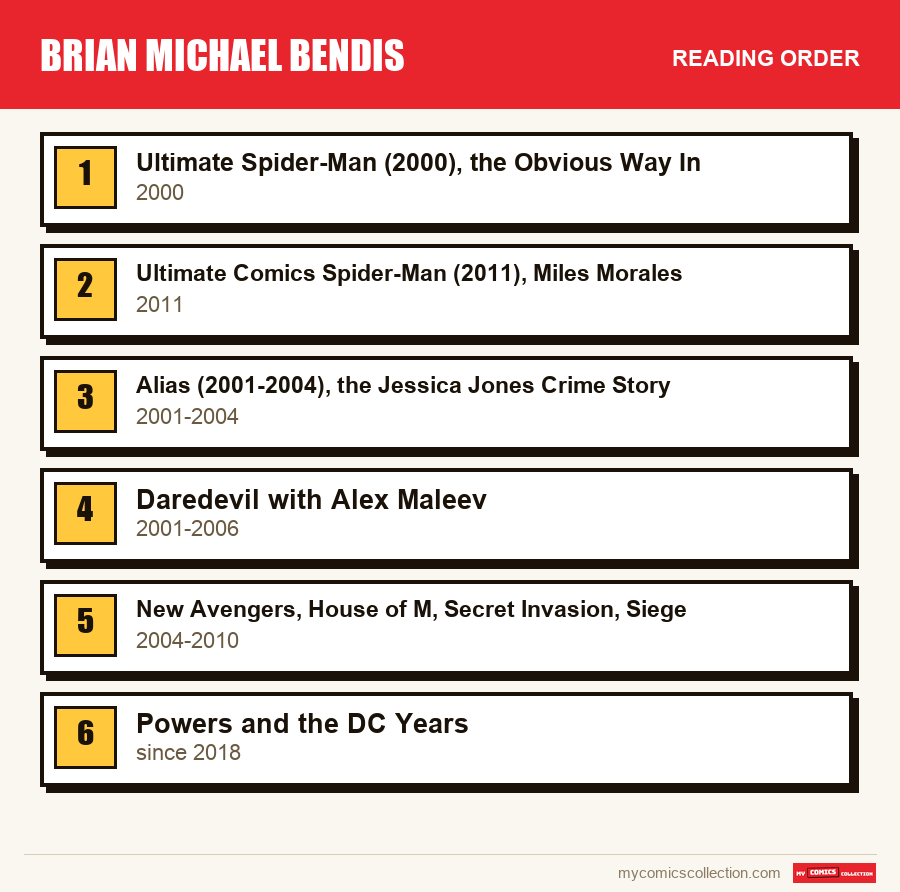
To read Brian Michael Bendis without getting lost, start with Ultimate Spider-Man (2000), whose first issues read on their own with Mark Bagley. Follow with Miles Morales in Ultimate Comics Spider-Man (2011), then Alias, Daredevil with Alex Maleev and the Avengers chain up to Siege (2010). Save Powers and the DC series for last, since they take patience and a real taste for dialogue.
Brian Michael Bendis wrote so many series for Marvel between 2000 and 2017 that a newcomer no longer knows where to set down the first single issue. Events, relaunches, spin-offs: everything runs together. Here is a six-step route that rises in difficulty and tells you, at each level, which reads support it and what you get out of it.
As always in this guide, only verified information (creators, issues, dates) is stated as fact; the analysis is ours, with no reproduction of artwork or protected dialogue.
The sorting rule is dependency: how much reading do you need behind you for the story to stand up? With this writer, the answer varies enormously. Some series, like Ultimate Spider-Man or Alias, rebuild their world and welcome any newcomer. Others, like House of M or Siege, are links in a five-year chain and only make sense with their predecessors. A good route starts with the former and only reaches the latter at the end.
Step 1: Ultimate Spider-Man (2000), the Obvious Way In
Ultimate Spider-Man #1 came out in October 2000, with Mark Bagley on art. The principle: restart Peter Parker's story in a new universe, without fifty years of continuity. Peter is a present-day high schooler, bitten by a genetically modified spider, and his first adventures play out at Midtown High, with Mary Jane Watson and Gwen Stacy. Bendis and Bagley together deliver a series of a little over a hundred consecutive issues, and the first arcs stand on their own.
Why start here: you need to know nothing, and you see the writer's method at work, those dialogues that cut each other off, those silences, those pages built on exchanges rather than fights. It is also the series that opened the doors of Marvel to Bendis, as our article on the writer's history details, which we won't repeat here.
For collecting, the first issues exist in several editions, with sought-after variants. Our benchmarks are gathered in the entry on the key issues of Ultimate Spider-Man. To simply read, the collected editions of the first volumes are more than enough: the first twenty-five issues give you the essence of the method.
Step 2: Ultimate Comics Spider-Man (2011), Miles Morales
The 2011 relaunch opens on a new hero: Miles Morales, created by Bendis with artist Sara Pichelli. Miles first appears at the very end of the Ultimate line, in Ultimate Fallout, before taking the costume in the series carrying the title Ultimate Comics Spider-Man. His entrance comes in Ultimate Fallout issue 4, published in 2011, and the teenager gets his own title a few weeks later.
This step is placed second because it extends the world of step 1 while giving a fresh starting point: Miles is a newcomer too. You can read it without having finished Ultimate Spider-Man, but you will lose some nods, notably about the death of Peter Parker that precedes Miles's arrival. When Miles joins Marvel's main world, Bendis also writes Spider-Man (2016), but that second series is more optional.
Our ranking of Miles Morales runs sets this period alongside the writers who followed. For collecting, the 2011 single issues are recent and easy to find, and the goal is to acquire a run with no gaps rather than a single issue. A broader guide to joining the character is available in the Miles Morales reading guide.
Step 3: Alias (2001-2004), the Jessica Jones Crime Story
Michael Gaydos draws all twenty-eight issues of Alias, published from late 2001 under the MAX banner, reserved for adults. The lead of this crime story is a woman, Jessica Jones, who has put away her costume to become a private investigator. The story is nothing like adventures in tights: sordid investigations, a battered heroine, unfiltered dialogue. The character of Jessica Jones makes her first appearance here.
The series is placed here because it stands on its own while asking you to accept an adult tone. It requires little knowledge of the Marvel universe: heroes show up, but the heart of the story is an investigation and a personality. It is also the best proof that the writer is not limited to spectacular fights. To place this character in time and on the market, read our entry on Alias twenty-five years later.
In collecting, Alias is a short, closed series: you aim for the completeness of its twenty-eight single issues, with attention to the opening numbers. For a reader, the complete collected edition makes the read more comfortable, since the story runs across several linked arcs.
Step 4: Daredevil with Alex Maleev (2001-2006)
Starting with issue 26 of volume 2, Bendis takes over Daredevil and writes with Alex Maleev through issue 81, in 2006. A newspaper reveals Matt Murdock's identity, which plunges the blind lawyer into a five-year legal and criminal serial. Maleev's photographic-looking pages give Hell's Kitchen a dirty, cinematic look, far from the settings of the 1990s Daredevil.
The challenge here is length: five years of serial, arcs that answer each other from afar, and the shadow of Frank Miller behind every night scene. The detailed ranking appears in our best Daredevil runs, where this period holds second place. If you hesitate, first read the arc where the identity is revealed, to judge the tone.
For those who prefer single issues, the Bendis and Maleev run is a reader's purchase: the early issues are the ones that stand out, and the rest can be completed at low cost. There are many collected editions, so you can start in volumes before deciding to buy the original format.
Step 5: New Avengers, House of M, Secret Invasion, Siege (2004-2010)
This is the heaviest block. It all begins with Avengers Disassembled in 2004, which ends the old team, then New Avengers #1 in January 2005, drawn by David Finch. The chain continues with House of M (2005, drawn by Olivier Coipel), Secret Invasion (2008, Leinil Francis Yu) then Siege (2010, Coipel again), which closes the era. Dark Reign and many tie-in series are added. Later, All-New X-Men (2012, with Stuart Immonen) brings the original X-Men into the present.
This step requires having come through the previous ones, since these sagas play on the balance of the Marvel universe: alliances, traitors, the place of each hero. Move forward in publication order and don't drown in the spin-off series: the main series of each event is enough to understand where things stand. For team fans, our section on the Avengers helps place this period in the group's history.
On the market side, these events were printed in large quantities, and the first issues of each series are worth more for their variants than for their rarity. One collected edition per event is the sensible route.
Do you collect this series?
Track what you own, what you're missing and what your collection is worth. 7-day trial.
Start my trial →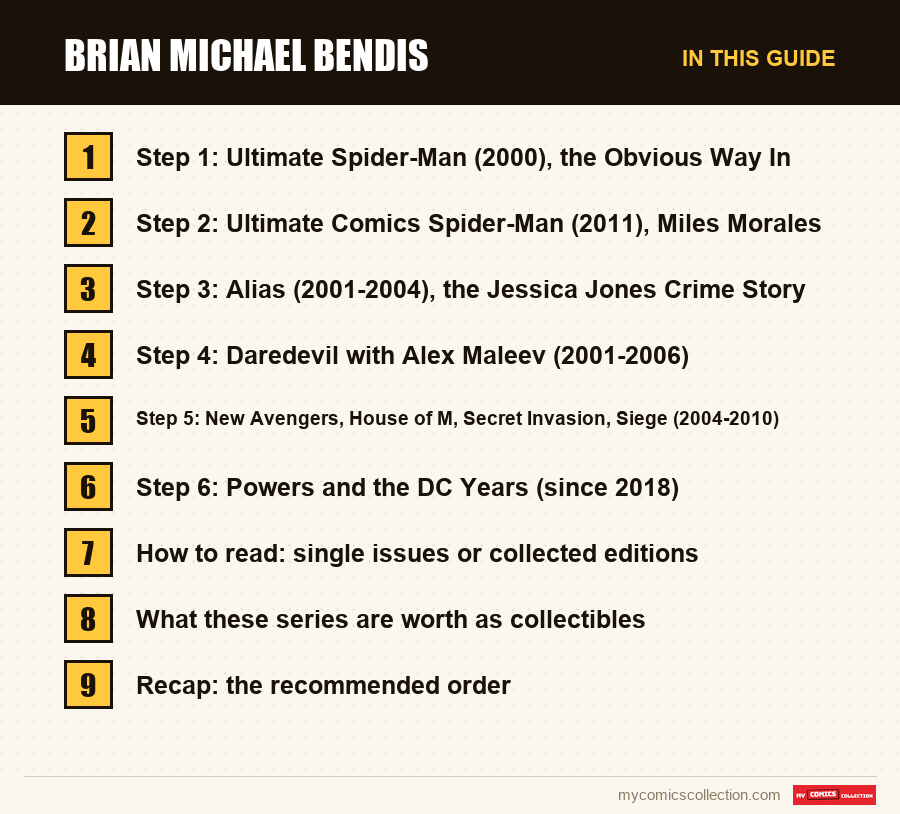
Step 6: Powers and the DC Years (since 2018)
Powers was born in 2000 under the pencil of Michael Avon Oeming: Christian Walker and Deena Pilgrim, two detectives on the super-powered crimes squad, investigate the deaths of vigilantes. The series changed publisher along the way and spans many volumes: it is a monument to patience, to tackle last. Starting in 2018, Bendis writes for DC: Action Comics #1000, then a relaunched Superman with Ivan Reis on art, the Man of Steel miniseries, Legion of Super-Heroes with Ryan Sook, and Naomi, co-created with David F. Walker.
Why at the end of the route: Powers is a very talkative auteur work whose pleasure depends on the taste you now have for this way of telling stories. The DC titles are more recent, hence harder to place: critical reception was split, and it is up to you to judge. For Superman, our character page gathers the useful guides, but it is not the best introduction to the writer.
On the market side, these single issues are too recent to have a stable rating. Three factors will move it: the longevity of the series, reprints and a possible adaptation, provided it is officially confirmed. Until then, the collected edition remains the sensible read.
How to read: single issues or collected editions
For this writer, the distinction is clear. Long-running series (Ultimate Spider-Man, Daredevil, Powers) read better in collected editions: a volume spares you from checking the order of fifty issues. Single issues make sense for first issues, Ultimate Spider-Man variants and the opening episodes of each series, if you collect the original format. Before any purchase, read the title, year and volume on the cover: Marvel has renumbered its series several times.
For events, don't chase every tie-in series. The central miniseries is enough to follow the story, and you then add the spin-offs that touch your favorite characters. The site catalog helps you check which volume an issue comes from.
What these series are worth as collectibles
Orders of magnitude vary with the type of issue. The first issues of Ultimate Spider-Man draw the strongest demand, especially in their alternate editions. Alias and Daredevil gain value through the completeness of a run. The events from 2005 to 2010, printed at scale, sell mostly one at a time at a low price. For the DC series and Miles Morales, the gap with older issues is wide: the rating still depends on time.
Method: note completed sales rather than active listings, compare at equal condition, and always note the cover edition. Discard mixed lots whose price says nothing about the issue you want. For a first reference on a specific copy, the site's free estimate can serve as a starting point.
Recap: the recommended order
- Step 1: Ultimate Spider-Man (2000), with Mark Bagley.
- Step 2: Ultimate Comics Spider-Man (2011), with Sara Pichelli, for Miles Morales.
- Step 3: Alias (2001-2004), twenty-eight issues with Michael Gaydos.
- Step 4: Daredevil (volume 2, issues 26 to 81) with Alex Maleev.
- Step 5: New Avengers, House of M, Secret Invasion and Siege (2004-2010).
- Step 6: Powers (2000) and the DC series since 2018.
If you keep only two titles, take Ultimate Spider-Man for the method and Alias for the most personal voice of the writer.
Frequently asked questions
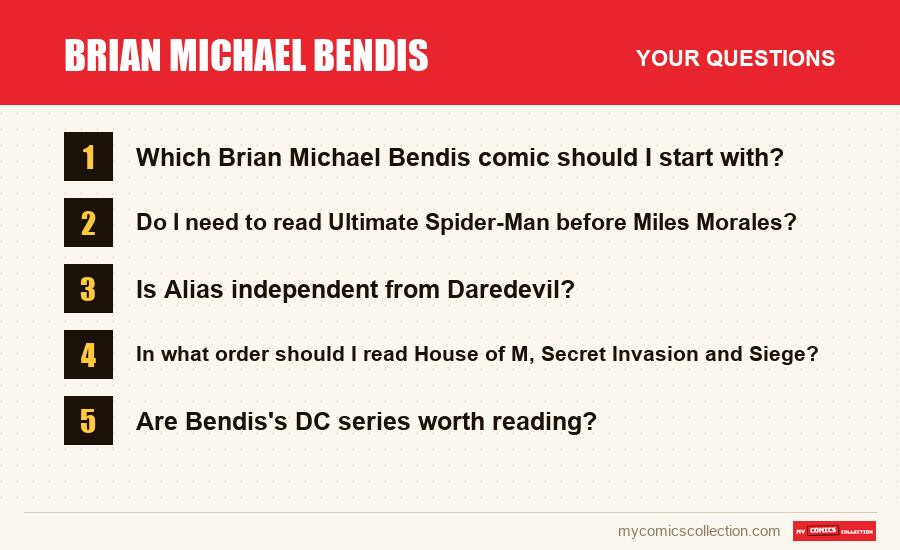
Start with Ultimate Spider-Man, launched in October 2000 with Mark Bagley. The first issues assume no knowledge of Spider-Man and showcase the writer's method: tight dialogue, high school scenes, a measured pace. A collected edition of the first volumes is enough to judge whether the style suits you.
It isn't mandatory, but it is recommended. Ultimate Comics Spider-Man (2011) follows Ultimate Spider-Man and can be understood alone, since Miles is a newcomer. That said, the death of Peter Parker, which paves the way for Miles, carries more weight if you followed the first arcs.
Yes. Alias, twenty-eight issues drawn by Michael Gaydos, reads with no other reading and is set in New York in the Marvel universe. Jessica Jones later crosses paths with other series by the writer, but the central investigation can be understood alone. Its adult tone sets it apart from most titles of the period.
In publication order: House of M (2005), Secret Invasion (2008), Siege (2010). They build on New Avengers, launched in 2005. Read the central miniseries of each event and set the spin-offs aside until you need a specific character.
They mostly appeal to the reader who is already won over. Starting in 2018, the writer pens Action Comics #1000, a relaunched Superman with Ivan Reis, Legion of Super-Heroes and Naomi. Reception was split: read them after the rest of the route, in collected form, before investing in single issues.
Is a Bendis Ultimate Spider-Man or Daredevil lying in your boxes? Get a first order of magnitude.
Estimate my comic