The Kree-Skrull War reading order is simple: Avengers #89 (June 1971) through #97 (March 1972), written by Roy Thomas with art by Sal Buscema, Neal Adams and John Buscema. Read Captain Marvel #17-21 first if you want to know Mar-Vell, then run the nine Avengers issues straight through. The story stands on its own and needs no tie-ins.
Few events in the Marvel catalog read as simply as this one: one ongoing series, Roy Thomas writing, nine consecutive single issues. The difficulty lies elsewhere, in the handoff between three artists and in choosing the right entry point if you are new to Mar-Vell. This guide fixes the order, places each block, and tells you what deserves a spot on your shelves.
As always in this guide, only verified information (creators, issue numbers, dates) is stated as fact; the analysis is our own, with no reproduction of pages or protected dialogue.
What to read first
The story demands no mandatory prelude: a reader who opens Avengers #89 can follow who is who thanks to the team's introductions. That said, Mar-Vell's presence gains depth if you have followed his path. Three landmarks are worth knowing, ranked from least to most useful.
- Marvel Super-Heroes #12 (December 1967): the first appearance of Mar-Vell, scripted by Stan Lee and drawn by Gene Colan. It is a historian's milestone more than a prerequisite.
- Captain Marvel #1 (May 1968): the launch of the character's own series. You can skip it without losing the thread of the event.
- Captain Marvel #17-21 (October 1969 to August 1970): the relaunch conceived by Roy Thomas and Gil Kane, with a new costume and Rick Jones, who shares his molecules with Mar-Vell. The series stops with #21, before returning with #22 in September 1972.
Our advice fits in one line: if you only have an evening, start straight with the Avengers. If you like origin stories, add the 1969 relaunch, since Roy Thomas lays the groundwork there for the bond between Mar-Vell and Rick Jones, a bond that runs through the rest of the story.
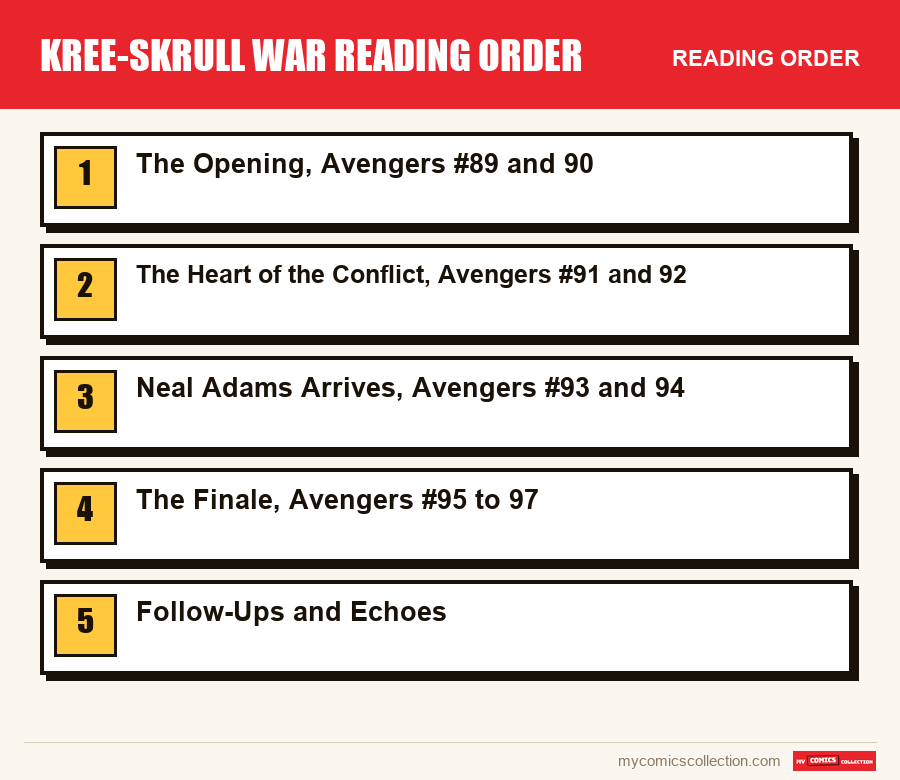
Phase 1: The Opening, Avengers #89 and 90
The first movement opens in June 1971 with #89. Roy Thomas places Mar-Vell in the Avengers' world, then the two empires, Kree and Skrull, enter the picture. On art, Sal Buscema draws issues #89 through 92, with Sam Grainger inking the first two. The letterers change from one issue to the next (Sam Rosen on #89, Mike Stevens on #90), a detail that amuses credit-hunters but has no effect on the reading.
These two single issues set the terms of the conflict. Read them in one sitting: the pacing of the era, full of explanatory captions and generous word balloons, takes a moment of adjustment if you come from airier contemporary reading. Once you adjust, the machinery moves fast with no dead time.
A tip for this block: keep an eye on the table of contents of your edition. The original single issues of the period contain letters pages and announcements that tell how the story was received while it was being published. A modern collected edition sometimes cuts them, and you lose a bit of editorial context.
Phase 2: The Heart of the Conflict, Avengers #91 and 92
These two issues are still drawn by Sal Buscema, but the inking changes: Sal Buscema inks himself on #91, then George Roussos takes over on #92. This detail matters if you compare how the art renders: the same pencils produce a different page depending on the inker, and fans spot the transition at a glance.
Narratively, the saga weaves several threads: the commission on extraterrestrial activities, the conflict in Attilan among the Inhumans, and the invasion by the Skrull empire are all tied to this stretch of the story. We deliberately do not break these episodes down issue by issue, because the point is not to check them off but to follow how they intertwine. Keep in mind that at this stage, the scale of the story goes beyond a simple team adventure.
Our reading marker: do not stop at #92. The next issue changes the look of the book, and keeping #93 within reach before you close #92 avoids breaking the momentum.
Phase 3: Neal Adams Arrives, Avengers #93 and 94
Issue #93 marks a graphic turning point. Neal Adams takes over the pencils, with Tom Palmer on inks, and this duo keeps that setup through #96. Issue #94 is penciled by Neal Adams with John Buscema, which makes it a two-hand issue. If you are assembling the story in single issues, this one is a good example of a "mixed" page: the eye moves from one style to the other as you read.
We do not detail the plot of these two issues, so as not to spoil anything. Let us just say that Neal Adams's layouts give the action scenes a scale that fans of the period still associate with the whole saga today, and that the anatomy of his characters stands out against the more classic tone of the earlier issues.
For those interested in the artist, we devoted a page to his career on the creator hub. Issues #93 through 96 are a centerpiece of it.
Phase 4: The Finale, Avengers #95 to 97
Issues #95 and 96 are drawn by Neal Adams and inked by Tom Palmer. Issue #97 is handed to John Buscema, still with Tom Palmer on inks, which keeps visual continuity despite the change of penciler. Sam Rosen letters every issue of this final block, as he did on #92.
Warning, reveal: the conclusion brings in Rick Jones's Destiny Force and the return of Golden Age heroes. We do not detail how these elements fit together, because it is the payoff of nine issues of building tension. Just know that the story is self-contained: closing #97 truly ends the arc.
One reading note: the romance between the Vision and the Scarlet Witch is tied to this saga, as a theme that continues over many years afterward. If that couple interests you, our Vision reading guide places these issues within his full chronology.
Do you collect this series?
Track what you own, what you are missing and what your collection is worth. 7-day trial.
Start my trial →
Phase 5: Follow-Ups and Echoes
The Kree-Skrull War has fed more than fifty years of stories. Here are the main bridges, in the order you might meet them:
- Marvel Team-Up #5, where Spider-Man and the Vision run into a Skrull scout from the war who disturbs the Vision's brain waves. It is a short issue with a lighter tone, and it reads as an echo.
- Avengers Forever, which revisits the nature of Rick Jones's Destiny Force.
- New Avengers: Illuminati (second series) #1-5, from February 2007 to January 2008, whose last issue ties the war to Secret Invasion.
- Captain America: Reborn, where Captain America briefly passes through the era of the war and passes a message to the Vision.
- In 2020, a one-shot on the origins of the war between the two empires, Road to Empyre: The Kree/Skrull War #1, accompanies the Empyre event.
None of these titles is needed to understand the 1971 saga. They serve to measure its reach, like cross-references in a catalog.
The Tie-Ins You Can Skip
The good news for a reader in a hurry: Roy Thomas's saga is a story contained within its own series, with no mandatory crossover. Everything in Phase 5 is optional, and our judgment comes down to a simple reason: each of these titles sheds light on the saga after the fact, none of them completes it. Skipping them deprives you of no essential fact.
The case of Marvel Team-Up #5 deserves a nuance. This issue mostly interests fans of the Vision or Spider-Man, who will find an unexpected meeting there. The more recent titles are aimed at readers who want to see how successive writers reinterpreted the war. They hold real interest, but of a retrospective kind.
Finally, do not feel obliged to hunt for hidden sequels. Unlike recent events, which multiply satellite titles, this saga unfolds within the Avengers series. That simplifies storage: nine issues follow one another, and none is missing.
Single Issues or Collected Editions: How to Read It
Two paths open up to you. The first is to gather the nine original single issues, #89 through 97. The second goes through a collected edition: the volume The Avengers: Kree-Skrull War exists as a 208-page trade paperback, released in August 2000 and reprinted in May 2008, which collects the nine Roy Thomas issues.
Which method to choose? For a continuous read, the trade is comfortable: it gathers the nine issues in the right order, with nothing to hunt down. For a collection, the original single issues have the advantage of physicality: period paper, letters pages, ads. The common compromise is to read in the trade, then acquire the key issues as singles according to your budget and the grade you want.
A tip on organization: store the nine issues together in the same box, separate from the other Avengers of the period, to find the saga in one go. In your collection tracker, put the event name in the notes of each entry: it makes searching easier later. Our Avengers collecting guide details the landmarks for ordering such a long series.
The Key Issues to Know
For collecting, the saga offers a clear hierarchy, which we can set out by method rather than by figures:
- Marvel Super-Heroes #12 (December 1967), the first appearance of Mar-Vell: it is the character's original reference, sought after as such.
- Captain Marvel #1 (May 1968) and #17 (October 1969): the launch of the series and its relaunch by Roy Thomas and Gil Kane.
- Avengers #89: the opening of the saga, the issue that those who want to "own the beginning" look for first.
- Avengers #93 and 94: the arrival of Neal Adams, then the issue with two artists. Fans of the artist often put them at the top of their list.
- Avengers #97: the conclusion, by John Buscema.
To value a copy, the method stays the same as on any issue from this era: compare sold listings of issues in a grade close to yours and account for any letters-page stamp, torn pages or dinged corners. Paper from the 1970s ages badly: browning and spine creases weigh heavily. The Avengers annuals and specials round out the picture for the period.
Recap: The Complete Order
- Marvel Super-Heroes #12 (optional, Mar-Vell's first appearance)
- Captain Marvel #17-21 (optional, the Roy Thomas and Gil Kane relaunch)
- Avengers #89 and 90 (Sal Buscema)
- Avengers #91 and 92 (Sal Buscema)
- Avengers #93 (Neal Adams)
- Avengers #94 (Neal Adams and John Buscema)
- Avengers #95 and 96 (Neal Adams)
- Avengers #97 (John Buscema)
- Marvel Team-Up #5 (optional echo)
- Optional follow-ups, your pick: Avengers Forever, New Avengers: Illuminati #1-5, Captain America: Reborn, then the 2020 one-shot Road to Empyre: The Kree/Skrull War #1
Frequently Asked Questions
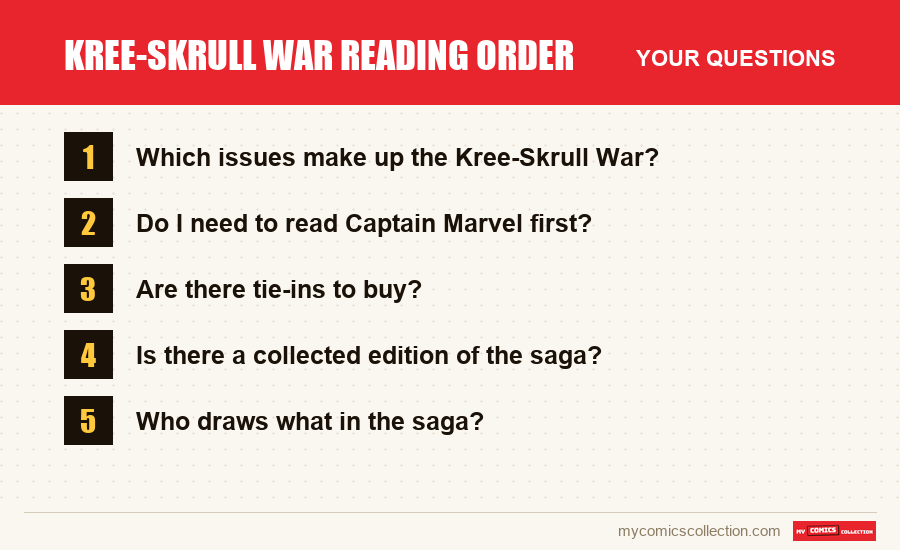
The saga runs across the nine issues of Avengers #89-97, published from June 1971 to March 1972. Roy Thomas writes the whole run; Sal Buscema, Neal Adams and John Buscema share the art. No other title is needed to understand the main story.
It is not required. The Avengers introduce Mar-Vell well enough to be read cold. If you want the context, Captain Marvel #17-21 (1969 to 1970) offers the Roy Thomas and Gil Kane relaunch, with Rick Jones, who matters in the rest of the story.
Not to read the story. Only Marvel Team-Up #5 and a few later tales echo it. They shed light on the saga or reinterpret it, without completing it. A list of nine single issues is enough to own the original event.
Yes: The Avengers: Kree-Skrull War, a 208-page trade paperback published in August 2000 and reprinted in May 2008. It gathers the nine issues in order and suits a continuous read; the original single issues remain the choice of fans who value physicality.
The pencils go to Sal Buscema from #89 to #92, to Neal Adams on #93, #95 and #96, to the Adams and John Buscema duo on #94, then to John Buscema on #97. Tom Palmer inks issues #93 through 97. The inkers vary on the first four issues.
Found an Avengers single issue from the Kree-Skrull War in your boxes? Get it valued before you put it away.
Value my comic