
To read the best Captain Mar-Vell comics, the Kree Captain Marvel, open Captain Marvel #25 to #34 (1973-1974), where Jim Starlin relaunches the character, then Marvel Graphic Novel #1, The Death of Captain Marvel (1982), which ends his story. Then go back to Marvel Super-Heroes #12, dated December 1967, where Stan Lee and Gene Colan create him, and read the Kree-Skrull War in Avengers #89 to #97.
Mar-Vell is not the Captain Marvel that the general public knows today: he is a Kree soldier sent to spy on Earth who switches sides, inherits a cosmic bond with Rick Jones and ends up dying of cancer in a story that remains famous. Six reads truly put him at the center; each is ranked below with what it adds, who it is for and how to read it.
As always in this guide, only verified facts (creators, issue numbers, dates) are stated as fact; the analysis is our own, with no reproduction of protected pages or dialogue.
His first appearance
Mar-Vell appears in Marvel Super-Heroes #12, dated December 1967, in the story "The Coming of Captain Marvel." Stan Lee writes the issue, Gene Colan draws it, Frank Giacoia inks it, and the cover is by Colan and Giacoia. The character is presented as a Kree warrior sent to observe Earth: the interest of this single issue is above all historical, because it sets up the hero before the regular series goes looking for its voice.
The Captain Marvel series then starts with #1 of May 1968. The early issues are the least defended in the catalog: Arnold Drake writes #11 and #12 with Dick Ayers on pencils, Archie Goodwin writes #16 with Don Heck, and the title does not find its identity until #17. That is one more reason not to start there: a reader who opens #1 to understand the hero will mostly see a character in search of an angle.
For a collector, the distinction to remember is simple. Marvel Super-Heroes #12 is the character's origin issue; Captain Marvel #17 (October 1969) is the one that fixes his costume and his relationship with Rick Jones, and so the one that makes him the hero later writers would develop. Both are sought after, but for different reasons.
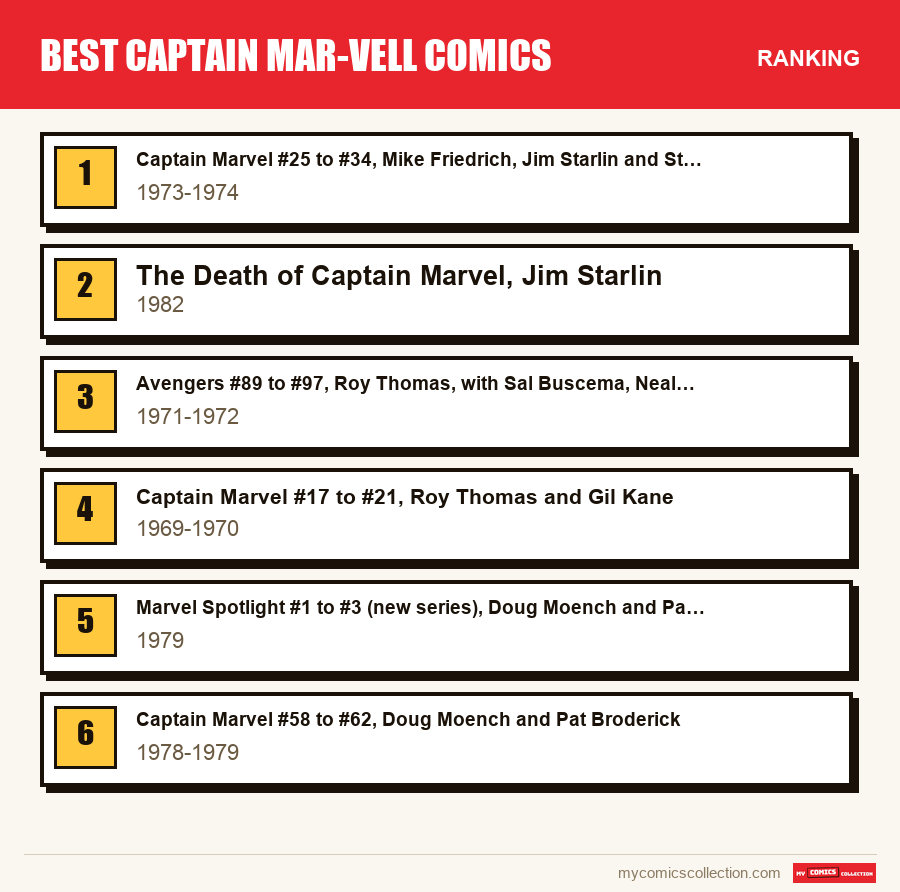
1: Captain Marvel #25 to #34, Mike Friedrich, Jim Starlin and Steve Englehart (1973-1974)
This is the heart of the character. Issue #25, dated March 1973, is written by Mike Friedrich and drawn by Jim Starlin, inked by Chic Stone; Starlin and Friedrich share the script of #26 and #27, then Starlin writes and draws #29 with Al Milgrom on inks. Issue #33 is scripted by Starlin and Steve Englehart, and #34 (September 1974) by the same pair. These ten issues are the moment a struggling series turns into cosmic science fiction.
What this stretch gives the character comes from its context: Starlin, who had just created Thanos and Drax in Iron Man #55 (1973), installs them in Mar-Vell's mythology. The Kree soldier stops being a spy torn between two loyalties and becomes a cosmic warrior, facing threats that go beyond Earth. It is also in #34 that Mar-Vell is exposed to Compound 13 while defusing a bomb of Nitro's, an exposure that will cause his cancer.
Who is it for? Any reader who wants to understand why Mar-Vell matters, and above all those who love the cosmic Bronze Age. How to read it: continuously, without skipping #34, because it is the hinge to what follows. Issues #26 and #29 are the easiest to pick up on their own; #25 remains the entry point.
2: The Death of Captain Marvel, Jim Starlin (1982)
Published on January 12, 1982 as Marvel Graphic Novel #1, the book is written and drawn by Jim Starlin, with Steve Oliff on colors and James Novak on letters. It follows Captain Marvel #34 and Marvel Spotlight #1 and #2: Mar-Vell records the story of his past while recovering the petrified body of Thanos, a coughing fit reveals the cancer, and the energy bands that give him his powers keep him from being cured. The people who matter in his life, Rick Jones, Elysius, Mentor, Eros, Drax and Yon-Rogg, are gathered around him, and the story ends with a dream confrontation with Thanos, then the acceptance of death.
What the book adds is what sets it apart from the rest of the genre: the death of a hero that is not caused by an adversary but by an illness, and treated on a human scale. It is for the reader looking for the end of the story, or for one who wants to see how Starlin wraps up a series of his own themes. How to read it: after #25 to #34, preferably in one sitting; it is a short read.
3: Avengers #89 to #97, Roy Thomas, with Sal Buscema, Neal Adams and John Buscema (1971-1972)
The Kree-Skrull War, published from June 1971 to March 1972, is written by Roy Thomas. Sal Buscema draws #89 to #92, Neal Adams #93 to #96 and John Buscema steps in on #94 and #97; Sam Grainger, Sal Buscema, George Roussos and Tom Palmer take turns on inks. Mar-Vell is a main character there, with Rick Jones, but the cast is collective: it is an Avengers saga in which he plays a part, not a story centered on him.
His role is specific. After his stay in the Negative Zone, he arrives on Earth, is captured by the Avengers, has a child with the Skrull princess Anelle, and Vision removes the radiation that would have killed him. Later, the Super-Skrull takes him off Earth and forces him to build an Omni-Wave projector for the Skrulls. What the arc adds to the character is his place in the politics of two empires: he becomes an interstellar stake.
Who is it for? Mostly Avengers loyalists: the saga is a classic of the series, and the four issues drawn by Neal Adams (see his hub) also draw fans of the artist. How to read it: in one go, from #89 to #97, after the two previous entries, which give you Mar-Vell and Rick Jones. The Avengers reading guide gives the context.
4: Captain Marvel #17 to #21, Roy Thomas and Gil Kane (1969-1970)
This is the overhaul that launches Mar-Vell. Roy Thomas writes, Gil Kane draws and Dan Adkins inks #17 (October 1969), #20 and #21; #17 gives the hero his new costume and pairs him with Rick Jones. The principle is simple and clever: Jones and Mar-Vell share their molecules and can swap places thanks to the Nega-Bands, which lets Mar-Vell stay about three hours at a time in the positive universe.
What this period adds is the character's mechanics: a hero whose presence on Earth depends on someone else. The series is canceled with #21 (August 1970), which limits the period to five issues, short, coherent and easy to put on a shelf. It speaks to the reader curious about the mechanics of the Mar-Vell and Rick Jones duo, and to anyone looking for single issues from the end of the Silver Age. How to read it: in one stretch, before the Starlin period if you like chronologies, after if you would rather have the best first.
Do you collect this series?
Track what you own, what you are missing and what your collection is worth. 7-day trial.
Start my trial →
5: Marvel Spotlight #1 to #3 (new series), Doug Moench and Pat Broderick (1979)
After Captain Marvel stops with #62 (May 1979), Marvel relaunches Marvel Spotlight to publish stories that were already finished. Issues #1 to #3 are written by Doug Moench and drawn by Pat Broderick, with Bruce Patterson on inks and Gene Day on #2 and #3. These are the issues that The Death of Captain Marvel directly continues.
Their interest is in showing the end of the regular series as it was lived, before Starlin returned to close it. They are for readers who want complete continuity, and for collectors looking for issues most readers overlook. How to read them: in order, just before the 1982 book. The entry is less immediate than the previous ones, which is why it is ranked fifth here.
6: Captain Marvel #58 to #62, Doug Moench and Pat Broderick (1978-1979)
The last stretch of the series. Doug Moench writes #58 to #62, Pat Broderick draws them and Bruce Patterson inks them; #62 is dated May 1979. Moench had already written #56, also drawn by Broderick with Bob Wiacek on inks, while #57 had been handed to Roger McKenzie.
These issues are for the completist reader: they show a title that changes writers several times before being stopped, and the Moench and Broderick team is the one that steers the last stories of the regular series. How to read them: at the end of the journey, once the four previous entries are in hand. This is not an entry point, it is a completist's entry.
Where to start based on your profile
You are discovering the character. Read Captain Marvel #25 to #34, then The Death of Captain Marvel. In about ten issues you will have grasped what made Mar-Vell a respected figure, without needing to know the series' early days.
If you are coming from the 2019 film, first understand that Mar-Vell and Carol Danvers are two distinct heroes: the film vs. comics page sorts it out, and the best Carol Danvers comics cover the other half of the name.
You like cosmic sagas. Chain Captain Marvel #25 to #34 with the Thanos stories: the Thanos hub and the reading guide give you what comes next, and Drax shares Starlin's shadow with Mar-Vell.
You are an Avengers reader. Start with the Kree-Skrull War, in Avengers #89 to #97, then go back to the 1969 series if the character hooks you.
You collect first appearances. Aim for Marvel Super-Heroes #12 and Captain Marvel #17, then the issues of the Starlin period.
You want complete continuity. Add Marvel Spotlight #1 to #3 and Captain Marvel #58 to #62 to the first four entries, then the 1982 book.
The key issues to know
The landmarks below rest on creators and dates, never on a price guide figure: to value a copy, always compare condition and completed sales rather than listings.
- Marvel Super-Heroes #12 (December 1967). His first appearance, by Stan Lee and Gene Colan.
- Captain Marvel #1 (May 1968). The launch of his regular series.
- Captain Marvel #17 (October 1969). The new costume, Rick Jones and the Nega-Bands, by Roy Thomas and Gil Kane.
- Avengers #89 (June 1971). The opening of the Kree-Skrull War.
- Captain Marvel #25 (March 1973). Jim Starlin's arrival on the series.
- Captain Marvel #34 (September 1974). The exposure to Compound 13 during the Nitro episode.
- Marvel Graphic Novel #1 (1982). The Death of Captain Marvel, by Jim Starlin.
- Silver Surfer Annual #6 (1993). The appearance of Genis-Vell, his son, by Ron Marz and Ron Lim; Mar-Vell is not the central character there.
The thread connecting these landmarks is this: the character is first a spy, then a hero tied to Rick Jones, then a cosmic figure, and finally a dead man whom the Marvel universe keeps invoking. After him, Monica Rambeau took the name Captain Marvel, then Carol Danvers. This is not the same reading line, and it helps not to mix them on the shelf.
For a collector, the challenge is to keep two separate lists: Mar-Vell's, whose origin story ends in 1982, and his successor's, which is a different reading adventure. A copy of Captain Marvel #25 or #34 is then read as an issue of the Kree soldier, not as a gateway to the contemporary Captain Marvel.
Frequently asked questions
In Marvel Super-Heroes #12, from December 1967: Stan Lee writes, Gene Colan draws. His regular series, Captain Marvel, begins with #1 of May 1968, but it is #17 of October 1969 that fixes his costume and his bond with Rick Jones.
No. Mar-Vell is a Kree soldier who dies of cancer in The Death of Captain Marvel in 1982. Carol Danvers is a different heroine, today the one Marvel designates as Captain Marvel. The two reads complement each other but must not be confused: keep two distinct lists in your collection.
Captain Marvel #25 to #34, published from 1973 to 1974, then Marvel Graphic Novel #1, The Death of Captain Marvel, released in 1982 and written and drawn entirely by Starlin. The first set establishes the hero's cosmic universe, the second gives its conclusion.
Not to understand Mar-Vell himself, since Avengers #89 to #97 is a collective saga written by Roy Thomas, where he shares the spotlight with Rick Jones. It is, however, a classic of Avengers history, and Mar-Vell's role in the conflict enriches your reading.
The exposure that causes it takes place in Captain Marvel #34, in September 1974, when he defuses a bomb of Nitro's and breathes in Compound 13. The diagnosis and death are told in The Death of Captain Marvel, in 1982, which also continues Marvel Spotlight #1 and #2.
Do you have a Captain Marvel from the Starlin period or a Marvel Super-Heroes #12? Have it appraised before you shelve it.
Appraise my comic