
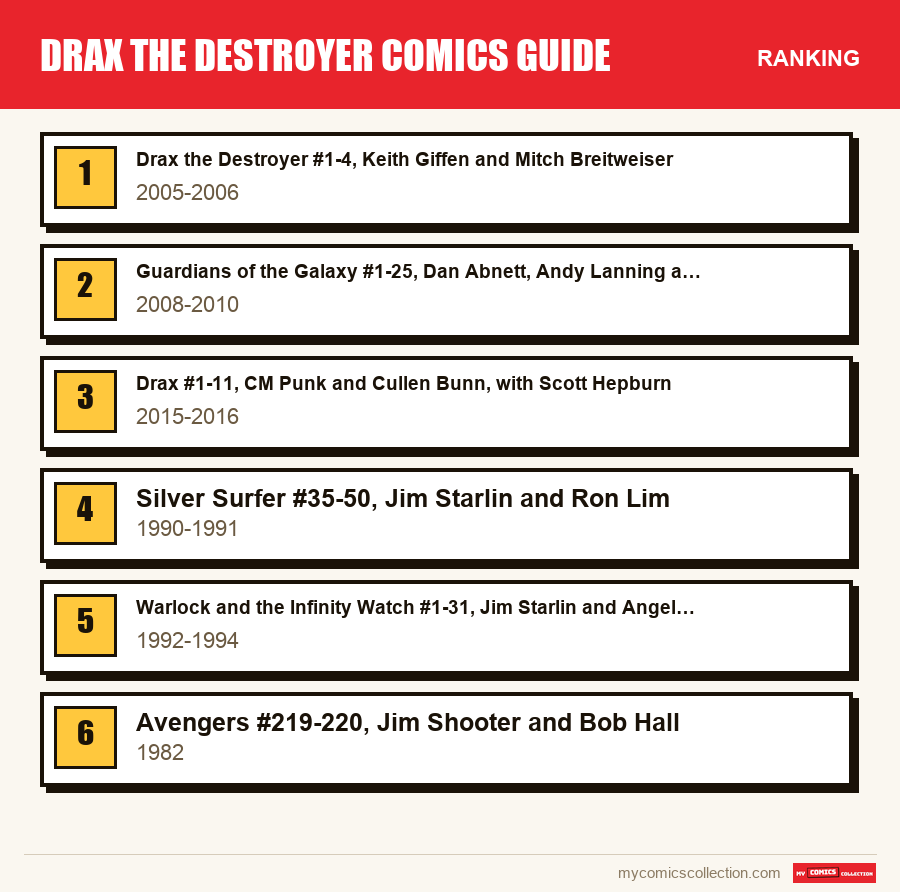
The best Drax comics start with the four-issue miniseries Drax the Destroyer (2005-2006), by Keith Giffen and Mitch Breitweiser, followed by the Guardians of the Galaxy series written by Dan Abnett and Andy Lanning (2008-2010), where he sits on the team. He is born in Iron Man #55, cover-dated February 1973, his first appearance and key issue. Jim Starlin's cosmic sagas come next for readers who want to go back to the source.
Drax the Destroyer is a character who changes faces with the era: a Thanos-killing colossus for the earliest writers, a prisoner of space under Giffen, a teammate under Abnett and Lanning, a detective in the 2015 series. That variety makes the "where to start" question less obvious than it looks, because no series follows him from start to finish and he lived for a long time in the margins of other heroes' stories.
As always in this guide, only verified information (creators, issue numbers, dates) is stated as fact; the analysis is our own, with no reproduction of protected art or dialogue.
His first appearance
Drax is born in Iron Man #55, cover-dated February 1973. Starlin conceives the plot and pencils, Friedrich writes the script, Esposito inks. The issue launches Thanos, Mentor and Kronos at the same time, and the cover features none of them: it shows Iron Man facing the Blood Brothers. That explains why Drax appears almost in passing, even though the issue contains his original identity, Arthur Douglas. Our Iron Man #55 page details the contents of this issue; we do not repeat it here.
One point of character history is worth laying out before you read anything: Arthur Douglas's mind is placed by Kronos into a new, powerful body, and Drax the Destroyer is the result. This origin governs every reading that follows, because it makes him a weapon built for a target, Thanos, more than a hero who chose his own path. Successive writers all play with this tension between function and person.
A second collecting landmark follows shortly after: Drax becomes a recurring character in the Captain Marvel series starting with issue #27, cover-dated July 1973. The issue does not mark his debut: it marks the moment the character settles into the series. Those going back to the source will find this whole stretch gathered in a Marvel Masterworks volume that covers Captain Marvel #22-33 as well as Iron Man #55.
1: Drax the Destroyer #1-4, Keith Giffen and Mitch Breitweiser (2005-2006)
This is the clearest way into the character, because these four issues are devoted entirely to him. The first is dated November 2005. Keith Giffen writes, Mitch Breitweiser draws. Drax and a group of space prisoners, big, muscular and violent, crash on Earth, and the story sets this brutality against a character who is more than physical force: Giffen gives him an intelligence that counts as much as his fists.
The miniseries also serves as a prelude to the Annihilation event, which gives it a place in Marvel's cosmic history. It reads fine without knowing the 1970s: the story recaps the essentials and assumes only a desire to discover a Drax more nuanced than his reputation as a mass of muscle. It is therefore for the curious reader who has read no Starlin comics.
To read it in a collected edition, the Annihilation: Epic Collection volume gathers the four issues with other titles tied to the event. If you would rather understand the context before starting, our Annihilation reading guide places this miniseries within the larger story that follows it.
2: Guardians of the Galaxy #1-25, Dan Abnett, Andy Lanning and Paul Pelletier (2008-2010)
The 2008 series is the one where Drax joins the modern Guardians team. Dan Abnett and Andy Lanning write it, Paul Pelletier draws the first issues, then other artists take over, among them Brad Walker and Wes Craig. The starting lineup brings together Star-Lord, Rocket Raccoon, Quasar, Adam Warlock, Gamora and Drax, among others. The Drax of this series is no longer the hero of a solo tale: he plays a part in an ensemble, and it is that ensemble you have to appreciate.
It suits the reader who wants to enter Marvel cosmic through a regular twenty-five-issue series rather than an event. The plot threads find their conclusion in The Thanos Imperative (2010), which makes reading this series a useful prelude. Our ranking of the best Guardians runs places it among the other eras of the team.
A note for your reading: the 2008 team is not the 1969 one, which played out in a distant future. Do not mix the two up when searching for a collected edition, because the titles look alike. The series at hand is the one that contains Drax, Gamora and Rocket Raccoon, with a first team formed around Star-Lord.
3: Drax #1-11, CM Punk and Cullen Bunn, with Scott Hepburn (2015-2016)
Marvel publishes an ongoing series bearing the character's name in November 2015. CM Punk and Cullen Bunn write, Scott Hepburn draws, Matt Milla provides the colors. The first five issues are collected under the title The Galaxy's Best Detective, issues #6-11 under The Children's Crusade. The first title sets the tone: Drax conducts an investigation there, which is a radical change from his role as destroyer.
This series is for anyone who wants to see Drax at the center of his own story, with no prior knowledge of Thanos. It also suits those who enjoyed Giffen's miniseries and want to find the character again in a longer format. In exchange, it does not carry the mythological weight of the 1970s or 1990s: read it for the pleasure of the adventure, not for the historical frame.
Two collected editions cover the whole thing, which makes continuous reading easy. You can therefore buy both volumes without hunting for the separate single issues, unless you collect the series in original issues.
4: Silver Surfer #35-50, Jim Starlin and Ron Lim (1990-1991)
After Drax's death in Avengers, it is Jim Starlin who brings him back in Silver Surfer #35, cover-dated March 1990, with Ron Lim on pencils and Tom Christopher on inks. Drax becomes a recurring character there through issue #50. This stretch is not the most readable for a new reader, because it sets up the great saga of 1991 and assumes you are following Thanos and the Surfer in parallel.
It mostly interests the reader who wants to understand how Drax came back, then how he fits into the cosmic sagas of the early 1990s. Starlin reuses his own creations here, seventeen years after their birth. Our page on Silver Surfer #34 sheds light on the issue that comes before and on Thanos's return.
If you read these issues in a collected edition, plan to take them in publication order: the plot moves forward with each issue, and a stand-alone issue gives the reader little to hold on to. Drax is not the center of every episode, but he returns often enough that the journey is worth the detour.
Do you collect this series?
Track what you own, what you are missing and what your collection is worth. 7-day trial.
Start my trial →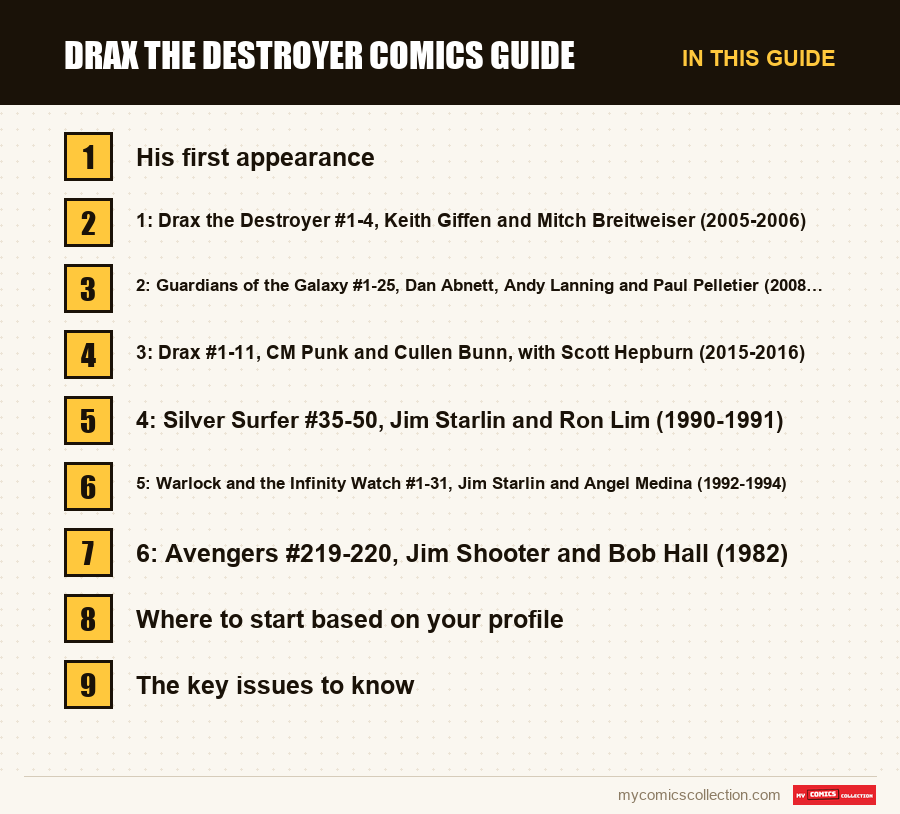
5: Warlock and the Infinity Watch #1-31, Jim Starlin and Angel Medina (1992-1994)
The series is born in the wake of the Infinity Gems saga: Adam Warlock is given custody of the gems and forms a team to protect them. Drax is part of it. Jim Starlin writes the first thirty-one issues, Angel Medina draws the first ones, and the series continues without him through #42, in 1995. Issue #2 is dated March 1992.
What it brings to Drax is a stable place in a cast that gives him room to breathe: he no longer chases Thanos but lives with his teammates. It is for the 1990s cosmic reader ready to commit to forty-two issues, which is no small thing. For everyone else, it is better to pick a few episodes from a collected edition than to force yourself through the whole series.
The series is better enjoyed if you have first read The Infinity Gauntlet (1991), six issues by Jim Starlin drawn by George Pérez and Ron Lim, where Drax is among the characters gathered against Thanos without playing the lead. Our Infinity Gauntlet key issues page describes this saga in more detail.
6: Avengers #219-220, Jim Shooter and Bob Hall (1982)
The two-parter is dated May and June 1982. Jim Shooter writes, Bob Hall draws, and Drax is a central player: he faces his daughter Moondragon, and that is where the character dies. He is later brought back by Starlin in 1990, which makes these two issues a reading milestone, that of the character's first disappearance.
It is not an entry point: you need to know Moondragon and know she is Drax's daughter for the story to resonate. It is for the reader already familiar with the character who wants to measure what Starlin's orchestrated return in 1990 comes to repair. The Avengers of this era read easily in the collected editions of the Shooter period, but these two issues are the ones you hunt for Drax.
A reading tip: read these issues after seeing Drax at work under Starlin. The effect of the death is stronger when you know what the character is made of, and you better perceive what the 1990 return repairs. See also our history of Thanos in the comics to place Drax's adversaries.
Where to start based on your profile
You saw Drax in the movies and want to find him again without effort: pick up the 2008 Guardians of the Galaxy, then our comparison Guardians of the Galaxy Vol. 3: the movie versus the comics to measure the gaps. You want a character at the center of his own story: the 2005 miniseries is the best door, followed by the 2015 series if the detective tone appeals to you.
You like Jim Starlin's cosmic sagas: start from Iron Man #55 and the Captain Marvel period, then move on to Silver Surfer and The Infinity Gauntlet. This path takes patience, but it follows the order in which the writers built the character. You collect keys above all: read the next section and choose according to the state of your shelves.
The key issues to know
The first appearance, Iron Man #55 (February 1973), remains the benchmark key; the issue also contains the debut of Thanos, which explains the interest it draws. Next come Captain Marvel #27 (July 1973), which establishes Drax as a regular presence, and Avengers #220 (June 1982), where the character disappears. Silver Surfer #35 (March 1990) marks his return.
On the modern side, Drax the Destroyer #1 (November 2005), Guardians of the Galaxy #1 (2008) and Drax #1 (November 2015) are the series openers you look for. The method is the same for each: confirm the cover date on the issue, tell the original print run apart from a reprint or a variant, and compare several completed sales rather than a single listing. For Drax, one simple criterion separates the keys: keep the issues that mark a change of status (birth, return, disappearance) rather than those where he is just passing through.
Single issues from the 1970s and 1980s are compared with each other on overall condition, spine and corners, while recent issues are judged first on identifying the print run. In both cases, a collected edition remains an excellent way to read without committing a budget to the original, even if you buy the single issue later.
Frequently asked questions
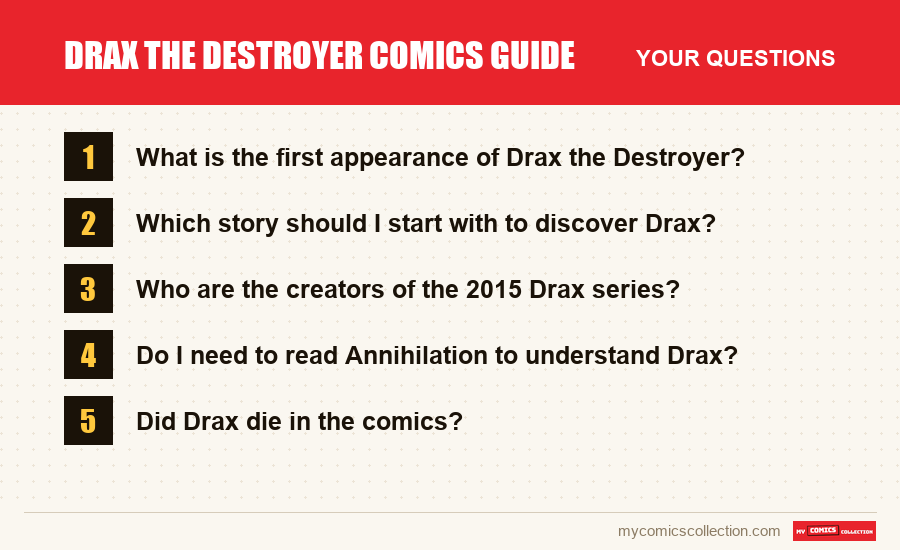
It is Iron Man #55, cover-dated February 1973. Starlin invents the story and pencils it, Friedrich puts it into words, Esposito inks. Thanos, Mentor and Kronos are also born in the same issue, and the cover advertises something else.
The Drax the Destroyer miniseries (2005-2006), by Keith Giffen and Mitch Breitweiser, is the simplest: four issues, one character at the center, no prerequisites. The 2008 Guardians of the Galaxy is the logical second step to see him evolve in a regular team.
CM Punk and Cullen Bunn write the series, Scott Hepburn draws it and Matt Milla provides the colors. It runs eleven issues, published starting in November 2015, collected in two volumes: The Galaxy's Best Detective for issues #1-5, then The Children's Crusade for issues #6-11.
No, the 2005 Drax the Destroyer miniseries reads on its own. It serves as a prelude to Annihilation, which makes you want to keep going, but the story recaps the essentials. For the cosmic context, our reading guide to that event will help you choose the order of the follow-ups.
Yes, in Avengers #219-220 (May and June 1982), by Jim Shooter and Bob Hall, where he faces his daughter Moondragon. Jim Starlin brings him back in Silver Surfer #35, cover-dated March 1990, and he remains present afterward in Marvel's cosmic sagas.
Did you find a copy of Iron Man #55 or another Drax key issue? Get it appraised before you put it away.
Appraise my comic