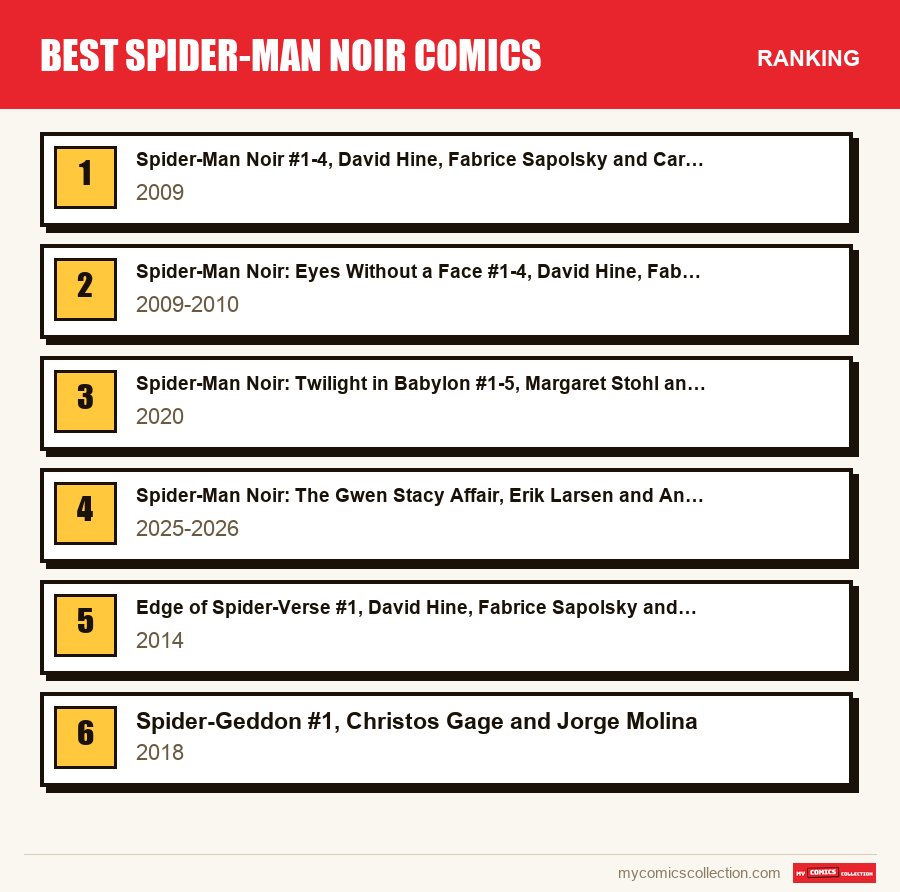
The best Spider-Man Noir comics start with Spider-Man Noir #1-4 (2009) by David Hine and Fabrice Sapolsky, drawn by Carmine Di Giandomenico: the 1930s Peter Parker is born there in a Depression-era New York. Follow it with Eyes Without a Face, then Margaret Stohl and Juan Ferreyra's Twilight in Babylon (2020). The crossover appearances come after.
Spider-Man Noir is not a simple costume variation: he is a Peter Parker reinvented for 1930s crime fiction, with its reporters, gangsters and smoky clubs. This guide ranks six reads, recalls what belongs to the comics and what belongs to video games, film and television, and gives a reading order that avoids false starts.
As always in this guide, we only state verified information (creators, issue numbers, dates); the analysis is our own, with no reproduction of protected artwork or dialogue.
His first appearance
This version's Peter Parker first appears in Spider-Man Noir #1, dated February 2009, the first issue of a four-issue miniseries. The script is by David Hine and Fabrice Sapolsky, the art by Carmine Di Giandomenico, and Marko Djurdjević designs the costume; the cover of #1 is by Patrick Zircher. The sequel, Spider-Man Noir: Eyes Without a Face, brings back the same writers and adds the hat to his costume.
The story takes place on Earth-90214, during the Great Depression. Peter Parker is a photojournalist and budding investigator there; his Uncle Ben is killed by henchmen of Norman Osborn, the crime boss nicknamed the Goblin, and his mentor Ben Urich is murdered in turn. Felicia Hardy runs the Black Cat club and lends him a hand, while Sandman (Flint Marko) and the Vulture are among his adversaries. This alternate Earth reuses familiar names but puts them in other roles, which is the whole appeal for readers who already know the classic Spider-Man stories. To compare this universe with Peter Parker's Earth-616, our history of Spider-Man in comics sets out the landmarks.
On the collecting side, the 2009 #1 is a recent single issue: examine the spine and corners, then ask to see the exact cover advertised. It is nothing like a Silver Age piece, but its status as the character's starting point makes it the natural key issue of a collection devoted to this variant.
1: Spider-Man Noir #1-4, David Hine, Fabrice Sapolsky and Carmine Di Giandomenico (2009)
This is the founding story, and it reads in one sitting. Hine and Sapolsky transpose the hero's landmarks to 1930s New York: the photographer, the newspaper, the mentor, and above all a world where corruption weighs more than superpowers. Carmine Di Giandomenico draws the four issues in a dark palette that gives the series its visual identity.
What this miniseries brings to the character: everything he will be afterward, including Uncle Ben's death tied to the Goblin. It is aimed at readers who like crime fiction and want a Spider-Man with no ties to current continuity. Read it without preparation: it is designed as a complete story, and the trade paperback of these four issues is the simplest way to own it.
2: Spider-Man Noir: Eyes Without a Face #1-4, David Hine, Fabrice Sapolsky and Carmine Di Giandomenico (2009-2010)
The four-issue sequel keeps the writers of the first miniseries and brings the hat into the hero's silhouette. The Crime Master enters the scene, which widens the criminal pantheon of this Earth. Carmine Di Giandomenico's art returns.
This read suits those who liked the opening miniseries and want to see the character settled into his setting. It reads after the first one, since it assumes you know Peter's losses. If you are looking for a stopping point, it is a good end of the road for anyone who only wants the 2009 and 2010 material.
3: Spider-Man Noir: Twilight in Babylon #1-5, Margaret Stohl and Juan Ferreyra (2020)
Eleven years later, the series returns with a different writer and a different artist. Margaret Stohl writes, Juan Ferreyra draws, and the hero travels abroad and finds himself plunged into a murder investigation. The 2020 volume is volume 2 of Spider-Man Noir, whose #1-5 form the trade paperback.
This story suits those who already know the two miniseries and expect a continuation; it takes the character out of his usual streets. The complete 2019 collected edition, which gathers the older series, does not contain it: look for it separately. If you follow the travels of other versions of the hero, compare it with Spider-Gwen's journey.
4: Spider-Man Noir: The Gwen Stacy Affair, Erik Larsen and Andrea Broccardo (2025-2026)
The most recent series is written by Erik Larsen and drawn by Andrea Broccardo. Its title puts Gwen Stacy at the center of the plot. To find your footing, it is better to know the 2009 miniseries first.
It is aimed at readers of Erik Larsen, whose work is gathered on our page devoted to the creator, and at those who want to follow the character up to today. Read it last: it is the most recent chapter.
5: Edge of Spider-Verse #1, David Hine, Fabrice Sapolsky and Richard Isanove (2014)
This issue is a prelude to the Spider-Verse event, written by Dan Slott. Hine and Sapolsky, the original writers, return to their character here, with Richard Isanove on art.
It is aimed at readers who want to keep the original pen for the transition to the multiverse. Read it between the 2009 miniseries and the crossovers, and keep in mind that it is a one-shot issue rather than a series. For the context of the event, see the page devoted to Edge of Spider-Verse #2, which introduces another version from the saga.
Do you collect this series?
Track what you own, what you are missing and what your collection is worth. 7-day trial.
Start my trial →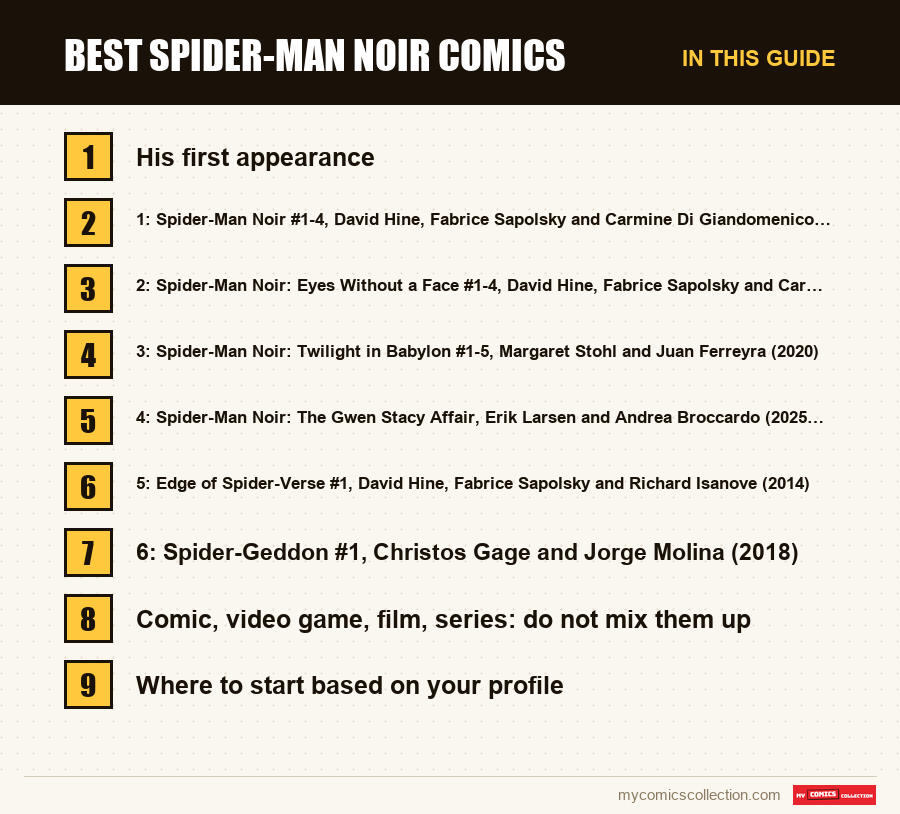
6: Spider-Geddon #1, Christos Gage and Jorge Molina (2018)
Here, Noir is not the hero of the story: he appears only in this first chapter of the event, where he seems to perish. The issue is cited for its role as a turning point in the character's biography, since his apparent death is followed by a return in 2020, in Spider-Verse (volume 3) #5.
It is aimed at event readers and at collectors who want to follow the character's full path, from his creation to his return. It is not an entry point: read it after the miniseries, and only if you want to know how the hero left the stage. Fans of Spider-Man's adversaries will find a context close to that of the Sinister Six ranking.
Comic, video game, film, series: do not mix them up
Spider-Man Noir has lived several lives off the page, and they need to be told apart from the comic series. In the game Spider-Man: Shattered Dimensions (2010), he is voiced by Christopher Daniel Barnes. In film, Spider-Man: Into the Spider-Verse (2018) gives him the voice of Nicolas Cage; our film versus comics page details this gap. A live-action television series, Spider-Noir, announced for 2026, brings back Nicolas Cage in the title role.
The point to watch for the reader: these adaptations do not replace the issues. A 2009 single issue remains a 2009 single issue, whatever buzz surrounds the character on screen. If you buy on reflex after a series release, compare completed sales over several weeks, not the current listings.
Where to start based on your profile
You like crime fiction and the 1930s. Read Spider-Man Noir #1-4, then Eyes Without a Face. That is the core of the character.
You are coming from the film Into the Spider-Verse. Keep in mind that the screen borrows a silhouette and a tone, not a plot: start with the 2009 miniseries, then read Twilight in Babylon.
You follow the multiverse crossovers. Read the 2009 and 2010 core first, then Edge of Spider-Verse #1, then Spider-Geddon #1 for the apparent death, and Spider-Verse (volume 3) #5 for the return.
You read Erik Larsen. Read The Gwen Stacy Affair with the 2009 miniseries close at hand.
You collect single issues. Aim for the 2009 #1, then the #1 of Eyes Without a Face, where the hat appears in the hero's silhouette.
The key issues to know
Method beats a price list: for each copy, establish the condition from photos, identify the cover, and cross-check against completed sales. The word "key" proves nothing until you understand what it refers to.
- Spider-Man Noir #1 (February 2009). The character's starting point, with a cover by Patrick Zircher. It is the centerpiece of a Noir collection.
- Spider-Man Noir: Eyes Without a Face #1. The issue where the hat enters the hero's silhouette.
- Edge of Spider-Verse #1 (2014). The character's return by his original writers, just before the event.
- Spider-Geddon #1 (2018). The chapter where Noir seems to perish.
- Spider-Verse (volume 3) #5 (2020). The issue of his return.
- Spider-Man Noir (volume 2) #1 (2020). The opening of Twilight in Babylon, by Margaret Stohl and Juan Ferreyra.
- The Amazing Spider-Man vol. 3 #9 to #15 (2014-2015): Dan Slott's Spider-Verse event, drawn by Olivier Coipel and Giuseppe Camuncoli, where the noir version fights alongside the other Spider-Men.
To place these issues within a broader collection, browse the Spider-Man hub; if you want a copy appraised, the appraisal form lays down the first baseline.
The villains and allies to know
This Earth's gallery borrows the names of the classic Spider-Man, but not their roles. Norman Osborn is not an industrialist: he is the Goblin, a crime boss. Felicia Hardy is not a costumed burglar: she runs the Black Cat club. Sandman is Flint Marko; the Vulture is among the threats. To measure the gap with the main versions, read our ranking devoted to the Black Cat and the one devoted to the Vulture. These two pages show how the same name can carry, from one Earth to another, a very different function.
This parallel reading is useful for a collector: it helps spot, in the early issues, the characters who will return later, and therefore those whose first appearances may matter.
Frequently asked questions
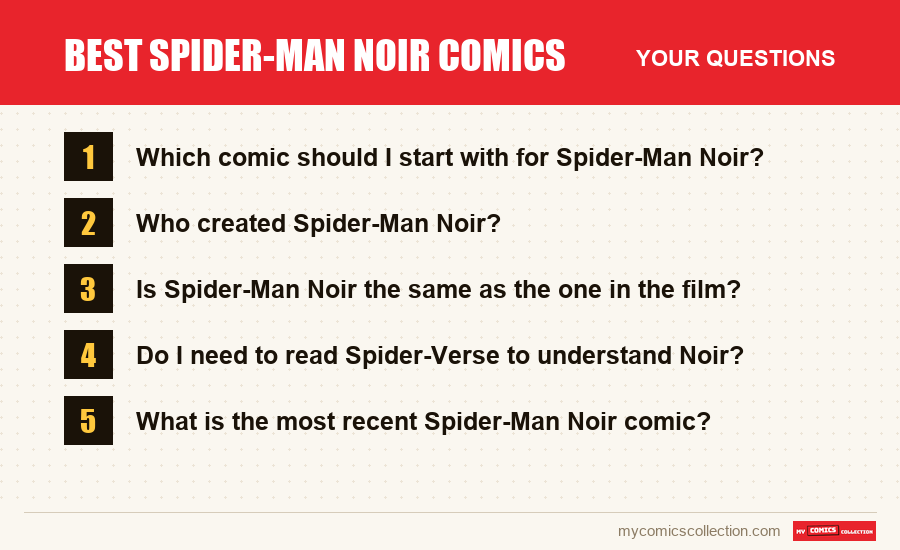
Start with Spider-Man Noir #1-4 (2009), written by David Hine and Fabrice Sapolsky and drawn by Carmine Di Giandomenico. This miniseries is self-contained and sets the 1930s scene. Then read Eyes Without a Face, followed by Twilight in Babylon by Margaret Stohl and Juan Ferreyra.
The character is born in Spider-Man Noir #1, dated February 2009, under the pen of David Hine and Fabrice Sapolsky, with Carmine Di Giandomenico on art. Marko Djurdjević designed the costume, and Patrick Zircher drew the cover of the first issue.
The film Into the Spider-Verse (2018) takes up the idea of a noir Spider-Man, voiced by Nicolas Cage, in a plot of its own. To find the character on the page, start from the 2009 miniseries.
No. The 2009 and 2010 miniseries and Twilight in Babylon read without the Spider-Verse event, written by Dan Slott. The crossovers mostly serve to follow the character through the multiverse, with his apparent death in Spider-Geddon and his return in 2020.
The most recent series is Spider-Man Noir: The Gwen Stacy Affair, written by Erik Larsen and drawn by Andrea Broccardo, published from 2025 to 2026. It comes after Twilight in Babylon, published in 2020 under Margaret Stohl's pen.
A 2009 Spider-Man Noir #1 or a multiverse issue in your boxes? Have its condition assessed before you put it away.
Estimate my comic