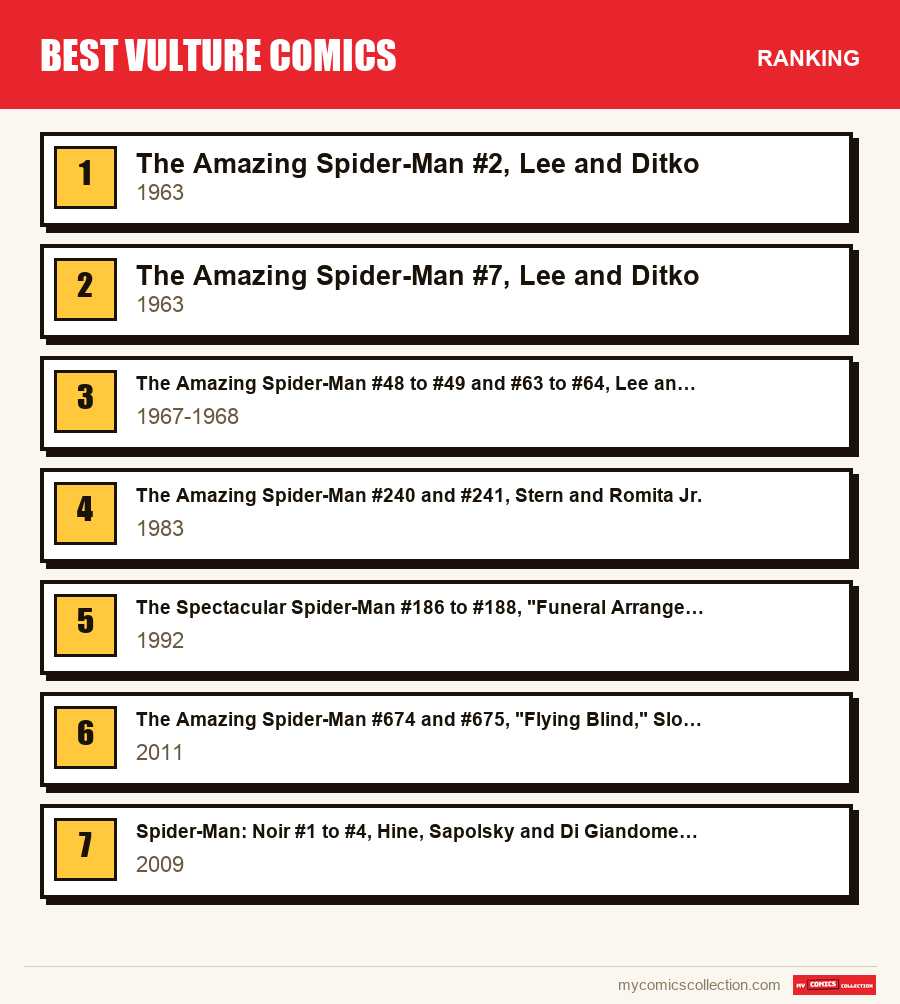
For the best Vulture comics, start where Adrian Toomes debuts: The Amazing Spider-Man #2 (May 1963), by Stan Lee and Steve Ditko. Follow it with #7, then #48 and #63 and #64 for the duel with Blackie Drago, the origin in #240 and #241 (1983), Funeral Arrangements in Spectacular Spider-Man #186 to #188 (1992), Flying Blind (2011), and finally Spider-Man: Noir (2009) for a standalone take.
The Vulture is a special case among Spider-Man's enemies: he is old, he is bitter, and his talent is first and foremost that of an engineer. He never got his own signature saga, but he shows up in a string of short stories that, put end to end, form a fuller portrait than his reputation as a supporting player suggests. Seven reads are ranked below, with their audience and how to approach them.
As always in this guide, we only state verified information (creators, issue numbers, dates); the analysis is our own, with no reproduction of protected art or dialogue.
His first appearance
Adrian Toomes makes his entrance in The Amazing Spider-Man #2, cover-dated May 1963, whose main story is titled "Duel to the Death with the Vulture!". Stan Lee writes, Steve Ditko draws. The same issue introduces the Tinkerer, Phineas Mason, which makes it a two-name single issue in the rogues' gallery. Toomes is an embittered electrical engineer who built himself a magnetic flying harness; Spider-Man only beats him by devising a device that cancels the harness's field.
One workshop detail is worth knowing: according to Ditko's own account, Lee wanted a massive villain, modeled on the actor Sydney Greenstreet, and Ditko drew him thinner, because a heavyset character takes up too much room in the panel. That leaner silhouette is the one later artists kept. The Vulture name had already been used, however: Isidoro Scarlotti, created by Joe Gill and Carl Burgos, carried it in Young Men #26 (March 1954). Toomes is therefore Spider-Man's Vulture, not the first to wear the name.
From a collecting standpoint, this issue belongs to the very first wave of the title; to go back further, see the entry on Spider-Man's debut. Check the May 1963 date on the cover, the condition of the spine and corners, and any sign of restoration.
1: The Amazing Spider-Man #2, Lee and Ditko (1963)
This is the story to read first, and the shortest to digest: the Vulture dominates Spider-Man from the air, and Peter Parker only gets out of it by understanding the principle of the harness so he can build something to cancel it. The structure is that of the series in its early days: one adversary, one technical puzzle, a teenager making do with his own means.
What is specific to the Vulture here is his know-how: Toomes does not owe his power to an accident but to his trade as an engineer, which sets the stage for the stories of betrayed business deals that other writers would give him. Intended audience: anyone who wants to grasp why Toomes survived his first fight. How to read it: on its own, in the original single issue or in a reference collection, without looking for extra context.
2: The Amazing Spider-Man #7, Lee and Ditko (1963)
Toomes returns in #7, still with Lee writing and Ditko drawing. This second encounter confirms the formula: the Vulture is not a one-issue enemy but a return you look forward to. This issue appears in the collection The Amazing Spider-Man vs. The Vulture, alongside #2, which indicates that it is part of the core of recommended reads.
The ideal audience is the reader coming out of #2 who wants to see Ditko pick Toomes back up a few months later. Read it right after #2, before any later story, because the 1960s stories are better enjoyed back to back. In 1964, the Vulture joins the Sinister Six in the first Annual, which we cover among the key issues below.
3: The Amazing Spider-Man #48 to #49 and #63 to #64, Lee and Romita (1967-1968)
The Blackie Drago saga is a moment apart. Issue #48 introduces Drago, who seizes Toomes's wings and becomes the third Vulture under the pens of Lee and Romita Sr. According to accounts from the time, Lee wanted this version because Spider-Man looked like a bully facing an old man, but readers received it poorly and the original Vulture came back. In this sequence, Kraven the Hunter also enters the story, which makes for an alliance that goes wrong. Issues #63 and #64 bring Toomes back face to face with Drago, each with wings, in a duel that lets the original reclaim his role.
Who is it for? A reader who wants to see the Vulture in the Romita period, after the Ditko one. How to read it: in two parts, issues 48 and 49, then issues 63 and 64, setting aside the single issues in between unless you are aiming for complete continuity. The contrast with the Ditko stories is instructive: the linework changes, the atmosphere too, and the Vulture stays the same in his determination.
4: The Amazing Spider-Man #240 and #241, Stern and Romita Jr. (1983)
The Vulture's origin took more than two hundred issues to arrive. Roger Stern writes it in #240, "Wings of Vengeance!" (May 1983, drawn by John Romita Jr. with Bob Layton on inks), then in #241, "In the Beginning…" (June 1983, with Frank Giacoia on inks). The first issue shows Toomes in New York, come to capture Gregory Bestman at a high-tech trade show; the second tells in flashback how that unscrupulous partner ruined him.
This story answers the question that #2 left open: why does an engineer become a thief? The answer comes down to a betrayed business deal. It is the read to prioritize if you care about the character more than the action. How to read it: straight through, both issues in one sitting, without going through the neighboring issues. Stern fans can continue with our Roger Stern hub.
Do you collect this series?
Track what you own, what you are missing and what your collection is worth. 7-day trial.
Start my trial →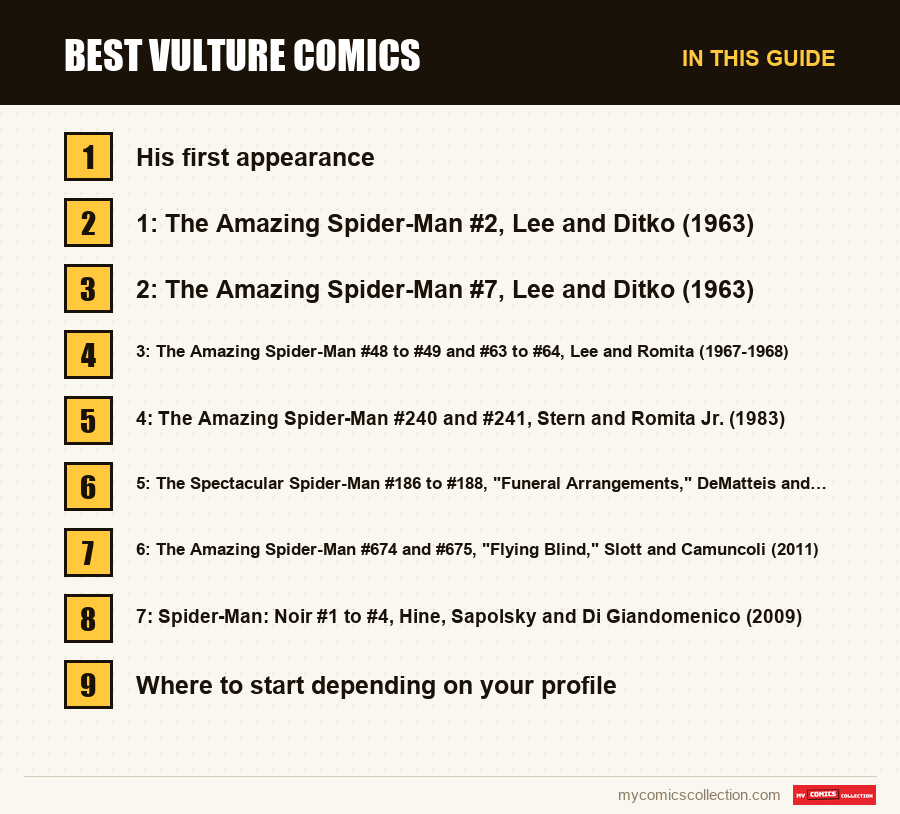
5: The Spectacular Spider-Man #186 to #188, "Funeral Arrangements," DeMatteis and Buscema (1992)
J. M. DeMatteis writes, and Sal Buscema draws, inks and covers included. The Vulture has learned that the technology that lets him fly has given him an incurable cancer, and he settles scores with his former accomplices and enemies. The first chapter, "Settling Scores," opens with the death of a small-time crook who had informed on him; the second, "Desperate Measures," brings him to Aunt May's house; the third, "Final Judgement," puts the Vulture face to face with Spider-Man.
It is, in our opinion, the best story centered on him alone. Its typical reader is looking for a short, dark tale, swallowed in one evening. How to read it: after issues 240 and 241, because it directly extends the idea of a man worn down by his own choices.
6: The Amazing Spider-Man #674 and #675, "Flying Blind," Slott and Camuncoli (2011)
Dan Slott writes, Giuseppe Camuncoli pencils, Klaus Janson inks. The arc follows up on the aftermath of Spider-Island and brings the Vulture back in a modern story. It is useful for anyone who wants to see how a 1963 character is picked up by a contemporary team.
It is the ideal entry point for a reader who prefers recent series to older ones. How to read it: no prerequisites, but ideally you already know Toomes's origin. Slott long held the main series, which gives the arc continuity with the contemporary plotlines.
7: Spider-Man: Noir #1 to #4, Hine, Sapolsky and Di Giandomenico (2009)
The Spider-Man: Noir series transposes the hero to the 1930s. David Hine and Fabrice Sapolsky write, Carmine Di Giandomenico draws. The Vulture here is a bloodthirsty brute who kills Uncle Ben, which feeds Peter's hatred. Issue 1 is dated February 2009.
It is an optional read, best saved for those who have already absorbed the classic version. It shows how far the character can stand being reinvented. How to read it: in four issues, with no link to main continuity.
Where to start depending on your profile
If you are discovering the character, read #2, then #7, and stop there until the urge to continue comes. If you like character-driven stories, jump straight to #240 and #241, then to "Funeral Arrangements." If you prefer modern action, Flying Blind is enough. If you are a collector, focus first on the 1963 #2 and on the first Annual from 1964.
For those coming from the movies, our comparison of Spider-Man: Homecoming (2017) and the comics says what the film borrows from the Vulture and what it invents.
The key issues to know
A short list is enough, and it reads more like a method than a price guide: a first-appearance issue earns its place in a collection because the character endures, and the Vulture has endured since 1963.
- The Amazing Spider-Man #2 (May 1963): first appearance of Adrian Toomes and the Tinkerer, Lee and Ditko;
- The Amazing Spider-Man Annual #1 (1964): first Sinister Six story, with the Vulture among the members, Lee and Ditko;
- The Amazing Spider-Man #48 (1967): first appearance of Blackie Drago, Lee and Romita;
- The Amazing Spider-Man #127 (1973): first appearance of Clifton Shallot, created by Ross Andru, Gerry Conway and John Romita Sr.;
- The Amazing Spider-Man #240 and #241 (1983): the Vulture's origin, Stern and Romita Jr.
One marker outside the page also drives demand: Michael Keaton plays Adrian Toomes in Spider-Man: Homecoming (2017), directed by Jon Watts. That salvager, embittered by a lost contract, sent many viewers toward the 1963 #2 and toward Stern's origin story, which is why it pays to know which issues actually tell the character's story before hunting for a copy.
The method for valuing a copy stays the same from one issue to the next: compare completed sales of the same grade rather than asking prices, and check the cover date before buying. Issues from before 1970 call for particular attention to restoration; those from 1983 are judged mostly on the condition of the corners and spine.
Frequently asked questions
Adrian Toomes appears in The Amazing Spider-Man #2, dated May 1963, by Stan Lee and Steve Ditko. The Tinkerer also makes his debut there. The Vulture name had existed since Young Men #26 (March 1954), however, carried by Isidoro Scarlotti, a different character.
Funeral Arrangements, in Spectacular Spider-Man #186 to #188 (1992), by J. M. DeMatteis and Sal Buscema, is often cited as one of the best stories centered on him. The 1963 #2 remains the historical reference, and the origin in #240 and #241 is the most useful for understanding his path.
In The Amazing Spider-Man #240 and #241, from May and June 1983, written by Roger Stern and drawn by John Romita Jr. Toomes is seen tracking Gregory Bestman, the former partner who ruined him. It took more than two hundred issues for this origin to be told.
Drago is the third Vulture. Born in The Amazing Spider-Man #48 under the pen of Lee and the pencil of Romita Sr., he seizes Toomes's wings. Readers did not much like him, and Toomes takes back his role in issues 63 and 64, where the two men fight with wings.
The film keeps the name Adrian Toomes, his past as an embittered engineer and the winged harness, but changes the context. Our article comparing Spider-Man: Homecoming and the comics details what it borrows and what it invents.
Do you own an Amazing Spider-Man from the 1960s or 1980s and want to gauge its condition before shelving it?
Estimate my comic