The best Electro comics start with Max Dillon's debut in The Amazing Spider-Man #9 (February 1964), by Lee and Ditko, the key issue to know; next come Annual #1, which founds the Sinister Six, and Daredevil #2. Where to start for a modern read: Ultimate Spider-Man #12 (2001), the Power to the People arc in Amazing Spider-Man #612 to #614 (2009-2010), then Francine Frye (2014-2016).
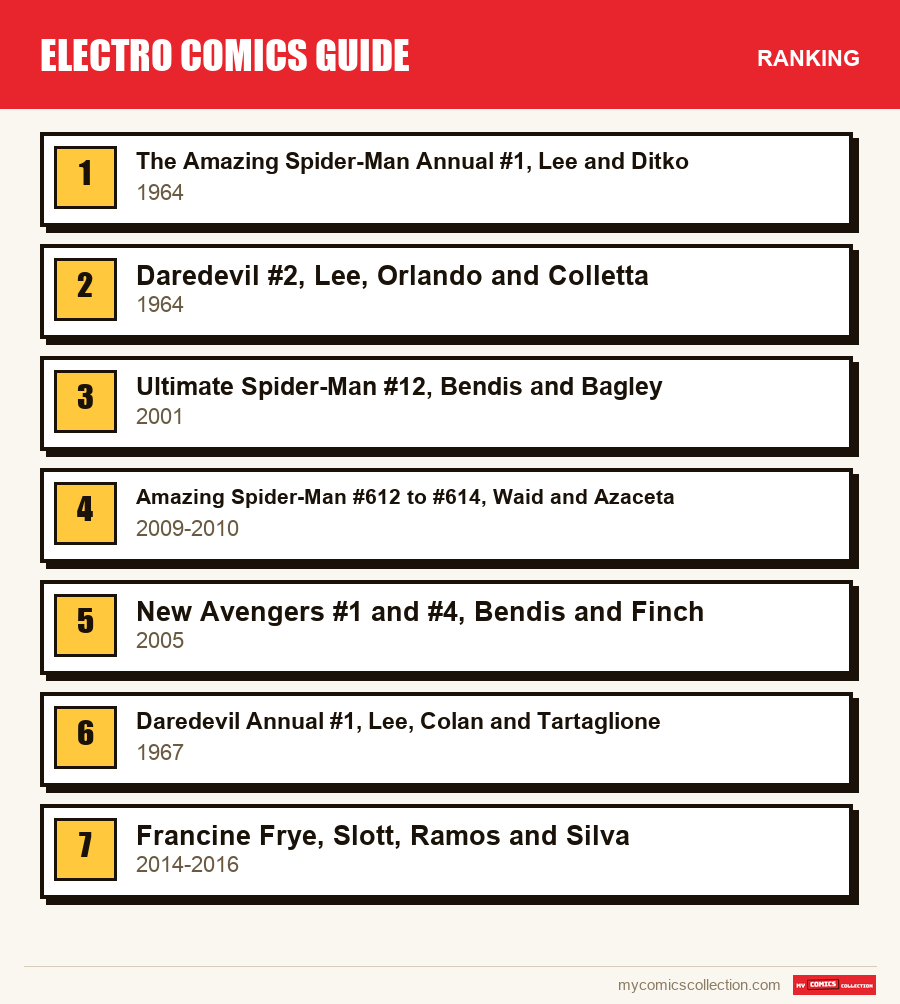
Max Dillon is one of those villains everyone thinks they know from the character sheet: an electrician, a storm, a yellow and green costume, a second-tier opponent who serves as a warm-up. Reading the issues says something else. Depending on the writer and the era, Electro is a B-movie comic relief, a man who thinks he is a force of nature, one inmate among many, or a social case. Seven stories are ranked below, with the intended audience for each and how to approach it.
As always in this guide, we only state verified facts (creators, issue numbers, dates); the analysis is our own, with no reproduction of artwork or protected dialogue.
His first appearance
Electro is born in The Amazing Spider-Man #9, the February 1964 issue, whose story is titled "The Man Called Electro!". Stan Lee writes, Steve Ditko draws. Max Dillon is a power line technician struck by lightning on the job; the accident leaves him able to produce and control electrical discharges, and gives him the urge to make a criminal career of it. The idea fits in one sentence, which partly explains its longevity: an ordinary man, an accident, a power that exceeds what he knows how to do with it.
For a collector, this issue sits in the first wave of the series, the one where each single issue introduces an opponent meant to return. Before buying a copy, look at the condition of the spine and corners, any sign of restoration, and the cover date, which must indeed be February 1964. To place this February 1964 within the series, the entry on issue #1 from 1963 describes the early days of the title.
1: The Amazing Spider-Man Annual #1, Lee and Ditko (1964)
Dated October 1964, Annual #1 brings six enemies together in one team, the Sinister Six, which Lee conceived and Ditko drew. The original lineup gathers Doctor Octopus, Electro, Kraven the Hunter, Mysterio, Sandman and Vulture. Electro changes nature there: he is no longer a lone criminal who loses his duel, he is a member of an organized group, which writes him into the long run of the rogues gallery.
For anyone who wants to understand the character, this annual has a simple virtue. It shows Electro next to five opponents already established or still to come, and it forces you to read the early Max Dillon as a cog rather than a headliner. On the collecting side, check that the single issue is complete, that the cover holds at the spine and that no page has been removed. If the Sinister Six interest you, the page Best Doctor Octopus comics develops the point of view of their organizer.
2: Daredevil #2, Lee, Orlando and Colletta (1964)
A few months after his birth, Electro leaves the Spider-Man universe. Daredevil #2, dated September 1964, is titled "The Evil Menace of Electro!"; Stan Lee writes, Joe Orlando draws and Vince Colletta inks. It is the first sign that Electro is transposable: an enemy whose menace does not depend on the hero he faces, but on his own discharges.
This issue does not read as a masterpiece, and that is not what is asked of it. It is worth having as a landmark: it reminds us that, as early as 1964, the character circulates between Marvel series. For a Daredevil collector, it is also an issue that serves as a meeting point between two collections, that of the blind hero and that of Spider-Man's enemies. If you follow that series, the file on the key issues of Silver Age Daredevil will help you place it.
3: Ultimate Spider-Man #12, Bendis and Bagley (2001)
The Ultimate Spider-Man series is written by Brian Michael Bendis and initially drawn by Mark Bagley. Its twelfth issue, from 2001, concludes the first big arc of the series: Spider-Man wants to find the Kingpin, but must first get past Wilson Fisk's henchmen, including the Enforcers and Electro. Art Thibert inks the issue, and the design of this universe's Electro is credited to Bagley.
This is the least demanding door for anyone who has never opened a single issue published before 2000. The story is self-contained, the structure of successive fights is readable without knowing the character's history, and the issue shows an Electro as part of a strike team, not as a gag. It is best read after the previous issues of the arc; if you want to spot the other important issues of the series, see our page on the key issues of Ultimate Spider-Man.
4: Amazing Spider-Man #612 to #614, Waid and Azaceta (2009-2010)
In the storyline called The Gauntlet, #612 opens "Power to the People", written by Mark Waid and drawn by Paul Azaceta. This issue also introduces Electro's new look, designed for the era. The arc continues through #614, and the following issues move on to other opponents.
It is the clearest modern read for anyone who likes short three-part stories. It dusts off the character without betraying him, and it lends itself to an independent read if you simply know the idea of Electro as a Spider-Man enemy. For a purchase, check the exact issue number and the mention of this arc on the spine of the trade paperback, because editions collect neighboring material that varies from one edition to another. For the rest of the series, where Dan Slott writes Francine Frye, see Dan Slott: where to start.
Do you collect this series?
Track what you own, what you are missing and what your collection is worth. 7-day trial.
Start my trial →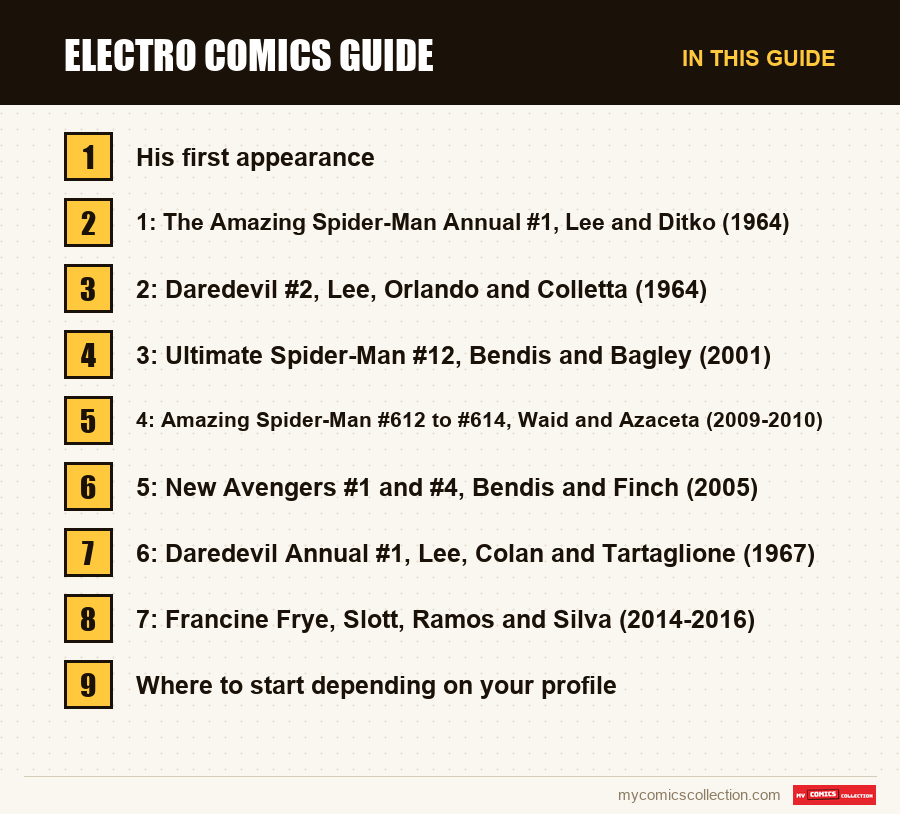
5: New Avengers #1 and #4, Bendis and Finch (2005)
In the first issue of New Avengers, Brian Michael Bendis and David Finch open the series with the breakout from the Raft prison, and Electro is among the inmates who escape. He returns in #4. Here the character is no longer the heart of the story: he is an element of the chaos, a piece of what brings the team together.
This entry point suits anyone who already reads the Avengers books or likes to see how a Spider-Man enemy behaves when he goes from being a personal threat to a systemic risk. For our purposes, it fills a precise role: it shows that, in 2005, Electro belongs to the pool of inmates Marvel can deploy in a large-scale story. Do not read it first if you are looking for a story centered on Max Dillon.
6: Daredevil Annual #1, Lee, Colan and Tartaglione (1967)
Daredevil Annual #1, dated September 1967, is titled "Electro and his Emissaries of Evil". Stan Lee writes, Gene Colan draws and John Tartaglione inks. Electro appears there at the head of a troop, which extends the idea of a character who can lead a group rather than being subject to one.
The read is mostly interesting for the way Gene Colan handles light and movement, different from Ditko's. It is for the reader who wants to see how the same character changes face depending on the artist. On the collecting side, the Daredevil annuals form a subset of their own; our page on the key Daredevil annuals and specials places them within the whole series.
7: Francine Frye, Slott, Ramos and Silva (2014-2016)
The seventh entry steps away from Max Dillon. Francine Frye appears in The Amazing Spider-Man vol. 3 #2, the July 2014 issue created by Dan Slott and Humberto Ramos. She becomes Electro in volume 4, in #17 from October 2016, with Dan Slott and R.B. Silva. She is therefore not Electro from the start: the character begins elsewhere and joins the name later.
This read appeals to anyone who wants to follow a thread of the series rather than a closed saga. It requires at least a little familiarity with Slott's universe, and it does not replace the original Electro: it opens another version of him. For a collector, two issues are worth remembering: the first appearance of Francine Frye and the issue where she takes the name Electro.
Where to start depending on your profile
If you discover Spider-Man through the movies or the cartoon, start with Ultimate Spider-Man #12: one issue, one arc, a clear ending, with no need to know sixty years of continuity. If you like three-part stories and character redesigns, read Amazing Spider-Man #612 to #614.
If you are drawn to the Silver Age, open The Amazing Spider-Man #9, then the 1964 Annual #1, then Daredevil #2. In three issues you will have the birth, the integration into the Sinister Six group and the first crossover into another series. If you collect by publisher and by format, add the 1967 Daredevil annual.
If you prefer character revisits, finish with Francine Frye: vol. 3 #2 and then vol. 4 #17 form a short thread, and you will compare two Electros. Whatever your profile, one tip on method: always read the starting issue of the arc, never an isolated issue in the middle, so you do not lose the thread of the plot.
The key issues to know
The list of issues that matter is short, which makes the collecting work easier. First The Amazing Spider-Man #9 (February 1964): first appearance of Max Dillon, created by Stan Lee and Steve Ditko. Then Annual #1 (October 1964), first appearance of the Sinister Six with Electro among the six. Then Daredevil #2 (September 1964), his first crossover into another series.
On the modern side, Amazing Spider-Man #612 introduces the character's renewed look in 2009, and vol. 3 #2 from 2014 introduces Francine Frye, who takes the name Electro in vol. 4 #17 in 2016. To decide which issues to target, use the same method as for all first appearances: ask whether the character has lasted, whether the copy is complete, whether its condition is documented and whether the label on the box or bag matches the contents. Finally, check the issue number and the cover date printed on the single issue itself, not just those in the listing.
To place Electro within the sixty years of the series, cross the file on the key issues of Amazing Spider-Man with the ranking of the best Spider-Man runs.
Frequently asked questions
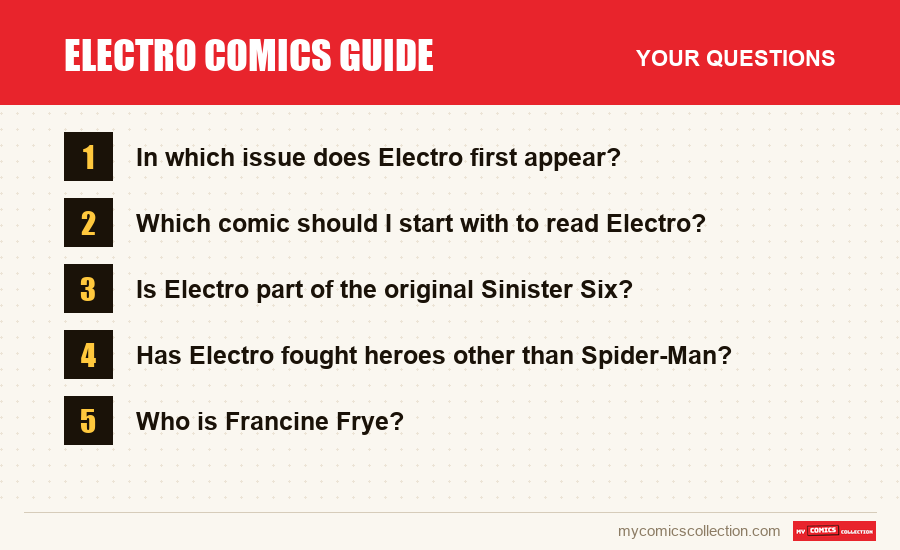
The first appearance of Max Dillon is in Amazing Spider-Man #9, cover-dated February 1964, in the story "The Man Called Electro!" that Lee wrote and Ditko illustrated. Francine Frye, another character who became Electro, appears much later, in vol. 3 #2 from July 2014.
The most accessible starting point is Ultimate Spider-Man #12 (2001, Bendis and Bagley), because the story leans on little continuity. If you prefer the origins, start with Amazing Spider-Man #9 from 1964. For a modern three-part read, take Amazing Spider-Man #612 to #614.
Yes. The team is born in Annual #1 from October 1964, the work of Lee and Ditko. It gathers Doctor Octopus, Electro, Kraven the Hunter, Mysterio, Sandman and Vulture. This annual is one of the issues to read to understand the character's place in the rogues gallery.
Yes. As early as September 1964, Daredevil #2 is titled "The Evil Menace of Electro!", with Stan Lee, Joe Orlando and Vince Colletta. He returns in Daredevil Annual #1 in 1967, then in New Avengers in 2005, where he is among the Raft inmates who break out.
Francine Frye is a character created by Dan Slott and Humberto Ramos in The Amazing Spider-Man vol. 3 #2, from July 2014. She takes the name Electro in volume 4, in #17 from October 2016, with Dan Slott and R.B. Silva. She is therefore another version of the name, distinct from Max Dillon.
Do you own Amazing Spider-Man #9, the 1964 Annual #1 or a Daredevil issue with Electro? Have its condition appraised before putting it away or selling it.
Estimate my comic