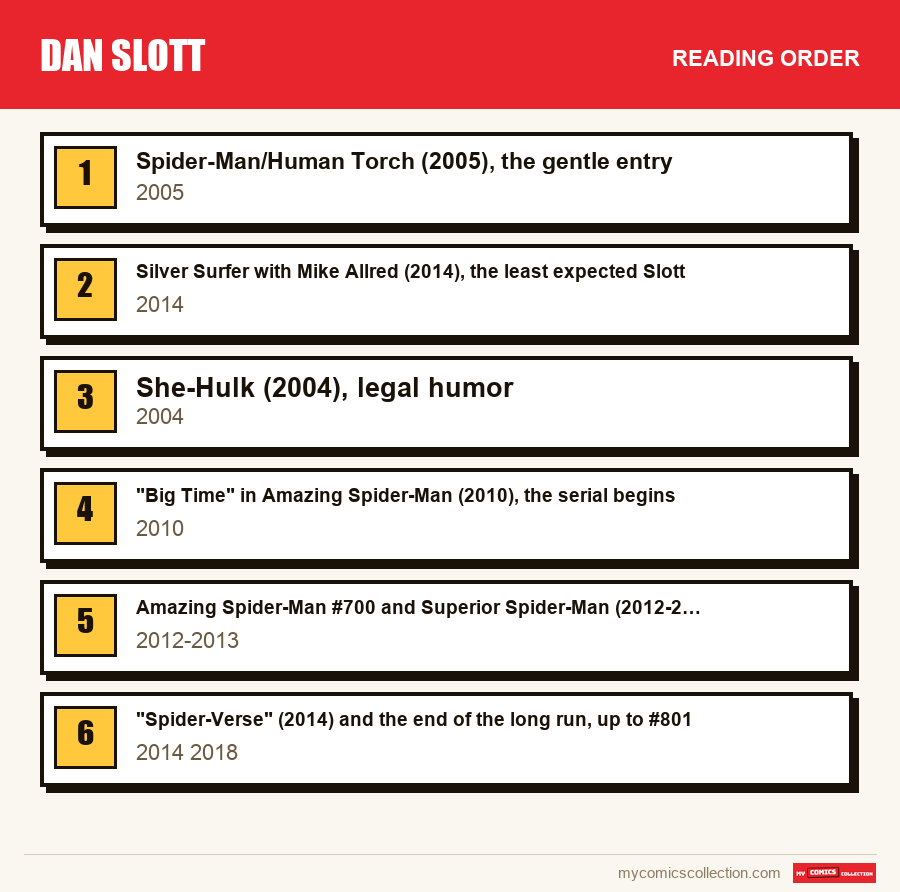
To approach Dan Slott's work, open Spider-Man/Human Torch, a 2005 miniseries, first, before the Silver Surfer series that Mike Allred draws in 2014. Then move on to She-Hulk (2004), "Big Time" in Amazing Spider-Man (2010), Amazing Spider-Man #700 and Superior Spider-Man (2012-2013), and finish with "Spider-Verse" (2014) and the end of that long run, up to issue #801 in 2018. The order goes from the self-contained story to the one that demands years of serial reading.
Dan Slott has been writing for more than thirty years, but most readers meet that work in the middle of an arc, on an issue of Amazing Spider-Man whose context they know nothing about. This guide offers the opposite: a progression that avoids the wrong entry points, so that each step makes you want to move on to the next instead of closing the book.
As always in this guide, only verified information (creators, issue numbers, dates) is stated as fact; the analysis is our own, with no reproduction of protected pages or dialogue.
Step 1: Spider-Man/Human Torch (2005), the gentle entry
The 2005 miniseries is the best first contact with Slott, because it runs just a few issues and assumes no prior reading. It follows the friendship of Peter Parker and Johnny Storm across the decades, with each episode paying tribute to an era of Marvel. The principle is a memory game: you laugh at a wink, you grow attached to a duo, and you already sense what will become the writer's signature, a sincere attachment to the character's past.
Why start here rather than with a big arc? Because you can gauge Slott's tone without committing to a serial of several hundred issues. If the mix of humor, tenderness and references appeals to you, the rest of the path will follow. If the exercise feels too turned toward the past, you will know that the later, more current material may suit you better.
As for format, the miniseries exists in a collected edition, and the single issues are cheap to gather: a short series with no notable variant poses no completion difficulty. Our Spider-Man reading guide shows how this miniseries fits into the hero's overall adventures.
Step 2: Silver Surfer with Mike Allred (2014), the least expected Slott
The Silver Surfer series was born in May 2014: Slott writes it, Mike Allred draws it, and Laura Allred provides the colors. The Surfer travels the universe alongside Dawn Greenwood, a young Earthling, and the tone is that of a cosmic romantic comedy. The issues play with form: some pages subvert the usual layout, which makes the book a graphic object as much as a story.
This series is the most independent of the writer's entire body of work. It requires no knowledge of the Marvel universe beyond the hero's name, and it reads like a short novel. Awarded the Eisner for best single issue in 2016, the eleventh episode serves as a test: if it wins you over, the whole volume will please you.
Why at this step? Because it reassures: if Spider-Man intimidates you, this Silver Surfer shows that Slott can write outside the conventions of the serial. To place the series among the other periods of the character, see our ranking of the best Silver Surfer runs; it explains what sets it apart from the cosmic Surfer of Stan Lee and his successors.
Step 3: She-Hulk (2004), legal humor
In the 2004 series, relaunched in October 2005, Jennifer Walters argues cases for a superhuman clientele at a specialized law firm. Juan Bobillo draws a large share of the episodes, with a dry line that serves the office gags. The court cases lean on Marvel continuity like case law: a trial can hinge on an event forty years old, and the pleasure comes from rediscovering it in the middle of a closing argument.
This step is a bit more demanding than the previous ones, because the humor rests on references. A reader who knows a few major Avengers or Fantastic Four sagas will enjoy it more, but a minimal base is enough. The series also tied into events of its day, which anchors it in a specific period of the publisher.
For the collection, the 2004 first issue is the most sought-after of the series, but it is not a rarity: the print run of the time makes it possible to find it in good condition. The ranking of the best She-Hulk runs places this period among the character's other creative teams, and the She-Hulk hub gathers the rest.
Step 4: "Big Time" in Amazing Spider-Man (2010), the serial begins
November 2010 marks a turning point: Slott becomes the sole writer of Amazing Spider-Man, now published twice a month. Humberto Ramos draws the opening arc, "Big Time." Peter Parker finally lands a steady job at a research center, and it is his daily life as a researcher that drives the episodes. It is the best entry point for following the serial from its origin, because the arc starts from a clear status quo.
Before this turn, Slott had already been writing the series since January 2008, as one of the four writers who alternated during the "Brand New Day" period. You can skip that period in your path: "Big Time" is designed to welcome new readers. A detour is still warranted toward Amazing Spider-Man #655 (2011), an almost wordless issue drawn by Marcos Martin, devoted to Peter Parker's grief, which shows a more intimate Slott.
The arcs that follow, such as "Spider-Island" (2011) and then "Ends of the Earth," read in sequence without difficulty. For continuous reading, prefer the collected edition: these single issues, printed in quantity, are not worth hunting for relentlessly. The details of the periods are in our biographical article on Dan Slott, which traces the writer's career without redoing the reading path here.
Do you collect this series?
Track what you own, what you are missing and what your collection is worth. 7-day trial.
Start my trial →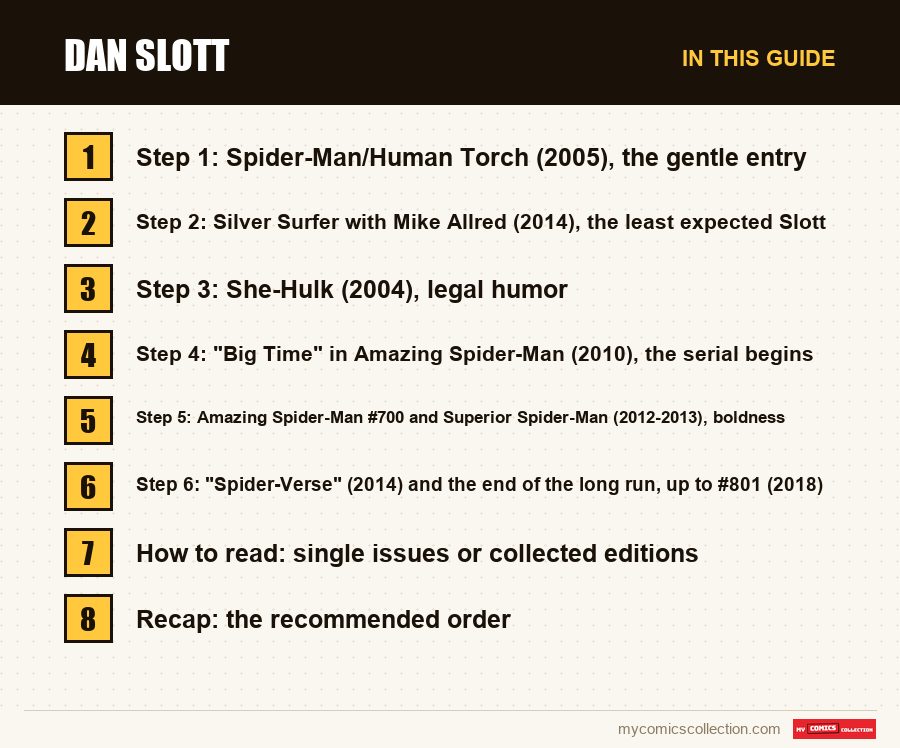
Step 5: Amazing Spider-Man #700 and Superior Spider-Man (2012-2013), boldness
Published at the end of 2012, Amazing Spider-Man #700 closes the first volume of the series. Octavius, doomed by illness, has swapped minds with Peter. Drawn by Humberto Ramos, the issue wraps up this storyline and leads into Superior Spider-Man, which appears in 2013 under Ryan Stegman's pencil. For more than a year, Octopus occupies Peter's body and wants to be a better vigilante: more effective, more brutal, more arrogant.
This is the most discussed step of the body of work. The premise upset part of the audience when it came out, and many readers who had rejected it later made it one of their favorite periods. To approach these issues, it is better to have read "Big Time" and its follow-ups: the emotional weight of #700 comes from what Slott built over the previous fifty issues.
On the collecting side, these are heavily printed issues, with several printings of #700 and many covers for Superior Spider-Man #1. Condition and printing number decide everything: check the latter before buying a copy presented as a first printing. Our ranking of Spider-Man runs places this period in the history of the series.
Step 6: "Spider-Verse" (2014) and the end of the long run, up to #801 (2018)
The last step is the most demanding. Peter Parker returns in 2014 in a new volume of Amazing Spider-Man, and "Spider-Verse" brings together dozens of versions of the hero from other realities, among them Spider-Gwen, who had appeared shortly before in another series. Olivier Coipel draws several chapters of the event, which can only be fully understood with knowledge of what came before. Our entry on Edge of Spider-Verse #2 details one of its collecting keys.
In 2015, Peter becomes the head of a global technology company, Parker Industries, which changes the setting of the series until the end of Slott's run. The finale, "Go Down Swinging," runs from #797 to #800 and pits the hero against a Green Goblin merged with Carnage. Slott then signs #801 in 2018, the final episode on the series. For a reader arriving here unprepared, the impact will be weak: this period rewards loyalty.
The last step is for the reader who has already worked through the other five and wants to see how a ten-year serial comes to a close. The collected editions follow publication order and remain the simplest solution, since several volumes and numbering systems succeed one another over the period.
How to read: single issues or collected editions
For reading, collected editions are the reasonable route as soon as a story runs past a few issues. Slott writes arcs that answer one another over years; a collected edition gathers the episodes in the intended order, without you having to check a series of issues scattered across several volumes. This applies above all to the Amazing Spider-Man period, which crosses several numbering systems.
For collecting, single issues have their appeal if you are after specific landmarks: #700, the first Superior Spider-Man, the "Spider-Verse" issues where new characters appear, and Silver Surfer #11. The Slott era is one of big print runs and multiple covers. Keep two habits in mind: identify the printing and note the cover letter, because a variant does not sell for the price of a regular copy. As for a copy you own, the free estimate reasons from its actual condition, and we avoid showing a price quote here.
Recap: the recommended order
The path comes down to six steps, and you can stop at any of them. First Spider-Man/Human Torch (2005) for the tone, then Silver Surfer with Allred (2014) for self-containment, She-Hulk (2004) for continuity humor. Next come "Big Time" (2010) to enter the serial, Amazing Spider-Man #700 and Superior Spider-Man (2012-2013) for the bold period, and finally "Spider-Verse" (2014) with the end of the run, up to #801.
Beyond these six steps, other paths exist: GLA: Misassembled, which puts Squirrel Girl back in the spotlight, Fantastic Four relaunched in 2018, or the 2022 Spider-Man series with Mark Bagley. They are for the reader who already enjoys the writer. The 2023 relaunch of Superior Spider-Man is also best read after the original. And if you want the most recent, the collecting guide to issue 1000 notes that Slott contributes a story drawn by Marcos Martin.
Frequently asked questions
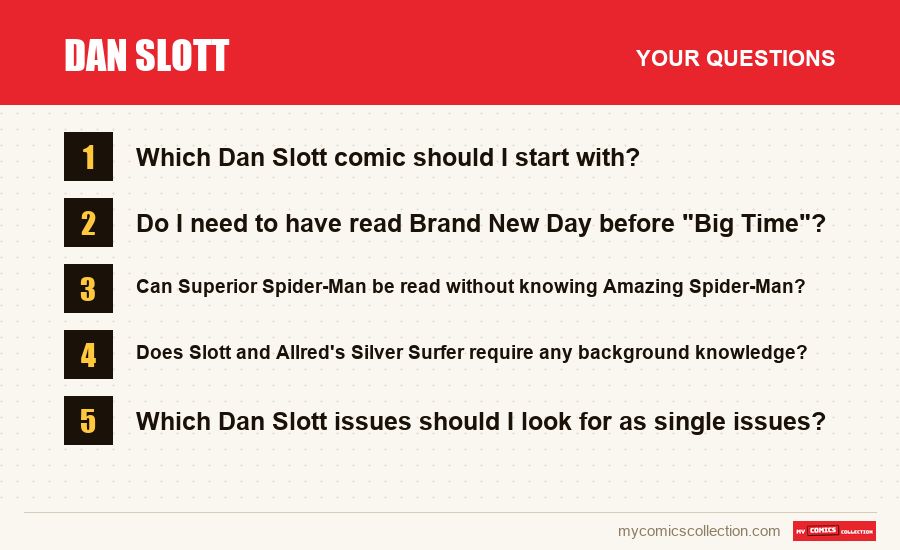
Two entries are possible: Spider-Man/Human Torch, short and with no prerequisites, dated 2005, or Allred's Silver Surfer, entirely self-contained, from 2014. Neither requires prior knowledge, and they show two different sides of the writer: tenderness for Marvel's history on one hand, graphic whimsy on the other.
No. "Big Time," which opens Slott's run as sole writer of Amazing Spider-Man in November 2010, starts from a clear status quo: Peter Parker gets a job in a laboratory. You can therefore skip the "Brand New Day" period without losing the thread.
Technically yes, but it would be a shame. The series begins in the aftermath of #700, which sees Otto Octavius take Peter Parker's place. The effect is much stronger if you have followed the relationship between the two men since "Big Time."
None. The series starts in May 2014 with Dawn Greenwood, a young Earthling who accompanies the Surfer, and the issues can be understood without knowing the Marvel universe. Issue #11, which won the 2016 Eisner for best single issue, is an excellent preview of the tone.
The usual landmarks are Amazing Spider-Man #700, Superior Spider-Man #1, the "Spider-Verse" episodes where new characters burst in, and Silver Surfer #11. These titles had large print runs: check the printing, note the cover letter and judge the condition before deciding on the right price.
Is an Amazing Spider-Man #700 or a Superior Spider-Man #1 hiding in your boxes? Estimate it from its actual condition before keeping it or selling it.
Estimate my comic