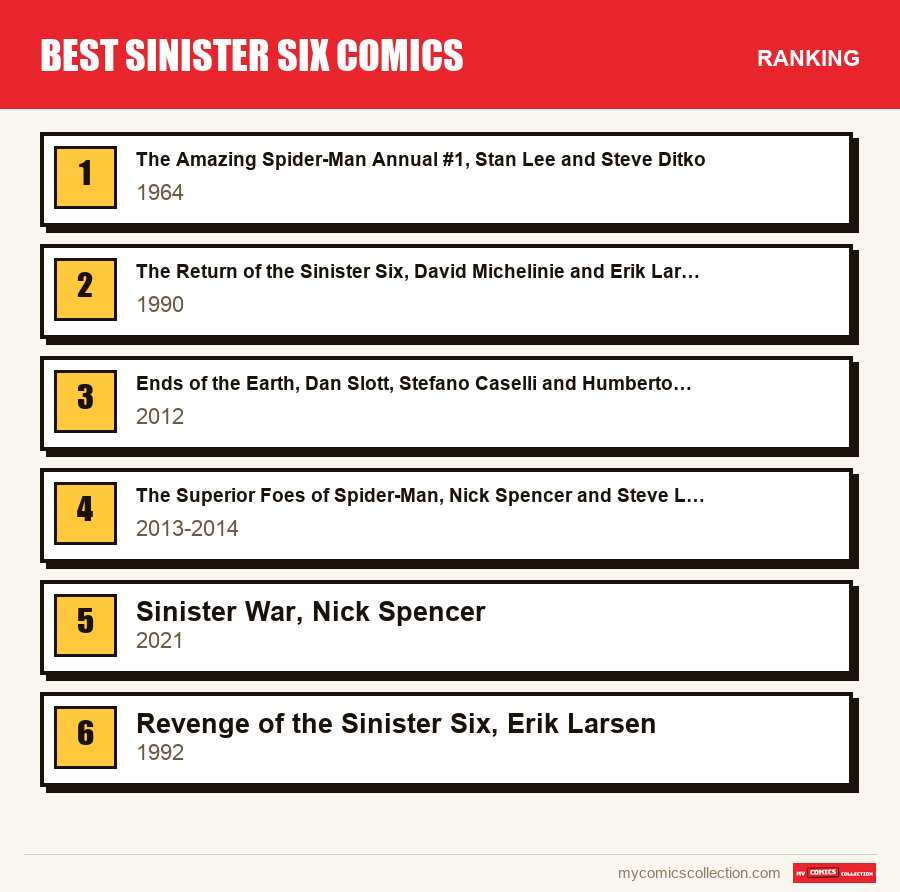
For the best Sinister Six comics, two stops lay the groundwork: The Amazing Spider-Man Annual #1, where Stan Lee and Steve Ditko founded the team in 1964, and the #334 to #339 arc (1990), in which David Michelinie and Erik Larsen bring it back to the forefront. For recent reading, you have three tracks: Ends of the Earth (2012), the comedy The Superior Foes of Spider-Man (2013-2014) and Sinister War (2021).
The Sinister Six is not a character but a story idea: six Spider-Man enemies who band together because none of them succeeded alone. The idea is simple, and that is precisely what makes it adaptable. Depending on the era, the lineup changes, the leader changes, and the tone moves from triumphant adventure to black-comedy chaos. This guide ranks six stories of the team, explains which reader each one is for and offers a path depending on your profile.
As always in this guide, we only state verified information (creators, issue numbers, dates); the analysis is our own, with no reproduction of protected art or dialogue.
Their first appearance
The birth year is 1964: The Amazing Spider-Man Annual #1, a thick volume where Lee writes and Ditko draws, sets up the whole team at once. Doctor Octopus plays the recruiter and calls to him Sandman, the Vulture, Mysterio, Electro and Kraven the Hunter, enemies Spider-Man had already met one by one in the regular series. The Vulture appears in #2 (1963), Octopus in #3 (1963), Sandman in #4 (1963), Electro in #9 (1964), Mysterio in #13 (1964) and Kraven in #15 (1964). In other words, the team is a roundup: it gathers the rogues' gallery of Ditko's first year into a single story.
The mechanics of the story come down to a few words. Octopus captures Betty Brant to lure the hero, then arranges the showdown so that each member fights Spider-Man separately, on ground he knows. The plan thus splits the team instead of uniting it, and Spider-Man takes advantage by beating them one after another. The six end up bickering over who is to blame for the failure, which sets up for decades the group's congenital flaw: an alliance of vanities.
For a collector, this issue matters because it founds the team, and it is generally easier to find in a collected edition than as a period single issue. The page on Amazing Spider-Man #1 from 1963 places the series as a whole.
1: The Amazing Spider-Man Annual #1, Stan Lee and Steve Ditko (1964)
This entry comes first because it serves as the yardstick for all the others. The story is short, linear, and built on a staging idea: six successive fights, each in a setting chosen by the enemy, and a hero improvising every time. Reading it requires no prior knowledge, which is rare for a 1964 story: you know who Spider-Man is, you discover who the six are, and you understand the team's logic without a footnote.
What the issue brings to the concept is its moral framework. Octopus commands, the others obey out of self-interest, and the whole thing collapses for lack of trust.
Who is it for? Readers who want to understand the source of the idea, Silver Age fans, and those who like Ditko's nervy, angular art. How to read it? Ideally after the appearance issues of each member: the Annual then works as a recap. Electro fans can also check our ranking of the best Electro comics, which mentions this same issue.
2: The Return of the Sinister Six, David Michelinie and Erik Larsen (1990)
The team's return plays out in The Amazing Spider-Man #334 to #339, whose first issue is dated July 1990. David Michelinie writes the arc, Erik Larsen is the main artist, helped by other inkers and artists on certain issues. In this version, Doctor Octopus recruits Electro, Sandman, Mysterio, the Vulture and Hobgoblin, the latter played by Jason Macendale. Shocker appears during the recruitment but does not join the lineup.
The construction is clever. Before bringing them together, the story shows Spider-Man beating each future member in a separate episode, which explains why they agree to team up: each has a score to settle. Octopus's plan then consists of holding the planet hostage with a giant rocket. True to the group's tradition, the coalition cracks from within, and Sandman, now more morally ambiguous, ends up turning against his allies.
What it brings to the collective character is a modernization that does not betray the original spirit. The 1994 collection and the Epic Collection editions let you read it in one go.
Who is it for? Those who want the best entry point to the team without going through the Silver Age. How to read it? In order, from #334 to #339, without skipping the recruitment episodes: they are half the charm of the arc. If you are following the whole period, the history of Amazing Spider-Man helps place it.
3: Ends of the Earth, Dan Slott, Stefano Caselli and Humberto Ramos (2012)
Published from March to June 2012 in The Amazing Spider-Man #682 to #687, this story by Dan Slott, drawn by Stefano Caselli (#682-683) then Humberto Ramos (#684-687), is the team's big spectacle in the modern era. Doctor Octopus, condemned by illness, has developed technology meant to repair the ozone layer; behind this generous front, the Sinister Six set up a planetary blackmail. Spider-Man, branded the world's public enemy, has to both clear his name and foil the plan, with the help of allies gathered for the occasion, including the Future Foundation.
What the story brings is the change of scale. Where the 1964 Annual played out in a few New York locations, the 2012 arc unfolds across the globe, with end-of-the-world stakes. It also brings the tragic dimension of Otto Octavius: a brilliant, dying man who wants to leave a mark, even if it means sacrificing everything else. That note sets up what follows, Dying Wish and then The Superior Spider-Man.
Who is it for? Readers who prefer modern stories, fans of big six-part arcs, and those who want to understand how Dan Slott built the pre-Superior era. How to read it? The six issues form the core; the one-shot Ends of the Earth #1 and Avenging Spider-Man #8 round out the set in the collected editions.
4: The Superior Foes of Spider-Man, Nick Spencer and Steve Lieber (2013-2014)
This seventeen-issue series, published from 2013 to 2014 under the pen of Nick Spencer and the pencil of Steve Lieber (James Asmus writes #10), takes the Sinister Six idea from the other end: instead of telling the story of the threat, it tells the story of the team of second-stringers. Boomerang is its leader, surrounded by Shocker, Speed Demon, Overdrive and Beetle (Janice Lincoln). Their plans fail, their leader betrays everyone at the first opportunity, and Spider-Man almost looks like an extra in his own rogues' gallery.
The series was supposed to run twelve issues before being extended on the strength of its critical acclaim, and it has kept the reputation of a quiet gem. What it brings to the concept is an inversion of point of view: you live inside a gang of mediocre and endearing criminals, in a black comedy where irony replaces heroism.
Who is it for? Readers who like humor, fans of short, complete series, and those tired of superhero brawls. How to read it? From #1 to #17, in order, with no prior knowledge other than the fact that Boomerang is an old Spider-Man enemy.
Do you collect this series?
Track what you own, what you are missing and what your collection is worth. 7-day trial.
Start my trial →
5: Sinister War, Nick Spencer (2021)
The conclusion of a long stretch written by Nick Spencer, Sinister War unfolds in 2021 in a four-issue miniseries and in the issues of The Amazing Spider-Man around #71. Spider-Man is caught between two teams of villains, the Sinister Six and the Savage Six, manipulated by Kindred, a figure who has haunted the series for several months. Doctor Octopus leads the Sinister Six, and Mysterio joins them after helping to capture Mary Jane. Mephisto, whose pact with Peter Parker and Mary Jane is the source of the conflict, is at the center of the resolution.
What the story brings to the team is a personal stake. The Sinister Six are no longer a planetary danger as in 2012 nor a farce as in 2013, but an instrument in a story that touches Peter, Mary Jane and their close circle.
Who is it for? Readers already settled into the series of those years, and those who want to see the team used as a cog in a big denouement. How to read it? After the Kindred arcs, following the publication order of the series and miniseries issues given in the publisher's collected edition.
6: Revenge of the Sinister Six, Erik Larsen (1992)
In Spider-Man (the 1990 series) #18 to #23, from January to June 1992, Erik Larsen writes and draws an arc where the Sinister Six seek revenge on Doctor Octopus. The coalition fights itself as much as Spider-Man, amid a shower of guest stars: Ghost Rider, Wolverine, Moon Knight, Deathlok, and even Hulk. The series has the tone of a big circus of the era, closer to action comics than to the tight plotting of the 1990 arc.
What the arc brings is an example of what the team becomes when it is given free rein: excess, cascading fights and few underlying stakes. It closes our ranking because it requires tolerance for the style of the period.
Who is it for? Early 1990s nostalgics and readers who like Larsen's energetic art. How to read it? After the 1990 arc, with which it forms a diptych of atmosphere; a companion story by Terry Kavanagh and Scott McDaniel, centered on Diablo, goes along with it but is not as interesting. The publisher's collected edition gathers the six issues.
Where to start depending on your profile
You are discovering the Sinister Six and want to understand the idea: read Annual #1 from 1964, then the 1990 arc. You will have the foundation and the first big reinvention, in under ten issues.
You are looking for a modern, spectacular, self-contained story: Ends of the Earth (2012) is the natural candidate. It reads without knowing all of Dan Slott, it benefits from Caselli's and then Ramos's art, and it feeds into what follows with The Superior Spider-Man.
You prefer humor and short stories: The Superior Foes of Spider-Man is made for you. Seventeen issues, a consistent writer and artist, and a fresh look at what "being a villain on a team" means.
You already follow the regular series: Sinister War makes sense within the Spencer cycle, and you will then see the team play a different role from that of a mere assault group.
You collect period single issues: focus on Annual #1 from 1964, on the appearance issues of each member and on the start of the 1990 arc; they are the landmarks collectors look for first to document the team's history. To find your bearings in the series, see the best Spider-Man runs and the first appearance of Mysterio.
The key issues to know
The key issues list follows the logic of a team: you collect the group's birth, then the appearances of its founding members, then the relaunches.
- The Amazing Spider-Man Annual #1 (1964): the team's birth certificate, by Stan Lee and Steve Ditko.
- The Amazing Spider-Man #2, #3, #4, #9, #13 and #15 (1963-1964): the respective appearances of the Vulture, Doctor Octopus, Sandman, Electro, Mysterio and Kraven.
- The Amazing Spider-Man #334 (July 1990): the opening of the team's return arc, by Michelinie and Larsen.
- Spider-Man #18 (January 1992): the start of the Revenge of the Sinister Six arc, by Erik Larsen.
- The Amazing Spider-Man #682 (2012): the opening of Ends of the Earth.
- The Superior Foes of Spider-Man #1 (2013): the launch of Spencer and Lieber's series.
- Sinister War #1 (2021): the opening of Nick Spencer's four-issue miniseries.
Method: an issue that founds the team draws its status from the story itself, while a return issue is mostly a reader's copy; compare the condition of the copy before choosing, and check that it belongs to the right volume of the series.
Frequently asked questions
At its founding in 1964, the group lines up Doctor Octopus as leader, then Sandman, the Vulture, Mysterio, Electro and Kraven the Hunter. These six adversaries had each already fought Spider-Man in the regular series, between 1963 and 1964, before being brought together in this giant-size issue.
Their original issue is The Amazing Spider-Man Annual #1, dated 1964, by Stan Lee on text and Steve Ditko on art. It is the starting unit of reading: the story is self-contained, it reads in a few minutes, and it exists in several collections devoted to the Ditko period.
For the foundation, Annual #1 from 1964. For an entry point more accessible to a modern reader, the arc in The Amazing Spider-Man #334 to #339 (1990), by David Michelinie and Erik Larsen, because it presents each member in a separate story before bringing them together.
It tells the story of a team from the same family, but with other members: Boomerang, Shocker, Speed Demon, Overdrive and Beetle. Nick Spencer and Steve Lieber make it a seventeen-issue comedy, published in 2013 and 2014, that reads without knowing the rest.
It is possible but not advised. Sinister War (2021) concludes a plot run through The Amazing Spider-Man, with Kindred and Mephisto's pact, and the Sinister Six are a cog in it. It is better to read the earlier issues of Nick Spencer's series first to grasp the stakes.
Do you own an Annual or an issue from the 1990 arc? Get your copy appraised before deciding whether to keep it or sell it.
Estimate my comic